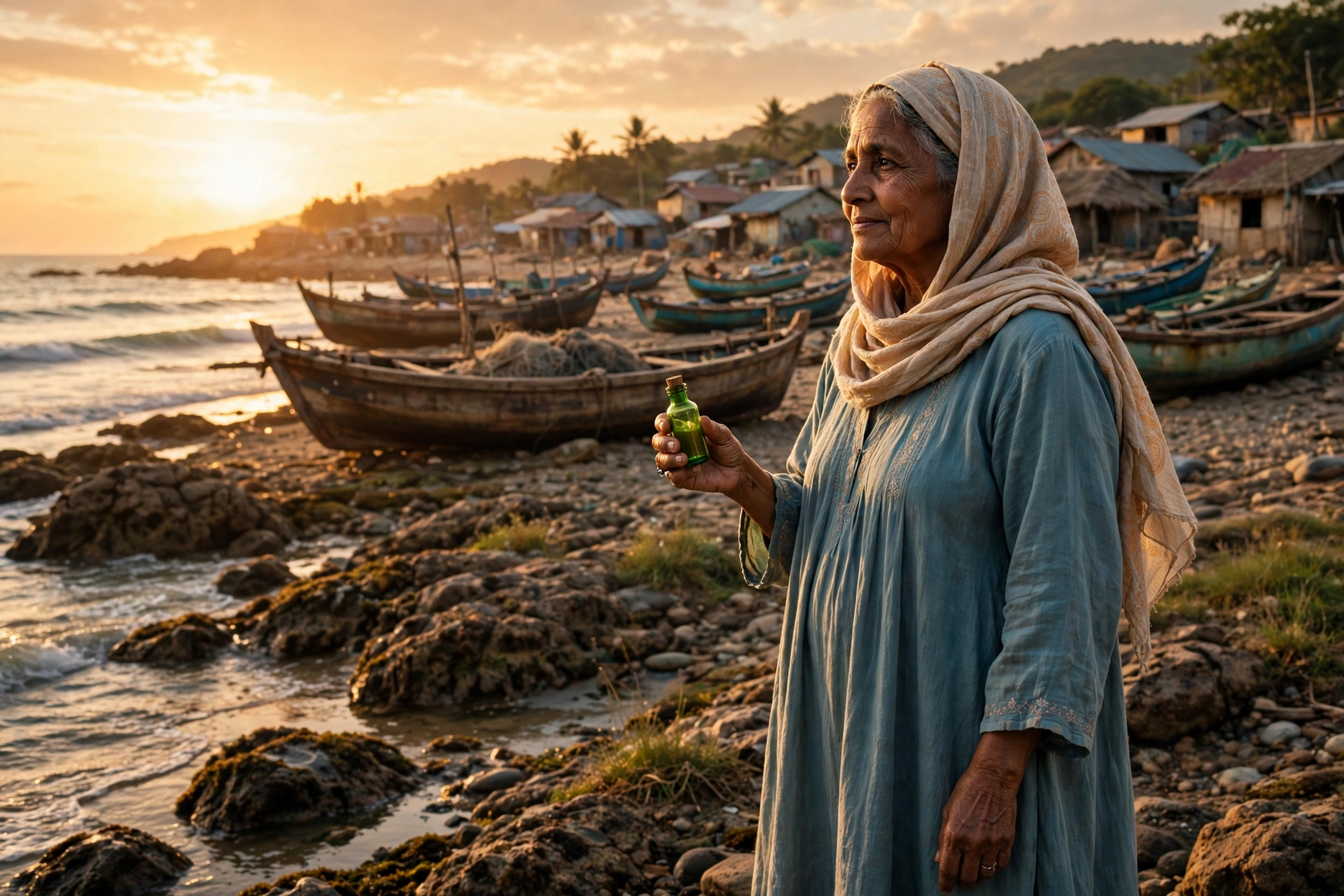
The sea had taken her husband on a Tuesday, and so every evening after that, Amina went back to the sea to ask for him.
She was fifty-two, her hair streaked with grey, her hands roughened by years of mending nets. Her husband Yusuf had fished these waters for thirty years. On the last morning of his life he kissed her forehead, took his lunch, and walked down to the boats. The storm came from nowhere that afternoon. Three boats came back. His did not.
The village held a funeral with an empty coffin, and the women sat with Amina for seven days. Then the village went back to its life. Only Amina did not.
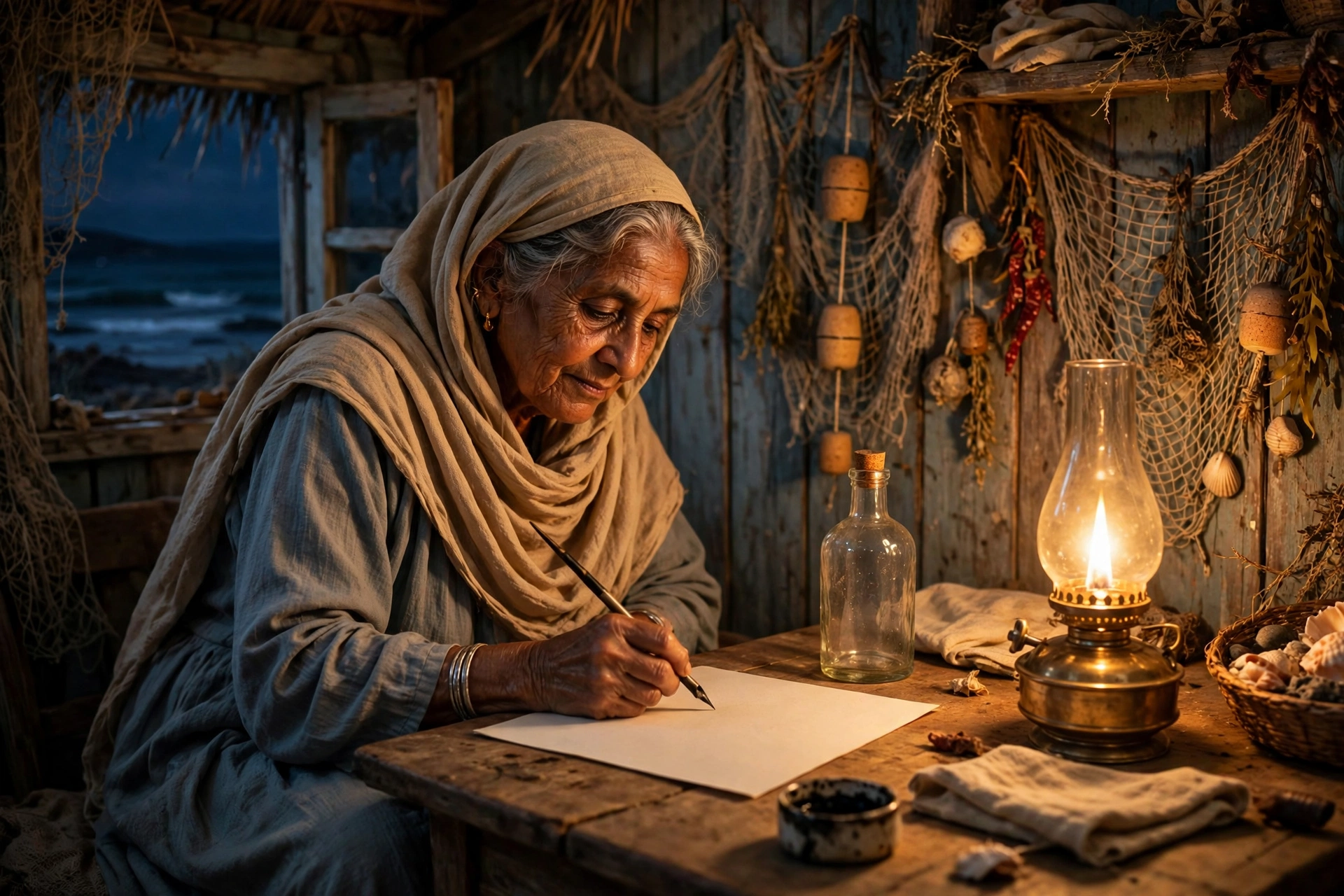
On the eighth evening, she took a piece of paper, a pencil, and an empty glass bottle, and walked down to the rocks where the fishermen pulled their boats ashore. She sat on the cold stone, and she wrote.
"Yusuf, the lentils are finished and I do not know which shop sells the good ones. You always bought them. The roof leaks above the kitchen. The cat had kittens. I miss you."
She folded the paper small, pushed it into the bottle, pressed the cork in tight, and threw it as far as she could into the waves. She slept better that night than she had in a week.
The next evening she did it again. And the next. Soon it became the rhythm of her days: mornings mending nets, evenings writing to the sea.
At first the village said nothing. But months passed, and the bottles kept coming. Children giggled when they saw her walking to the rocks with her basket. "She talks to the water," one fisherman muttered. "The sea took her husband and her mind together."
Only old Rahim, who had fished beside Yusuf for forty years, said nothing unkind. "Let her be," he told them. "A woman who writes letters has not given up."
Amina heard the laughter sometimes. She went to the rocks anyway. The letters were not for the village. They were for Yusuf, and for herself.
She wrote about everything: the price of fish, the mango tree, the nights when the wind sounded like his voice. She wrote angry letters too — "You promised you would never go out when the clouds were that dark" — and softer ones the next evening.
Three years passed this way.
Then, one morning in the fourth year, something happened that had never happened before.
Bilal was twelve, the son of a fisherman who worked on a big boat far down the coast and came home only twice a year. He lived with his mother, who had been coughing for months and growing weaker, and his little sister Maryam, who was six. Bilal spent his afternoons wandering the beach, collecting shells and driftwood to sell for a few coins.
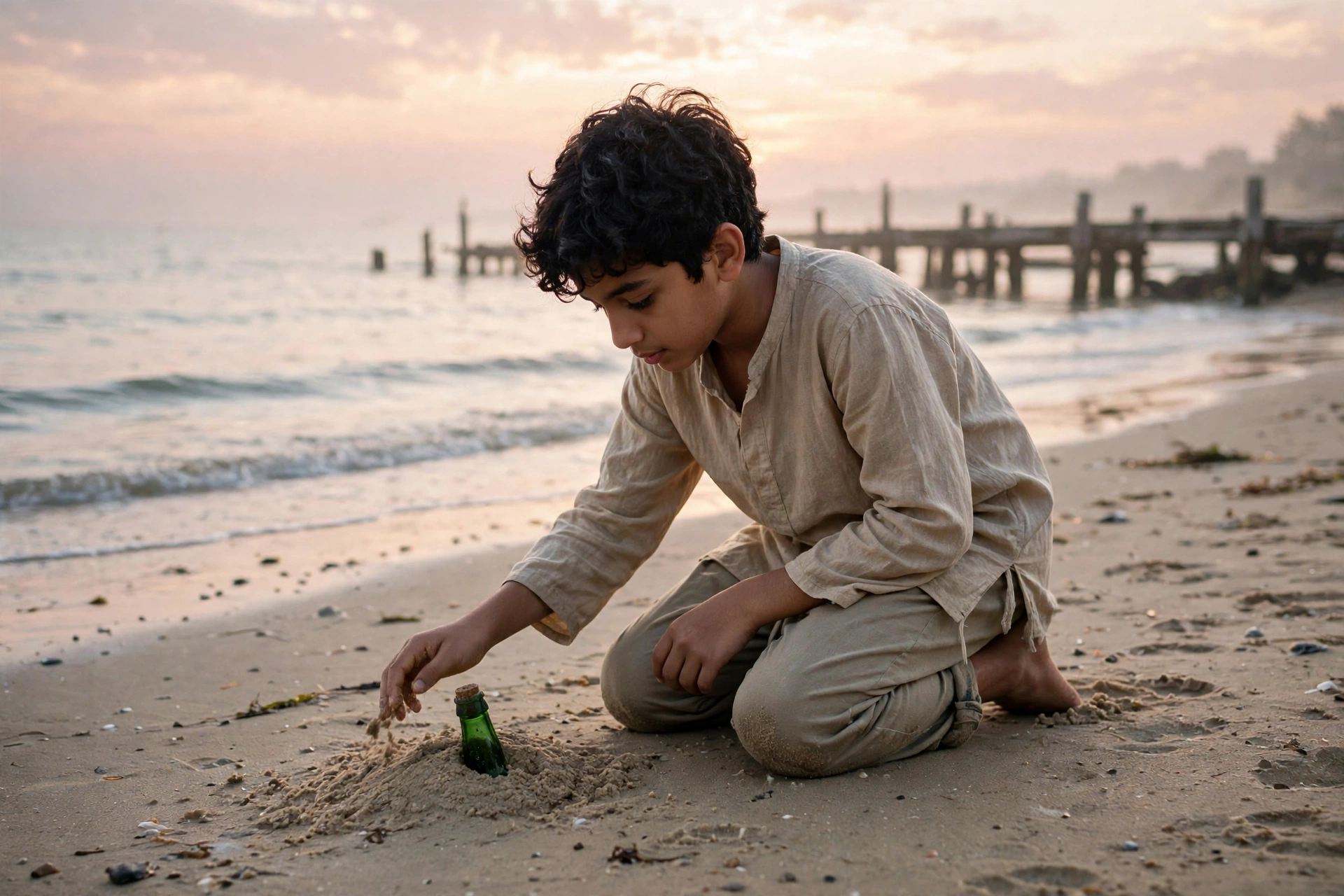
That morning, half-buried in the sand near the old jetty, he found a green glass bottle. Inside was a folded paper, damp at the edges, the pencil writing still clear.
"Yusuf, today the doctor came for the widow Saleema and said her heart is tired. I cooked her soup. Do you remember how your mother used to make soup when it rained? I miss you. I miss you. I miss you."
Bilal read it twice, then carried the bottle home and hid it under his bed like a treasure.
That night, Bilal read the letter a third time. He did not know who Yusuf was or who had written it. But he knew one thing: the woman who wrote this was lonely, and lonely was something Bilal understood very well.
The next morning, before school, Bilal took a paper from his notebook and wrote, in his large careful letters:
"Dear Aunty. I found your letter on the beach. I am sorry your husband is gone. My father is also far away. My mother is sick and I am scared sometimes. I hope you are not too sad. From Bilal."
He folded the paper, put it into the green bottle, and threw it into the sea where he had found it. Then he ran to school, late, and was scolded by his teacher, and did not mind at all.
Three evenings later, Amina found a bottle washed up near her rock. It was her own green bottle — she recognised the chip on its neck. But the paper inside was different: a different hand, large careful letters that slanted uphill.
She read it twice, her hands shaking. For three years the sea had never answered. Now it had.
She did not sleep that night. Was it Yusuf? Had the sea given him back, the way the old stories said it sometimes did? Her head said it was impossible. Her heart whispered, "What if?"
In the morning the shopkeeper told her: "Bilal? The fisherman's son, down by the old jetty. His mother has been ill since the winter. Poor boy carries the whole house on his shoulders."
So it was not Yusuf. It was a boy — scared, his mother sick, his father far away. And somehow that did not make the letter less precious. It made it more.
That evening, Amina sat on her rock and wrote a different kind of letter.
"Dear Bilal. Thank you for finding my bottle. My husband's name was Yusuf. He was a fisherman, and the sea took him three years ago. I write to him because it helps my heart. I am glad my words found you instead of the deep water. You are a brave boy. If you ever need anything, my door is open. My house is the blue one at the end of the lane. Love, Amina Aunty."
She threw it into the sea and walked home, and for the first time in years, she did not feel alone in her own house.
The letters went back and forth all summer, carried by the tide between the rocks and the old jetty. Bilal told her about his mother's cough and Maryam's lost tooth. Amina told him about Yusuf — the fish so big it had pulled him halfway out of the boat, the way he sang while he mended nets.
One evening in late August, Bilal's letter was different. The handwriting was hurried, the paper smudged.
"Dear Aunty. Mother is worse. The doctor says she needs medicine from the city but we have no money. Father's boat will not come for two months. I do not know what to do."
Amina read the letter and did not go to the rocks that evening. She put on her shawl, took the money she had saved in a tin box under her bed — money she had been saving for a new roof, a little at a time, for three years — and walked down to Bilal's house by the old jetty.
Bilal opened the door, his eyes wide. "Aunty?"
Amina stepped inside, took one look at the thin woman coughing on the bed, and said, "Pack a bag for your mother. We are going to the city doctor. Maryam, you are coming with me."
It took two buses and most of the day. The doctor listened to the mother's chest, wrote a prescription, and said words Amina carried home like gold: "You brought her in time. Another month, and it would have been too late."
On the bus home, Bilal's mother — Farida — held Amina's hand and wept. "You are a stranger," she whispered. "Why did you do this?"
"I am not a stranger," Amina said. "I am the woman from the bottles."
"Not from the sea," Amina said. "From a house at the end of the lane — and from now on, that house is open to all of you."
At home, Amina cooked a pot of soup — the same soup Yusuf's mother used to make when it rained — and they ate together, Maryam falling asleep with her head in Amina's lap.
Word spread through the village. The woman who talked to the water had spent her roof money on a sick neighbour, and the fishermen who had laughed stopped laughing.
But the story was not finished. The sea had one more thing to test.
It came in October, with the worst storm in twenty years. The wind tore the roofs off sheds, and the waves came over the jetty. Out at sea, a small fishing boat with three men aboard was caught in it — one of them Bilal's father, home at last on leave, who had gone out that morning before the storm turned.
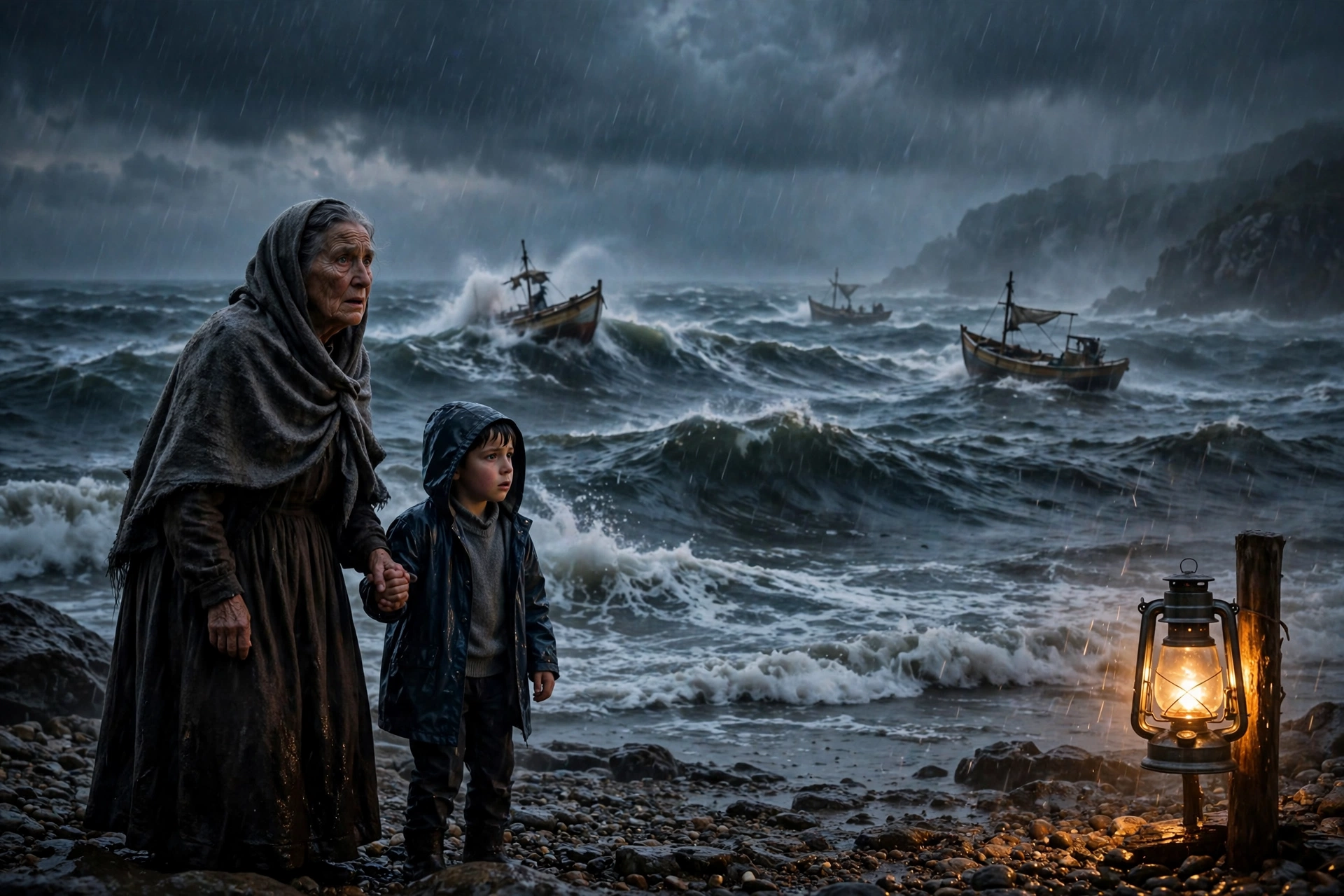
Amina stood on the shore with the other women, her shawl whipping in the wind. Bilal stood beside her, his small hand in hers, shaking.
"Not another one," Amina whispered to the sea. "You have taken enough from this family. You have taken enough from me."
For hours there was nothing. The women lit lamps and held them up, as if light alone could guide a boat home. And then someone shouted from the jetty: a light on the water. A boat. Coming in, low and slow, battered but afloat.
The men came ashore soaked and shivering, and Bilal's father fell to his knees and held his son so tightly that Bilal squeaked. Farida sank down beside them, laughing and crying at once.
Amina stood back, her heart so full it hurt, and understood at last: she had spent three years writing to a man who could not answer, believing love ended when a person was gone. But love had not ended. It had been waiting — for a boy on a beach, for a sick mother, for a little girl who needed someone to sit with her. Her love for Yusuf had not disappeared into the sea. It had changed shape — into soup, and medicine, and a hand held in a storm.
That night, for the first time, Amina did not write to Yusuf. Instead she wrote on her best paper, in her neatest hand, and in the morning she pinned it to the notice board beside the mosque, where everyone could read it.
"To anyone who is lonely," it said. "I am Amina, the woman from the rocks. For three years I threw my words into the sea because I thought no one was listening. I was wrong. A boy found my words, and a family found me. If you are lonely, do not throw your words into the water. Bring them to my door. The blue house at the end of the lane. There is always soup. You are not alone."
By noon, three women had come to her door. By evening, five. One brought bread. One, an old fisherman who had lost his wife the year before, brought an empty bottle and asked, shyly, if she would teach him to write a letter too.
Amina laughed — a sound that surprised her, because she had not laughed like that in years.
"Of course," she said. "But we will not throw this one into the sea. This one we will give to someone who can read it."
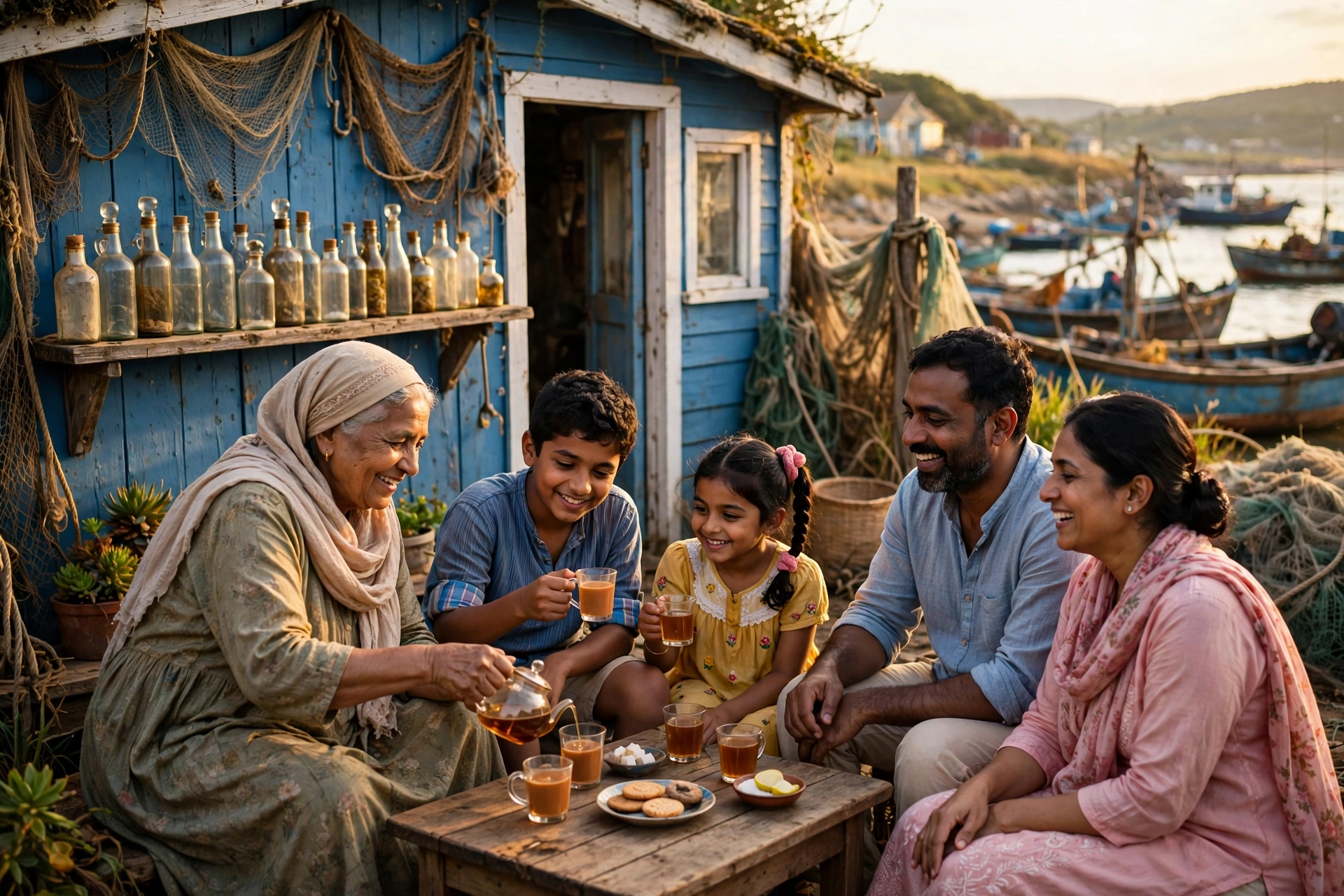
That winter, the blue house at the end of the lane became the warmest house in the village. In the evenings, the lamp burned in the window, and inside, people sat together — mending nets, drinking tea, writing letters. Not letters to the sea. Letters to each other.
And if you walk to the rocks at sunset now, you will see Amina there. But she no longer writes alone. Beside her sits Bilal, and sometimes Maryam, and the basket between them is full of paper and pencils and bottles — not for the dead, but for the living.
The sea took her husband. But the sea also brought her a family. Grief, Amina will tell you, is only love with nowhere to go. Give it somewhere to go — a letter, a bowl of soup, an open door — and it becomes, once again, love.