Amna Bibi had sold tea at the corner of the old railway station for forty-one years, and in all that time she had never once asked a customer for money first. She asked for something else. She asked for a smile.
It was a strange price, and the morning crowd knew it well. The rickshaw drivers laughed about it. The schoolchildren giggled about it. The tired office workers, the porters with their heavy loads, the fruit sellers pushing their carts — they all knew the rule of the little blue stall with the chipped kettle and the faded green awning. One cup of tea, hot and sweet and strong, in exchange for one honest smile and one good thing that had happened that day. If you could not think of a good thing, Amna Bibi would wait. She would pour your tea anyway, and she would say, in her soft, cracked voice, "Then drink slowly, beta. The good thing will come to you before the cup is empty."
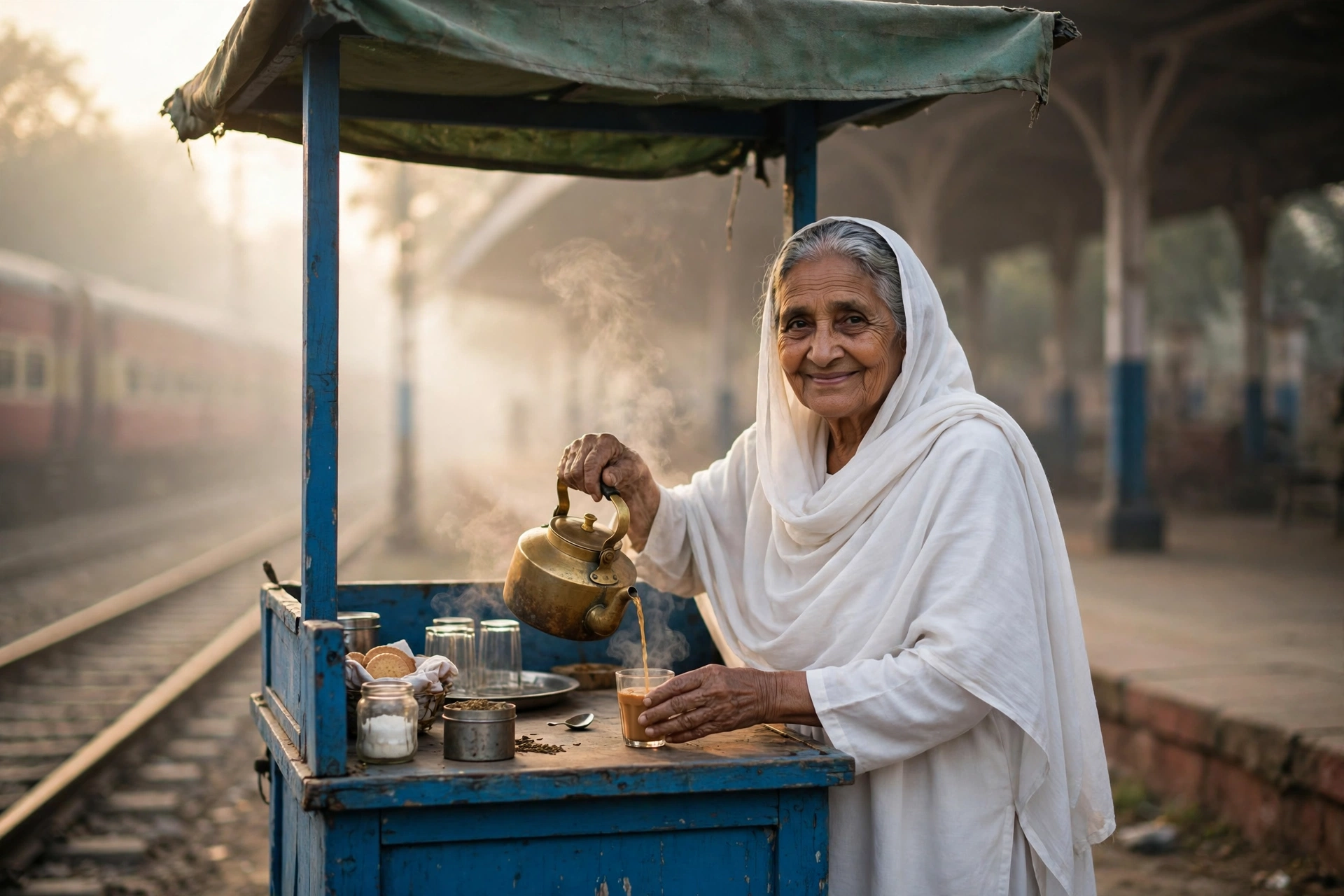
People said she had once been a different woman entirely. They said she had a husband who drove the night bus, and a son, Bilal, with a laugh so loud it could be heard from one end of the street to the other. And then, one winter night twenty-three years ago, the night bus had not come home, and neither had her son, who had gone to meet his father at the depot. The road had been foggy. After that, Amna Bibi had sold the house, given away the furniture, and set up a tea stall at the station where she had waited for them that last night. People expected her to wither away. Instead, she began to collect smiles.
She kept them in a battered notebook with a red cover, held together with a rubber band. Every smile came with a name and a small joy, written in her careful, slanting handwriting. "Rashid, rickshaw driver — his daughter learned to write her name today." "Sana, schoolgirl — her teacher said her drawing was the best in the class." The notebook was fat now, its pages swollen with ink and tea stains, and when the wind blew through the station, Amna Bibi held it tight against her chest, as if it were the most precious thing she owned. In a way, it was.
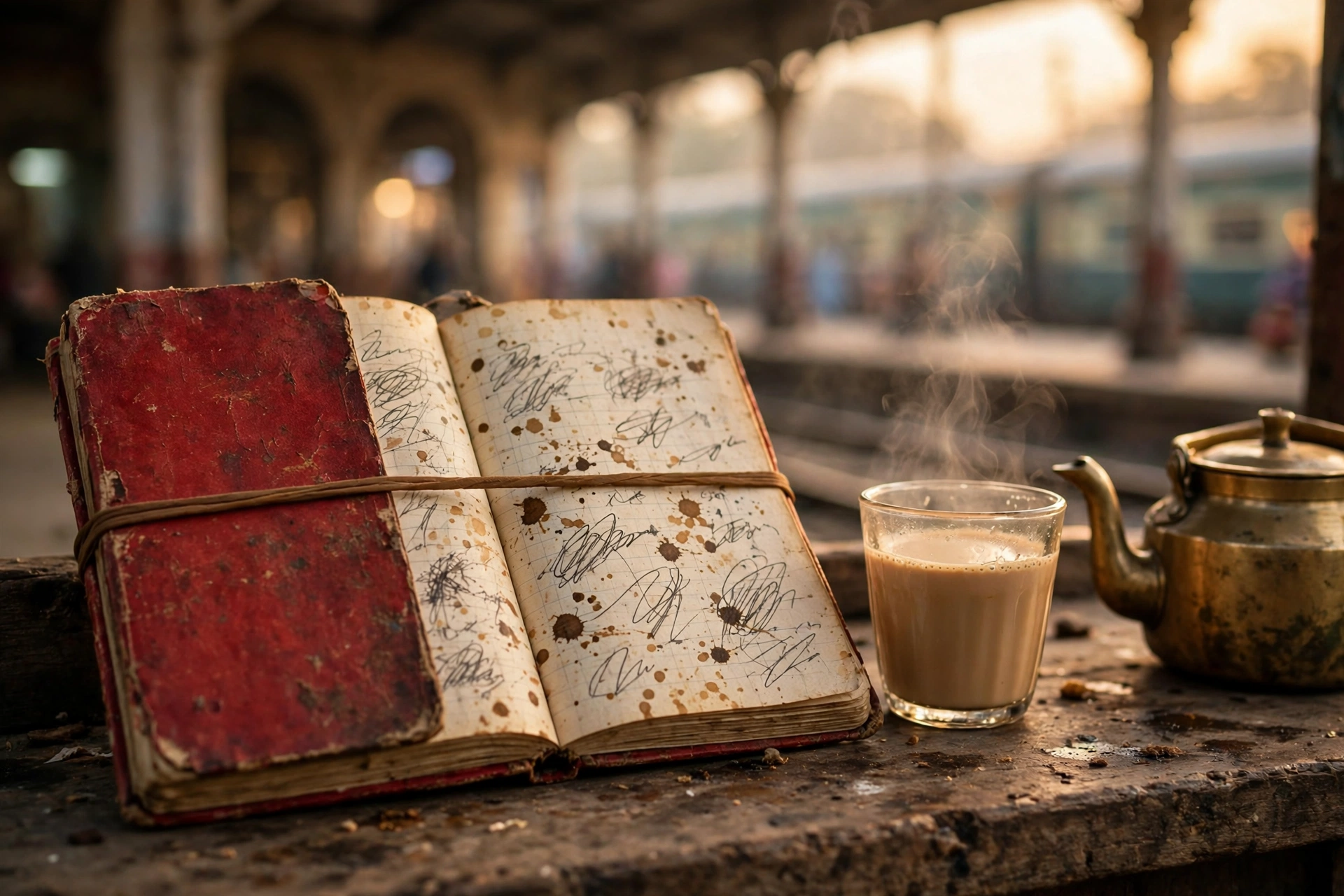
On a grey Tuesday morning in November, when the fog lay low over the tracks and the air smelled of coal smoke and rain, a young man came and stood at the edge of her stall. He did not order tea. He simply stood there, hands deep in the pockets of a coat that had once been expensive, staring at nothing at all.
Amna Bibi had seen that look before — on men who had lost their jobs, on mothers who had lost their children, on boys who had come home with empty pockets and broken dreams. It was the look of a person who had run out of reasons. She poured a cup of tea without being asked and set it gently on the wooden counter.
"Drink, beta," she said. "It is cold today."
The young man looked at the cup as though he had forgotten what tea was. "I have no money," he said flatly.
"Good," Amna Bibi said, smiling. "I do not sell tea for money. I sell it for a smile."
"I have no smile either."
"Then you need the tea more than anyone," she said, and pushed the cup a little closer. "Sit. The bench is free too."
His name was Daniyal, though he did not tell her that until much later. He was twenty-nine years old, and six months earlier he had owned a small electronics shop in the market — a shop he had built with his father's savings and three years of sixteen-hour days. Then a fire had taken it in a single night, and the insurance papers had burned with it. The suppliers had not waited. The debts had come like vultures, and one by one his friends had stopped answering his calls. His father had stopped speaking to him, not out of cruelty but out of a grief too heavy for words. That morning he had come to the station with a one-way ticket in his pocket and a plan he had rehearsed a hundred times in his head. He was going to the river bridge, two stops away, and he was not coming back.
He drank the tea because it was warm and because the old woman's eyes made it impossible to refuse.
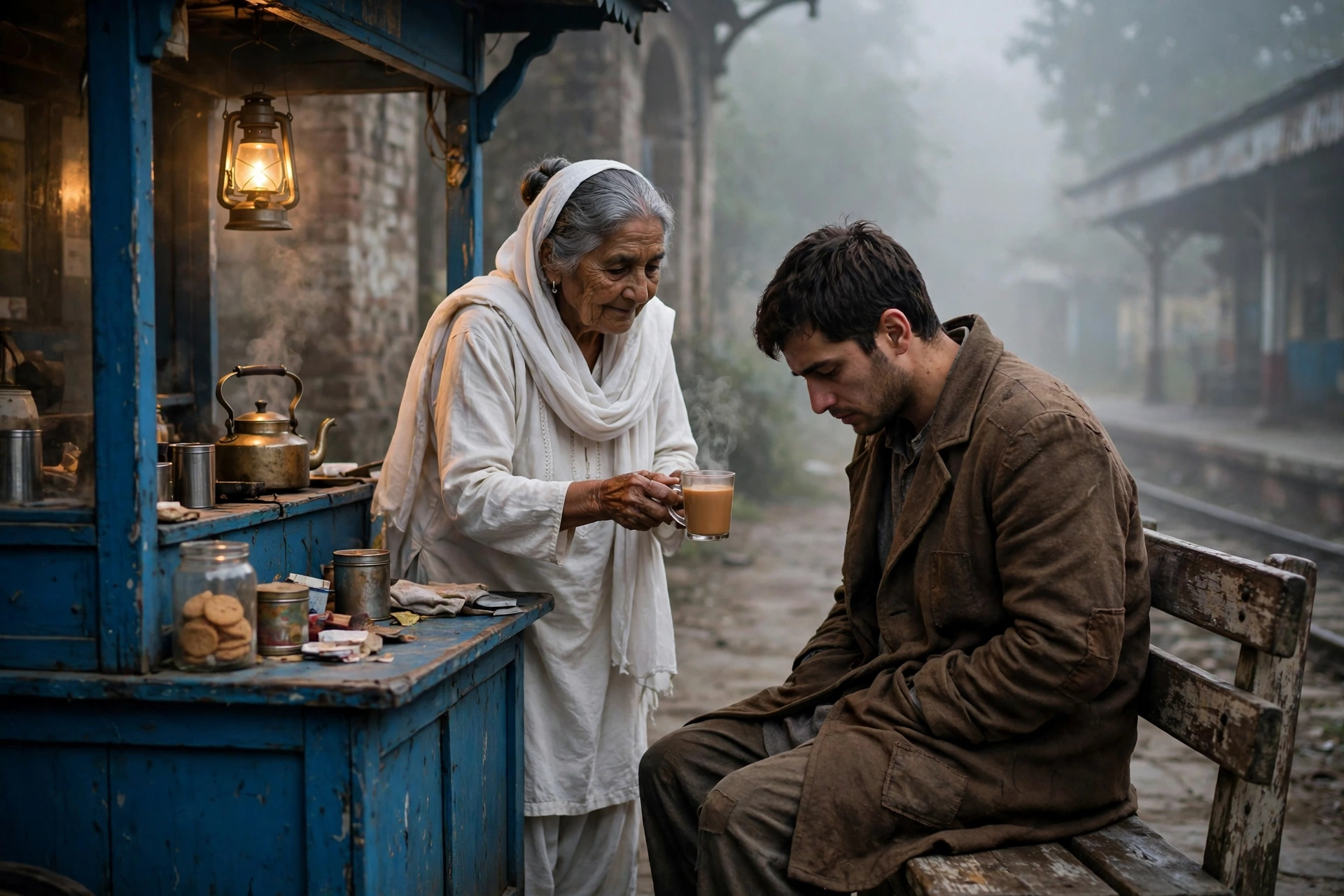
"What is that book?" he asked, nodding at the red notebook.
"My treasure," Amna Bibi said, and opened it to a page at random. "Listen. Yesterday, a porter named Younis told me his wife laughed for the first time in a month. The day before, a little girl told me she found a rupee on the road and gave it to a beggar, and the beggar blessed her so loudly that the whole street turned around. Last week, a man who had not spoken to his brother in eleven years told me he finally telephoned him." She closed the book gently. "These are small things, beta. Nobody writes songs about them. But a thousand small things together become a reason to stay alive."
Daniyal stared at her. "That is a nice story, Amma. But my shop is gone, my money is gone, and my father will not look at me. What good is a notebook of other people's happiness to me?"
Amna Bibi poured him a second cup. "Your shop is gone," she agreed. "Your money is gone. But tell me one thing, honestly. This morning, when you woke up, did the sun come up?"
"What kind of question is that?"
"Answer it."
"Yes," he said, irritated. "The sun came up."
"Then something good already happened today, and you did not even notice it. That is the whole trouble with people like us, beta. We wait for big happiness, and we walk straight past the small ones."
She tore a page from an old newspaper, folded it into a small square, and held it out to him. "Take this. Write down one good thing before the sun sets today. Just one. It can be as small as you like. A warm cup. A kind word. A bird singing. If you cannot find one, come back tomorrow and I will help you look. But do not go to the bridge."
Daniyal froze. He had not told her about the bridge. He had not told anyone. His hand shook as he took the folded paper, and for the first time in months, something other than numbness moved inside his chest. It was not hope — not yet. It was the thin, startled feeling of being seen.
The next morning he came back, and the morning after that, and the morning after that. Amna Bibi never asked him about the bridge, and she never asked him about his debts. She only asked him the same question every day: "What is today's good thing?" Some days he had an answer ready. Some days he had to sit with his tea for a long time before he found one. "A stranger held the door for me." "My mother made my favourite food, even though we have so little." "I slept without dreaming about the fire." Each time, Amna Bibi wrote his good thing into the red notebook, in her careful, slanting hand, and each time she wrote his name beside it, as if his small joy mattered exactly as much as anyone else's.
Slowly, without quite noticing it, Daniyal began to change. He learned to pour tea the way Amna Bibi liked it — strong, with just a little too much sugar. He began to ask the customers for their smiles, and to his amazement, they gave them. A week became a month. A month became a season.
One cold morning, when the fog was so thick that the trains sounded like ghosts, Daniyal arrived to find the stall closed, the awning rolled up, the kettle cold. His heart hammered in his chest as he ran to Amna Bibi's small room behind the station, where he found her in bed, weak with fever, her breathing shallow and fast. The doctor said it was pneumonia, and that she needed rest and medicine, and could not work for at least a month.
Daniyal did not hesitate. He opened the stall himself that morning. He had no money for tea leaves, so he went to the shopkeepers in the market and told them about Amna Bibi. To his astonishment, they listened. The grocer gave him tea leaves. The milkman gave him milk. The baker gave him bread. "She gave my son his first job," the grocer said. "She wrote my daughter's name in her book the day she was born," the baker said. One by one, the people of the station came forward, and each of them had a story about the old woman with the red notebook.
For a whole month, Daniyal ran the stall. He poured the tea. He asked for the smiles. He wrote the good things in the notebook, and the notebook grew fatter still. And something extraordinary happened: people began to come to the stall not for the tea, but for the question. Office workers who had not smiled in years found themselves smiling. A woman who had just lost her job told him about the sparrow on her windowsill that morning. A tired father told him about his son's first tooth. The station, which had always been a place people hurried through, became a place where people paused, just for a moment, to remember that their lives still held something good.
When Amna Bibi finally recovered and returned to the stall, leaning on a stick but with her eyes bright as ever, she found a crowd waiting for her. Daniyal stood behind the counter in her place, pouring tea with steady hands, and the red notebook lay open on the counter, full of new pages in a young man's handwriting. She looked at him for a long moment, and then she laughed — a deep, delighted laugh that she had not laughed in twenty-three years.
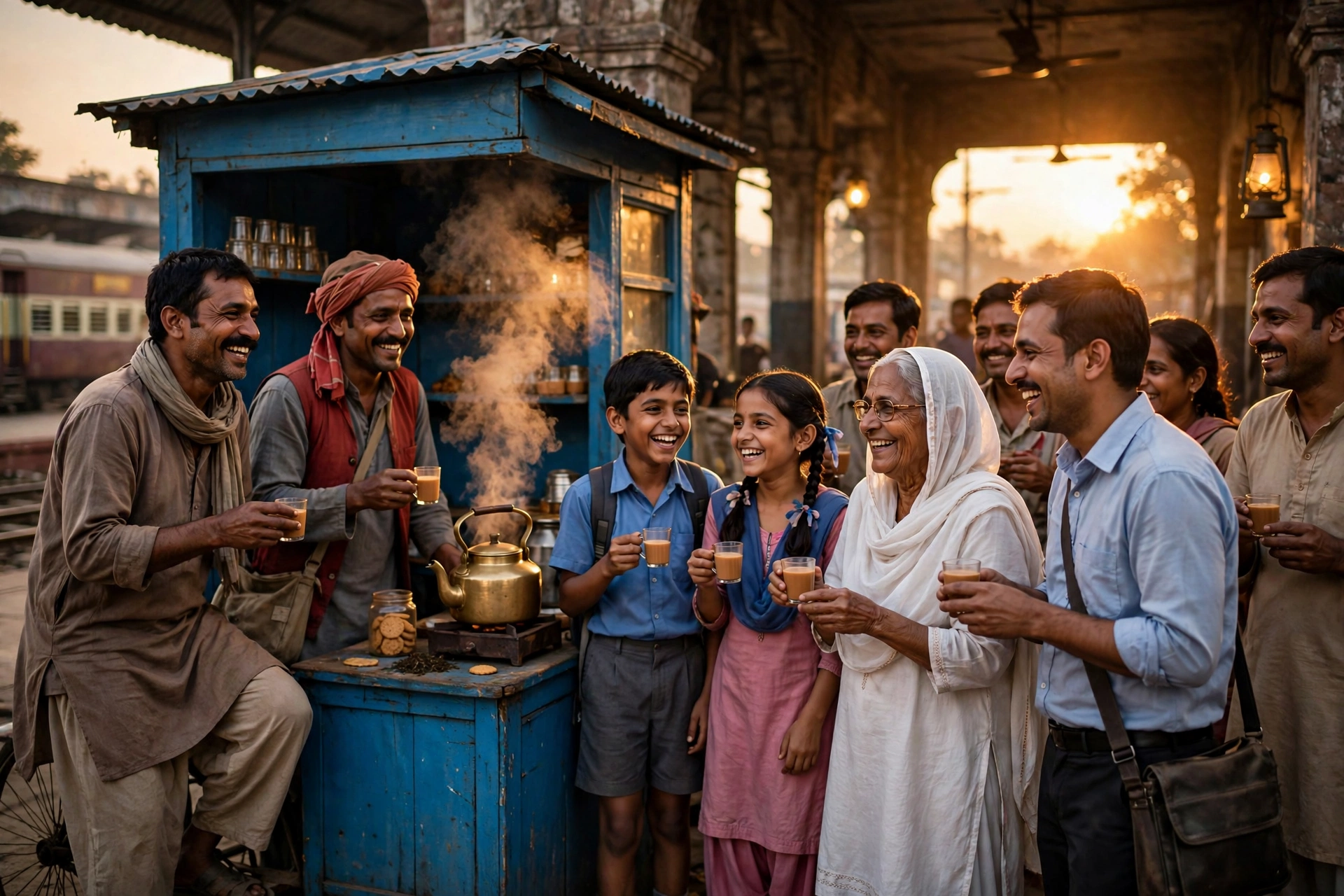
"You have been collecting smiles without me," she said.
"You taught me how," Daniyal said. "And Amma — I found something. My father came here last week. He drank tea. He told me his good thing. He said his son came home."
Amna Bibi's eyes filled with tears, and she did not try to hide them. She took the notebook from the counter and held it out to him with both hands.
"It is yours now, beta," she said. "I collected smiles because I lost my own. I needed to borrow them from the world until I could find mine again. But you — you have learned the secret. The secret is not the notebook. The secret is the asking. When you ask a person for their smile, you remind them that they still have one to give. That is all I ever did."
Daniyal took the notebook with both hands.
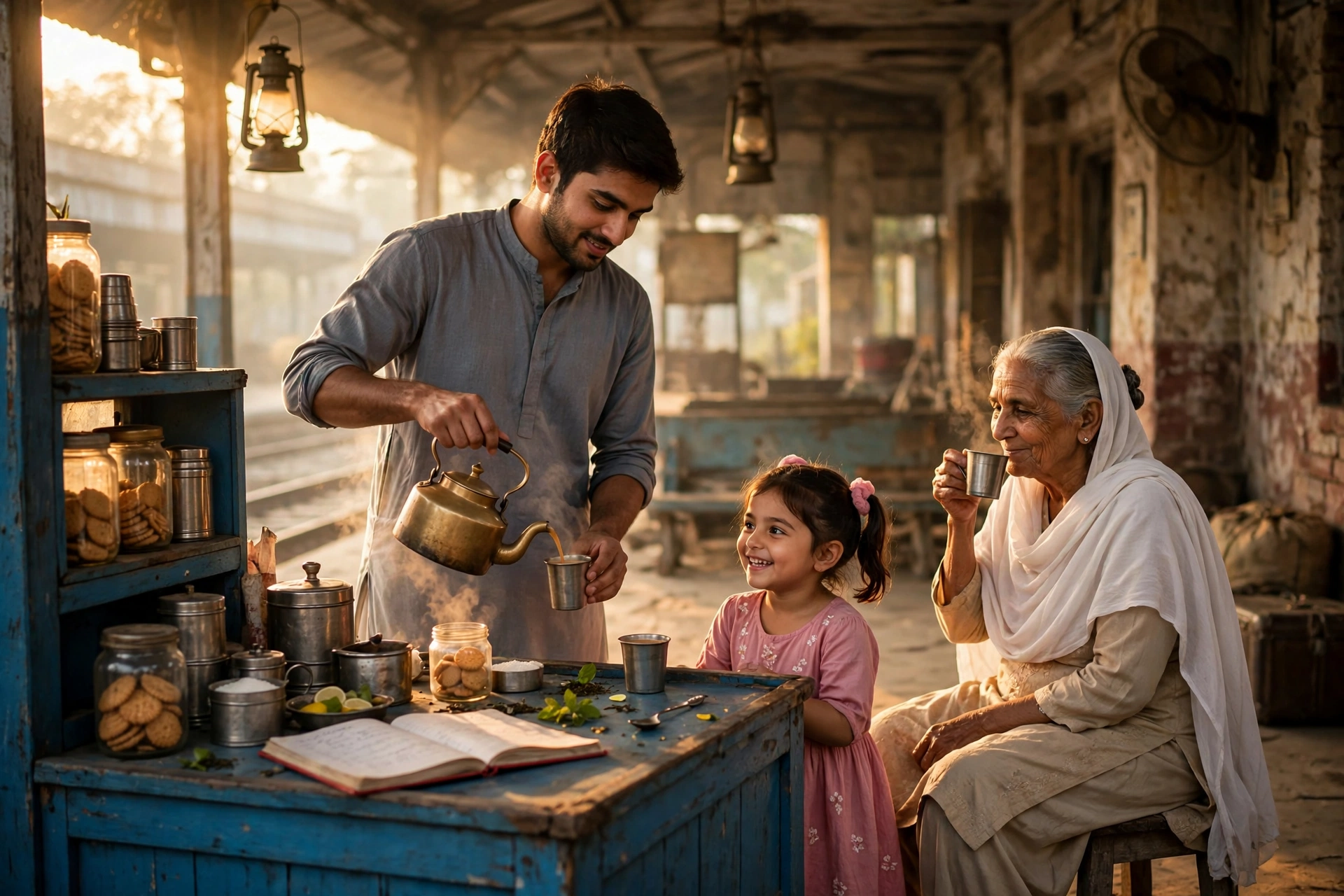
Today, the little blue stall at the corner of the old railway station still stands, and the kettle still sings every morning. Amna Bibi still sits on her stool in the corner, sipping her tea slowly, watching the world go by. And behind the counter stands a young man who once came to the station with a one-way ticket and no reason to live, asking every stranger the same question, in the same soft voice: "One cup of tea — in exchange for one smile, and one good thing that happened today."
And the notebook, fat and stained and held together with a rubber band, keeps growing. Because the world, it turns out, is full of small joys, waiting only for someone brave enough to ask.