The first winter after her husband died, Amara learned that grief has a temperature. It was not the sharp cold of the wind outside her small flat, or the chill that crept through the cracks of the old windows at night. It was a colder thing than that, a hollow cold that lived inside her chest, in the space where a voice used to say her name in the morning and ask whether the tea was ready.
For fifty-two years, her hands had been busy. They had cooked for a family, mended school uniforms, and held grandchildren who have since grown tall and moved to cities far away. Now her children called on Sundays, lovingly and briefly, and the rest of the week stretched out in front of her like an empty road.
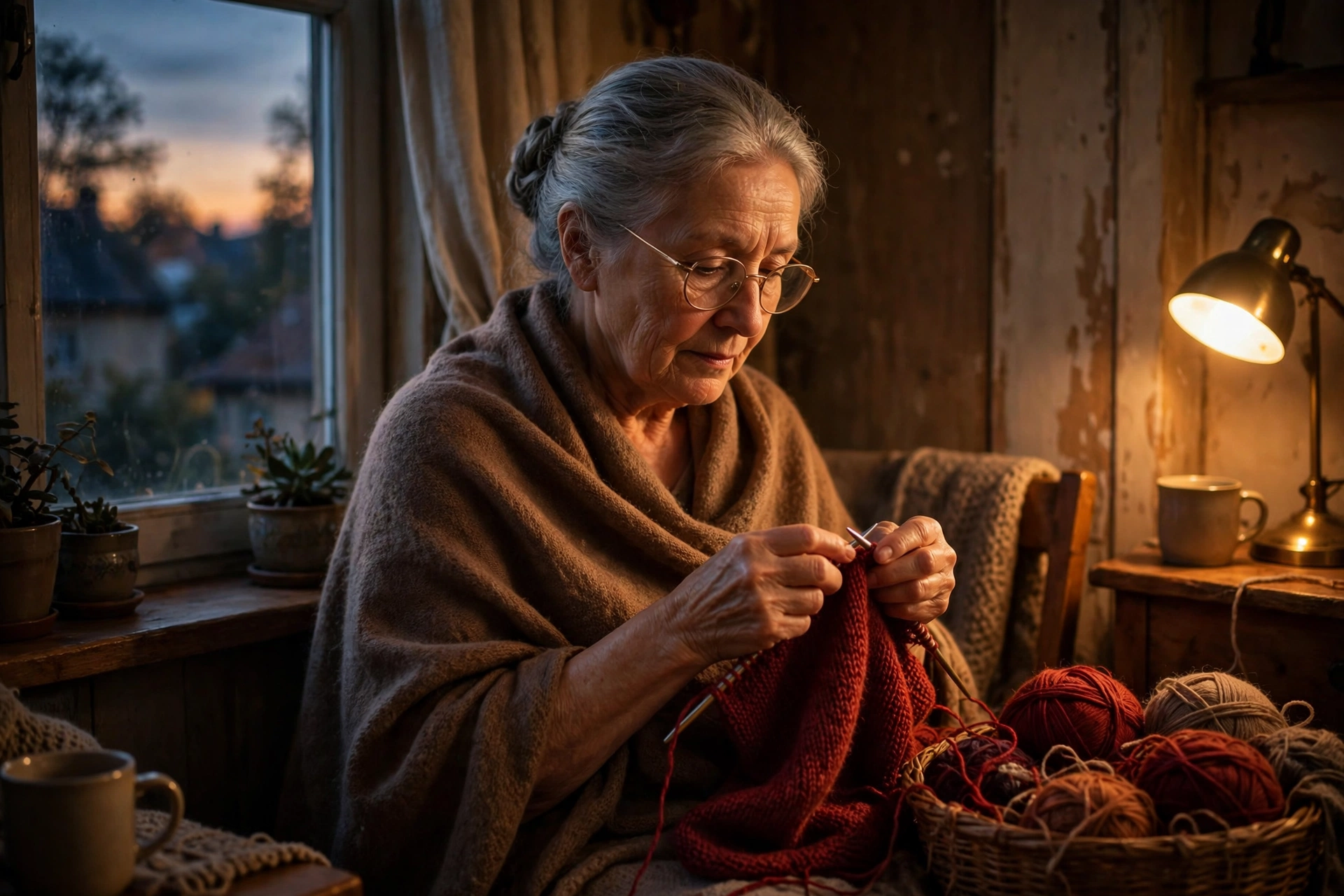
One grey November afternoon, while sorting through an old cupboard, Amara found a basket of wool her husband had bought her years ago. He had brought it home one winter evening, proud as a boy, saying, "For your hands, so they never get bored." She had laughed at him then. Now she sat down with the basket on her knees, picked up her knitting needles, and began. She did not know what she was making. Her fingers remembered before her mind did: cast on, knit, purl, knit, purl, the rhythm as steady as a heartbeat. By evening, she had the beginning of a sweater, deep red, the colour of winter berries.
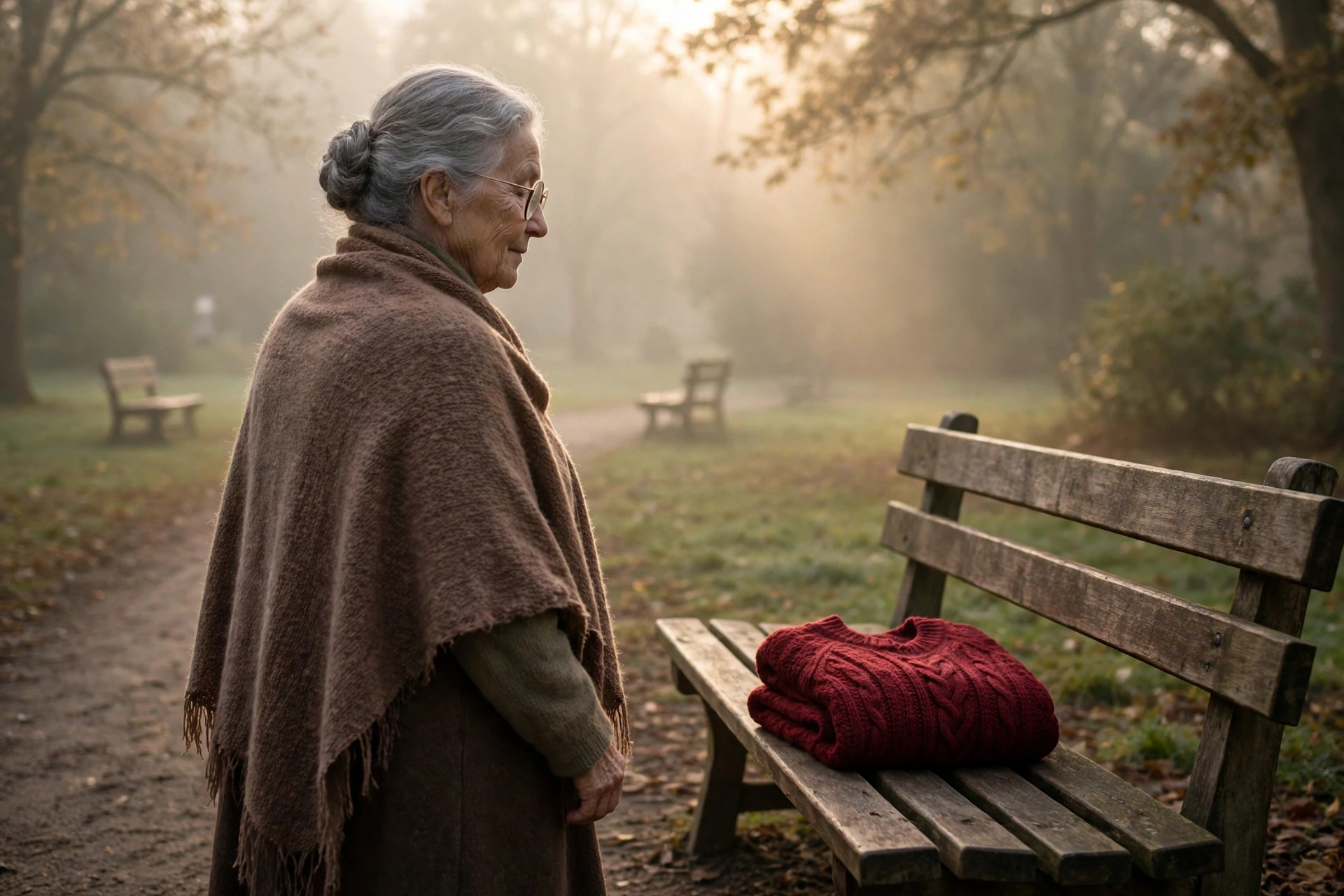
When the sweater was finished, she held it up and felt something she had not felt in months: a small, warm satisfaction. But she had no one to give it to. Her grandchildren had coats enough. Her neighbours had heating. So she folded it carefully, wrapped it in brown paper, and the next morning, before dawn, she walked to the park at the end of her street and laid it on a bench, with a small note tucked inside the fold. The note said only: "This was made with love. It is yours now. Stay warm."
She walked home quickly, her heart beating strangely fast. And when she passed the park again that afternoon, the bench was empty. The sweater was gone.
Amara did not know who had taken it. She never would. But that night, for the first time since her husband's death, she slept without waking at three in the morning to stare at the ceiling. Her hands had done something useful again. The hollow cold in her chest felt, just slightly, less cold.
So she knitted another. And another. Blue, green, grey, mustard, soft cream. Each one took about two weeks, working in the evenings by lamplight, and each one carried the same secret habit: on the left cuff, she stitched a tiny yellow star, no bigger than a thumbnail.
Every second Sunday, before the sun came up, she walked to a different bench, in a different corner of the park, and left her gift. She never waited to see who took it. She never wanted thanks. It was enough to know that somewhere, someone who was cold might be a little less cold because her hands had been busy.
She did this for nine winters. Seventy-two sweaters, by her quiet count. She never told a soul.
In the ninth winter, the cold came early and cruelly. One December night, when the frost turned the park's grass white and the wind cut through thin coats like a knife, a young man named Daniel sat on a bench with his hands tucked under his arms, trying not to shake.
Daniel was twenty-six and had lost almost everything in the space of a single year. He had lost his job when the warehouse where he worked closed down, and his small rented room when he could no longer pay for it. He had quarrelled with his father, said words he could not take back, and walked out of his family home with a bag and a pride that had kept him from ever going back.
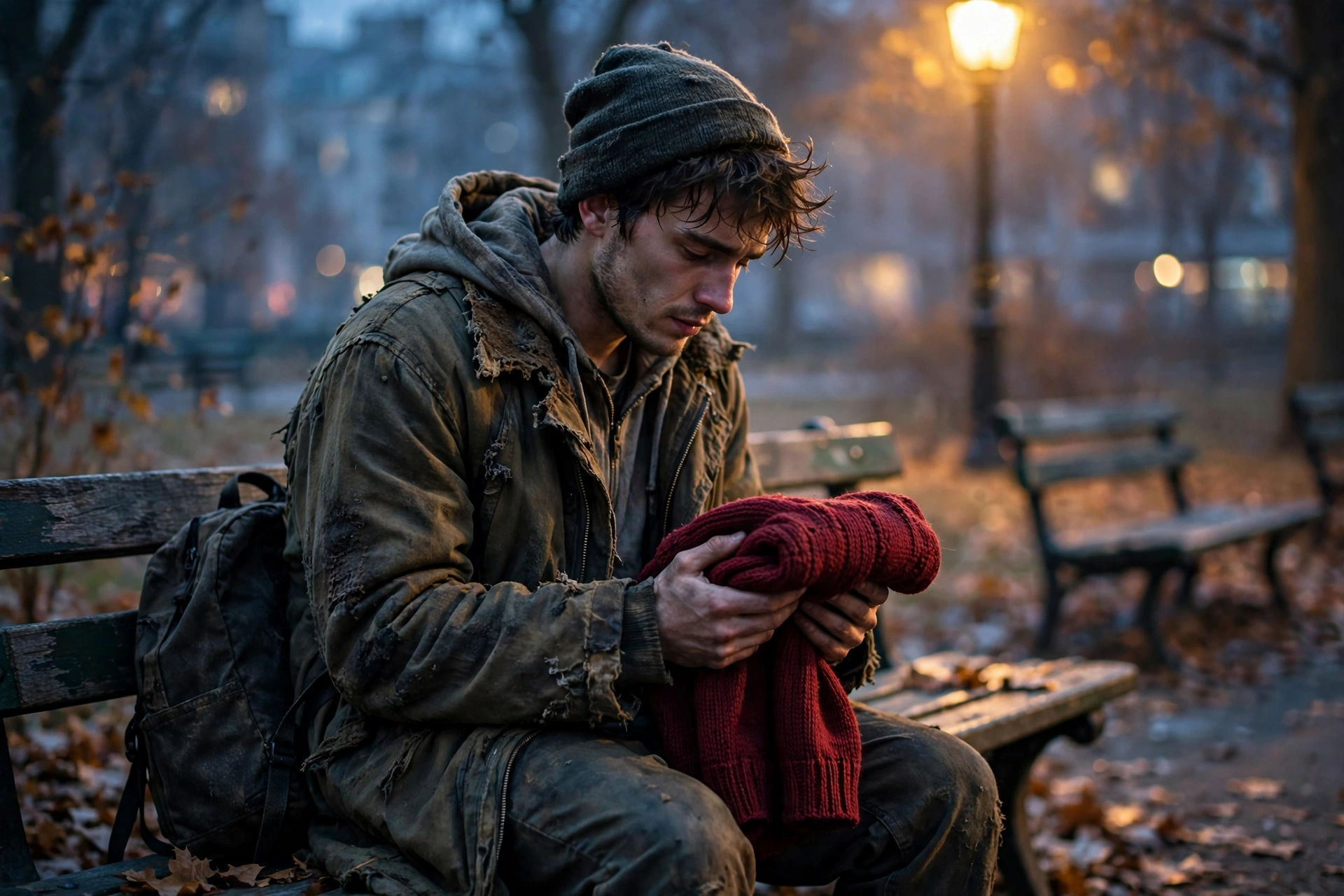
He was about to lie down on the bench and try to sleep when he noticed something beside him in the dark: a parcel wrapped in brown paper. He almost ignored it. People left rubbish in the park all the time. But something about the neatness of the fold, the careful way it was tied with string, made him open it.
Inside was a sweater. Deep red, thick, beautifully knitted, smelling faintly of lavender. Tucked into the fold was a small note, written in a careful, slightly shaky hand: "This was made with love. It is yours now. Stay warm."
Daniel stared at the note for a long time. Nobody had made anything for him in years. Nobody had thought about whether he was warm. He pulled the sweater over his head, and it fit as if it had been measured for him. The wool was soft against his skin, and for the first time in months, the shaking stopped. He sat there on the bench, wrapped in a stranger's kindness, and he cried — not the loud, tearing sobs of despair, but quiet tears of something he had almost forgotten: the feeling of being cared for.
It was only later, when he was smoothing the cuff, that he noticed the tiny yellow star stitched into the wool. He touched it with his thumb, and a thought formed in his mind, clear and stubborn: someone, somewhere, had spent weeks making this for no one in particular. If a stranger could care that much about someone they would never meet, then perhaps his own life was not finished after all.
Daniel did not become rich overnight. Life does not work like that. But the sweater became a turning point, the way a single warm coal can restart a dying fire. The next morning, wearing the red sweater, he walked to the shelter he had been avoiding out of shame, and asked for help. The people there helped him find work, first sweeping a shop floor, then driving a delivery van. He saved what he could. After two years, he rented a small room again. After three, he stood outside his father's house with his heart hammering, and knocked. His father opened the door, looked at his son, and pulled him inside without a single word about the past.
Daniel kept the red sweater all through those years. He wore it on cold days and folded it carefully on warm ones. He never knew who had made it, but he made a promise to it, the way you make a promise to a person: one day, when he was steady on his feet, he would pass the warmth on.
Seven years after that December night, Daniel kept his promise. He had become a youth worker at a community centre near the same park, helping young people who had lost their footing the way he once had. One autumn, he started a project called the Warmth Wall: a row of hooks along the centre's entrance where anyone could hang a coat, a scarf, or a sweater for someone who needed it, no questions asked.
But Daniel wanted to do more. He had taught himself to knit — badly at first, then patiently — because he wanted to give the way he had once been given: something made slowly, by hand, with love in every stitch.
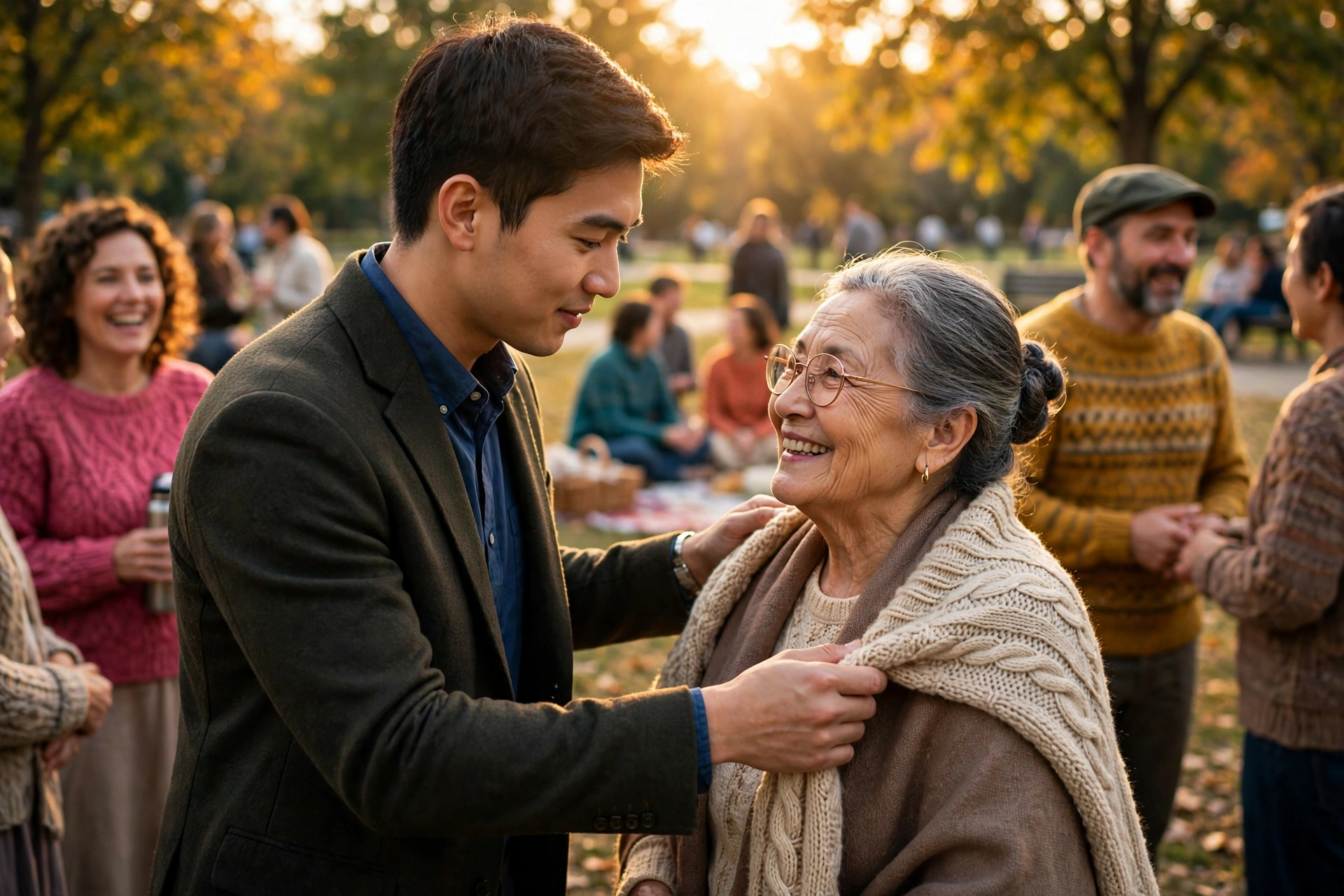
One bright October afternoon, the community centre held a small gathering in the park to celebrate the Warmth Wall's first year. An old woman was there too, invited by a neighbour, sitting quietly on a bench with a brown shawl around her shoulders. She was eighty-three now, and her hands, which had knitted seventy-two sweaters for strangers, rested in her lap, a little stiff, a little slower, but still her own.
Daniel was handing out cups of tea when his eyes fell on her. Something about the way she sat, patient and unassuming, made him walk over. He introduced himself and asked if she would like some tea. She smiled and said yes, thank you, and they talked about the weather and the park and the turning leaves, the way strangers do.
Then Daniel noticed her hands. The fingers were bent with age, and on one wrist there was a faint mark he recognised — not a scar, exactly, but the kind of mark that years of holding knitting needles leaves behind. And suddenly, without knowing why, he found himself telling her about a red sweater he had found on a bench one freezing December night, years ago, and the note that had been tucked inside it, and the tiny yellow star on the cuff that he still carried in his wallet as a reminder.
Amara listened, and her teacup trembled slightly in her hands. She did not say anything for a long moment. Then, very quietly, she said, "I stitch a star on every one."
Daniel stared at her. The noise of the gathering faded away. "It was you?" he whispered. "All those years — it was you?"
She nodded, tears shining in her eyes, and said, "I never knew who took them. I only hoped they were warm."
Daniel knelt down in front of the bench, took her hands in his, and told her everything: the shelter, the job, the return to his father, the Warmth Wall, and the promise he had made to a stranger's sweater. "You did not just keep me warm that night," he said, his voice breaking. "You kept me alive. And everything good that has happened since — my work, my family, this wall — it all started with your hands."
Then he reached into his bag and took out something he had been working on for weeks: a soft cream-coloured shawl, knitted by his own hands, with a tiny yellow star stitched into one corner. He had learned the star from a photograph of the sweater he had kept all those years, never knowing its meaning, only that it belonged in the pattern. He placed it gently around her shoulders.
"You gave warmth to strangers," he said. "Let a stranger give a little back to you."
Amara touched the shawl, felt the familiar texture of wool made with patience, and wept openly, the way people weep when a circle they did not know they were drawing finally closes. Around them, the gathering continued — people laughing, children running, the Warmth Wall bright with coats and sweaters — and on a bench in the autumn sun, an old woman and a young man sat together, two strangers no longer.
Amara lived three more winters after that day, and she did not spend them alone. Daniel visited every Sunday, bringing tea and stories from the centre, and together they knitted side by side: her hands slow but sure, his hands still learning, both of them stitching a tiny yellow star into every piece. The sweaters they made together went to the Warmth Wall, and then out into the world, to benches and shelters and strangers who would never know the names of the people who made them — only that someone, somewhere, had thought about whether they were warm.
And if you walk through that park today, on a cold morning before dawn, you might still see a neatly folded sweater waiting on a bench, wrapped in brown paper, with a note tucked inside that says: "This was made with love. It is yours now. Stay warm." Nobody knows who leaves them now. But the stars on the cuffs are still there, small and yellow and bright, like a promise kept between strangers — a promise that the warmth you give away never truly leaves you, because one day, in ways you cannot imagine, it finds its way home.