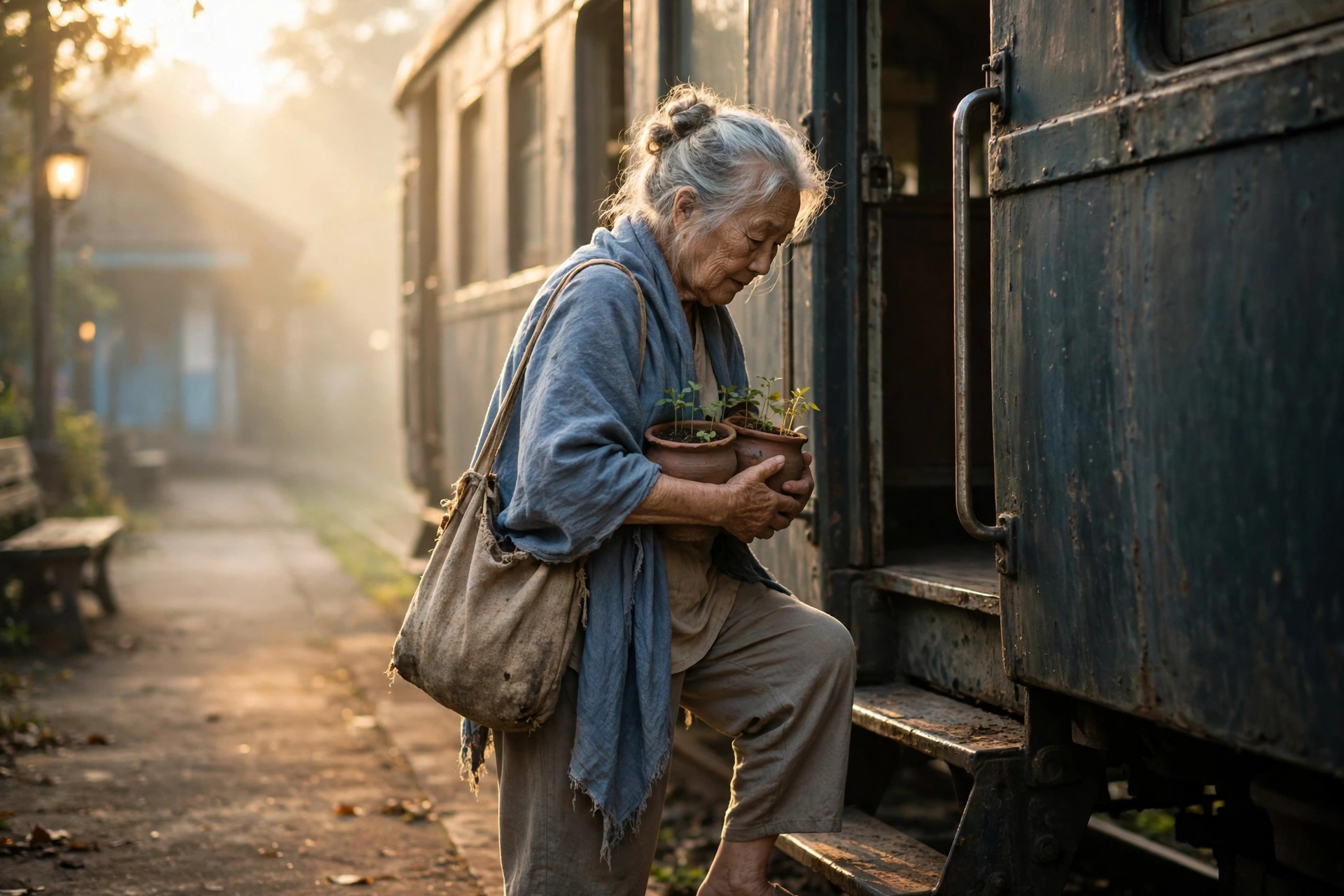
The morning after they buried her husband, Amina boarded the 7:10 train carrying a clay pot.
She was seventy-two years old, small and straight-backed, with a faded blue shawl wrapped twice around her shoulders and her grey hair pulled neatly back. In her arms she held the pot as carefully as other women held a newborn child. Inside it, in dark, damp soil, stood a single green basil plant, no taller than her hand. Her husband, Yusuf, had planted it on their windowsill forty years earlier, on the morning their first son was born, and he had tended it every day of his married life. When he fell ill, he had whispered to her, "Do not let it die, Amina. A living thing should outlive us both." She had promised. She did not yet know how she would keep that promise, because the little rented room she was moving to, in her daughter's crowded flat in the city, had no windowsill at all. It had no balcony, no courtyard, and no patch of earth. So on that first grey morning, with grief still sitting heavy in her chest like a stone, she did what felt least impossible: she took the basil plant with her on the train.
The 7:10 was an old train, the kind with windows that slid open with a shudder and seats covered in worn blue cloth. It rattled through fields and small towns for almost two hours before it reached the city, and Amina had ridden it a hundred times in her life, always beside Yusuf, always with a basket of food between them. Now she sat alone by the window in the last carriage, set the pot on the ledge where the sun would find it, and stared out at the passing fields without really seeing them. Only the conductor noticed the pot, and he stopped beside her seat with his ticket punch in his hand.
"Madam, plants are not allowed on the seats," he said, not unkindly. He was a broad man in his fifties named Karim, with a moustache and tired eyes, and he had worked this train for twenty years. "If it falls, the soil will make a mess, and I will be the one to clean it."
Amina looked up at him. Her eyes were red, but her voice was steady. "It will not fall," she said. "I will hold it the whole way. It is all I have left of my husband's garden."
Karim opened his mouth, then closed it again. Something in her face stopped him. He punched her ticket, nodded once, and moved on down the carriage. But the next morning, when Amina boarded again with the same pot, he was waiting. "One pot," he said, holding up a finger. "Only one. And it stays on the floor, not the ledge."
Amina nodded, though she knew the floor got no sun. She rode with the pot between her feet, shielding it from every jolt, and when she reached the city she carried it to her daughter's flat and set it on the kitchen table, where it drooped in the dim light. On the third morning, she did something she had not planned. She brought a second pot, a small mint plant she had bought from a roadside seller for a few coins, and set it beside the basil on the train's window ledge while Karim was checking tickets at the other end. When he came back, he stared at the two pots, then at her, then sighed the deep sigh of a man who knows he has already lost an argument.
"You are a stubborn woman," he said.
"I am a woman with a garden and no garden," Amina answered, and smiled for the first time in days.
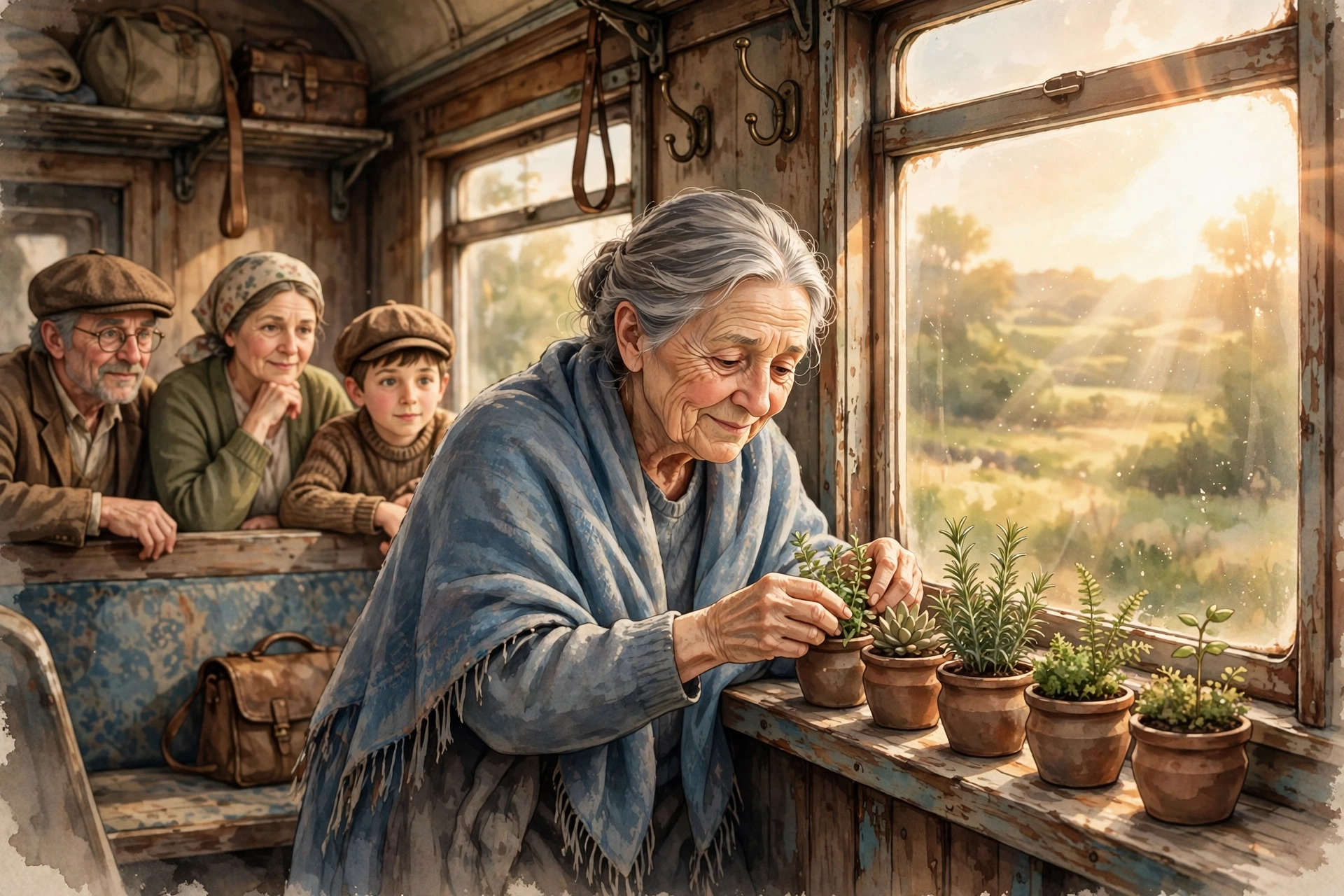
That smile changed something. The woman across the aisle, a young nurse named Sana who rode the train after long night shifts, leaned over and said, "My mother grows mint too. She says it helps a person breathe when they are tired." She had dark circles under her eyes and a lunchbox she never seemed to open. Amina broke off a mint leaf and held it out. "Smell this," she said. Sana did, and laughed softly, and for the rest of the journey she sat a little straighter. The next day, Sana brought a tiny pot of her own, a cutting from her mother's plant, wrapped in newspaper. "It needs sun," she said, as if that explained everything, and set it beside Amina's basil. Karim walked past, saw three pots, and said nothing at all. He only straightened them carefully with one hand so they would not slide when the train turned.
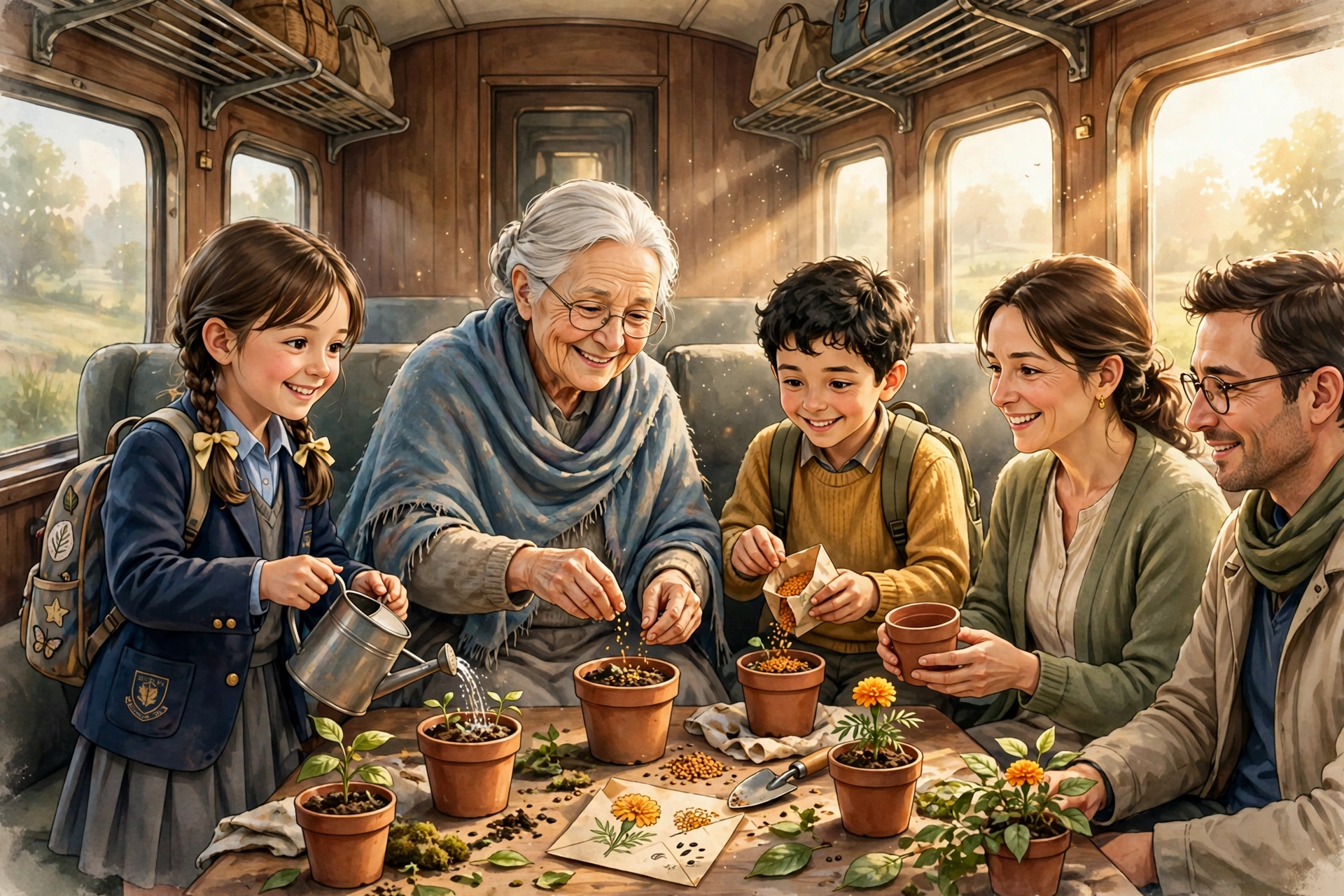
After that, the garden grew the way gardens do when people stop being afraid to care. A schoolboy named Bilal, who always sat with his schoolbag hugged to his chest and never spoke to anyone, began to watch Amina water the plants with a small bottle she carried in her bag. One morning he arrived with a paper packet of marigold seeds, pressed it into her hand without a word, and hurried to his seat, his ears burning red. Amina planted the seeds in a chipped cup she had brought from home, and every morning Bilal checked the cup before he checked anything else. When the first green shoot pushed through the soil, he gasped so loudly that half the carriage turned to look, and then he grinned, a wide, unguarded grin that made the tired passengers smile too. An old fruit seller added a pot of chillies. A young man who worked in a factory brought a struggling rose cutting he had rescued from a pavement. Amina knew the name of every plant, and soon she knew the names of the people who brought them, and the people began to know each other. The last carriage, once the quietest and loneliest part of the train, became the place where strangers asked after each other's plants, and then, slowly, after each other.
Karim stopped pretending to object. He brought a wooden tray from the station one morning and fitted it along the window ledge so the pots would sit steady. "A train needs something living in it," he told a new ticket inspector who raised an eyebrow at the sight of green leaves fluttering beside the windows. "Otherwise it is only metal moving through fields."
Then came the day the train broke down. It was high summer, the air thick and still, and the old train shuddered to a halt between two stations with no shade in sight. The announcement crackled that repairs would take two hours, maybe three. The carriage grew hot. Babies cried. A man in a suit loosened his tie and cursed under his breath. Bottles of water ran out. People fanned themselves with newspapers and stared at the empty fields, their tempers fraying with every minute. Amina, calm as ever, opened her bag and took out her watering bottle, a small tin cup, and a bunch of mint leaves. She crushed the mint into the last of her drinking water, poured it carefully into the cup, and handed it to the crying baby's mother. Then she passed the cup along the carriage, refilling it again and again from the little water she had saved for her plants, until every passenger had tasted something cool and green. Sana, the nurse, took charge of the elderly passengers, moving them near the open windows where Amina's plants trembled in the faint breeze. Bilal, who had never spoken to a stranger in his life, walked up and down the aisle telling younger children the names of the plants, as proudly as if he had grown them himself. When the train finally lurched forward again, hours later, the carriage did not feel like a crowd of strangers who had suffered together. It felt like neighbours who had looked after one another. The man in the suit, who had cursed at the delay, stopped beside Amina's seat before he got off and said, quietly, "Thank you. I had forgotten what patience looks like." He left a small packet of sunflower seeds on her tray.
Not everyone was pleased, of course. A railway officer in a crisp uniform boarded one morning with a clipboard and a list of rules, and he stared at the row of pots as if they were a crime. "This is a passenger carriage, not a nursery," he said. "There are regulations. One complaint and all of this must go." The carriage fell silent. Bilal clutched his schoolbag. Sana looked down at her hands. Amina said nothing for a moment. Then she stood up, slowly, and picked up her basil plant, the oldest of them all, now bushy and strong. "This plant travelled with me when I had nothing else," she said, her voice soft but clear enough for the whole carriage to hear. "It taught a boy to speak to strangers. It taught a nurse to rest for a moment. It taught all of us to look after something that cannot look after itself. If that breaks a rule, then the rule is smaller than the reason." Before the officer could answer, Karim stepped forward. Behind him, one by one, the passengers stood too: Sana, Bilal, the fruit seller, the factory worker, the man in the suit who now rode this carriage every day on purpose. The officer looked at their faces, looked at his clipboard, and slowly put his pen away. "I will write it as a trial," he said at last. "One carriage. For the passengers' well-being." Karim winked at Amina when the officer was gone, and the whole carriage burst into applause that startled the pigeons at the next station.
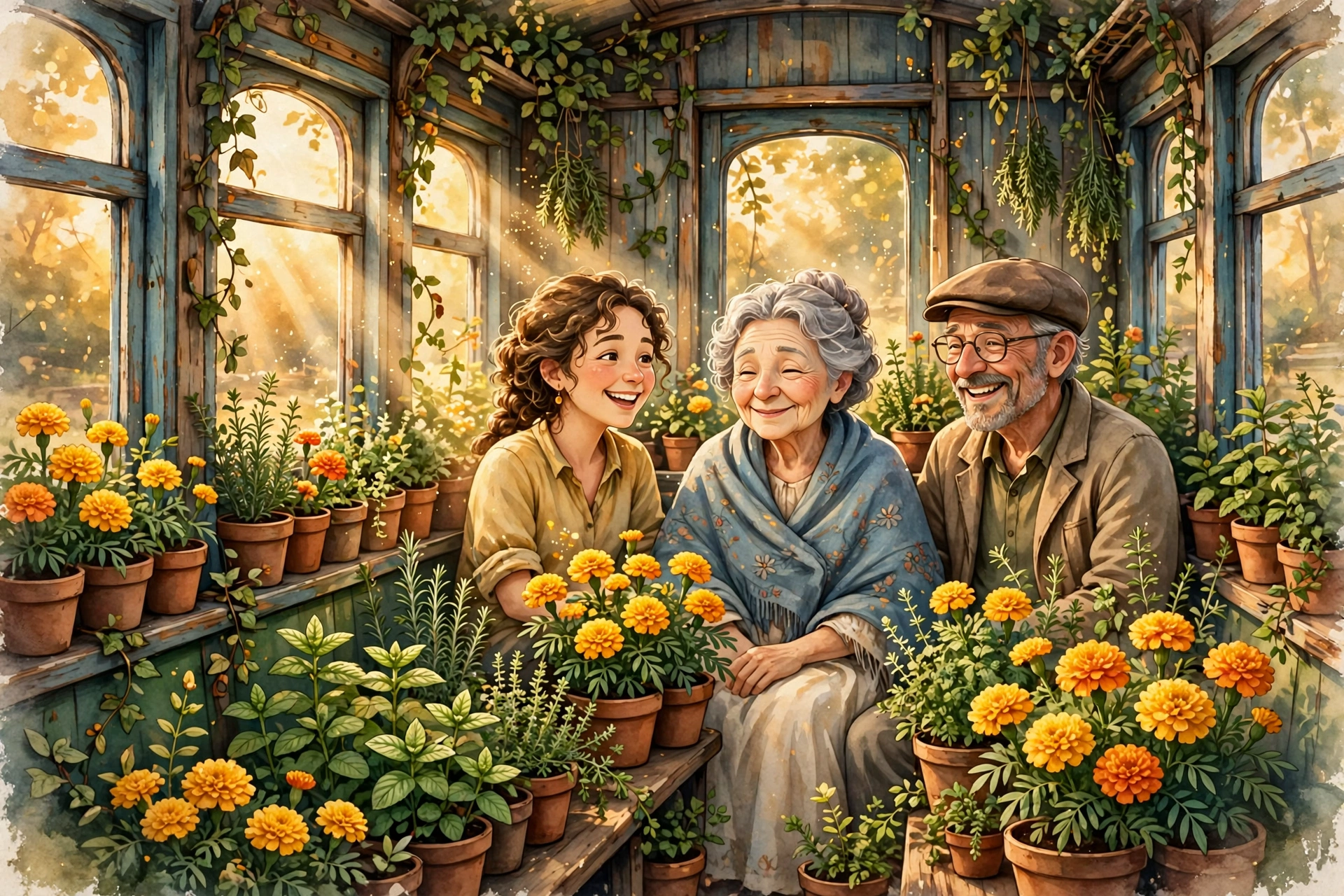
Word spread, as good news does. People began to choose the last carriage on purpose. A grandfather brought his granddaughter to see the marigolds, and the little girl pressed her nose to a flower and whispered, "It smells like sunshine." The railway, to everyone's surprise, did not remove the garden. Instead, one spring morning, a small brass plaque appeared beside the door of the last carriage. It read, simply, "The Garden Carriage — tended by its passengers." That same week, Amina's daughter visited the train for the first time, carrying her own small son. She watched her mother move among the pots, answering questions, handing out cuttings wrapped in newspaper, laughing with people who had once been strangers, and she understood, finally, why her mother had never seemed lonely on those long journeys. "You did not lose your garden when father died," her daughter said, tears in her eyes. "You just planted it somewhere it could grow bigger."
On the last morning of that summer, Amina boarded the train to find a surprise waiting on her tray: a new clay pot, painted bright blue by Bilal's class, holding a young basil plant grown from a cutting of her own. A card tucked into the soil read, in Bilal's careful handwriting, "For the woman who taught our carriage to grow." Amina held the pot to her chest and laughed, and then she cried, and then she laughed again, because grief, she had learned, does not disappear. It changes shape. It becomes the soil in which something new can grow, if you are willing to keep watering it. As the train pulled out of the station and the fields rolled past the windows, green and gold in the morning light, the passengers of the Garden Carriage tended their plants together, talking softly, sharing water, sharing seeds, sharing the quiet knowledge that they were no longer travelling alone. And somewhere among the marigolds and the mint and the basil, Yusuf's little plant, now forty years old and stronger than ever, swayed gently with the motion of the train, still growing, still giving, still keeping its promise.