The canal took Yusuf's son on a Tuesday, in the hour when the light turns gold and mothers call their children home for supper.
Yusuf had been in the city that day, selling the season's wheat, and by the time his bus dropped him at the edge of the village, the shouting had already begun. His wife Fatima stood on the bank with her shawl pressed to her mouth. His twelve-year-old son Hamza had gone to the canal with his friends after school, as he had done a hundred times before. Chasing a ball that had rolled into the deep bend where the current runs fast, he slipped from the muddy bank and went under. None of the boys knew how to swim, and neither did the men who ran to help. By the time someone pulled Hamza from the water, it was too late to save him.
After that, Yusuf could not look at the canal. He took a longer road to the fields to avoid it, and stopped sitting on the bank in the evenings, where he and Hamza used to watch the kingfishers. In their small mud-brick house, Hamza's wooden toy boat still sat on the windowsill, its paint faded by the sun, and Fatima dusted it every morning without saying a word.
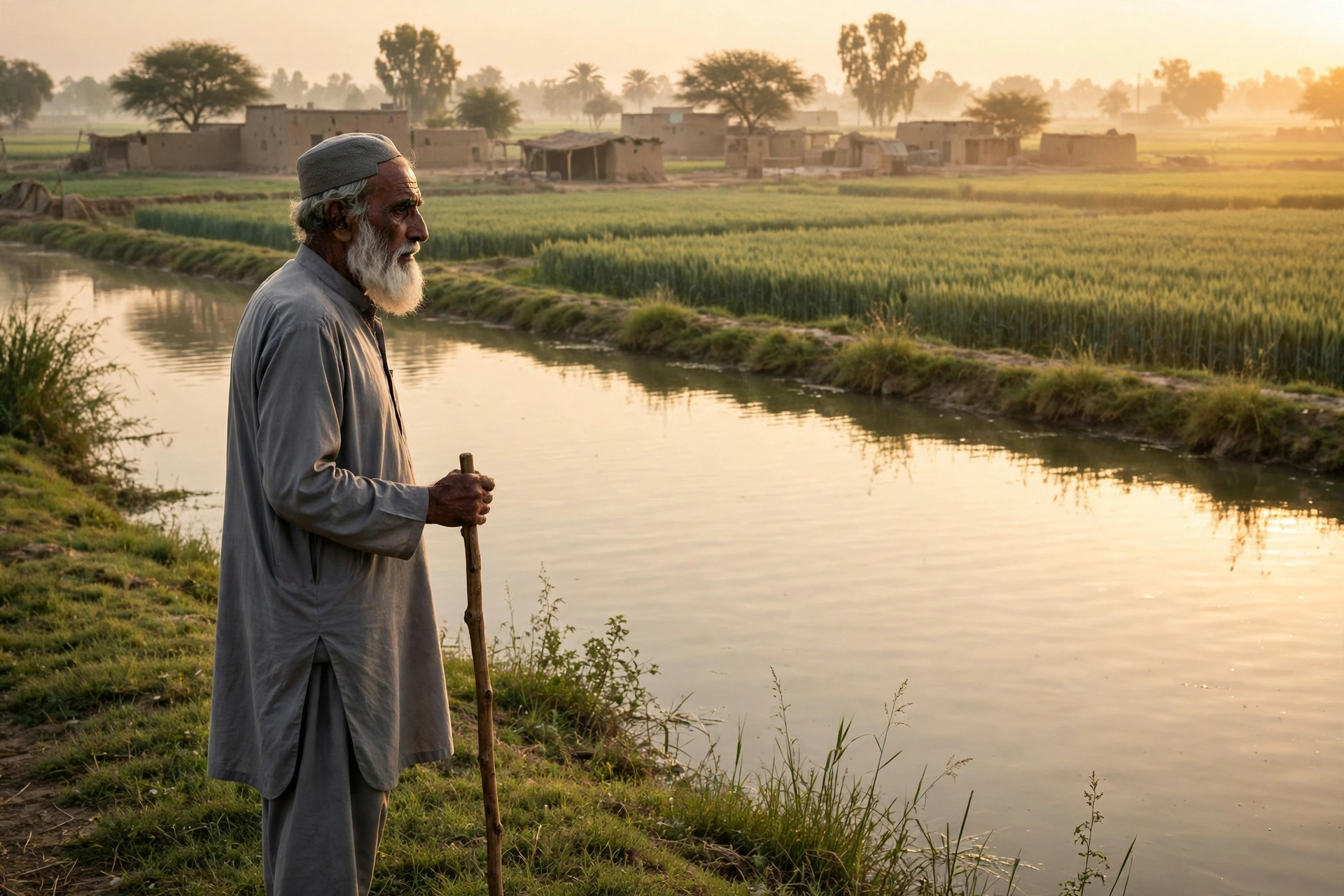
The village did not forget either, but it forgot in the wrong way. Mothers warned their children to stay away from the canal, and the children, being children, went anyway, because the water in summer was cool and bright and more inviting than any warning. The canal remained what it had always been: beautiful, useful, and dangerous to anyone who did not know its moods.
Then, one hot afternoon twelve years after Hamza's death, Yusuf was walking home from the fields when he heard laughter and splashing from the far bank. Three small boys were playing near the deep bend, the very bend where Hamza had fallen, throwing stones to see who could throw the farthest and leaning further over the edge with each throw. One of them, a thin boy of about eight with a torn shirt, slipped on the wet mud and windmilled his arms, and for one dreadful second Yusuf's heart stopped. The boy caught himself on a root and laughed, as if it had all been a game. Yusuf stood trembling on the road, his hands shaking so hard that he dropped his walking staff, and he understood, all at once, what he had been doing for twelve years. He had been hiding from the canal, while the canal went on taking its chances with other people's children.
That night he did not sleep. He thought about Hamza, not as he had been at the end, but as he had been alive: a boy who loved the water and who had never been taught to respect it properly, because no one in the village had ever taught any child to swim. In the morning, before the sun was fully up, he went to Fatima in the courtyard and said the words he had not said in twelve years. "I am going back to the canal," he said. "Not to remember. To teach." Fatima looked at him for a long time, and then she nodded, as if she had been waiting for him to say it. "Then take your time," she said. "And take some tea. Teachers need tea."
Yusuf walked to the shallow side of the canal, far from the deep bend, where the water came only to a grown man's knees and the bottom was soft sand. When the thin boy with the torn shirt came past with his friends, Yusuf called out to him gently, so as not to frighten him. "What is your name, son?" he asked. "Bilal," the boy said, eyeing the old man warily. "Come here, Bilal," Yusuf said. "I want to show you something. Not a game. Something that could save your life one day." Bilal came closer, curious despite himself, and Yusuf told him, plainly and without any drama, that he had lost a son to this canal, and that he did not want to lose a neighbour's son to it too. He simply asked Bilal if he would like to learn to float.
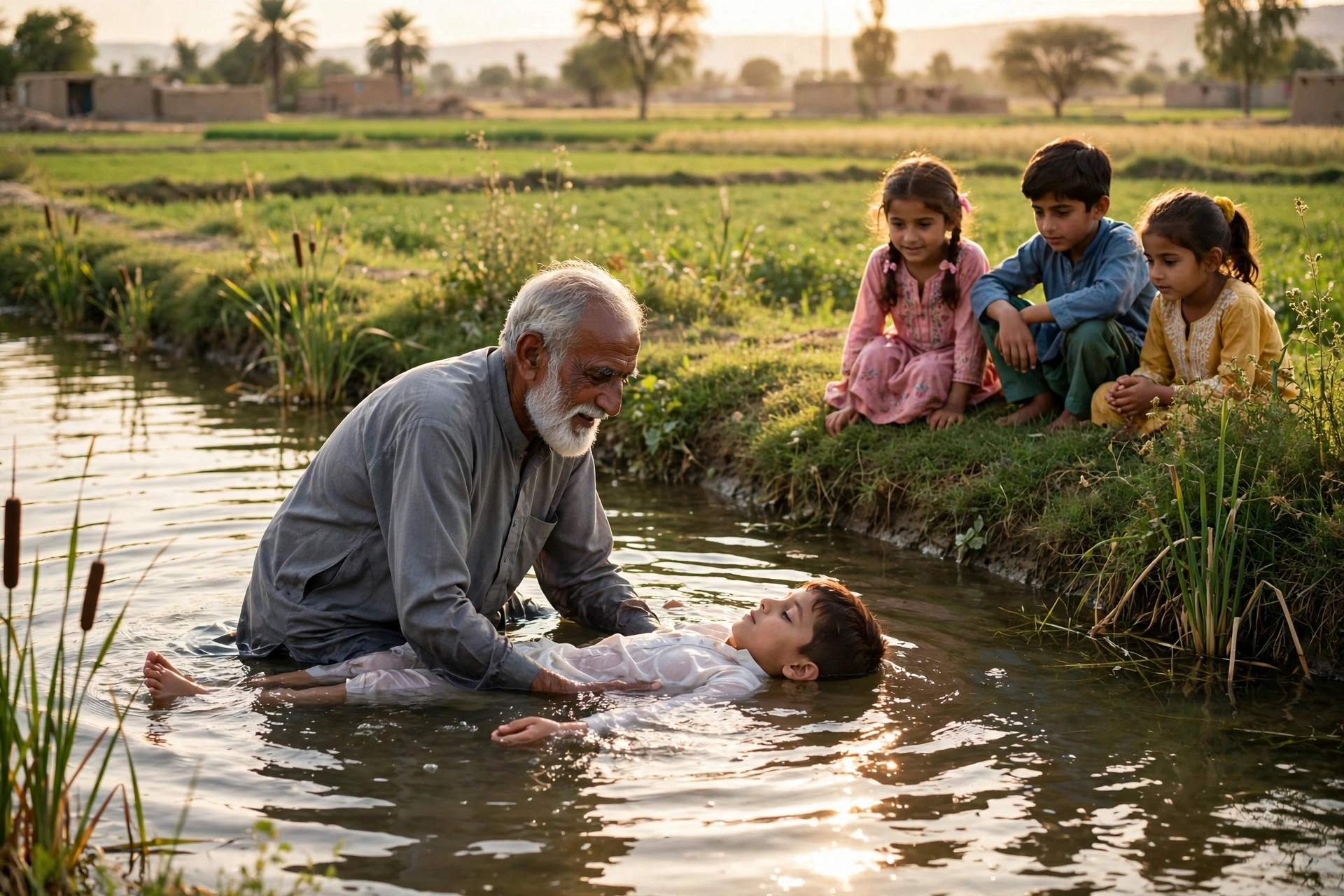
Bilal's mother came running when she heard, because in the village a strange old man talking to children by the water was a thing to worry about. But when she saw Yusuf, sitting patiently in the shallow water, holding Bilal gently under the back while the boy lay stiff as a board and terrified, she stopped and watched. "Breathe out slowly," Yusuf was saying. "The water will hold you if you let it. Do not fight it. Be like a leaf." Bilal's body began to soften. His ears went under, then his hair, and suddenly he was floating, staring up at the sky in amazement, while Yusuf's steady hands stayed beneath him. "I am floating, Ammi!" Bilal shouted. "I am really floating!"
Word travelled through the village from courtyard to courtyard, faster than any messenger. By the end of the week, six children were coming to the shallow side in the mornings, and by the end of the month there were fourteen. Yusuf had rules, and he repeated them every single day until the children could recite them in their sleep. Never go to the water alone. Never swim in the deep bend. Never push another child in, even as a joke. Learn to float before you learn to swim, because floating is what saves you when you are tired or frightened. If someone falls in, lie flat, reach with a stick or a cloth, and shout for a grown-up.
Not everyone was pleased. Master Iqbal, the retired schoolteacher, came to the bank one morning with his arms folded. "This is foolishness, Yusuf," he said. "You are an old man. If a child drowns while you are teaching him, the blame will fall on you. The canal should be fenced, not played in." "Master, we fenced it once, and the fence fell down. You cannot fence a whole canal, and you cannot fence a child's curiosity. But you can put knowledge inside a child, and no flood and no thief can take that away."
Among the children was a girl named Zara, ten years old, who was braver than most boys and yet terrified of the water. When she was small she had fallen into a well in her grandmother's courtyard and had been pulled out coughing and shaking, and ever since then she had avoided even the shallow edge. She came to watch her brother learn, standing well back from the bank with her arms wrapped around herself. Yusuf never forced her. One morning, after three weeks of watching, Zara walked to the water's edge on her own and put one foot in. Then the other. Then she looked at Yusuf and said, very quietly, "Will you hold me the way you held Bilal?" Yusuf waded to her at once, and held her just as steadily, and when she floated for the first time, she laughed and cried at the same time.
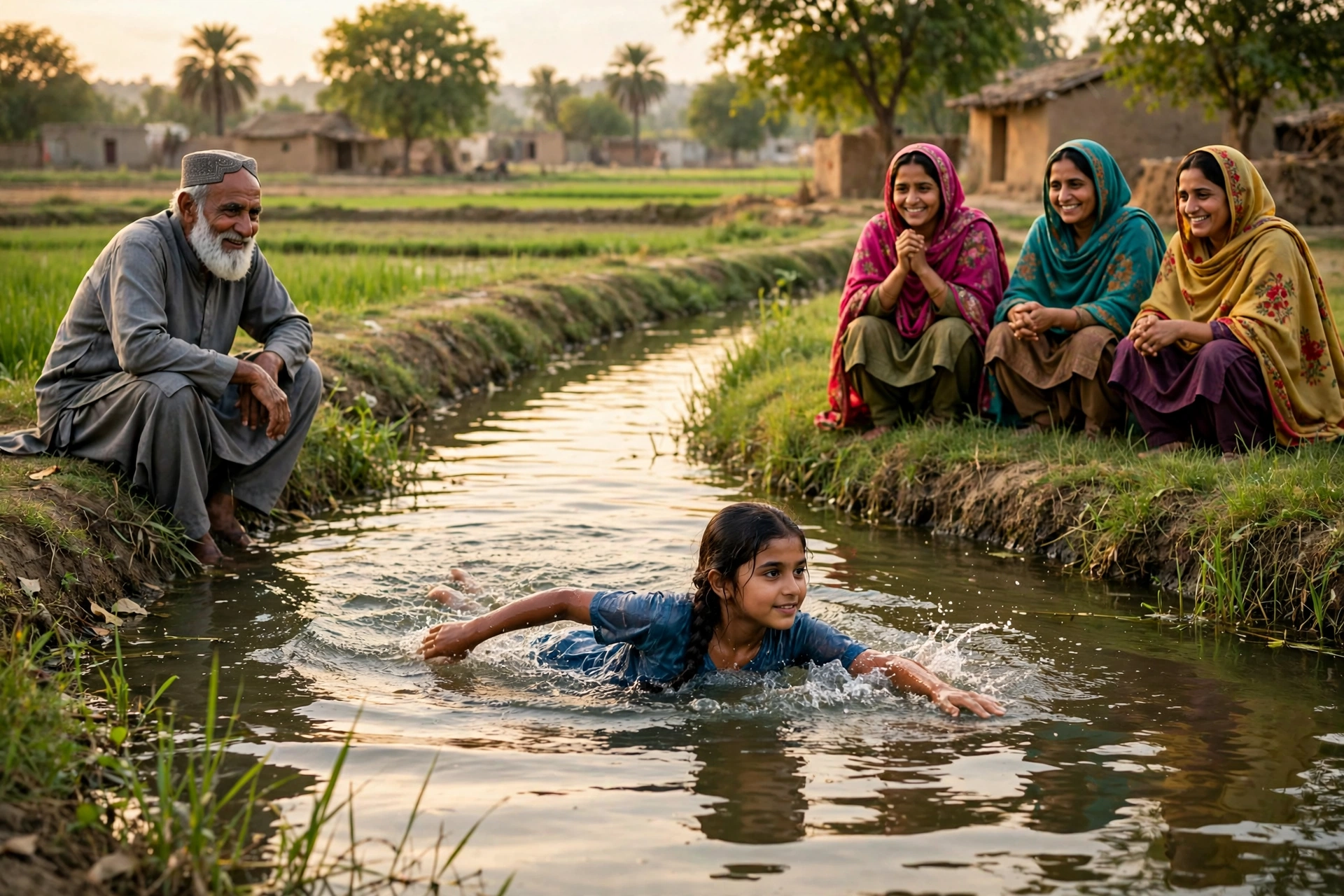
The morning Zara swam across the shallow stretch all by herself, without anyone holding her, the whole bank cheered. Mothers who had once forbidden their children to come now stood on the grass with cups of tea, calling out encouragement. Bilal swam beside her for the last few strokes, shouting, "You did it! You did it!" Yusuf stood knee-deep in the water, his hands empty at his sides, and he felt something inside him loosen, like a knot that had been pulled tight for twelve years beginning, at last, to come undone.
Then came the afternoon that tested everything Yusuf had taught. The children were practising their floating in the shallow side while Yusuf sat on the bank mending a torn fishing net. Little Sana, who was only six and had just begun her lessons, saw her red ball roll away from the group and bounce toward the deep bend. Before anyone could stop her, she ran after it, laughing, and her small foot slipped on the same muddy edge where Hamza had slipped twelve years before. She went into the water with a cry, and the current, which looks so lazy on a still day, caught her at once and pulled her toward the middle. The mothers on the bank screamed. Bilal shouted her name. And Yusuf, who was sixty-eight years old with knees that ached every morning, did not hesitate for a single breath. He threw off his shawl and plunged in, swimming with strong, steady strokes, reaching Sana just as her head went under for the second time. He caught her, turned her onto her back as he had taught all the children to do, and held her against his chest while he floated and kicked slowly toward the shallow side, where Master Iqbal and the other men were already wading in with a long rope. When they pulled them both out, Sana was coughing and crying and clinging to Yusuf's neck, and Yusuf was coughing too, sitting in the mud with his white beard dripping.
No one in the village argued about the swimming lessons after that day. Master Iqbal was the first to come to Yusuf's house that evening, and he did not fold his arms at all. "Forgive an old teacher who was slow to learn," he said. "Will you teach my grandson too?" Yusuf smiled, the first full smile Fatima had seen on his face in many years, and said, "Bring him in the morning. Bring all of them." From then on, the lessons had a proper shape. The older children, Bilal and Zara at the front of them, helped watch the younger ones.
Years passed, and the canal changed in the eyes of the village. It was still beautiful, and it was still to be respected, but it was no longer a place of only fear. Every summer morning, the sound of children's laughter rose from the shallow side, and mothers brought tea without being asked. Bilal grew tall and strong, and one morning Yusuf handed him the whistle and said, "Today, you teach the new ones to float. I will watch."

On the last evening of that summer, when the light turned gold over the water, Yusuf walked slowly to the deep bend, the place he had avoided for so long. He stood there for a while with Fatima beside him, holding his hand, and he looked at the water without flinching. Then he took the small wooden toy boat from his pocket, the one that had sat on their windowsill for so many years, and he set it gently on the current. Yusuf watched it until it was out of sight, and he said, very softly, so that only Fatima could hear, "I could not save you, my son. But I have saved others in your name, and that will have to be enough."
Yusuf never got his son back. No kindness in the world can undo a loss like that, and this story does not pretend otherwise. But every child in the village who learned to float, and every young teacher like Bilal who now holds a frightened child steady in the water, is living proof of what Yusuf discovered: that the deepest way to honour someone we have lost is not to hide from what hurt us, but to make sure it never hurts another person in the same way again.