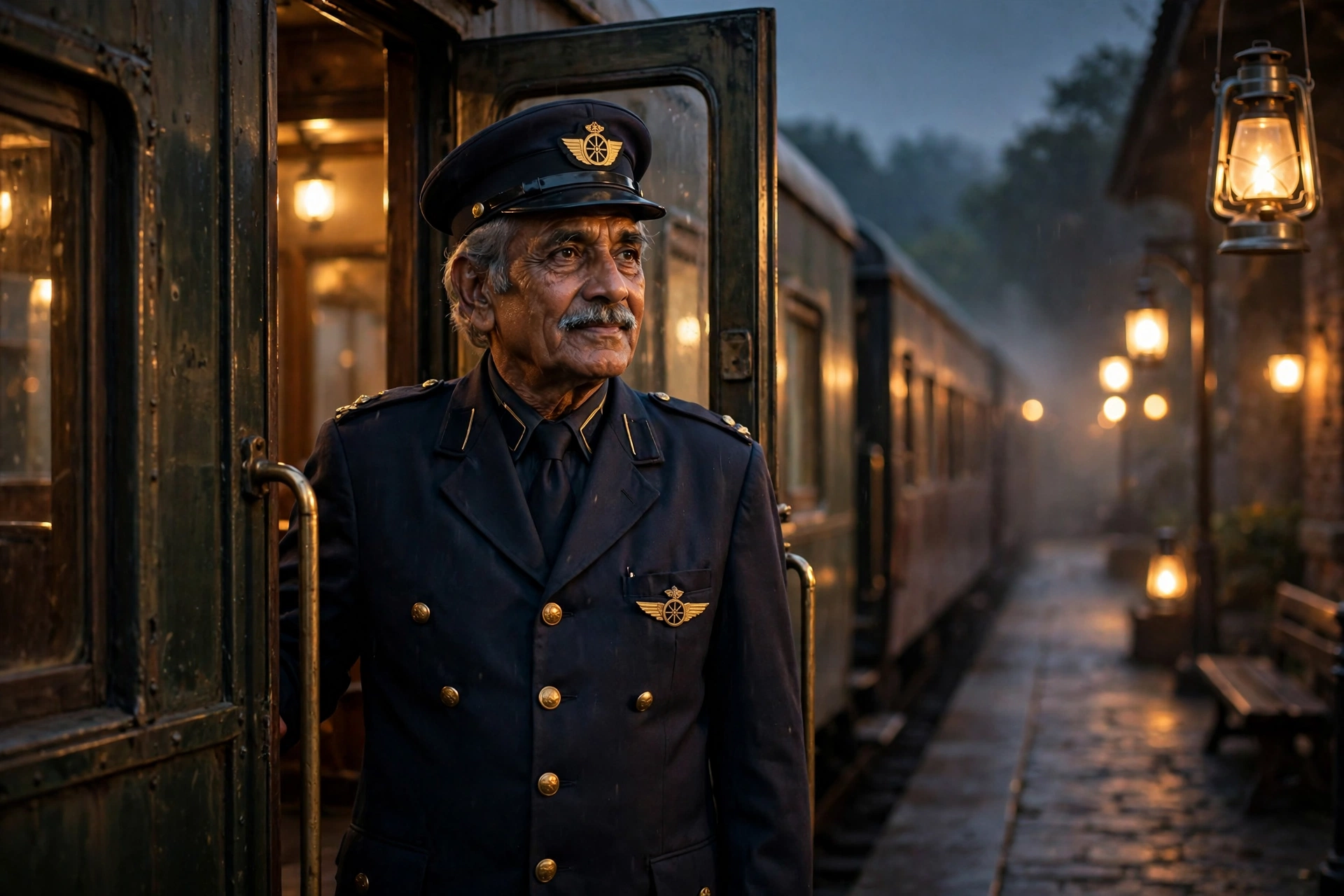
On the night of his last journey, Conductor Rahim stood on the platform with his cap pulled low and his ticket punch hanging from his belt like it had for forty years, and he tried very hard not to cry in front of the train.
The night train was not a beautiful train. Its paint was faded, its windows rattled in their frames, and its whistle sounded tired, the way old things sound when they have done their job for too long. But to Rahim, it was the most beautiful thing in the world, because it had carried him through his whole life. He had boarded it as a nervous young man of twenty-two with a new uniform that did not fit, and now he was sixty-two, with grey in his moustache and lines around his eyes that had been drawn by a thousand dawns seen through moving windows. Tonight, the railway was retiring him. Tonight, the night train would run one last time with his hand on its doors.
"Last call, Uncle?" the young porter asked, grinning. Everyone at the station called him Uncle, even men old enough to be his sons.
"Last call," Rahim said, and his voice came out steadier than he expected. "And first call for someone else, I suppose. That is how it goes."
He walked the length of the train the way he always did, checking doors, straightening a crooked seat, tapping a loose window frame. In compartment after compartment, the passengers were settling in for the night: a mother tucking a blanket around two sleepy children, a student with his nose in a book, an old farmer clutching a cloth bundle as if it held the whole world. Rahim knew the look of every kind of traveller. He had spent four decades learning that people do not just carry luggage on night trains. They carry worries, and hopes, and goodbyes they have not finished saying.
In the third compartment from the engine, he found the boy.
The boy could not have been more than twelve. He sat curled into the corner seat, knees pulled up to his chin, wearing a shirt far too thin for the cold night air. There was no bag beside him, no food, no one waiting with him. When Rahim asked for his ticket, the boy looked up with eyes that were trying very hard to be brave, and said, in a voice barely louder than the wind outside, "I don't have one, Uncle. I ran away."
Rahim had heard many stories in forty years, and he had learned to tell the difference between a troublemaker and a frightened child. This was a frightened child. He sat down opposite the boy, slowly, the way you approach a sparrow that might fly away, and asked where he was going.
"To my grandmother's village," the boy whispered. "My father shouts all the time since my mother died. He says I am useless. So I thought... I thought if I go to Grandmother, she will let me stay."
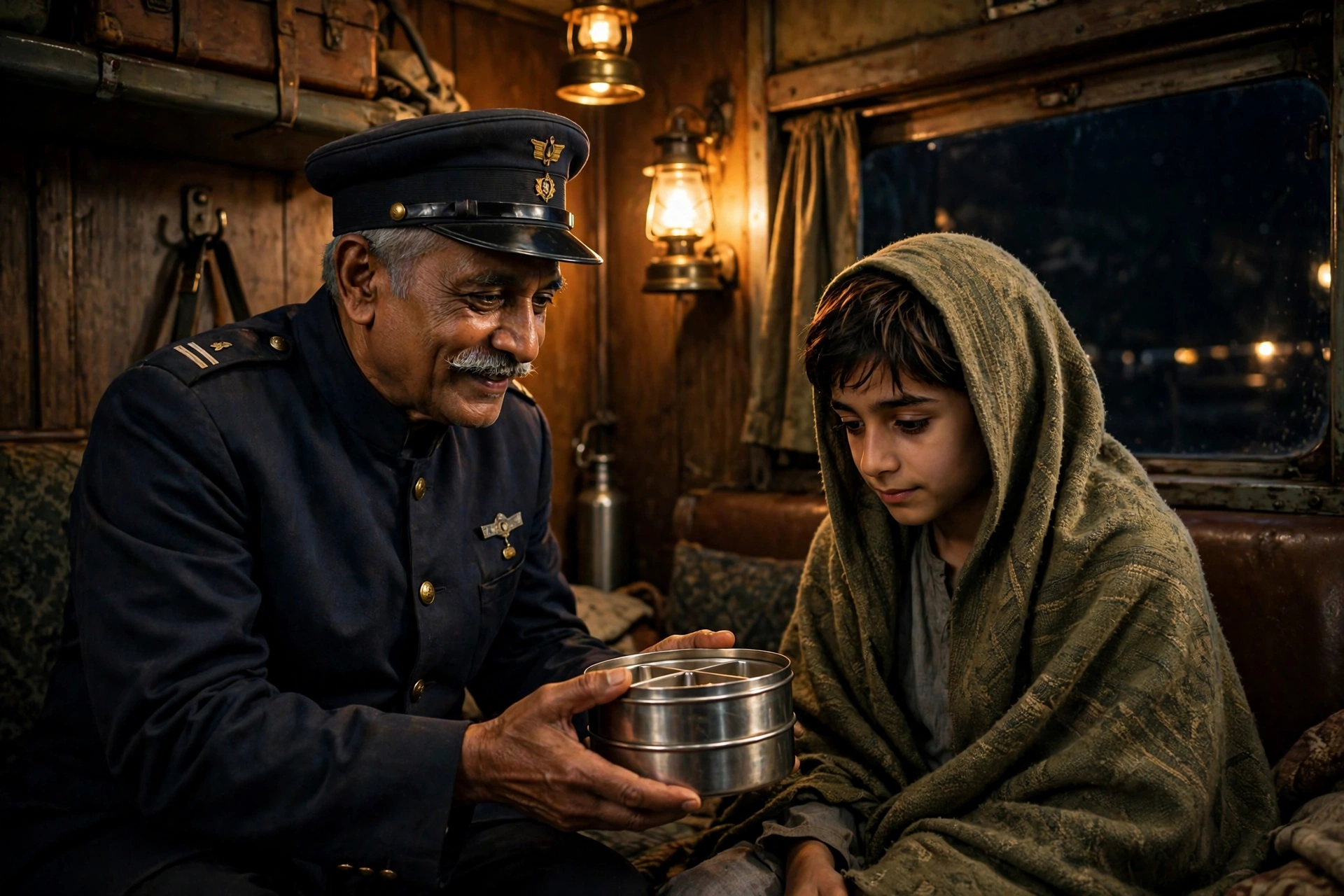
Rahim's heart did something it had done a hundred times before on this train: it quietly broke and quietly decided, both at once. He did not lecture the boy. He did not drag him to the stationmaster. Instead, he reached into his own tiffin box, the dinner his wife had packed for his last shift — rice, lentils, and two pieces of chicken — and held it out.
"First rule of travelling, young man," he said, "is that no one travels on an empty stomach. Eat. Then we will talk."
The boy ate as if he had not eaten all day, which he probably had not. Between mouthfuls, the story came out in pieces: the shouting, the silence afterwards, the grandmother two hundred miles away who used to sing him to sleep when he was small. Rahim listened the way only a man who has spent forty years listening to strangers can listen — without interrupting, without judging, as if the boy's words were the most important cargo on the train. Then he said gently, "Your grandmother loves you, I am sure of it. But running away in the night is not the way to reach her. Tomorrow morning, I will call your father from the station, and we will talk to him together. And if he shouts, I will be standing right beside you. That is a promise from a conductor, and a conductor never breaks a promise."
The boy stared at him, and then, very slowly, the fear in his eyes began to loosen its grip. "You would do that? For me?"
"I have done it for many," Rahim said, smiling. "That is the real job. The tickets are only the excuse."
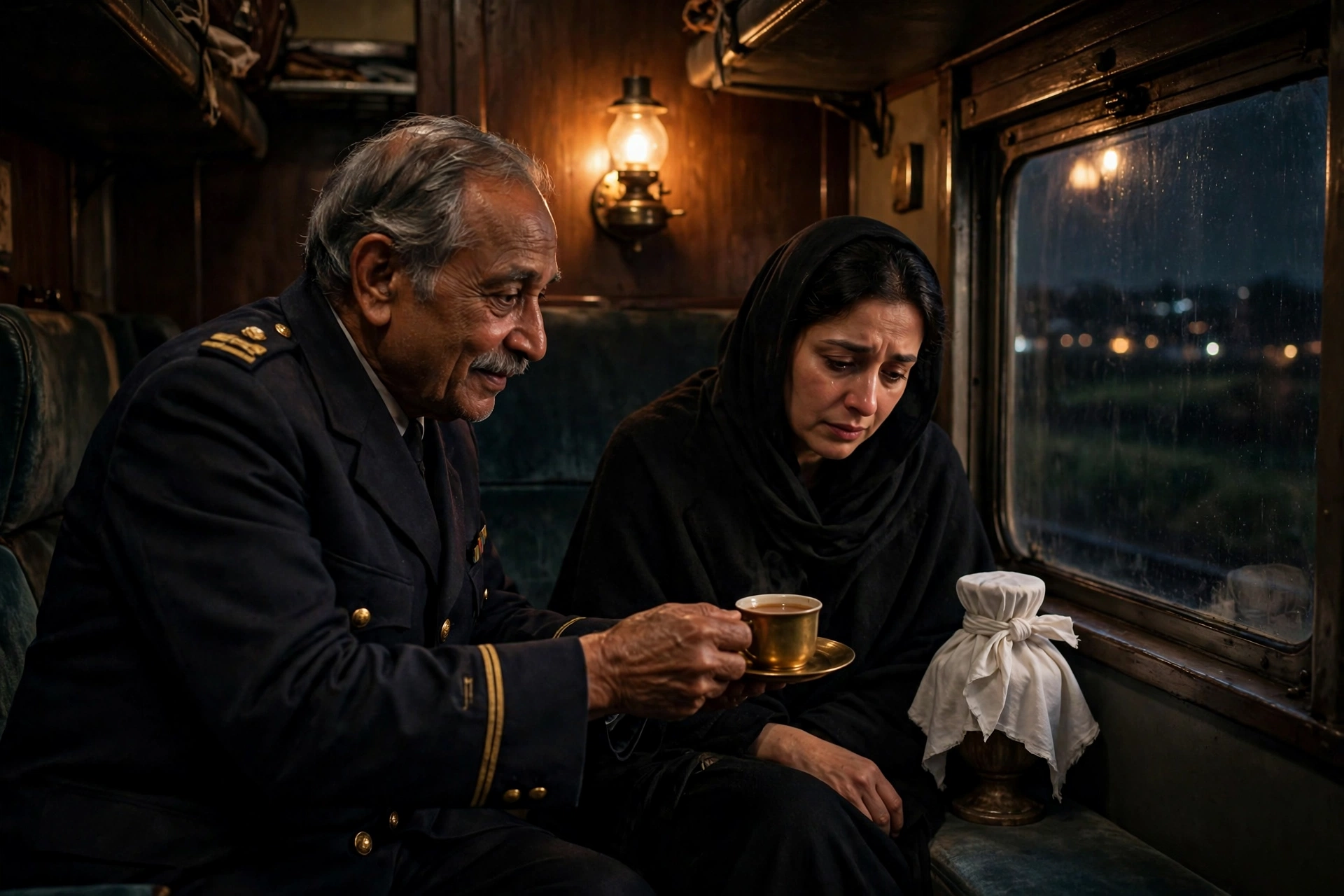
Further down the train, in a dim compartment near the middle, sat a woman in black. She was not crying loudly. She was crying the way people cry when they have been crying for a long time and have run out of noise — silently, with tears sliding down her face while she stared out at the dark fields rushing past. A small brass urn sat on the seat beside her, wrapped carefully in a white cloth.
Rahim stopped at her door. He had learned long ago that grief does not want questions. It wants company. So he did not ask where she was going. He simply fetched a blanket from the conductor's cabin, draped it over her shoulders, and sat down across from her for a little while, saying nothing at all. After a long silence, she spoke.
"My husband," she said. "Forty years we were married. He always said he wanted his ashes scattered in the river near his village. I am taking him home."
Rahim nodded. "Then you are doing a brave thing," he said softly. "And he is lucky. Not everyone is carried home with such love."
She looked at him then, really looked at him, and managed the smallest, saddest smile. "You are kind," she said. "In all my life, I have never met a conductor like you."
"I am just doing my rounds," Rahim said, but his eyes shone. Before he left, he poured her a cup of tea from his own flask, and he stayed until she had drunk half of it and her hands had stopped trembling.
As the train rolled on through the night, Rahim did what he had always done. He helped an old farmer lift his heavy bundle onto the rack. He found a lost shoe for a sleepy child and tucked it beside her berth. He woke a student gently at his station instead of letting him sleep past it, the way a lesser man might have. He checked on the boy twice more, and each time the boy was sitting up a little straighter, wrapped in Rahim's spare shawl. He checked on the woman in black once more, and found her asleep at last, the blanket still around her shoulders, her hand resting near the urn as if she were holding her husband's hand one final time.
Somewhere past midnight, the young porter found Rahim standing between two carriages, watching the moonlight run along the fields. "Uncle, why do you do all this?" the porter asked. "The other conductors just check tickets and sleep."
Rahim thought for a moment, watching the dark shapes of trees fly past. "When I was young," he said, "an old conductor did the same for me. I was travelling home after my father died, and I had no money for food. That man shared his dinner with me and sat with me until I stopped shaking. I never saw him again. I never even learned his name. But I promised myself that if I ever wore this uniform, I would be that man for someone else." He smiled at the porter. "Kindness is the only thing on this train that does not need a ticket. And it is the only thing that arrives before you do."
Dawn came slowly, the way it always does on a night train, in thin lines of gold at the edges of the sky. The boy woke to find Rahim standing at his compartment door, holding a paper cup of hot milk. "We reach the junction in an hour," Rahim said. "From there, we will call your father, and then your grandmother, and we will sort this out together. And you will write to me, yes? I want to know how you are doing."
"I will," the boy said fiercely, clutching the cup with both hands. "I promise, Uncle. When I grow up, I want to be like you."
The woman in black woke too, and when the train slowed at her small riverside station, Rahim carried her bag to the door himself and helped her down the steps. On the platform, she turned and pressed something into his hand: a small, smooth river stone, white as bone. "My husband collected stones from that river," she said. "Keep it. So you remember that you carried us home."
Rahim closed his fingers around the stone, and for the first time that night, he could not hold back his tears.
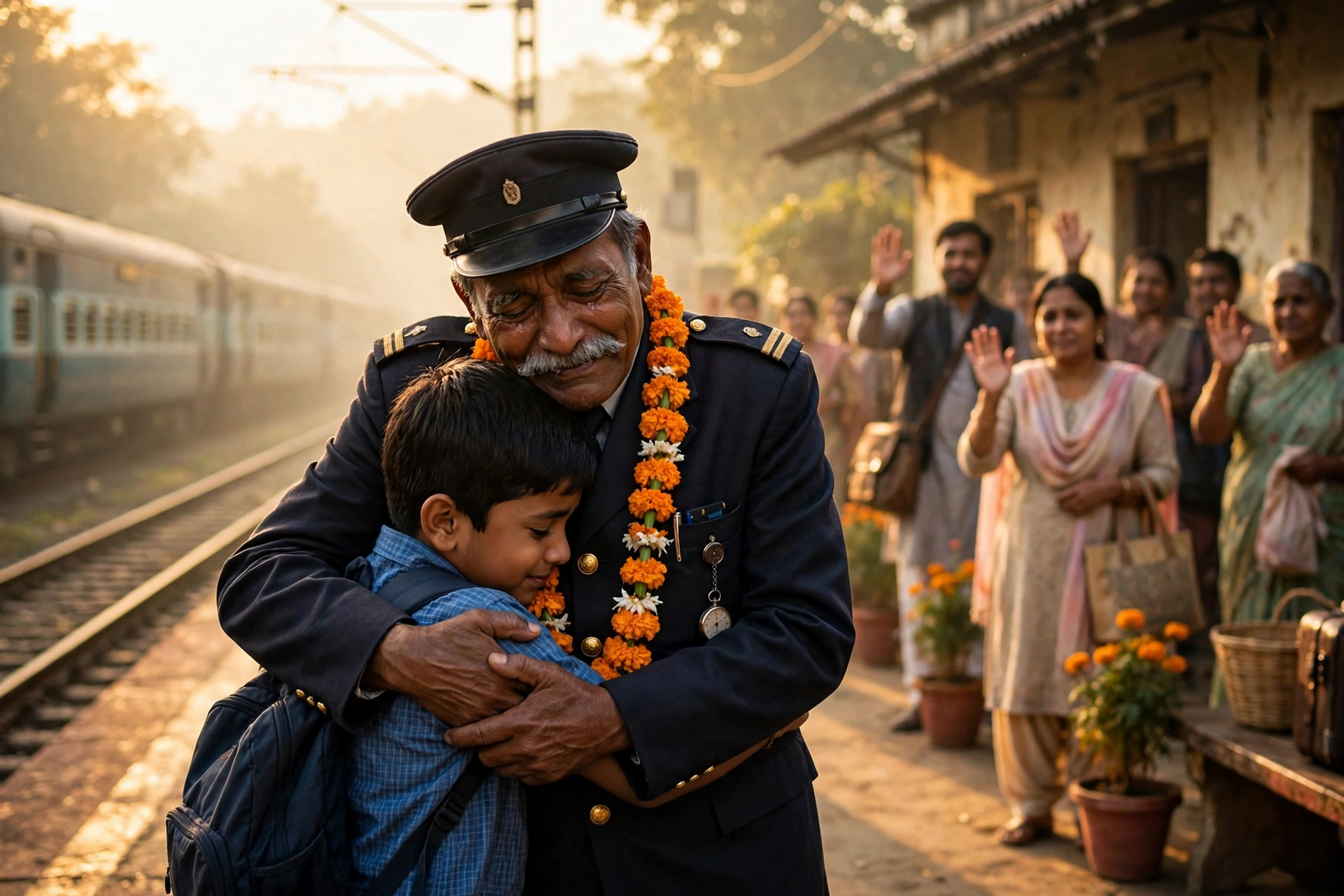
The train reached its final station as the sun came fully up, washing the platform in warm light. Rahim expected to step off quietly, the way he had stepped off a thousand times before. But the platform was full of people. The porter was there. The stationmaster was there, holding a garland. And there, standing in a shy row near the gate, were faces Rahim half-recognised from a hundred different nights: the student he had woken at his station years ago, now a teacher; the farmer whose bundle he had lifted; a woman holding a little girl's hand who said, "You found my daughter's shoe once, on the night train, do you remember? She never forgot you."
And then the boy ran forward, still wrapped in Rahim's shawl, and hugged him hard around the waist. "Thank you, Uncle," he whispered. "I will never forget this train."
Rahim stood there with the garland around his neck, the river stone in his pocket, and the boy's arms around him, and he finally understood something he had never quite put into words in forty years. A train carries people from one place to another. But a conductor — a real conductor — carries something else entirely. He carries the tired, the frightened, the grieving, and the lost, and he sets them down a little lighter than he found them. The train would run tomorrow without him. The tracks would still shine, the whistle would still blow. But the kindness he had left behind in a thousand dark compartments would keep travelling long after his last journey ended, passed from one stranger to another, like a ticket that never expires.
He took off his cap, held it to his chest, and waved at the train one last time as it pulled away into the morning light — not with sadness, but with gratitude. Because some journeys do not end at a station. They go on, quietly, in the hearts of everyone they touched along the way.