The first time Rafiq saw the boy, the boy was watching other children run, the way a person watches a country he will never be allowed to visit. It was late afternoon in Scrap Lane, and the light was turning the colour of honey. A group of boys was chasing a football down the dusty street, shouting and laughing, their sandals slapping against the stones. At the edge of the lane, sitting on a low wall with his thin legs tucked beneath him, was a boy of about ten. He did not shout. He did not wave. He simply watched, his chin resting on his knees, as if he were memorising the sound of running feet so he could keep it for later.
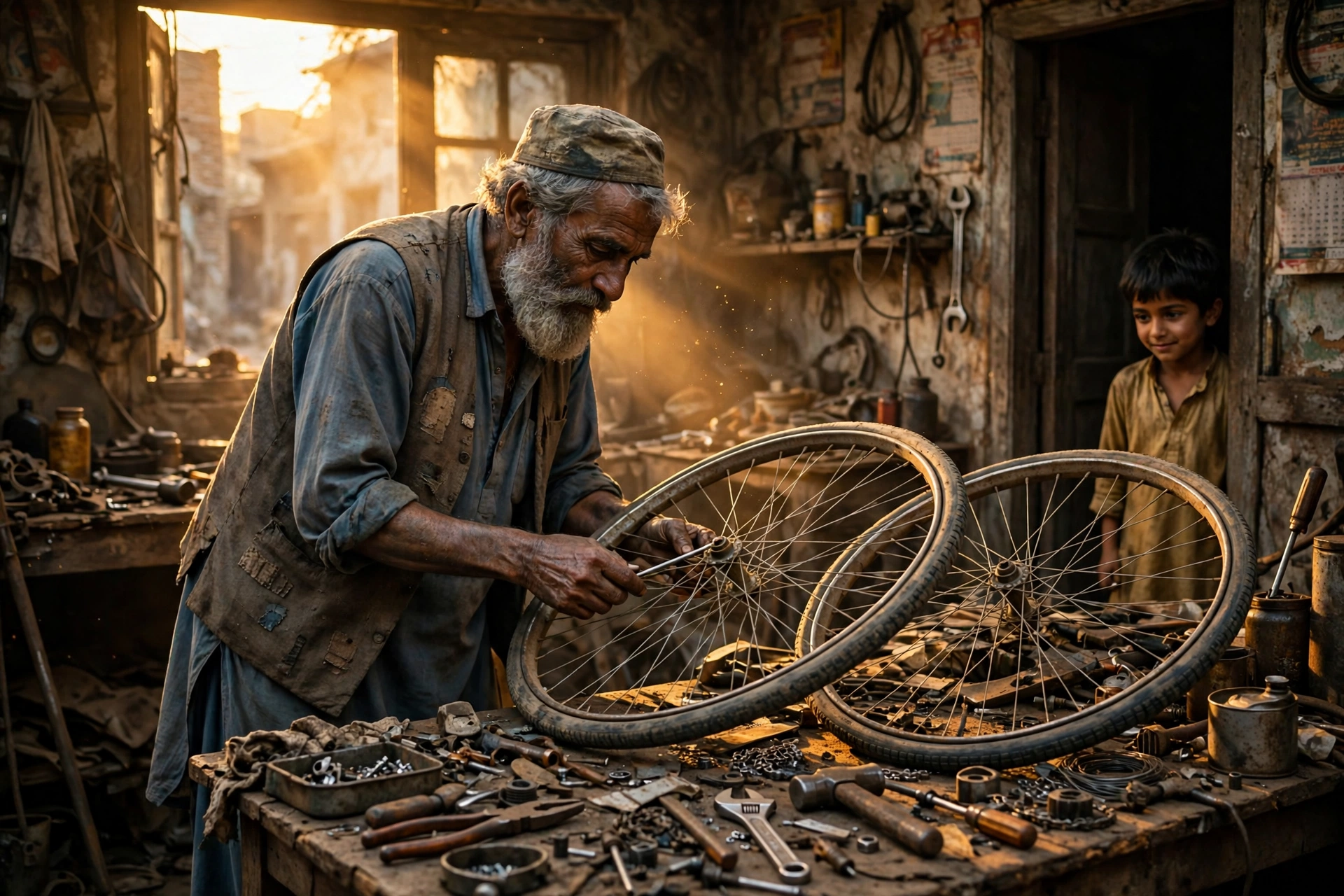
Rafiq had been a bus mechanic for forty years. He knew the sound of an engine that was about to give up, and the sound of a brake that needed mercy. He knew how to coax life out of machines that other men had already written off. But since his retirement, his small workshop at the end of Scrap Lane had grown quiet. His wife had died two years earlier, his daughter had married and moved to another city, and the workshop, once full of buses and drivers and arguments and tea, was now full of things nobody wanted: bent bicycle frames, rusted wheels, a broken office chair, springs, bolts, and lengths of pipe that he could not bring himself to throw away. He kept them, he told himself, because they might be useful one day.
That evening, when the game broke up, the boy stayed where he was until his older brother came, lifted him gently onto his back, and carried him down the lane. Rafiq, who was sweeping the front of his workshop, stopped sweeping and watched them go. The boy looked back over his brother's shoulder and met Rafiq's eyes for a single second. He did not smile. He looked, Rafiq thought, like a child who had already learned not to ask for things.
The next day, Rafiq asked the tea seller who the boy was. His name was Hamza, the tea seller said — ten years old, whose legs had never grown strong enough to carry him. His father had died when he was small, and his mother stitched clothes for neighbours to keep the family fed. Every morning, his brother carried him to school, and every evening, his brother carried him home. At school, Hamza sat at the side of the playground, and he was, by all accounts, the cleverest boy in his class.
Rafiq went back to his workshop and sat for a long time among his piles of scrap, saying nothing. He looked at the two bicycle wheels leaning against the wall, and at the broken office chair with its torn seat, and at the strong, straight lengths of pipe. He believed in spanners, in measuring twice, and in a bolt that finally turns. That night, after his evening meal, he lit the lamp in his workshop and did not go home. He worked until his back ached and his hands were black with grease, cutting and fitting and welding, and when he finally locked the door, something was standing in the middle of the floor that had not been there before: a low, sturdy chair on two big bicycle wheels, with small front wheels that could turn in any direction, and a footrest made from a piece of smooth, sanded wood.
It was not beautiful — mismatched paint, a patched seat, one squeaking wheel. But when Rafiq pushed it across the floor, it rolled straight and true, turned in a neat circle, and did not wobble. He stood looking at it, hands on his hips, feeling a quiet pride he had not felt since his wife was alive.
The next morning, he wheeled the chair down Scrap Lane to Hamza's house and knocked on the door. Hamza's mother opened it, wiping her hands on her apron, and stared at the chair. Then she stared at Rafiq. "I cannot pay for this," she said at once, her voice tight with the pride of a woman who has never once asked for charity. "We have nothing to spare."
"It is not for sale," Rafiq said. "And it is not charity either. It is made from things nobody wanted. If you call it charity, you will have to call the scrapyard charitable too." He looked past her to where Hamza was sitting on a mat, his schoolbooks spread around him. "Let the boy try it," he said. "If it does not suit him, I will take it back, and no harm done."
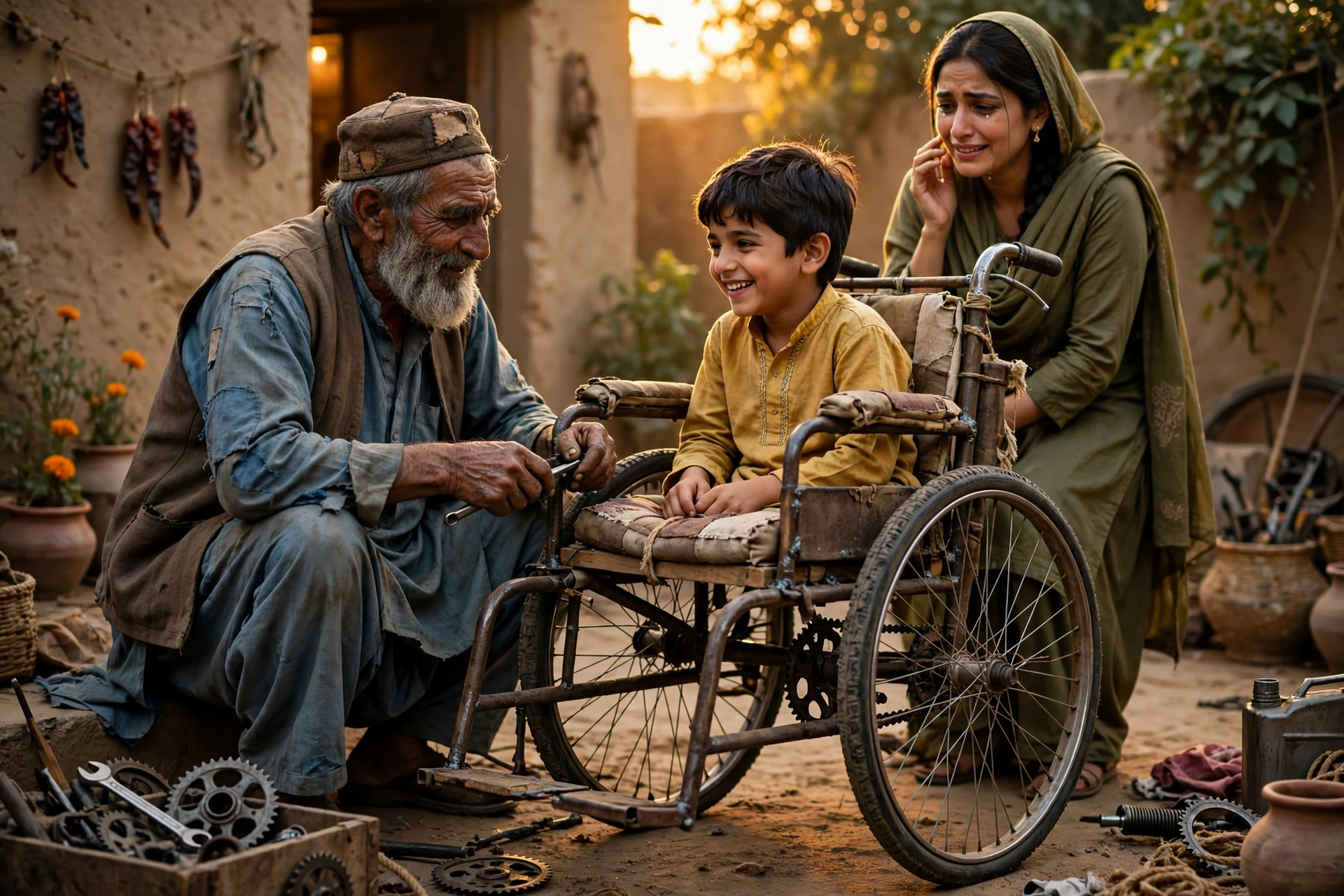
Hamza came to the door slowly, dragging himself forward on his hands, and Rafiq lifted him gently into the seat. For a moment, Hamza simply sat there, his hands gripping the wheels. Then he pushed, tentatively, and the chair moved forward. He pushed again, harder, and it rolled out into the lane. He turned it in a circle, then another, faster, and then he laughed — a loud, surprised laugh that seemed to startle even him. His mother put her hand over her mouth, tears in her eyes, and Rafiq pretended to adjust a bolt so nobody would see his own.
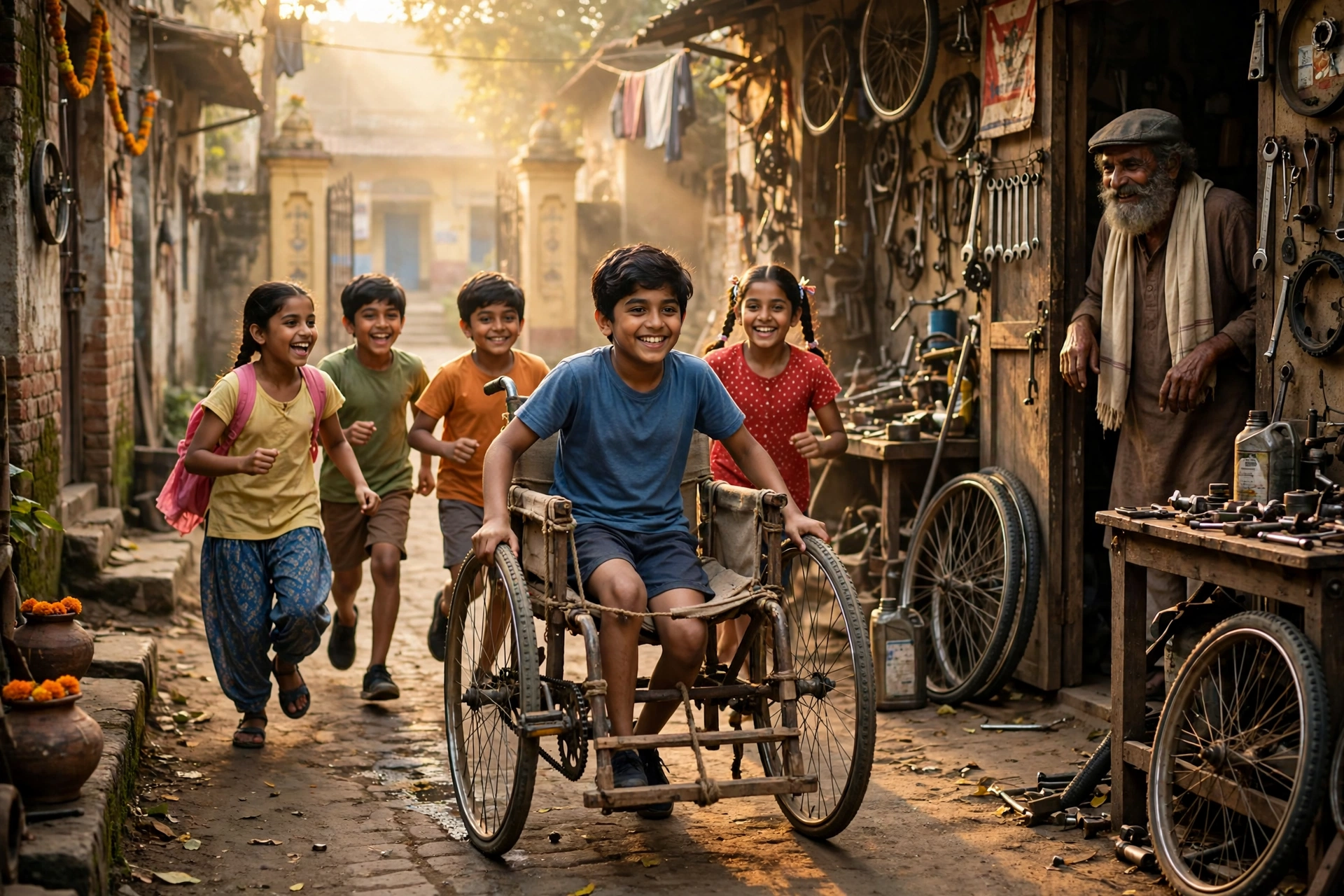
That was the first day Hamza went to school by himself. He rolled down Scrap Lane in the morning light, his schoolbag on his lap, his brother walking beside him at first and then, at Hamza's insistence, falling behind. The children at the school gate stared. Some of them whispered. One boy, braver than the rest, ran up and asked if the chair was fast. Hamza grinned and said, "Race me and find out." By the end of the week, the race to the school gate had become a daily event, and Hamza, who had never run in his life, was beating boys who had two strong legs and no excuses. But Hamza was clever, too. Within a month, he was bringing Rafiq careful drawings of a better chair: a higher back for a girl who tired easily, a stronger brake for the steep hill near the school, a little basket for books. "If the wheel is bigger here," he would say, pointing with his pencil, "it will go over stones more easily." Rafiq studied the drawings as he had once studied engine diagrams, and together they built the next chair, and then the next.
Word travelled the way it always does in a neighbourhood where everyone knows everyone else's business. A mother came to the workshop with a daughter who had lost the use of one leg after a fever. Then a father came with a son who had been injured in an accident and could no longer walk to school. Rafiq built a chair for each of them and charged nothing, because the chairs were made from scrap and his time, he said, was his own to give. But he did ask one thing of every family: that they bring something to the workshop in return — not money, but whatever they had. One family brought a pot of stew. Another brought a bag of old bicycle parts. Hamza's mother, who could not bear to receive without giving, mended Rafiq's torn shirts and stitched a new cushion for his own chair. Slowly, the workshop stopped being a place of broken things. It became a place where people arrived with problems and left with something that rolled.
There were seven chairs by the end of that summer, and seven children who no longer waited at the edge of things. On warm evenings, they raced down Scrap Lane while their parents watched from doorways, and Rafiq sat outside the workshop drinking tea, pretending not to be proud. He had spent forty years repairing buses that carried strangers. Now he was building chairs for children he knew by name, and it felt like the most important work he had ever done.
Then, in the autumn, the trouble came.
The scrapyard where Rafiq bought his parts for almost nothing was sold to a builder who wanted shops there. The workshop, which Rafiq rented cheaply, was part of the same plot, and the new owner gave him one month to leave. Rafiq read the notice twice and folded it into his pocket. He did not tell anyone at first. He was sixty-eight, and his hands had begun to tremble when he was tired. He told himself that seven chairs were a fine thing to have made, and that he could go home and rest, and nobody would blame him.
But Hamza noticed. Children notice everything, especially when an old man who used to whistle while he worked has gone quiet. One evening, Hamza rolled into the workshop and found Rafiq sitting among his tools, not working at all. "What is wrong?" Hamza asked, and would not accept a brush-off until Rafiq showed him the notice.
Hamza was quiet for a long time. Then he said, "We will not let them close this place," like a boy who has only just discovered that he has a voice and intends to use it.
What happened next, Rafiq would say for years afterwards, was the most extraordinary thing he had ever seen. Hamza went to his teacher, the teacher went to the parents, and the parents went to the neighbours. The seven children wrote letters, in their best handwriting, to the new owner, explaining what the workshop was and why it mattered. Their parents collected signatures. The school offered an empty storeroom behind the playground, rent-free. The tea seller organised a collection, and people gave what they could — money, tools, bolts, a promise of help on a Saturday. Even the builder, when he read the children's letters, came to the workshop himself, looked at the chairs lined up against the wall, and said, gruffly, that he would give them two months instead of one, and donate the scrap from his building site for a year.
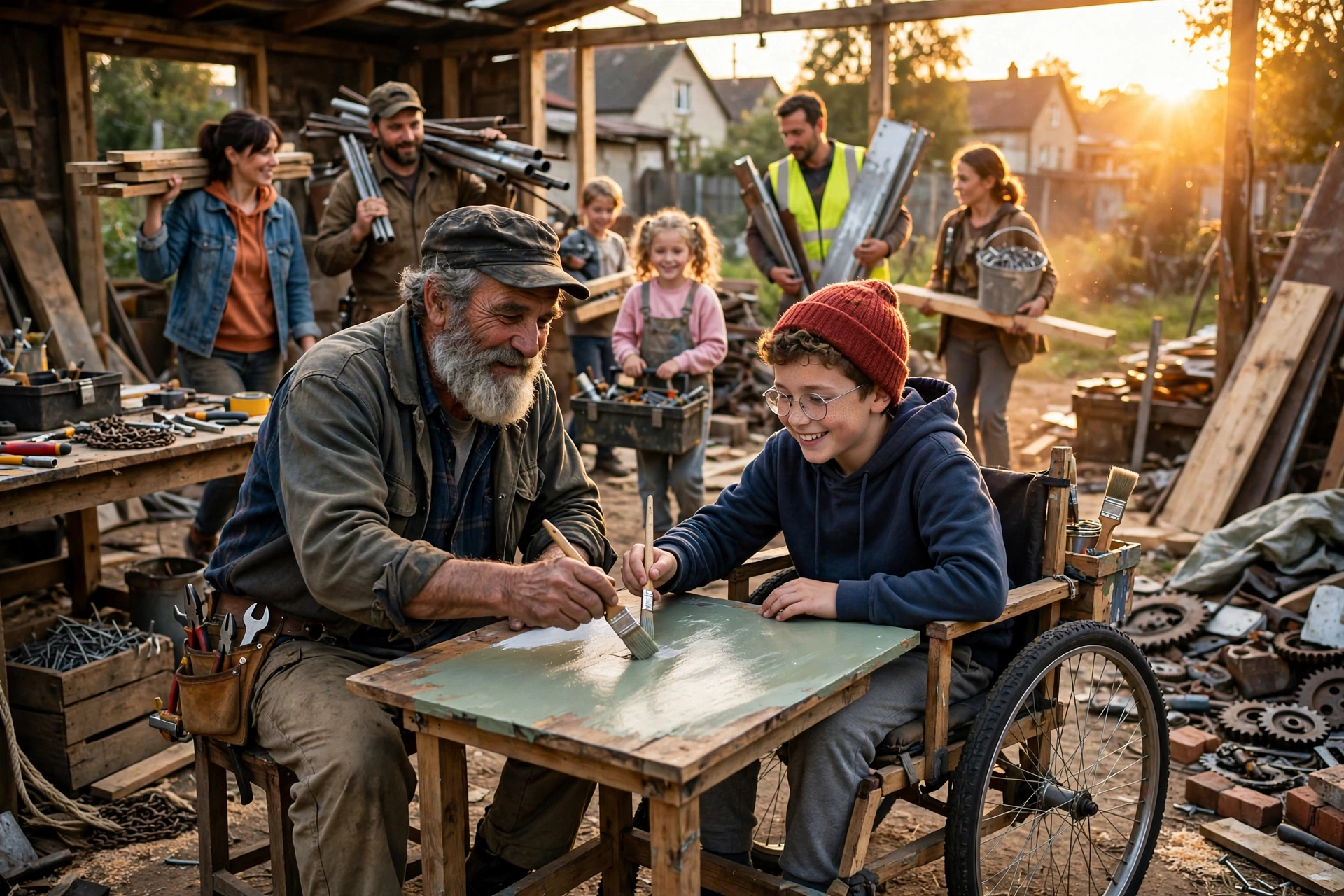
On the last Saturday in the old workshop, the whole lane turned out to help move it. Men carried workbenches, women carried boxes of parts, and the seven children rolled back and forth ferrying tools and shouting directions like foremen. Hamza, in the chair Rafiq had built first, led the little procession down Scrap Lane, and Rafiq walked beside him, his hand resting lightly on the back of the chair.
The new workshop behind the school was smaller and smelled of chalk dust instead of grease. But within a week, it was full again — of wheels and frames and children and drawings and tea. And on the wall, in Hamza's careful handwriting, someone had painted a sign: "The Wheelchair Workshop. Everything here is made from what others threw away. Everyone here is welcome."
Rafiq is an old man now, and his hands tremble more than they used to. But he still comes to the workshop every morning, and Hamza still comes after school, taller now, with new drawings, and together they build chairs for children they have never met, from parts that nobody wanted. On warm evenings, if you walk down Scrap Lane, you may still hear the rattle of wheels on stones, and the laughter of children racing to the corner and back, and the voice of an old mechanic calling out, "Slower on the turn, or you will wear out the brake!"
And if you ask Rafiq what he has learned from a lifetime of fixing broken things, he will wipe his hands on a rag, look at the chairs lined up against the wall, and say, "A thing is not worthless because it is broken. A person is not worthless because he cannot walk. Give a child a way to move, and you give him a way to belong. That is not charity. That is simply what neighbours are for."