Every morning before the sun had finished climbing out of the sea, Sami was already on the shore with his father's old sack over his shoulder.
The town of Maris Bay woke slowly. Shutters rattled open, fishermen pushed their boats toward the water, and the smell of fresh bread drifted down from the bakery on the hill. But Sami was always there first, barefoot in the cool sand, picking up what the tide had left behind: plastic bottles, tangled rope, broken crates, and pieces of net that could strangle a turtle if nobody bothered to remove them.
He had not always done this. A year ago, he had been an ordinary schoolboy who loved football and hated early mornings. Then came the winter storm that took his father's boat, and with it, his father. The sea gave back the boat's broken rudder and nothing else. After that, Sami could not look at the shore without feeling angry, and he could not stay away from it either.
So he made a quiet bargain with himself. He would come every morning, and he would clean. Not because cleaning would bring his father back — he was old enough to know it would not — but because doing nothing felt worse. His mother worked long hours at the fish market, and his younger sister needed schoolbooks, so Sami worked afternoons at the boatyard. But the mornings belonged to the shore.
People noticed, the way people in small towns always notice. At first they thought it was a school punishment, or that he was collecting bottles to sell. Old Uncle Rahim, who had fished beside Sami's father for thirty years, watched him for a week from the harbour wall before he said a word.
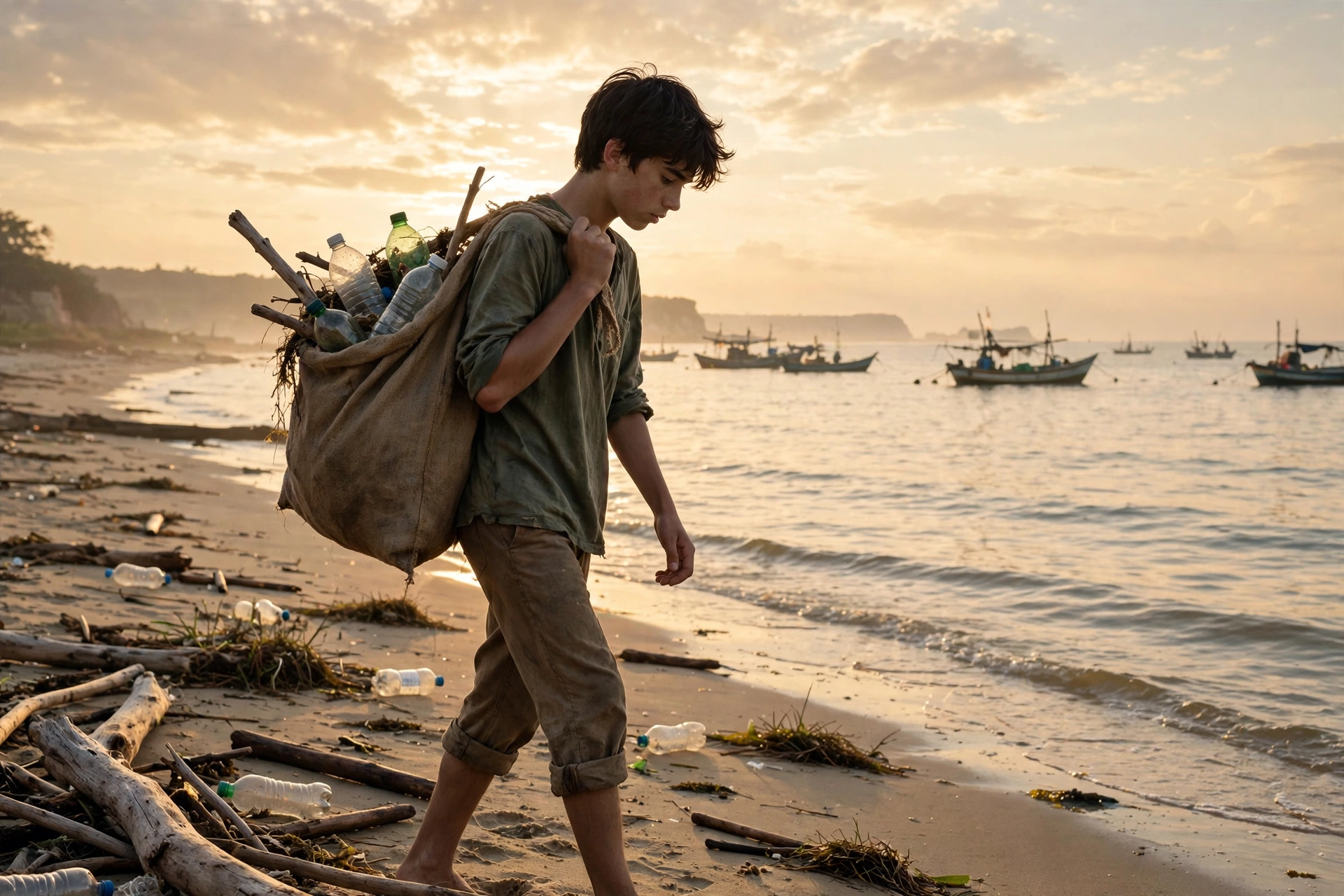
"You'll never finish it, boy," Rahim said one morning, his voice rough as driftwood. "The sea brings more every night than you can carry away in a day."
"I know," Sami said, without stopping. "But today's part will be clean."
Rahim stared at him for a long moment, then nodded slowly, as if Sami had said something worth remembering. From then on, Rahim always left a flask of hot tea on the harbour wall for him, and never made a fuss about it.
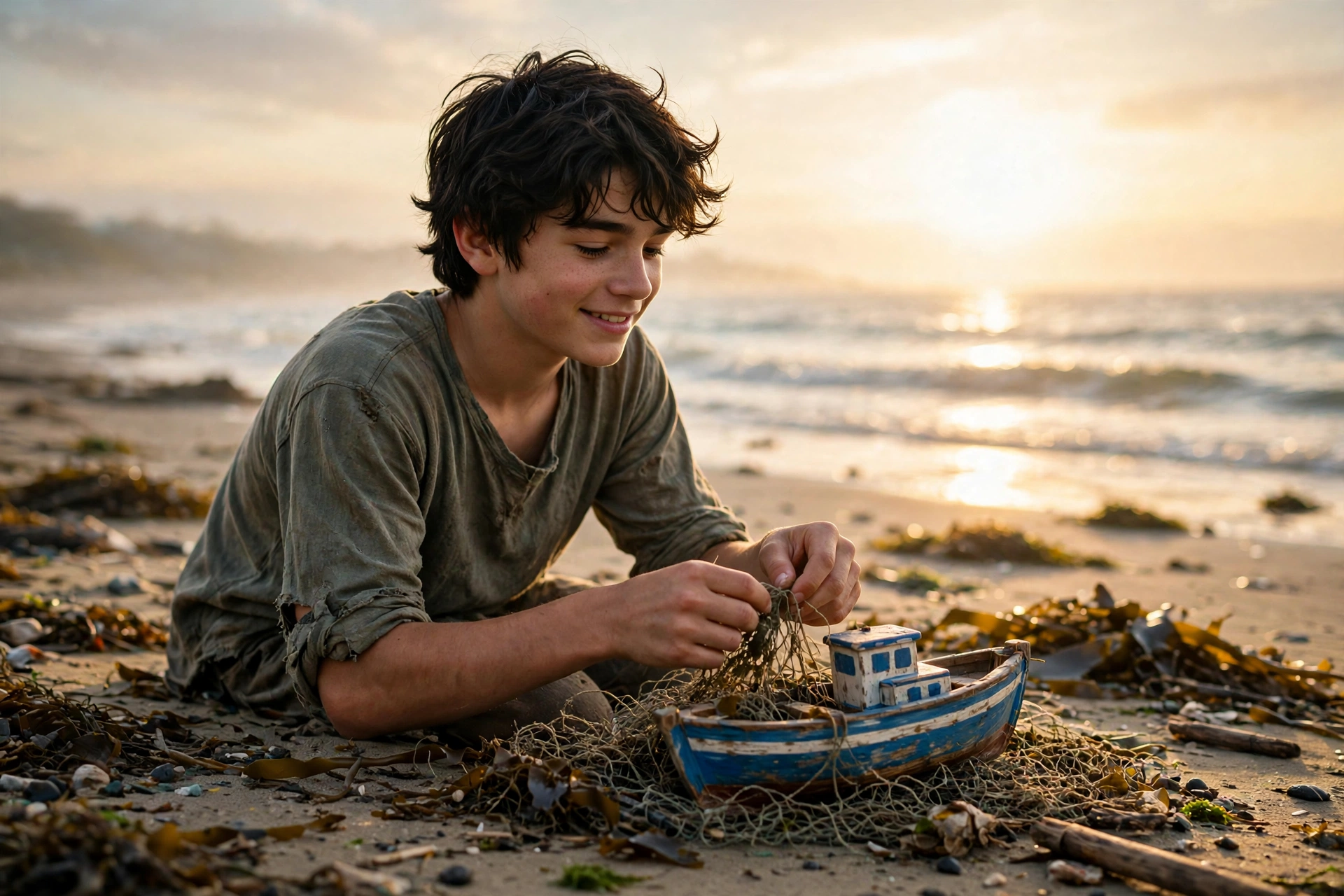
The morning that changed everything began like all the others. The sky was pale gold, the waves were gentle, and gulls circled above the fishing boats. Sami was working his way along the rocks at the far end of the beach when he saw something caught in a knot of old net and seaweed: a small wooden boat, no longer than his hand, painted blue and white. Its little mast was broken, and one side was scratched, but someone had clearly made it with great care. On its stern, in faded paint, was a single word: Meera.
Sami sat down right there in the sand and carefully worked the net free, strand by strand, the way his father had once taught him to untangle a fishing line without breaking it. The little boat felt warm from the sun. It was not valuable. It would not feed anyone. But whoever had lost it had loved it, and Sami knew what it was to lose something you loved to the sea.
That evening, instead of going straight home, he carried the boat to the boatyard and set it on his workbench. He washed away the salt, glued the mast back into place, sanded the scratched side smooth, and repainted the blue and white stripes with paint left over from a real fishing boat. He worked slowly, the way his father had worked, humming an old sea song under his breath without realising it. When he finished, the little boat looked almost new — except for the name on the stern, which he touched up carefully, letter by letter, so it would not be lost again.
For days he asked around the town. He asked at the bakery, at the school gate, at the fish market where his mother worked. Did anyone know a Meera who had lost a toy boat? Most people shook their heads. A few said the name sounded familiar but could not place it. Sami began to wonder if Meera had been a visitor, long gone, or a child who had grown up and forgotten. He kept the boat on his windowsill anyway, where the morning light caught its blue paint, and every day he looked at it and felt a small, stubborn hope he could not quite explain.
Then, on a Saturday, a little girl came to the shore with her mother. She was about seven, in a red dress, with her hair tied back in two plaits, and she was searching the sand with the serious concentration only a child can give to a lost thing. Sami watched her for a while, then walked over, his heart beating a little faster than usual.
"Are you looking for something?" he asked gently.
She nodded, her eyes fixed on the sand. "A boat," she said. "A little blue boat. My grandfather made it for me before he went away. The waves took it in the big storm, and I never found it again."
Sami felt something tighten in his chest. "What is your name?" he asked, though he already knew the answer.
"Meera," she said.
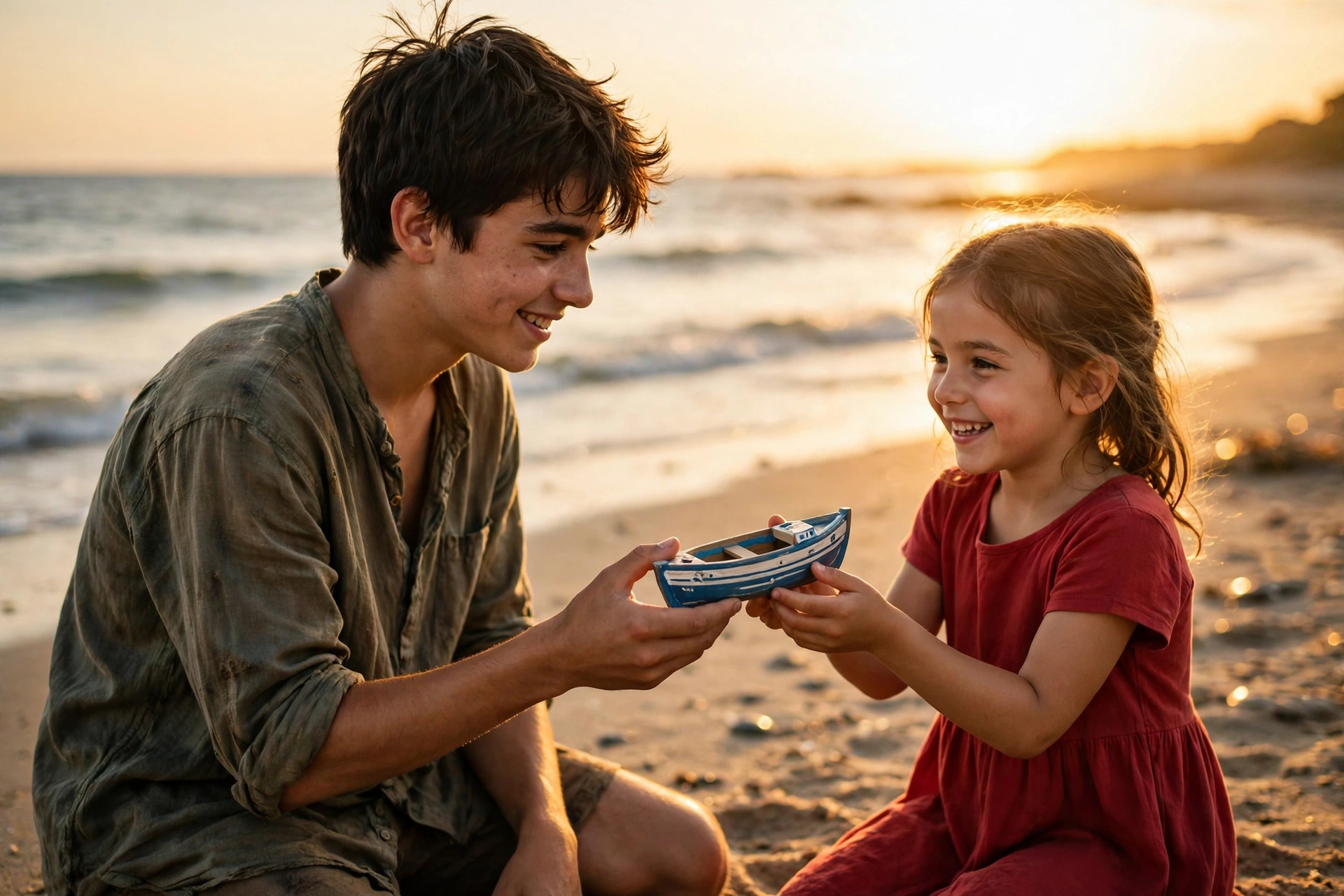
He went home and fetched the little boat, wrapped in an old cloth, and brought it back to the shore. When he unwrapped it and held it out, Meera stared at it for a long moment without speaking. Then her whole face lit up like the sun breaking through cloud, and she threw her arms around it — and then, to Sami's surprise, around him too.
"It is my boat," she whispered, turning it over in her hands. "Grandfather painted the blue himself. See? He let me paint the white stripe, and it is a bit wobbly, just like I left it."
Her mother stood nearby with tears in her eyes. She explained that Meera's grandfather had died the previous winter, and that the little boat was the last thing he had made with his own hands. The family had searched the beach for weeks after the storm, and Meera had cried herself to sleep more than once. "She stopped talking about him for a while," her mother said softly. "I think she was afraid that if she stopped looking, she would forget him."
Sami understood that feeling better than anyone. He had stopped saying his father's name out loud for months, as if silence could protect him from the pain. Looking at Meera cradling her grandfather's boat, he realised something he had not allowed himself to believe: remembering someone does not have to hurt in the same way forever. Sometimes remembering can feel like holding a small, painted boat in your hands — worn, repaired, and still afloat.
Meera did not let go of Sami's hand for the rest of that afternoon. She showed him where she used to sail the boat in the rock pools, and told him about her grandfather's laugh, and about how he used to say that a boat is only lost if nobody goes looking for it. Sami told her about his father, for the first time in a long while, and about the mornings on the shore. Meera listened with her whole heart, the way children do, and then she said something very simple.
"Then I will help you clean," she said. "Tomorrow morning. I can carry the small bottles."
Sami laughed — a real laugh, the kind he had not heard from himself in a year — and agreed.
The next morning, Meera arrived at dawn with her mother, carrying a small bucket. The morning after that, two of her school friends came too, with their own buckets. By the end of the week, a dozen children were combing the sand beside Sami, racing to see who could fill a bucket first, and Uncle Rahim was there as well, hauling a heavy sack and pretending he had only come to check on the tide. The week after that, the children's parents came. Then the fishermen, before they set out. Then the shopkeepers, the teacher from the school, and even the baker, who brought warm bread for everyone when the work was done.
Nobody made a speech about it. Nobody put up a sign or took charge. People simply started arriving at dawn, because a boy who had lost his father and a little girl who had lost her grandfather's boat had shown them that the shore belonged to everyone, and that caring for it was a way of caring for each other. Within a month, the beach at Maris Bay looked different. The sand was clean enough for children to run barefoot without their mothers worrying. The fishermen found fewer nets tangled in their propellers. And in the evenings, families sat on the clean sand to watch the sunset, the way they had when Sami and Meera were small.
One golden morning, Uncle Rahim did something Sami had not expected. He walked up to the harbour wall, looked at the clean shore, and then looked at Sami.
"Your father would be proud of you, boy," he said quietly. "Not because you cleaned a beach. Because you did not let the sea make you bitter. You took what it gave you and you made something good out of it."
Sami stood there with his sack over his shoulder, the sun warm on his face, and felt the grief that had sat like a stone in his chest for a year shift, just a little, into something softer. It had not gone away. He knew it never fully would. But it no longer felt like a weight he carried alone. It felt like a story he could tell, a morning he could share, and a shore he could keep clean — one day, one tide, one small act at a time.
That afternoon, Sami and Meera sailed her little blue boat in the rock pools, and it floated perfectly, its wobbly white stripe catching the light. Around them, the beach was full of people, and the sea, for once, seemed to be giving back more than it took. Sami thought about his father's old saying, the one he had almost forgotten: the sea remembers everyone who treats it with respect. And as he watched the little boat bob on the clear water, he finally understood what his father had meant. You cannot control the storms. You cannot bring back what the waves have taken. But you can show up, every morning, with an open heart and a willing pair of hands — and that is enough to change a shore, a town, and, in time, yourself.
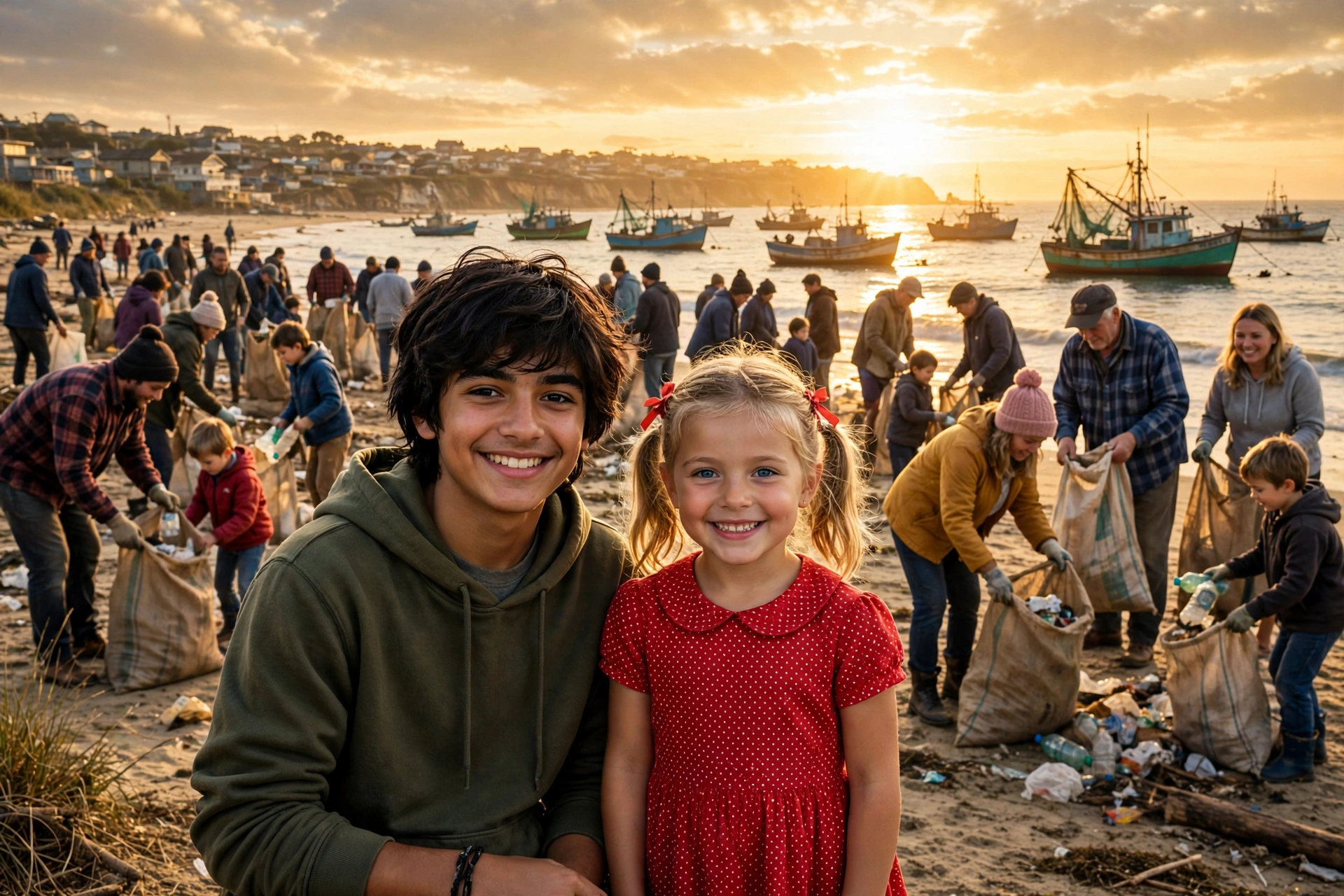
Months later, when visitors asked the people of Maris Bay how their beach had become the cleanest on the coast, nobody told them about a grand plan or a government project. They told them about a boy with a sack, a little girl with a red dress, and a small painted boat that the sea had tried to keep — and that kindness had brought home.