The siren was still screaming when Bilal saw the old woman standing barefoot on the pavement, clutching a shawl around her shoulders and staring up at the third floor as if she could pull the whole building down with her eyes alone.
It was just past midnight on Rose Lane, and the old apartment block was burning. Smoke poured from the broken windows, and the orange light of the flames painted the faces of the crowd gathered in their nightclothes. Firefighters moved fast, shouting to each other, unrolling hoses, pushing people back. Bilal had been a firefighter for six years, long enough to know the smell of a fire that had made up its mind. This one had. The stairwell was filling with smoke, the wooden floors were groaning, and the captain had given the order everyone dreads hearing: get the people out, and then get out yourselves.
They had done it. Floor by floor, door by door, the residents were out — a family with two small children wrapped in blankets, a young couple coughing into their sleeves, a man in a wheelchair carried down three flights of stairs by two of Bilal's crewmates. Bilal was already on his way out himself, his breathing loud inside his mask, when he heard it. So faint that at first he thought he had imagined it. A sound thinner than a cry, smaller than a whisper, coming from behind the door of flat number nine.
He stopped. The corridor was thick with smoke, and the heat pressed against his suit like a hand. His training said to keep moving. His captain's voice crackled in his ear, telling him the floor was clear and to come down now. But the sound came again — a tiny, frightened mew — and Bilal knew, the way you know some things without thinking, that he could not walk past it.
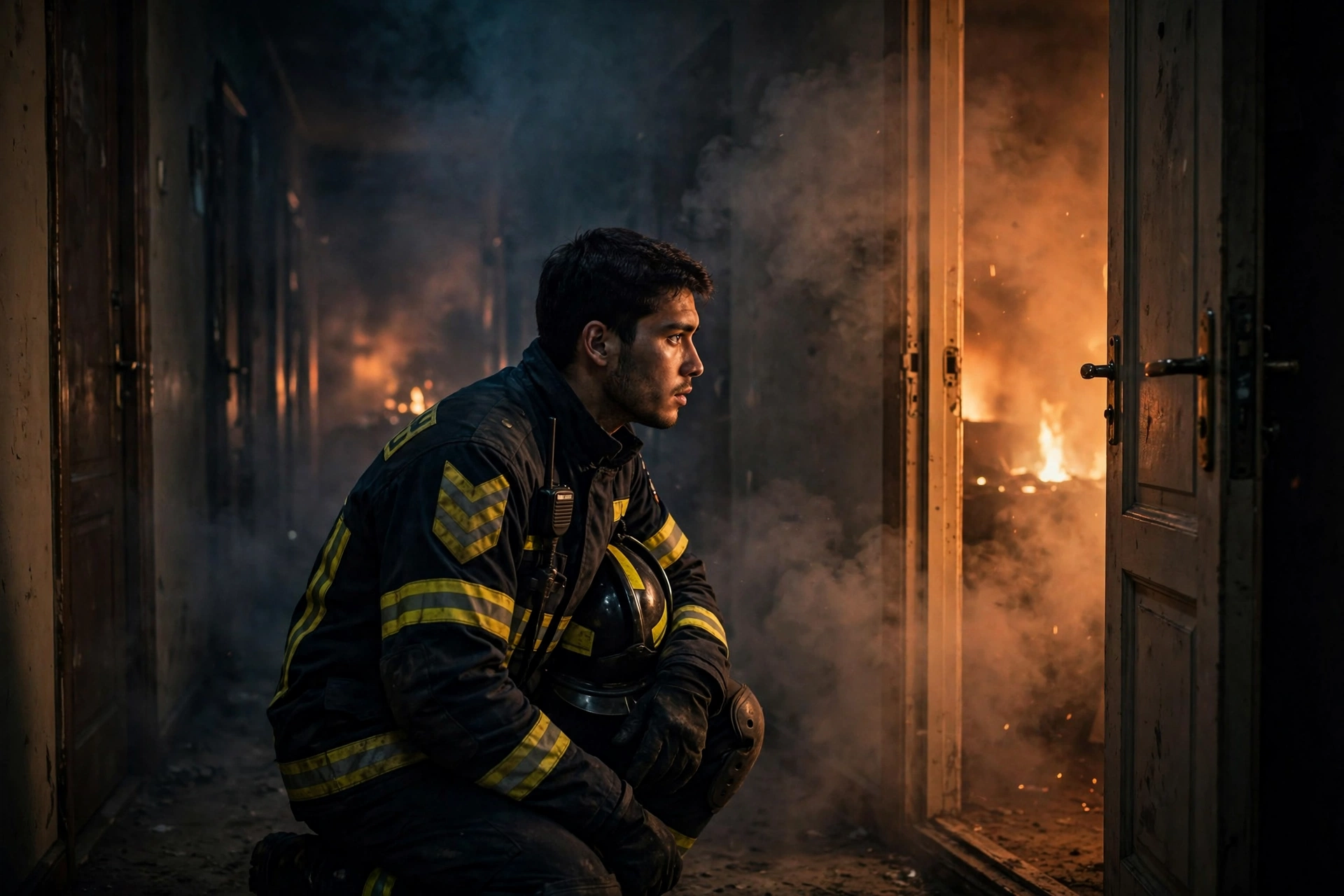
He pushed the door open. Inside, the flat was a small world turned upside down. A curtain had fallen, a photograph hung crooked on the wall, and under the bed in the corner, shaking so hard its whole body trembled, was a kitten no bigger than Bilal's hand. Grey fur, a white patch on its chest, eyes wide with terror. It had tried to hide from the fire in the darkest corner it could find, and the smoke had found it there anyway.
Bilal knelt down slowly, the way you would approach a frightened child. He did not grab. He waited, talking softly through his mask, though he knew the kitten could not understand a word. After a moment that felt much longer, the kitten stopped shaking quite so hard. Bilal slipped one gloved hand under its tiny body, tucked it gently inside his jacket, close against his chest where the air was cleanest, and turned for the stairs.
The way down was worse than the way up. The smoke was thicker now, and twice he had to stop and crouch low, where the air was still breathable, before going on. He could feel the kitten's heart hammering against his ribs, a frantic little drum, and he whispered to it without thinking, the way his mother used to whisper to him when he was small and afraid of thunderstorms. "Almost there," he said. "Just hold on. Almost there."
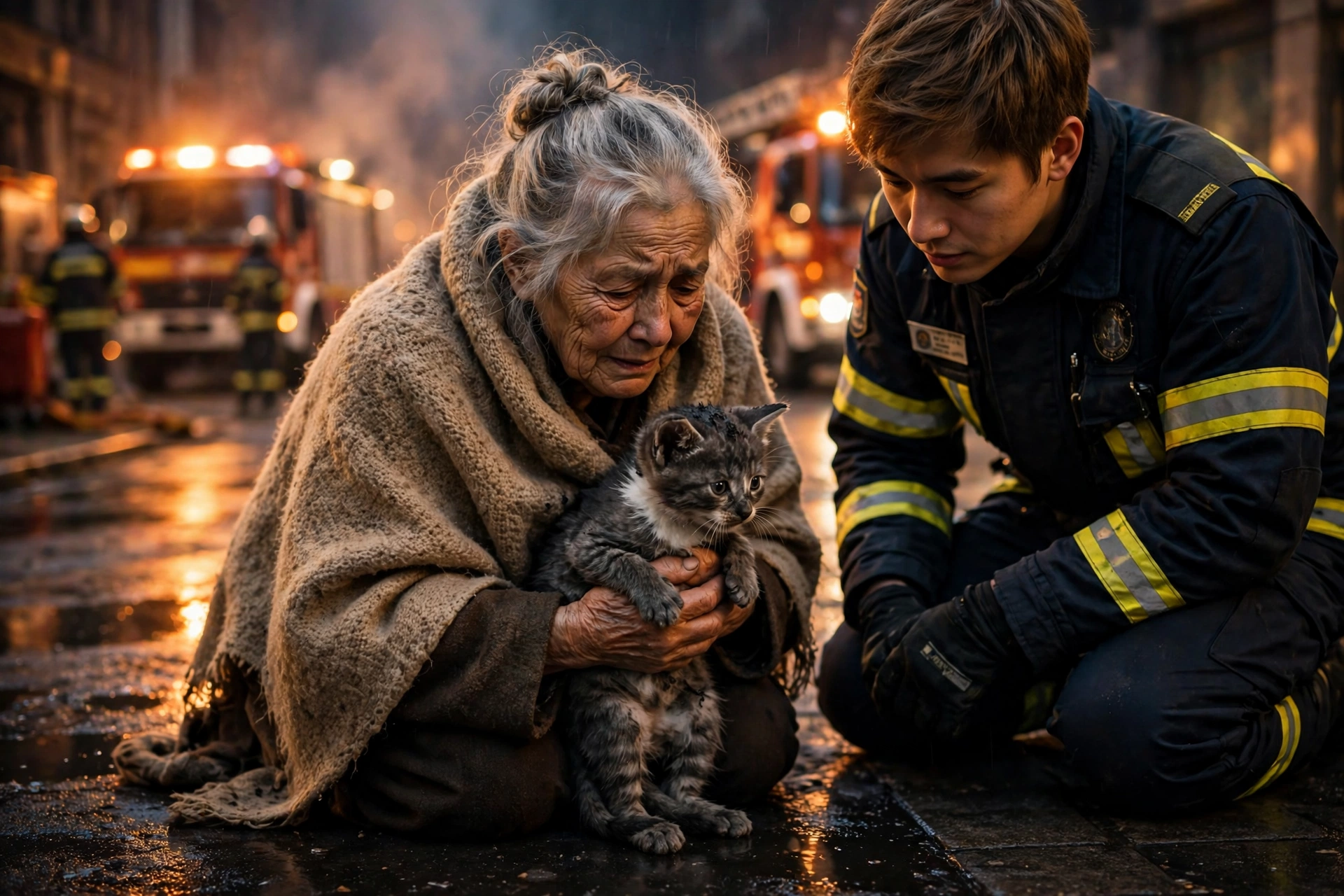
When he came out of the building, the crowd gasped. Someone shouted his name. His captain ran towards him, ready to scold him for going back in, and then stopped dead when Bilal opened his jacket and lifted out the kitten. It was covered in soot, its grey fur streaked black, its tiny nose twitching as it took its first clean breaths. A paramedic brought a small oxygen mask and held it gently over the kitten's face while Bilal knelt on the pavement, his own mask pushed up, his hands still shaking. The kitten coughed once, sneezed, and then, to everyone's amazement, began to purr — a thin, wobbly purr, like a tiny engine starting up again.
That was when the old woman from the pavement pushed through the crowd. Her name, Bilal would learn, was Zainab, and she was eighty-two years old. She had lived in flat number nine for more than forty years. Her husband had died a decade ago, her only son worked far away and could visit only once a year, and for three years, since a neighbour had found the kitten abandoned in a box behind the market, the little grey cat had been her whole world. She had named her Noor, which means light, because the kitten had come into her life in her darkest winter.
"My Noor," Zainab whispered, dropping to her knees beside Bilal, not caring about the wet pavement or the soot or the crowd watching. She took the kitten into her arms as carefully as if it were made of glass, and she wept — not the loud weeping of the fire, but the quiet, shaking weeping of someone who has lost almost everything and found the one thing that matters most still breathing. Bilal stayed kneeling beside her, and he did not know what to say, so he said nothing. He just stayed.
By morning, the fire was out, but flat number nine was gone. The roof had fallen in, and everything Zainab owned — her photographs, her husband's old letters, her kitchen pots, her winter blankets — was burned or soaked through. The council offered her a bed in a shelter across town, but Zainab refused to go. "Noor is afraid of strange places," she told the woman with the clipboard, holding the kitten tighter. "And I am afraid too."
Bilal went home that morning exhausted and could not sleep. He kept seeing Zainab's face on the pavement, and the kitten's tiny heart against his ribs. His mother had raised him alone after his father died, and she used to say, "Bilal, a life is a life. It does not matter if it is big or small. If it is in front of you and it needs you, you do not walk past it." That night, he understood those words in a new way.
The next evening, after his shift, Bilal went back to Rose Lane. The building stood black and silent behind a barrier, and Zainab was sitting on a neighbour's doorstep with Noor in a borrowed basket, her few salvaged belongings in two plastic bags beside her. She had nowhere to go, and the shelter still frightened her. Bilal sat down beside her and listened, really listened — not rushing to fix, not offering empty comfort, just being there. Then he called his captain, who called the station, and by the end of the week, something quietly wonderful had begun to happen.
It started with the firefighters. They collected money for a small ground-floor flat two streets away, just enough for the first month's rent, and carried Zainab's salvaged things there themselves. Then the neighbours joined in. Fatima from the corner shop brought blankets and rice, and a young couple rescued from the second floor brought a second-hand armchair and a little bed for Noor. Bilal came every evening after his shift with milk for the kitten and food for Zainab, and stayed for tea, listening to her stories about her husband and about the Rose Lane of forty years ago.
At first Zainab protested. She was proud, and she did not want to be a burden. "I have lived through worse than this," she said, lifting her chin. But Bilal only smiled and said, "Amma, you are not a burden. You are our neighbour. And neighbours do not keep count." Slowly, she began to believe him, and the flat began to feel like a home. She hung the one photograph that had survived the fire — her wedding photograph, its edges singed but her smile still clear — above the armchair, and planted a small pot of mint on the windowsill. And Noor, so frightened that first night, began to play again, chasing a piece of string across the floor, sleeping curled against Zainab's feet.
But the story did not end there, because kindness, once it starts moving, rarely stops where you expect it to. One Sunday, Bilal brought his captain's daughter, a shy eight-year-old named Ayesha, to visit. Ayesha had been afraid of cats since one had scratched her when she was small, and she stood uncertain in the doorway. Zainab did not force anything. She simply sat with Noor asleep in her lap and told Ayesha about the kitten — how Noor had been found in a box, how she liked her milk warm, how she purred loudest when it rained. Ayesha took one small step closer, then another, until she was sitting beside the chair with her hand resting gently on Noor's back. By the time they left, she was laughing, and she asked if they could come again next Sunday. They did.
Word of the firefighter and the kitten spread through the neighbourhood. People who had never met Zainab knocked on her door with small gifts — a knitted shawl, a tin of biscuits, a plant for the windowsill. Bilal was embarrassed by the attention and kept saying he had only done his job. But Zainab knew better, and one evening, over tea, she told him so.
"You think you saved a kitten," she said, looking at him over her cup. "But you saved much more than that. When you carried Noor out of that fire, you carried out the only family I had left. And when you came back the next day, and the day after that, you taught an old woman who had forgotten how to ask for help that it is not a shame to need people. That is not a small thing, my son. That is everything."
Bilal did not have an answer for that, so he did what he had done on the pavement that night. He just stayed, and he listened, and he drank his tea while Noor purred in Zainab's lap and the evening light came warm through the window of the little flat.
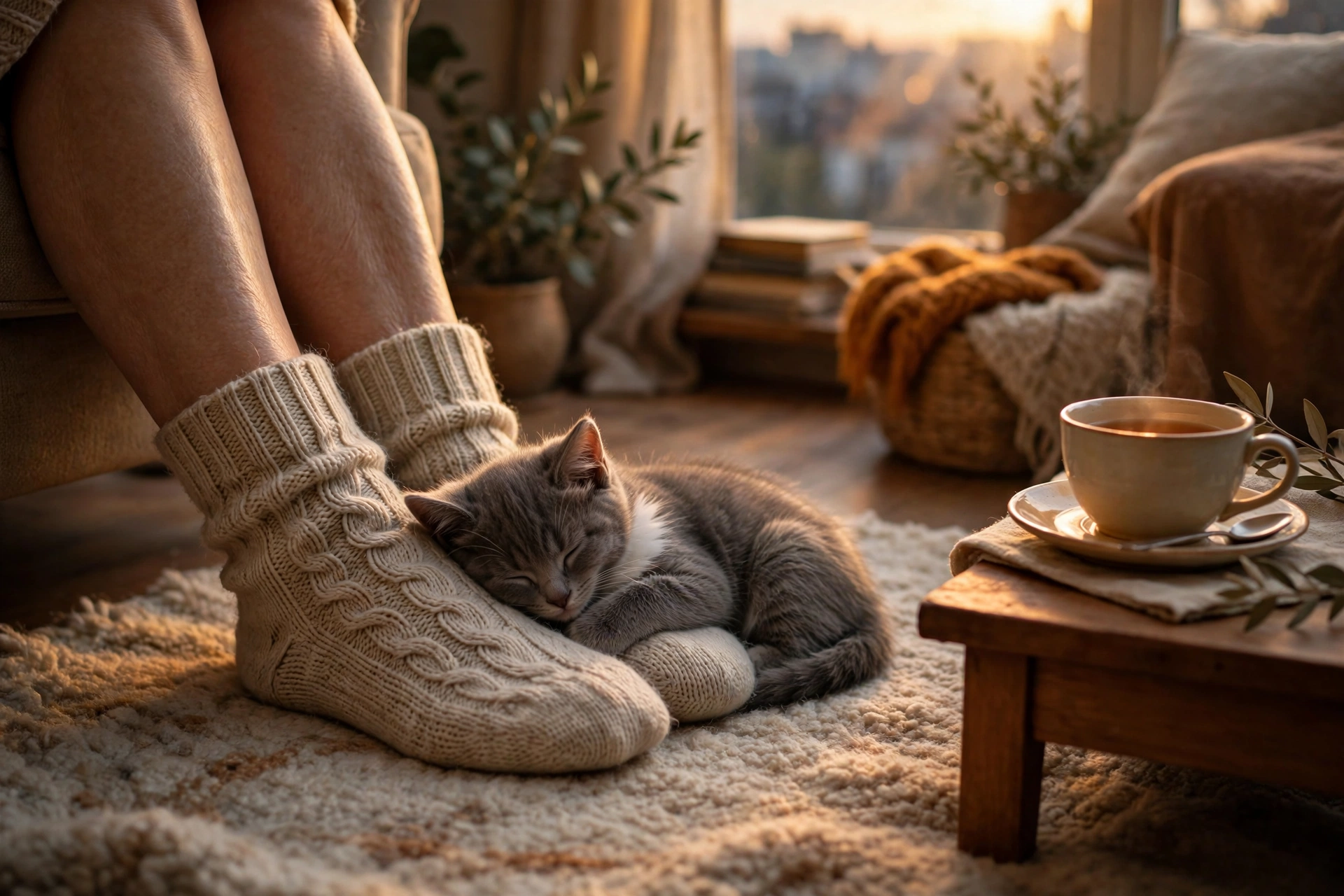
Months passed, and Rose Lane was rebuilt, brick by brick, though Zainab chose to stay in her little ground-floor flat, where Noor could sit in the sun by the door. Bilal still visits every Sunday, and he is no longer the only visitor — Ayesha comes with him, and sometimes other firefighters and neighbours who have grown fond of the old woman with the grey kitten. Noor is no longer tiny. She is a sleek, confident cat now, grey as smoke and gentle as lamplight, and she still sleeps curled against Zainab's feet every night, as if she remembers the night someone carried her out of the dark and into safety.
If you ask Bilal today what he is proudest of in his years as a firefighter, he will not tell you about the biggest fire he fought. He will tell you about a kitten no bigger than his hand, and an old woman who taught him that saving a life is only the beginning. What comes after — the visits, the tea, the neighbours who show up, the child who learns not to be afraid — that is where kindness does its real work. A fire can take a home in a single night, but a single act of kindness, carried gently, can rebuild a life, and then, quietly, a whole street.
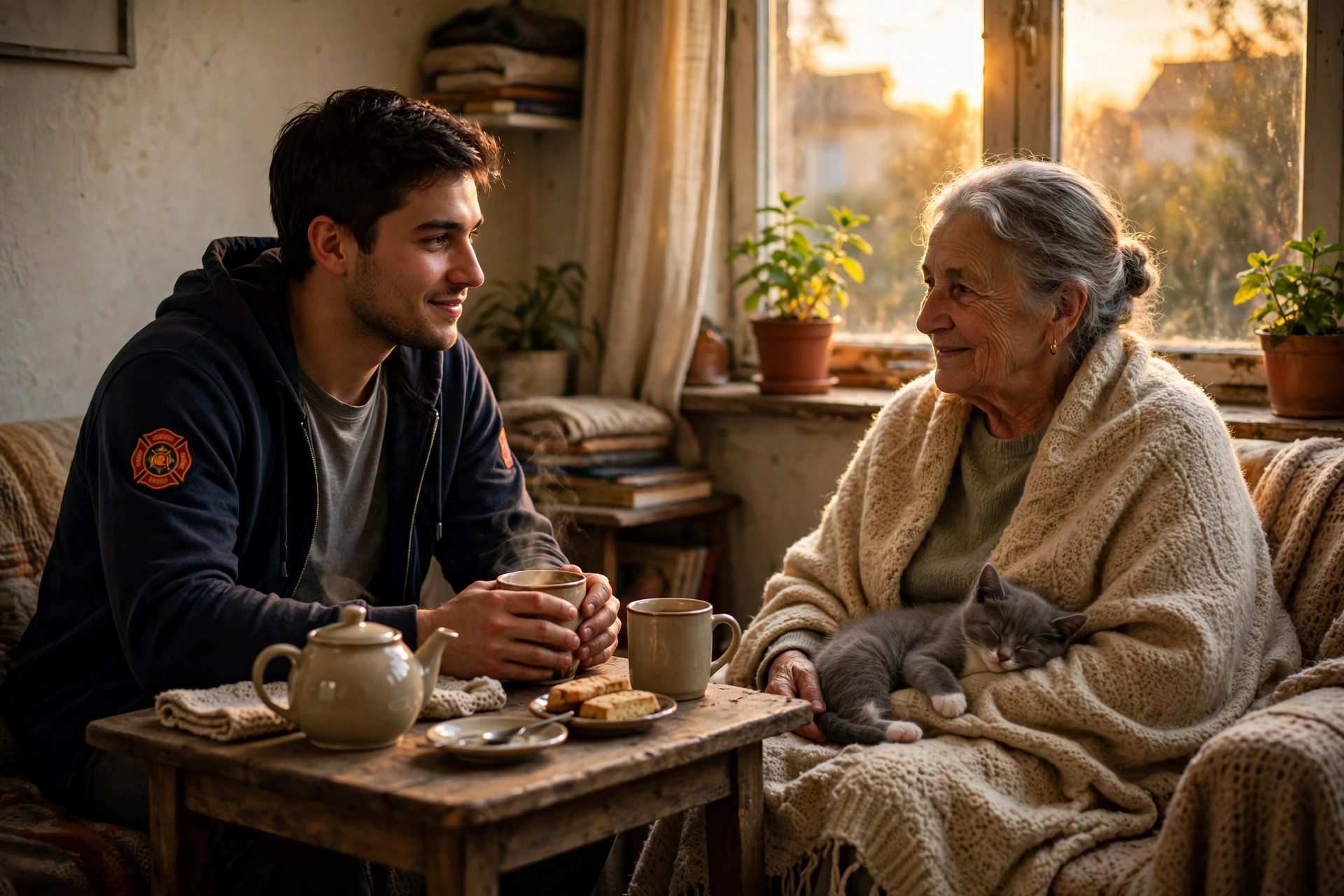
And somewhere on Rose Lane, if you walk past in the evening, you might see an old woman in her doorway with a grey cat in her lap, waving to a firefighter walking up the street with a bag of milk in his hand. She will smile and call him her son, and he will smile back, because some families are not born. They are found — sometimes in the smoke, sometimes in the kindness that follows, and always worth carrying out of the dark.