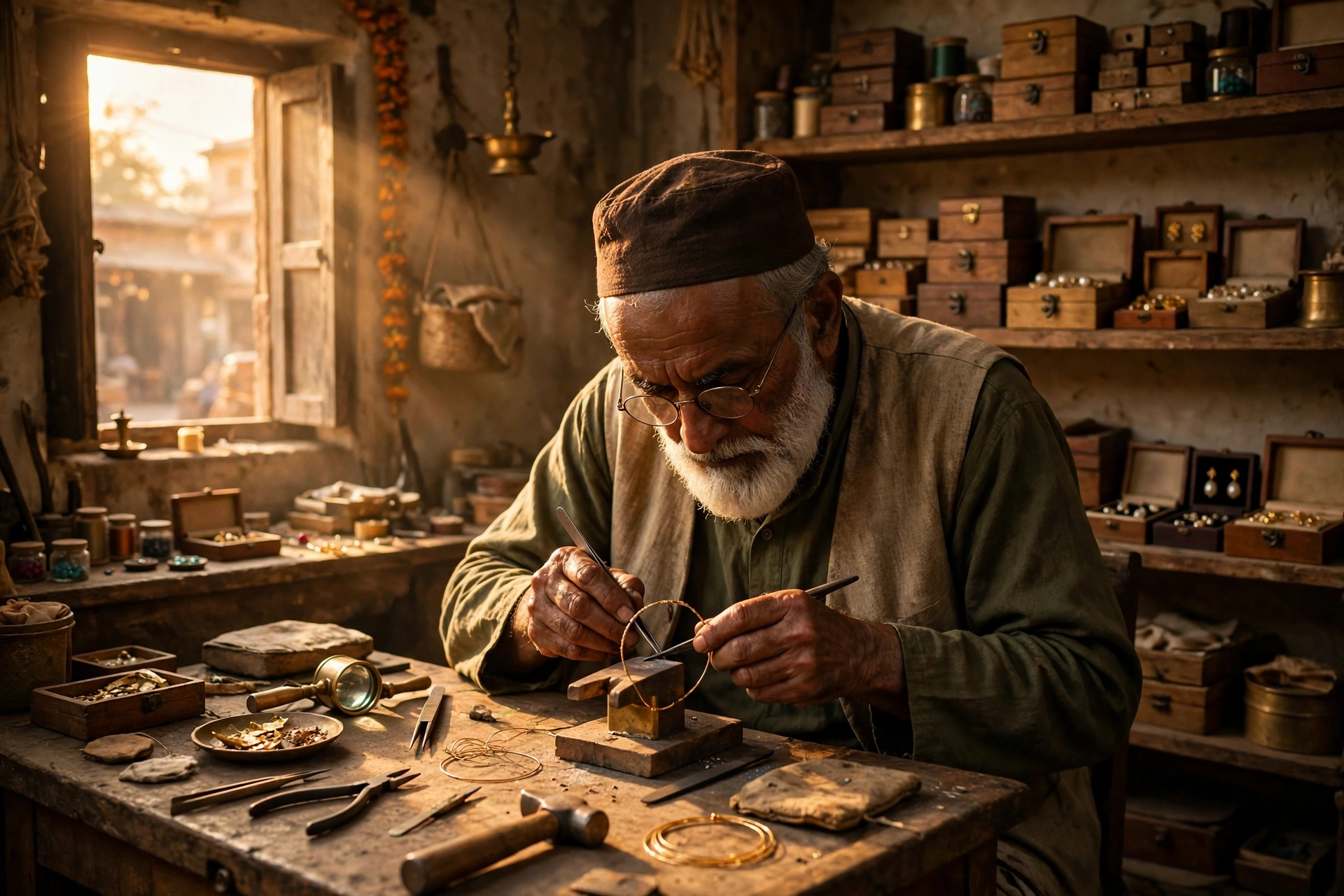
Every morning, before he opened the shutters of his little shop in the old bazaar, Rahim polished the small brass plate beside the door. It said, in letters worn almost smooth by fifty years of hands and weather, RAHIM JEWELLERS. He had hung that plate himself on the day he opened the shop, when his beard was still black and his hands did not shake and the whole street had come to wish him luck. Now the beard was white, the hands trembled a little when he held his finest tools, and most of the old shops around him had closed or become mobile phone stalls. But every morning, without fail, he polished the plate, unlocked the door, and sat at his workbench by the window, where the light fell best on gold.
People in the bazaar said Rahim could fix anything: a snapped chain, a ring worn thin by decades on a finger, an earring with a missing stone, a locket whose hinge had given up. He took them all in his spotted, careful hands and gave them back whole. What people did not say, because Rahim never said it himself, was that he had stopped enjoying his work a long time ago. Three years earlier, his wife Zainab had died quietly in her sleep, and something in Rahim had gone quiet with her. He still came to the shop and did honest work for honest pay, but the joy had gone out of it, the way light goes out of a room when the lamp is carried away.
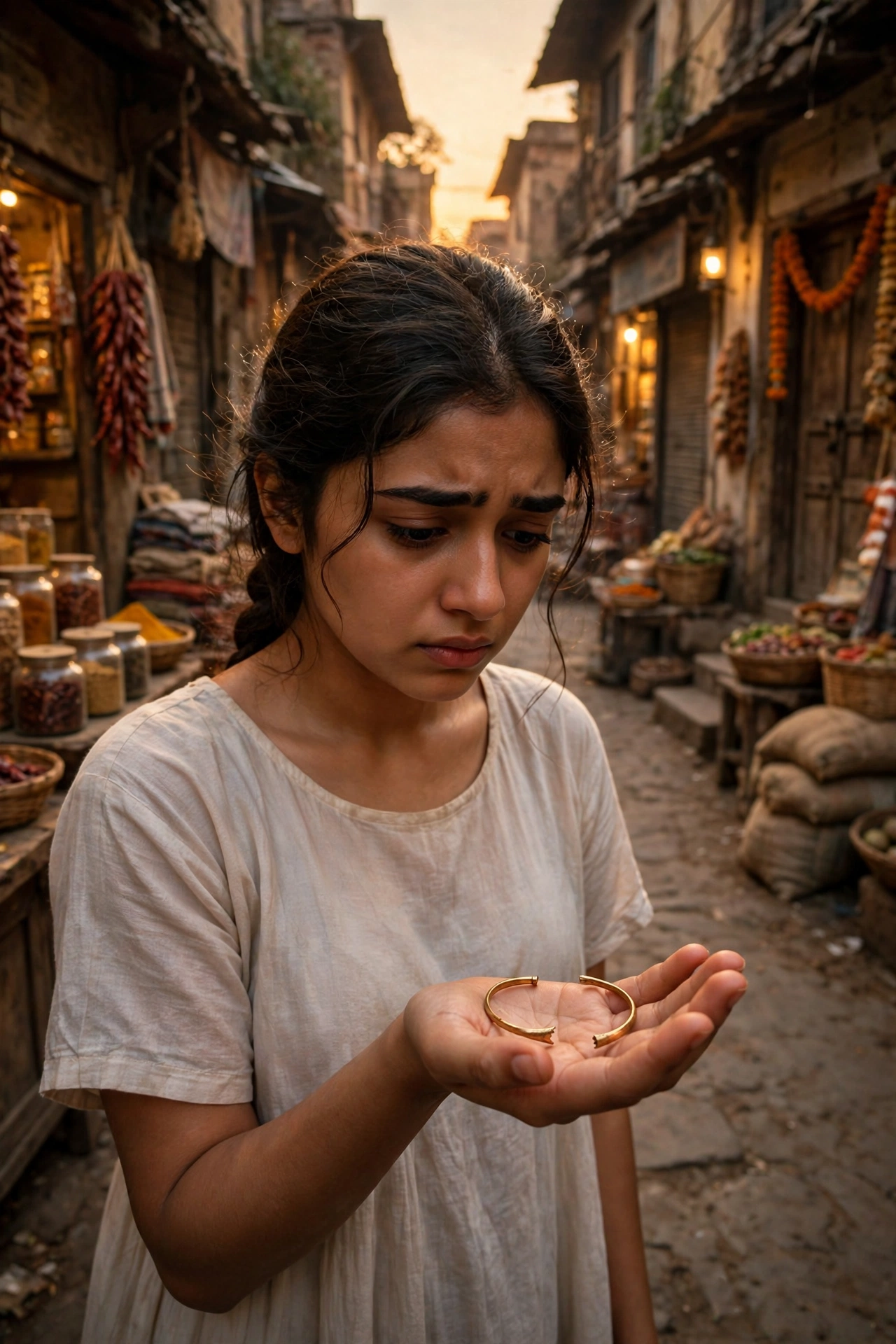
It was a Thursday afternoon, the bazaar thick with the smell of frying samosas, when a girl hurried into his shop. She could not have been more than nineteen, and she was trying very hard not to cry. In her open palm she held two pieces of a thin gold bangle, snapped cleanly in half, as if someone had broken a small golden twig.
"Please," she said, her voice shaking. "Can you fix it? My wedding is tomorrow."
Rahim took the pieces gently and held them up to the light. The bangle was old and beautifully made, thin as a wheat stalk, with a tiny flower engraved near the clasp — not the heavy, fashionable jewellery people bought nowadays, but the kind of thing a grandmother kept in a cloth pouch and took out only on special days.
"It belonged to my grandmother," the girl said, as if she had read his thoughts. "She gave it to me before she died last winter. She wore it on her own wedding day, and her mother wore it before her. I was going to wear it tomorrow, just for the ceremony, so that she would be there somehow." She swallowed hard. "This morning I dropped it on the kitchen floor and it broke. My father took it to two big shops in the new market. They said it is too thin and too old to repair, that I should melt it and buy a new one. But I do not want a new one. I want this one."
Rahim turned the pieces over in his fingers. The gold was soft with age, and the break was in a difficult place, right beside the engraved flower. It would take patience, and a steady hand, and most of the evening. He could do it. He knew he could do it. But when he looked up and asked, as he always did, about the price, the girl's face crumpled.
"I have no money," she whispered. "My father has spent everything on the wedding. I came here because the old shops are cheaper, but even so —" She stopped, embarrassed, and began to wrap the pieces back in her handkerchief. "I am sorry. I should not have wasted your time."
"Wait," Rahim said. "What is your name, child?"
"Amna," she said.
"Amna," he repeated, and something in his chest moved, like a door opening a crack after years of being shut. "Leave the bangle with me. Come back tomorrow morning, early, before your wedding. And do not worry about the price."
Amna stared at him. "But —"
"Tomorrow morning," Rahim said firmly, though his voice was gentle. "Early. Now go home and rest. A bride should not spend the night before her wedding crying over a bangle."
After she left, Rahim sat for a long time looking at the two broken pieces on his workbench. Then, with hands that shook more than usual, he picked up his magnifying glass and looked closely at the tiny engraved flower. His breath caught. He knew that flower. He had engraved it himself, more than fifty years ago, when he was a young man just starting out, for a shy young bride who had saved for months to buy a simple bangle and had asked, blushing, if he could put a small flower on it, because flowers were her favourite thing in the world. He had never forgotten how she had smiled at the finished bangle, the way people smile at something they will love for the rest of their lives.
That bride, he realised with a jolt, must have been Amna's grandmother.
That evening, Rahim did not go home at his usual hour. He lit the second lamp, made himself a cup of strong tea, and set to work. The repair was delicate, exactly as he had feared: the old gold threatened to melt under too much heat, and the break sat so close to the flower that one careless movement would have ruined the engraving forever. Twice he had to stop, rest his eyes, and breathe slowly until his hands steadied. He thought about Zainab, who used to sit in the corner of the shop in the evenings, mending clothes while he mended jewellery, and who always said that a thing repaired with care lasts longer than a thing bought new. And somewhere between the tea going cold and the bazaar falling quiet outside, he realised that he was enjoying his work again — truly enjoying it — for the first time in three years.
It was past midnight when he finally set his tools down. The bangle lay on dark velvet, whole again, the join so fine that only someone who knew where to look could find it, the little flower shining in the lamplight, perfect and untouched. Rahim wrapped it in a clean handkerchief, placed it in the small wooden box where he kept his most precious pieces, locked the shop, and walked home through the empty bazaar, tired to his bones and strangely, quietly happy.
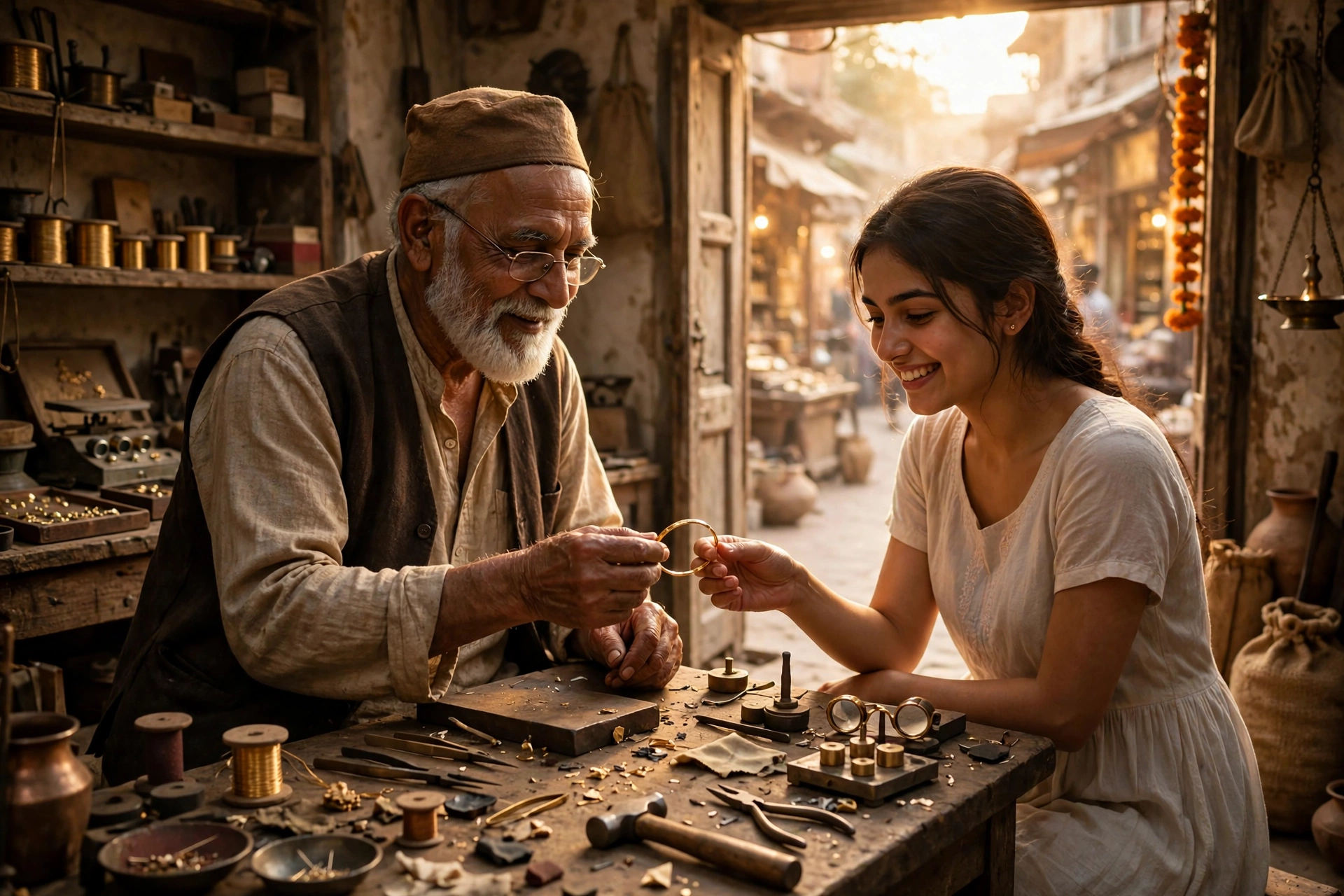
Amna arrived at dawn, before the neighbouring shutters had even gone up, wearing a simple yellow dress, her eyes red as if she had not slept at all. Rahim did not keep her waiting. He took the wooden box from its shelf, opened it, and held out the bangle.
Amna gasped. She slipped it onto her wrist with trembling fingers, and it sat there exactly as it should, catching the morning light. She turned her wrist this way and that, then began to cry in earnest — not the frightened tears of yesterday, but tears of relief so deep that she laughed through them at the same time.
"It is perfect," she whispered. "You cannot even see where it broke."
"You can," Rahim said, smiling, "if you know where to look. But a mended thing does not need to hide its mending. Sometimes the mending is the most beautiful part."
Then Amna remembered the price, and her smile faded. "How much do I owe you? I will pay you, I promise, even if it takes months."
Rahim shook his head. "You owe me nothing."
"But you worked all night —"
"Amna," he said, and told her about the young bride from fifty years ago, and the little flower, and how he believed the bangle on her wrist was the very same one he had made for her grandmother. "Your grandmother paid me for this bangle long ago, with money saved coin by coin. She would be very pleased to know her granddaughter is wearing it tomorrow. Consider it already paid for, many times over."
Amna threw her arms around him then, the way a granddaughter hugs a grandfather, and Rahim, who had not been hugged like that since Zainab died, stood very still and blinked hard at the ceiling until he could trust his voice again.
"There is one condition," he said at last.
"Anything," Amna said.
"Wear it tomorrow," he said. "And when someone asks about the little flower, tell them it was made with love, and mended with love, and that both kinds of love last."
Amna promised, and ran home to show her father, the bangle shining on her wrist like a small piece of the morning sun.
Rahim expected that to be the end of it. It was not. Word travels fast in an old bazaar, and faster still on the wings of a wedding. By the following week, people were coming with things they had kept in drawers for years because they believed them beyond repair: a widow with her husband's broken watch chain, a schoolteacher with her mother's cracked ring, a young father with a tiny silver anklet his daughter had snapped while playing. With each one came a story, and Rahim found himself listening the way he used to when Zainab was alive — slowly, properly, as if the story mattered as much as the gold.
He also noticed that many of these people could not afford the big shops in the new market. So one morning he put a small handwritten sign in his window: "Mending Morning, every Friday. If you cannot pay, bring your broken thing anyway, and we will find a way." On the first Friday only three people came, bringing sweet tea and biscuits, and they sat and talked while he worked, and the little shop felt full in a way it had not felt for years.
One Friday visitor was an old man with a dented silver locket that had belonged to his late wife; he had dropped it the day she died and had never forgiven himself. Rahim repaired it in silence, polished it until it shone, and when the man opened it and saw his wife's faded photograph inside, safe and undamaged, he wept openly at the workbench. "You did not just mend the locket," he said. "You mended something in me." Rahim thought about that long afterwards, and understood at last what Zainab had meant: a goldsmith does not only mend gold. If he is lucky, and if he is kind, he mends the hearts of the people who bring it to him.
Months passed. Amna visited often, sometimes with her husband, sometimes alone, always with sweets and always asking after Rahim's health like a granddaughter. On the first anniversary of her wedding she brought her baby daughter, and Rahim told the baby about the little flower on her mother's bangle, which had travelled through three generations of women who loved each other. The baby gurgled and grabbed at his beard, and Rahim laughed until his eyes watered.
The shop is still there today, in the old bazaar, between the samosa stall and the shop that sells school books. The brass plate is polished every morning, and the Mending Morning sign is still in the window, a little faded but legible. Rahim's hands shake a little more and he works a little more slowly, but the light still falls on his workbench, and people still come with broken things and leave with more than they brought in. If you visit on a Friday morning, you might find him bent over his bench, mending a chain or a ring or a bangle, while someone tells him a story over sweet tea — a reminder that love, like gold, does not break easily, and that what is mended with kindness shines longer than gold itself.