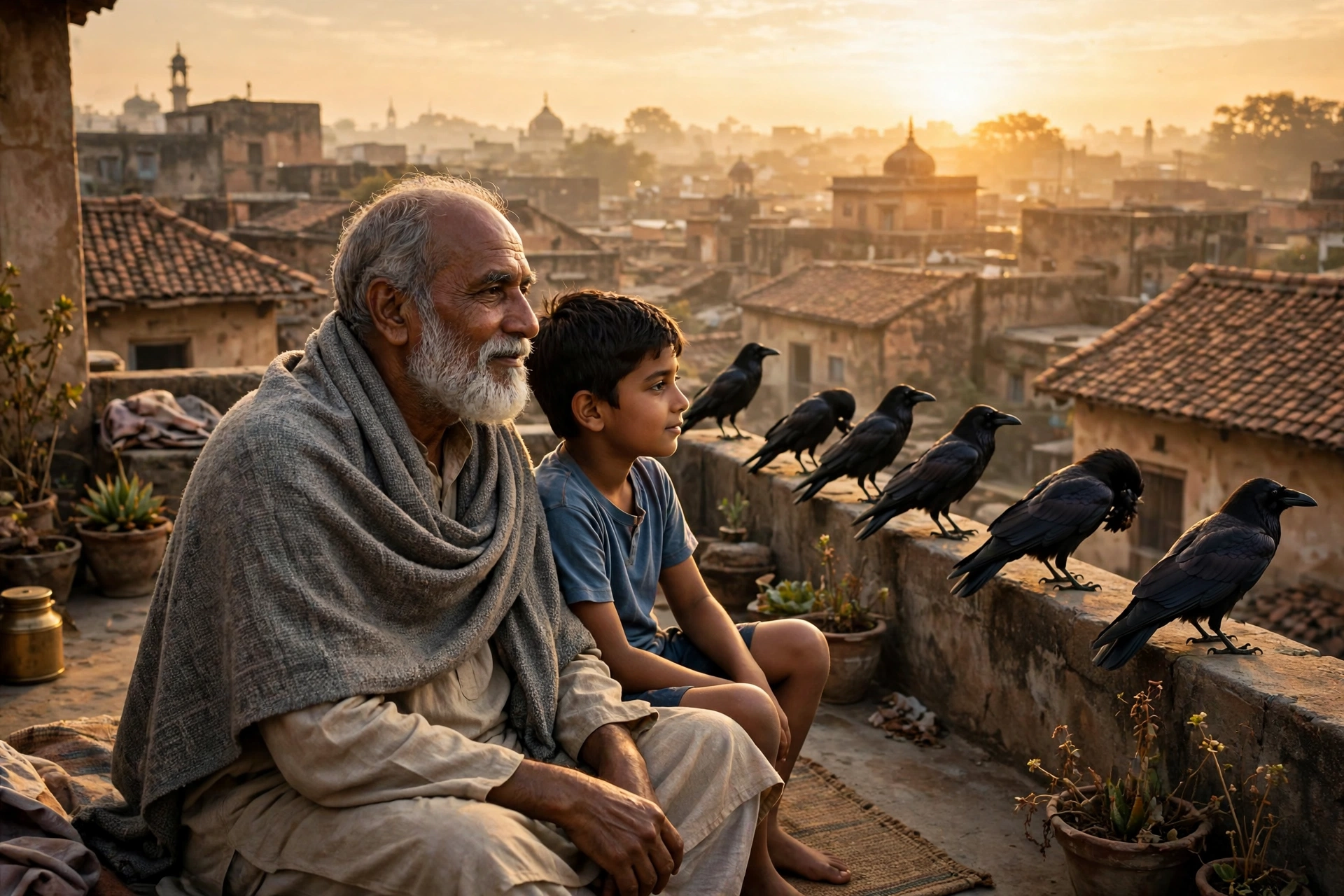
Long before the first bus rattled down Mill Street, before the bakery shutters rolled up and the milkman began his round, an old man named Rahim climbed the narrow stairs to his rooftop with a chipped blue bowl in both hands. Inside was rice, cooked the night before and left to cool, mixed with a few crumbs of dry bread. He scattered it along the low parapet in a slow, even line, the way a farmer sows a field, and then sat down on an upturned wooden crate to wait. Within minutes the crows came — first one, bold and black as polished coal, and then a dozen more, dropping out of the grey morning sky.
The people of Mill Street had watched this ritual for years, and most of them had long since stopped wondering about it. The shopkeepers called him a harmless old fellow with nothing better to do. The children called him the Crow Man. The new families assumed it was some old superstition, or simply the habit of a lonely widower who had run out of people to talk to and settled for birds instead. None of them were entirely wrong, and none of them knew the half of it.
Rahim had not always lived alone. For fifty-one years he had shared the small house at the end of Mill Street with his wife, Amina, a woman with a laugh that could be heard two houses away and a firm belief that no creature should ever go hungry if there was food in the house to spare. Every morning of their married life, Amina had risen before dawn, cooked a small pot of rice, and carried it to the rooftop for the crows. "They were here before us, Rahim," she used to say. "The street belongs to them as much as to us. We only borrow it."
When Amina fell ill in her seventy-ninth year, the doctors spoke in the careful, lowered voices that doctors use when there is nothing left to try, and Rahim sat beside her bed holding a hand grown thin as a bird's wing. On her last clear morning, she said, "Don't let them wait, Rahim. The crows will come at dawn whether I am here or not, and they will not understand why the bowl is empty." He promised. He had kept every promise he ever made to her, and this one would be the easiest and the hardest of them all — easy because it cost so little, hard because every dawn without her reminded him of exactly what he had lost.
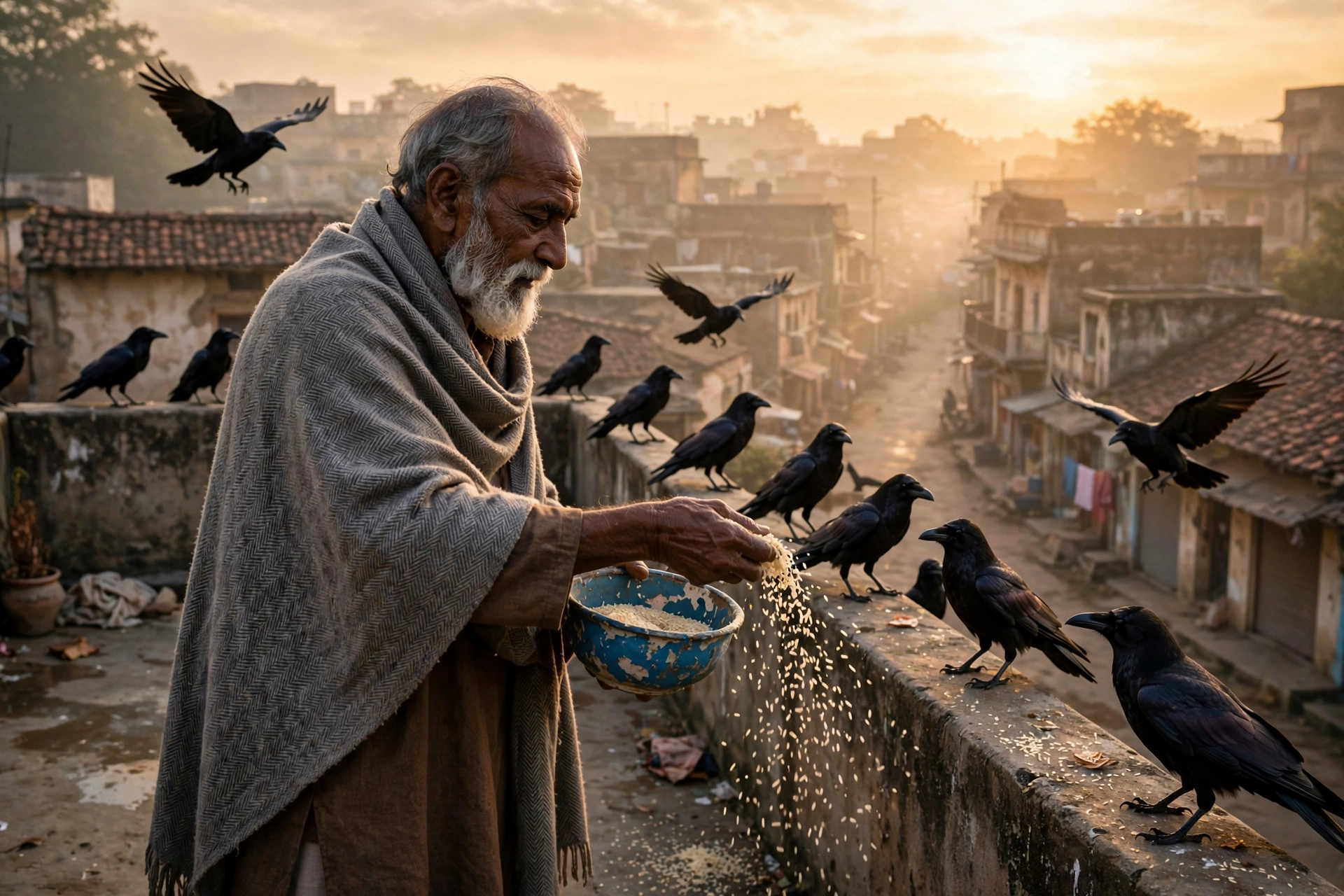
For three years after Amina's passing, Rahim kept the promise alone. He rose at five, cooked the rice, climbed the stairs with his knees protesting each step, and sat on his crate while the crows ate. Some mornings he talked to them, the way he used to talk to Amina while she worked — small, ordinary sentences about the weather and the price of onions. The crows listened, or seemed to, and Rahim found that talking to them kept the silence of the house from settling too heavily on his chest before the day had even begun.
It was on a cold morning in late October that he first noticed the boy.
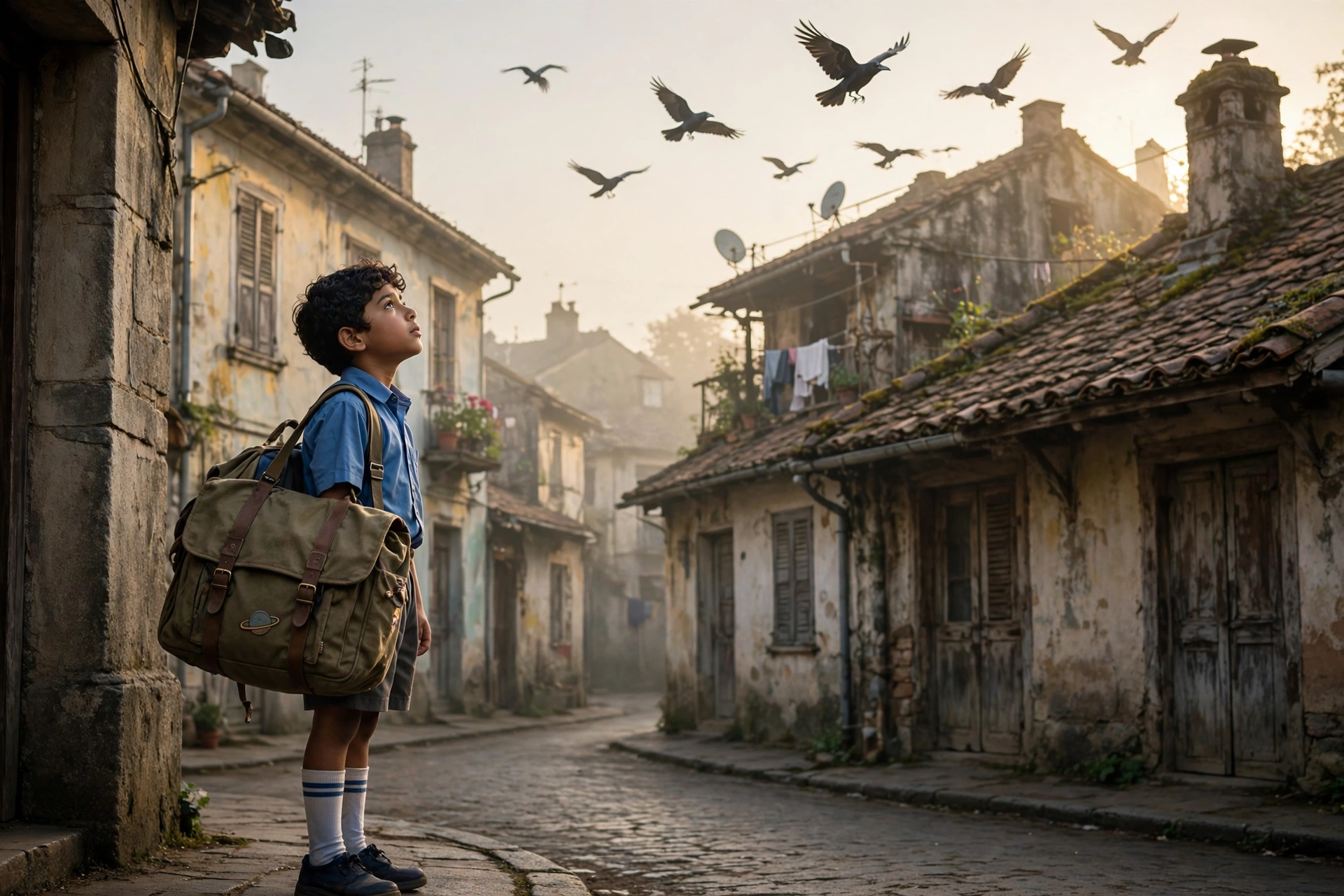
The boy was small, perhaps nine years old, with a schoolbag too big for his shoulders and a habit of standing very still at the corner of the street, watching the rooftop the way other children watched shop windows. Rahim saw him three mornings in a row before he said anything. On the fourth, he leaned over the parapet and called down, in the gentle voice he reserved for stray animals and small children, "Are you waiting for someone, beta?"
The boy looked up, startled, and after a long pause shook his head. "I just like watching the crows," he said. "My mother used to feed the sparrows. On our balcony. Before she went away."
Rahim understood the careful words at once. "Went away" was the phrase children used when the truth was too big to carry in one sentence. He nodded slowly. "Then come up tomorrow," he said. "The crows do not mind an extra pair of hands. And the rice tastes better when it is shared."
The boy's name was Kabir. His mother had died the previous spring, and his father, a night-shift driver, slept through the daylight hours, so Kabir spent his mornings mostly alone — walking to school alone, eating his breakfast alone, doing his homework at a table far too quiet for a nine-year-old. He had watched Rahim's rooftop ritual for weeks because it was the only thing in his morning that looked like company. The next dawn, he climbed the stairs, and Rahim handed him the bowl without ceremony, as if a nine-year-old helper had always been part of the arrangement.
Kabir scattered the rice with great seriousness, his tongue caught between his teeth, and when the first crow landed, he gasped. "That one has a white feather on its wing," he whispered. "I have seen it before. It is the bravest one."
"That one is the captain," Rahim said gravely. "He comes first so the others know it is safe. Amina named him herself."
They sat together as the sky turned from grey to gold, and Kabir told Rahim about his mother — how she used to hum while she cooked, how she had taught him to crumble bread for the sparrows, how he had stopped feeding them after she died because it hurt too much to do alone. Rahim listened the way only a person who has known the same hurt can listen, without hurrying or fixing. When Kabir finished, Rahim said quietly, "I stopped for a while too, after Amina went. For three days, I could not climb these stairs. And on the fourth morning, the crows were waiting anyway. That is how I learned that grief does not ask you to stop living. It only asks you to find a new way to carry it."
From that morning on, Kabir came every day. Rahim always had a second, smaller bowl ready for him. The boy learned the names of the crows — the captain with the white feather, the shy one that always ate last, the noisy pair that squabbled over the same grain — and he learned, without anyone teaching him in words, that a morning begun by caring for something smaller than yourself cannot be entirely sad. His father, noticing the change — the boy who now hummed while he tied his shoes, who came home from school with stories instead of silence — asked one evening where he went before school. Kabir told him. The next morning, the father stood at the bottom of the stairs, watching his son and the old man on the rooftop, and something in his tired face softened in a way it had not done since the spring.
Winter came, and with it a week of bitter rain and wind that rattled the windows of Mill Street. On the third morning of the storm, Rahim did not appear on the rooftop. Kabir waited at the bottom of the stairs until his shoes grew wet, and then he ran up alone. The door to Rahim's house was unlocked, as it always was, and inside he found the old man in bed, feverish, a half-finished pot of rice cold on the stove. Kabir panicked for exactly ten seconds, and then he got to work. He heated the rice, carried it to the rooftop in the chipped blue bowl, and scattered it along the parapet in a slow, even line, the way Rahim had taught him. The crows came, as they always did. The captain landed first.
Then Kabir ran downstairs, knocked on the door of the neighbour across the lane, and said, in the clearest voice he could manage, "Rahim uncle is sick, and the crows still need feeding, and I have to go to school." Mrs. D'Souza, who had lived on Mill Street for thirty years and had never once climbed to anyone's rooftop, looked at the small, wet, determined boy, and said, "Show me the stairs."
That morning, Mrs. D'Souza fed the crows. The next morning, the baker's son did. The morning after that, the milkman left a small sack of rice at Rahim's door with a note that said, "For the captain and his crew." Word travelled down Mill Street from window to window, and by the end of the week a roster had formed, written on cardboard pinned to Rahim's front door: a different neighbour for every dawn, so the bowl would never be empty while the old man recovered.
Rahim, propped up in bed, heard about the roster from Kabir, who reported it each evening with pride. The old man laughed until he coughed, and then his eyes filled with tears. "Amina would have loved this," he whispered. "She always said the street would look after the birds one day, if only someone showed them how."
It took Rahim three weeks to recover, and by the time he climbed the rooftop stairs again, the dawn ritual had changed beyond imagining. He was not alone. Kabir was there, of course, with his small bowl — but so were Mrs. D'Souza, the baker's son, the milkman, and half a dozen neighbours holding cups of tea. Someone had brought an extra crate for Rahim to sit on. Someone else had mended the loose step on the stairs. The captain landed first, as always, and then the flock descended, and for a moment nobody spoke, because the sight of a street gathered in silence at dawn was somehow the most beautiful thing any of them had seen in a long time.
Rahim sat down on his crate, and Kabir pressed the blue bowl into his hands. "You are the captain here," the boy said. "You come first, so the rest of us know it is safe."
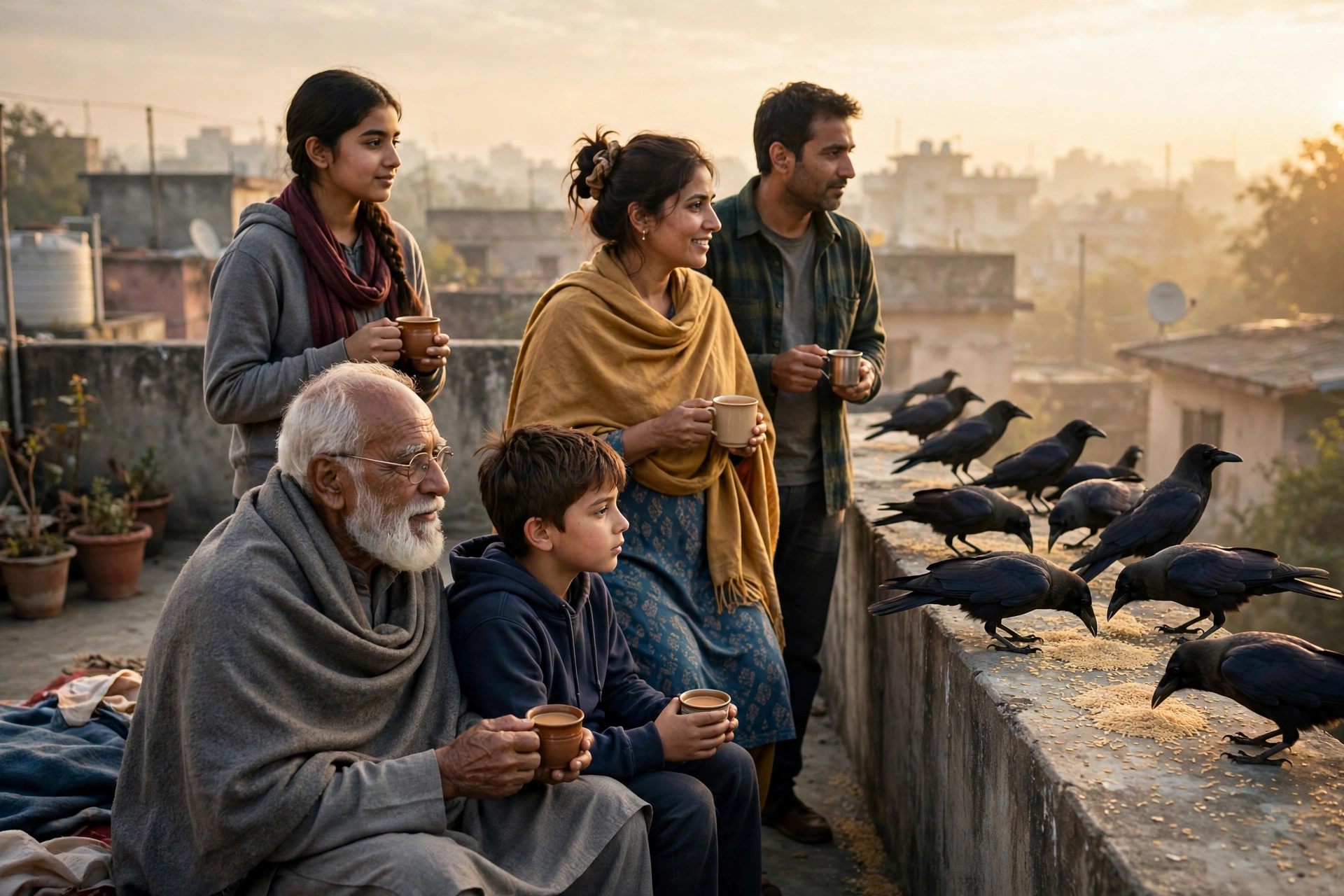
After that morning, the rooftop gatherings became a permanent part of Mill Street. Not everyone came every day, but someone always came, and the bowl was never empty, and the crows, once fed by one woman and then by one old man, were now fed by a whole street. Kabir's father began joining them on his days off, watching his son scatter rice with the confidence of a boy who had found his place in the world again. And Rahim, who had spent three years believing his mornings belonged only to his grief, discovered that a promise kept faithfully, day after day, has a way of growing beyond the person who made it — like a seed that becomes a tree.
On the first morning of spring, Kabir arrived to find Rahim already there, scattering rice with his slow, even hand. The boy sat beside him, and for a while they watched the crows in silence. Then Kabir said, "Rahim uncle, when I grow up, will I still come here?"
Rahim smiled, the deep, unhurried smile of a man who has finally understood something important. "That is the wonderful thing about a promise, Kabir," he said. "You do not have to keep it in the same way forever. You only have to keep it alive. One day you will scatter rice on a rooftop of your own, or feed sparrows on a balcony, or simply be kind to someone waiting at the bottom of the stairs. And on that day, Amina and your mother will both be there — not in the way we wish they were, but in the way that matters. In the kindness that keeps going."
The captain landed on the parapet and let out a single, approving caw. And as the sun rose over Mill Street, painting the rooftops gold, the old man and the little boy sat side by side, two keepers of a promise that had begun with one woman's gentle heart and would now never end.