On Willow Lane, between the bakery that smelled of fresh bread every morning and the tailor's shop with its window full of bright cloth, there was a tiny shop with a painted wooden sign that read simply: "Rahim's Toys." Nobody in the neighbourhood remembered a time when it had not been there. The paint on the sign had faded, the bell above the door rang a little off-key, and the shelves inside were crowded with wooden trains, cloth dolls, spinning tops, and little carved animals. But the children of Willow Lane did not come to Rahim's shop to buy things. They came because Rahim fixed what was broken, and he never asked for a single coin in return.
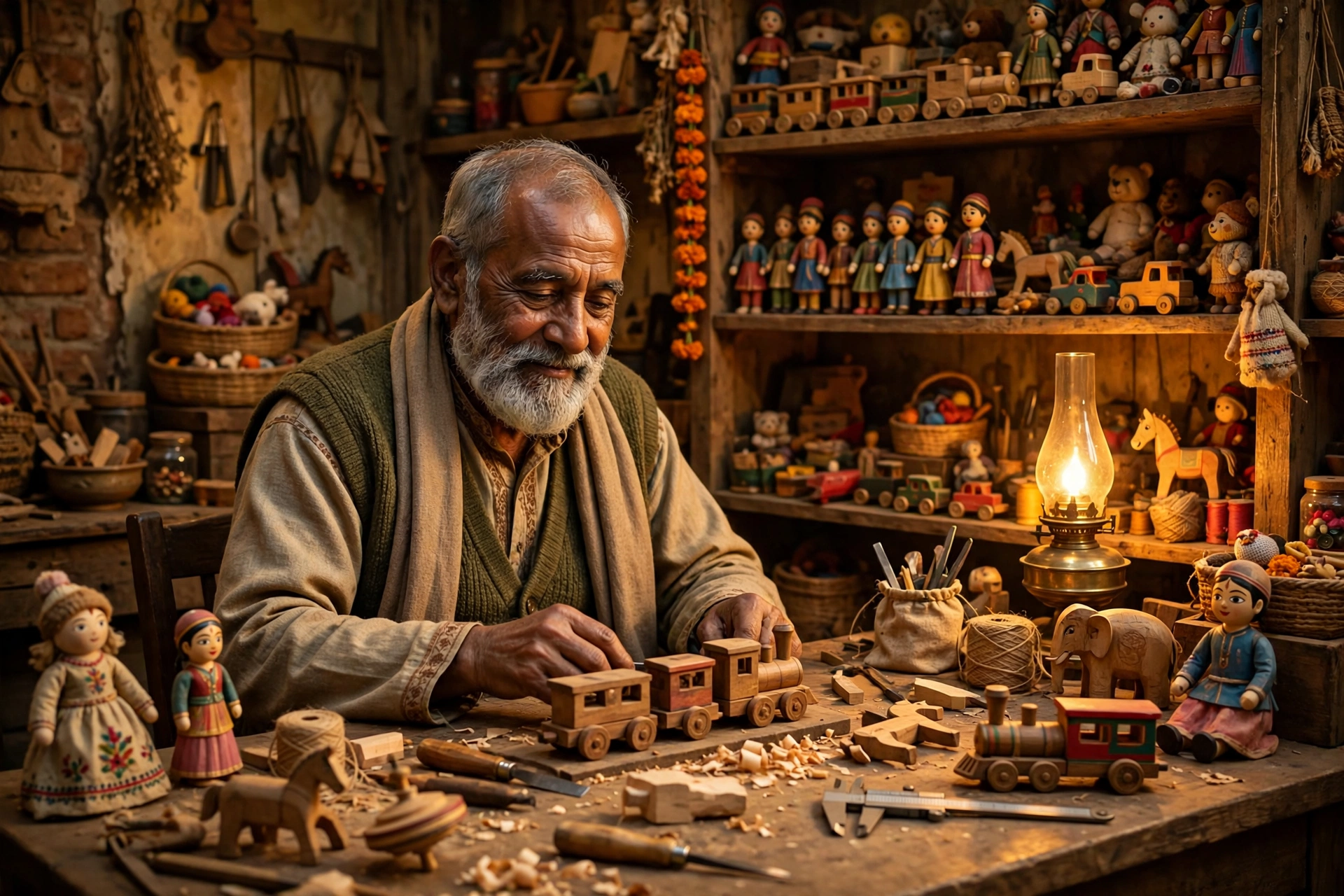
Rahim was seventy-three years old, with hands that trembled slightly and eyes that had seen too much of life. He had once been the finest toymaker in the whole town. People from faraway villages would travel to buy his carved horses and dancing dolls, and his workshop had hummed from dawn until late at night. Then, twenty years ago, everything had changed. His only son, Imran, a bright-eyed boy of nine who loved to watch his father work, had fallen ill one winter and never recovered. Rahim buried his son on a cold grey morning, closed his workshop for a month, and when he finally opened the door again, something in him was different. He no longer made toys to sell. He made them, quietly, one at a time, and he repaired the broken ones that children brought to him, because every toy he fixed felt like a small promise kept to the boy he had lost.
The children did not know this story. They only knew that Uncle Rahim, as they called him, could fix anything. A doll with a missing arm, a train with a broken wheel, a teddy bear whose stuffing had spilled out onto the pavement — all of it came back to life on his workbench, stitched and glued and painted, as good as new, sometimes better. He would hand the toy back with both hands, the way you hand someone something precious, and say, "Take care of it now. Toys remember who is kind to them."
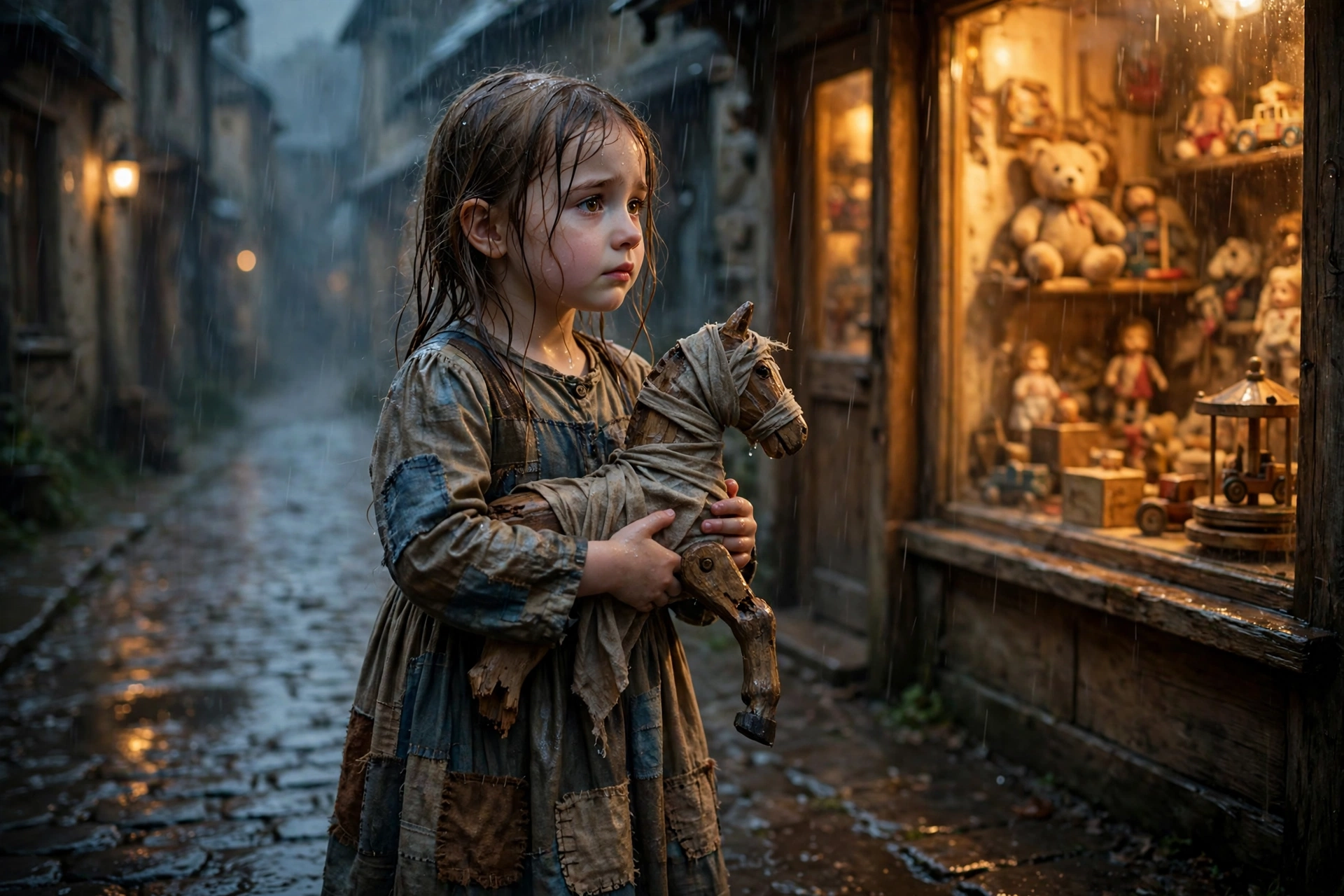
One rainy afternoon in October, when the clouds hung low over Willow Lane and the gutters ran with water, a little girl stood outside Rahim's shop for a long time before she found the courage to push the door open. She could not have been more than eight years old. Her dress was patched at the elbows, her shoes were too big for her feet, and she was holding something wrapped carefully in an old piece of cloth. The bell above the door rang its off-key note, and Rahim looked up from his workbench.
"Come in, child," he said gently. "You are getting wet out there."
The girl stepped inside, water dripping from her hair, and unwrapped the cloth. Inside was a wooden horse. Or rather, what was left of one. One leg was broken clean off, the tail had snapped away, the painted mane was chipped, and one of the glass eyes was missing. It was the kind of toy most people would have thrown away long ago. But the girl held it as though it were made of gold.
"My grandmother gave it to my father when he was small," she said in a small voice. "And my father gave it to me. But yesterday I dropped it on the stairs, and now..." Her voice broke. "Can you fix it, Uncle? Please? My father is not here anymore, and this is all I have left of him."
Rahim's hands went very still. He looked at the broken horse, and for a moment he was not in his shop at all. He was twenty years back, in a workshop filled with sawdust and sunlight, watching a small boy ride a wooden horse across the floor, laughing so hard he could barely breathe. He blinked, and the memory folded itself away, the way it always did, quietly and without asking permission.
He took the horse from the girl with both hands. "What is your name, child?" he asked.
"Meera," she said.
"Meera," he repeated, as if trying the name out. "Leave it with me. Come back in three days. I will do my best."
That night, long after the shops on Willow Lane had closed and the street lamps had flickered on, Rahim sat at his workbench with the broken horse under the lamp. He studied it the way a doctor studies a patient. The wood was old and good — cedar, he thought, the kind that lasts a hundred years if you treat it right. The broken leg could be joined with a dowel and glue, stronger than before. The tail could be carved from a fresh piece of wood. The missing eye could be replaced. But the mane, chipped and worn by two generations of small hands, needed the most care. He would have to repaint it stroke by stroke, matching the faded brown as closely as he could, so that it still looked like the horse Meera's father had loved.
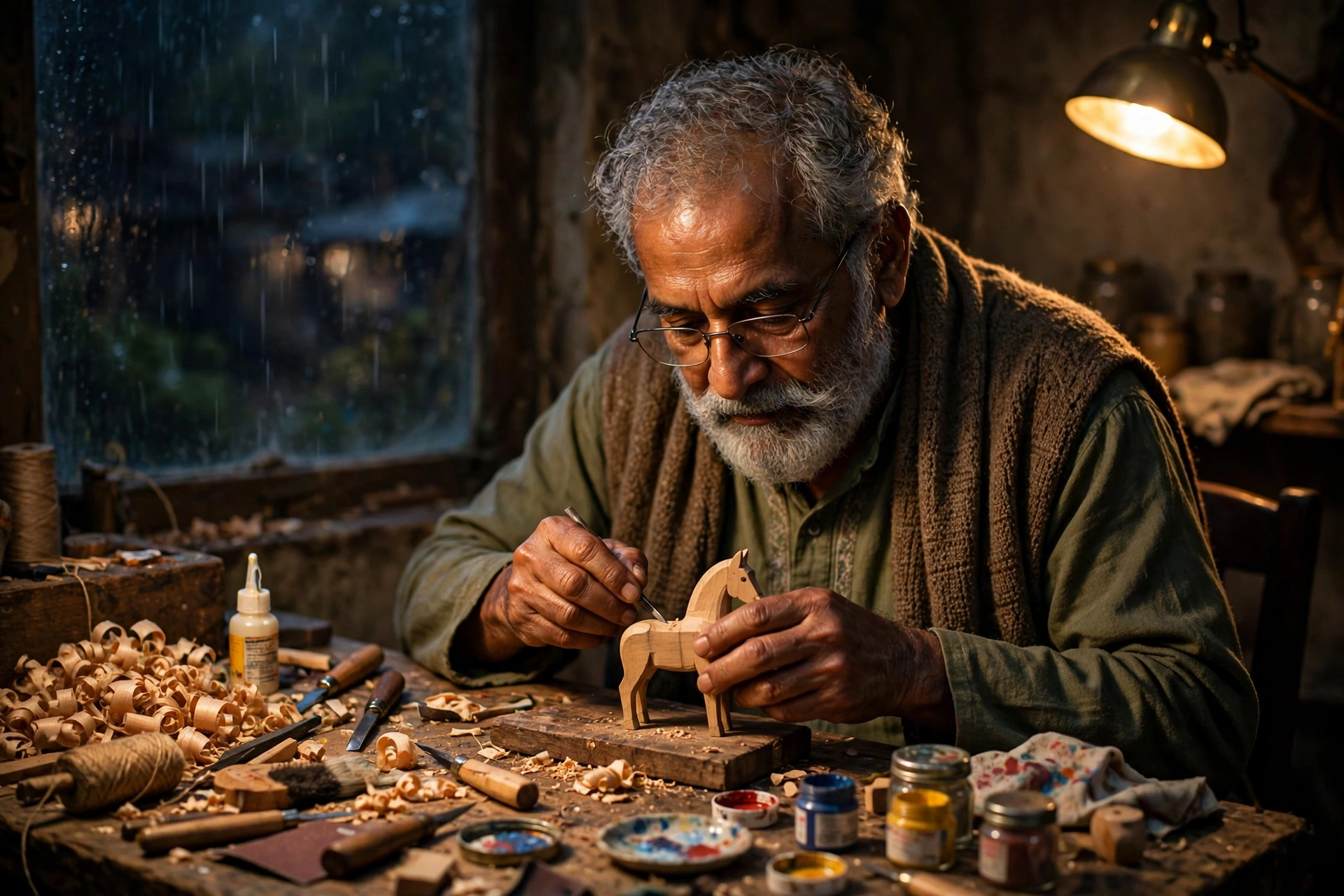
He worked on it for three days. Not because the repairs were so difficult, but because he could not bear to rush. Every evening he stayed late, the lamp burning in his window, the rain tapping against the glass, shaping and sanding and painting with a tenderness he had not felt in years. On the third day, he held the finished horse up to the light. It stood on all four legs, its mane freshly painted, its tail whole, its eyes bright and even. It looked old and new at the same time, the way a beloved thing should.
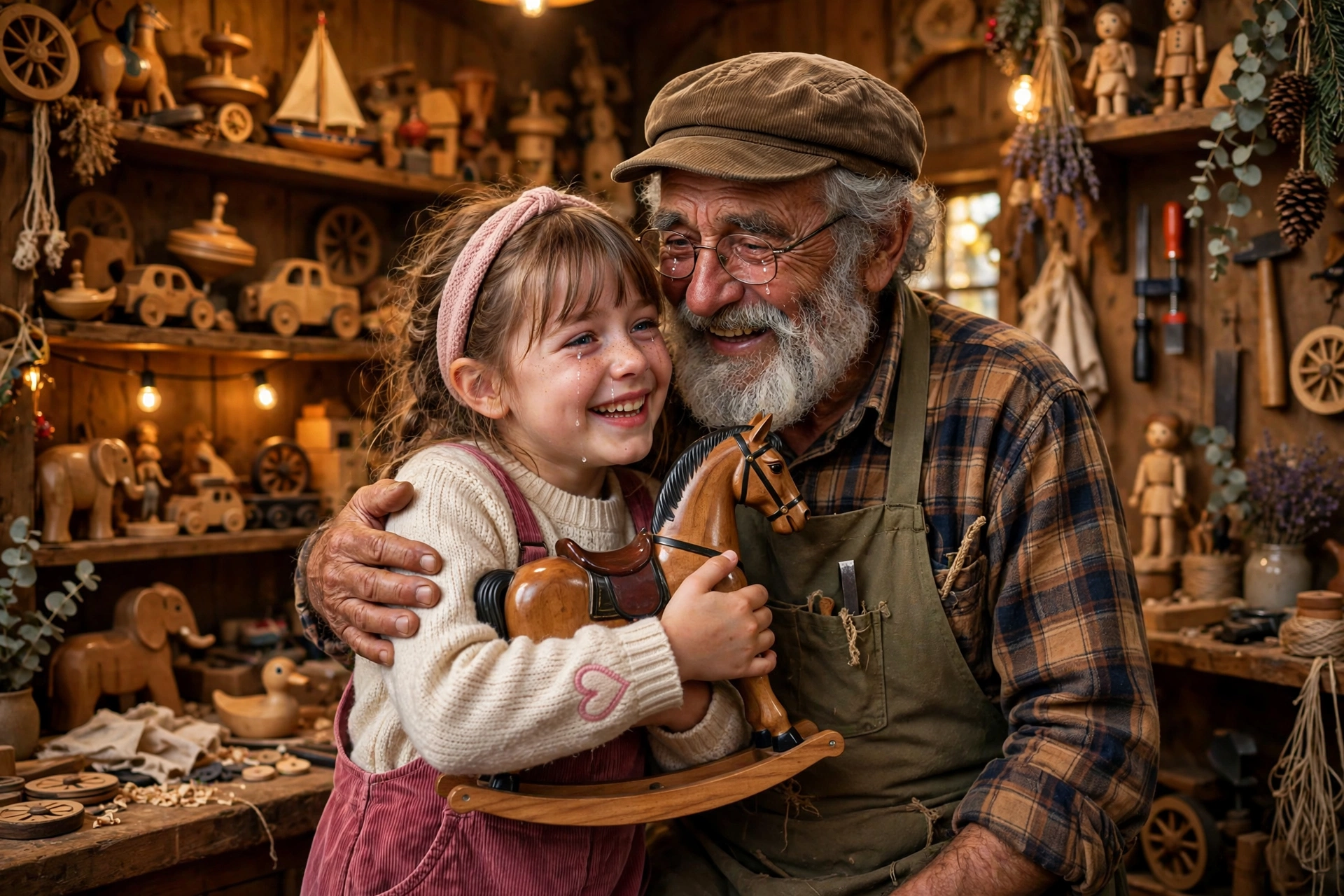
When Meera came back, she stopped in the doorway and pressed both hands to her mouth. Then she ran forward and took the horse, and held it against her chest, and cried — not the loud crying of a child who has hurt herself, but the quiet, shaking kind that comes when a heart is too full for words.
"It looks just like it did," she whispered. "Just like when my father held it."
Rahim knelt down, slowly, because his knees complained these days, until his eyes were level with hers. "Toys carry love, Meera," he said. "Your father loved this horse, and now you love it, and one day someone you love will love it too. That is how love travels. It does not stop. It just changes hands."
Meera hugged him then, suddenly and fiercely, the way children do when they have no other words. And Rahim, who had not been hugged by a child in twenty years, stood very still, and felt something inside his chest — something that had been locked away for a very long time — begin, very gently, to open.
After that day, things changed on Willow Lane, though nobody could quite say how. Meera came to the shop every afternoon after school. At first she just watched Rahim work, sitting on the little stool by the window. Then she began to help — handing him sandpaper, sorting the tiny jars of paint, sweeping the sawdust from the floor. She had clever hands and a patient nature, and Rahim found himself teaching her the way he had once taught his son: how to hold a chisel, how to sand with the grain of the wood, how to paint a tiny eye so that it looked alive.
And slowly, without either of them planning it, the shop filled with life again. Word spread among the children that Uncle Rahim had a new helper, a girl with clever hands who could fix a doll's dress and paint a train's wheels. More children came. Some brought broken toys. Some just came to watch. Rahim began to make new toys again — small ones at first, a spinning top here, a carved bird there — and he gave them away to children who had none. Meera painted them, carefully, her tongue caught between her teeth in concentration, and Rahim would laugh, a sound so rare in that shop that the neighbours would stop on the pavement outside just to listen.
One evening, as the winter light faded and the shop glowed warm behind its windows, Meera asked him the question she had been carrying for weeks. "Uncle Rahim," she said, "why do you fix toys for free? You could sell them and be rich."
Rahim was quiet for a long time. He sanded the edge of a little wooden boat, and the sound filled the silence between them. Then he said, "Once, I had a son. His name was Imran. He loved toys the way you do. When he left this world, I thought my heart had broken for good, and that nothing could ever fix it. But then a child brought me a broken doll, and I fixed it, and the child smiled. And I understood something. A broken heart cannot be glued back together like a toy. But it can be mended, slowly, every time you give love to someone else. Every toy I fix is a piece of my heart, given away. And somehow, the more I give, the more I have."
Meera was quiet too. Then she said, "My father is gone too. And when you fixed his horse, it felt like he was hugging me again."
Rahim reached across the workbench and took her small hand in his old, trembling one. "Then you understand," he said. "Love does not end when someone leaves. It stays in the things they touched, and in the people they loved. We carry it forward. That is our job."
The winter passed, and spring came to Willow Lane, and the shop with the faded sign became something it had not been in twenty years: a place of laughter. Rahim never became rich. He never wanted to. But his shop was full every afternoon, his workbench was covered in half-finished toys, and his heart, which he had believed was broken beyond repair, beat warm and steady in his chest. And on the highest shelf, where the light from the window fell every morning, stood a small wooden horse with a freshly painted mane — not for sale, not for repair, just there, watching over the shop like a quiet guardian of everything love leaves behind.
Years later, when Meera was grown and had children of her own, she would walk down Willow Lane with them and stop outside the little shop, and tell them about the old toymaker with trembling hands who could fix anything. And her children would press their faces to the window, and she would smile, because she knew that some kinds of love never break. They only wait, patiently, to be mended by the next pair of kind hands.