The first thing Hamza noticed about people was not their faces. It was their eyes, and the way they searched for something they could not quite reach.
He had worked since he was sixteen at a small optical shop on Market Road, a narrow, noisy street where mornings began with the clatter of shutters and the smell of fresh bread from the bakery next door. He tightened loose screws, replaced broken arms, and polished lenses until they shone. Most customers thanked him and left. But Hamza always noticed what they left behind.
They left their old spectacles.
When a customer's prescription changed, the old pair was suddenly useless to them. Some dropped the old glasses into the shop's waste bin without a second thought. Others left them on the counter, saying, "Keep them, they are no good to anyone now." Hamza watched the bin fill up week after week with frames that were scratched but whole, lenses cloudy but unbroken, spectacles that had once helped someone read a newspaper, thread a needle, or recognise a grandchild across a crowded room. And every time he saw them thrown away, he thought of his grandmother.
His grandmother, Dadi Amna, had lived with him and his parents in a small house two streets away. She was a warm, laughing woman who told stories that made the children sit in a circle around her feet. But in her last years, her eyesight grew weak, and she could no longer read. Letters came for her from her elder son, who worked far away in another city. Dadi Amna would hold each letter close to her face, then further away, as if the words were hiding from her. In the end she would fold it carefully, press it to her chest, and say, "Read it to me later, beta. My eyes are tired today." Hamza was young then, busy with school and friends, and he often forgot to read those letters aloud. He did not understand, until much later, that his grandmother had not been tired. She had simply been unable to see, and too proud, and too poor, to ask for spectacles of her own.
She died on a winter morning, with a bundle of unread letters tied in a ribbon beside her bed. Hamza read them all that night, his voice shaking, learning her son had written about his children, his work, and his longing to come home. All those words had waited for her, just out of reach, for years. From that night on, Hamza could not look at a discarded pair of spectacles without hearing his grandmother's voice saying, "My eyes are tired today."
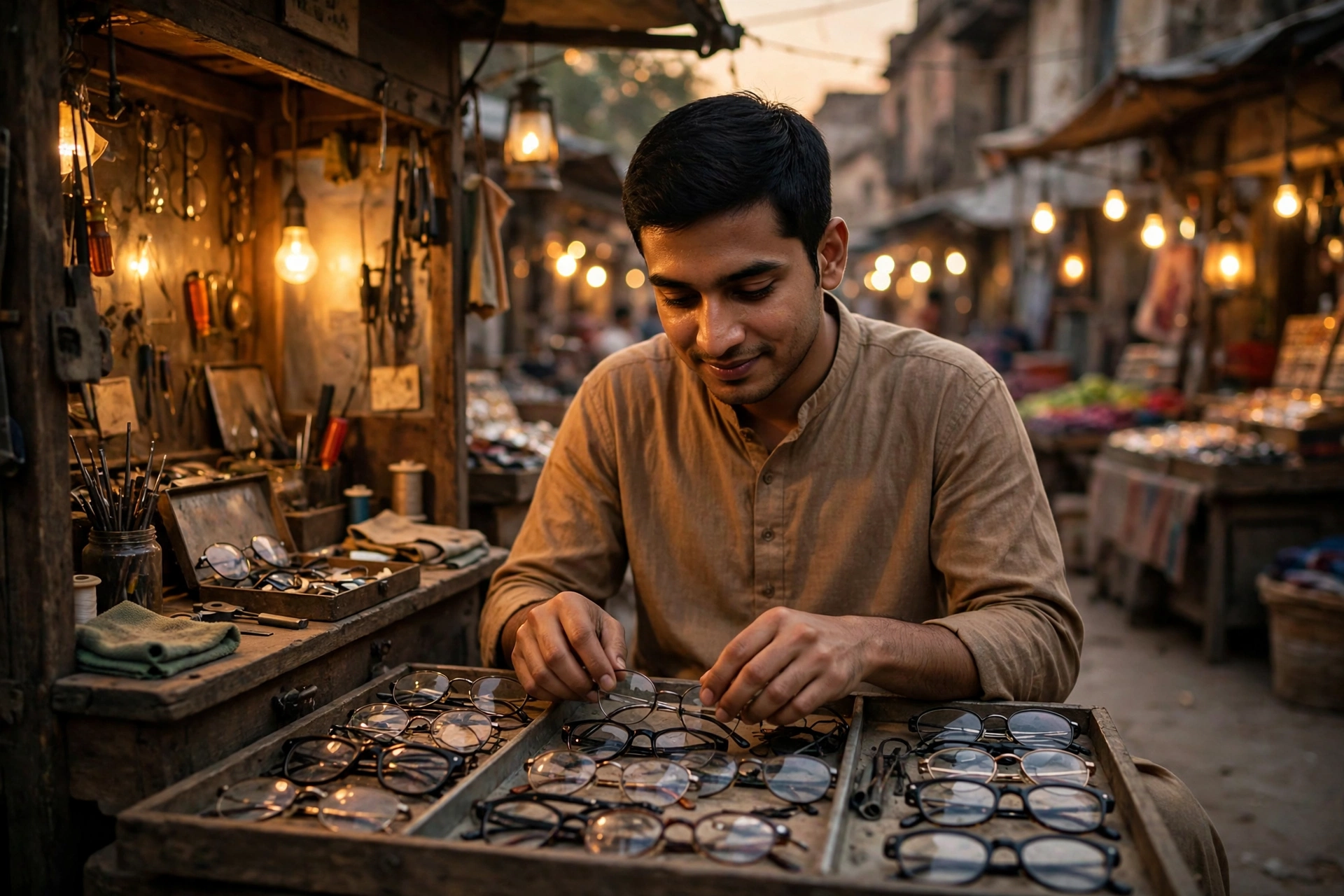
One rainy afternoon, Hamza asked the shop owner, Mr. Saleem, a question he had carried for months. "What if, instead of throwing the old spectacles away, we kept them?" he said. "I could clean and repair them in the evenings, and give them to people who cannot afford new ones. It would cost the shop nothing."
Mr. Saleem laughed, not unkindly. "Hamza, you are a repair boy, not a charity," he said. "People who need spectacles should go to a doctor and buy proper ones."
But Hamza did not argue. He simply brought a plain wooden box to work the next day and placed it beside the waste bin, with a note saying anyone who no longer needed old spectacles could leave them there for a new home. For the first week, the box stayed empty. Every evening, after the shop closed, he stayed behind for an hour, practising on broken frames, learning to straighten a bent arm, replace a missing screw, and polish a lens until it looked almost new.
Then, slowly, things began to change. An elderly woman left her late husband's spectacles in the box, saying she could not bear to throw them away. A schoolteacher left three old pairs. A young man who had just bought new glasses dropped his old ones in and said, "If they help someone, good." Within a month, the box was full, and Hamza carried it home and sorted the spectacles by shape and strength, testing each pair against a reading chart pinned to his wall.
He did not charge a single rupee. He set up a tiny stall at the corner of Market Road on Sunday mornings, with his repaired spectacles laid out neatly on a cloth, and a simple rule: try them, take the pair that helps you see best, and when you no longer need them, bring them back so someone else can see through them too. Word spread quietly, from one kitchen to another, from one shop counter to the next.
The moment that changed everything came on a bright Sunday morning, when a little girl in a faded blue school uniform stood shyly at the edge of his stall. Her name was Meher, and she was nine years old. Her teacher had sent a note home saying Meher was falling behind in class and seemed not to pay attention. But Meher's mother knew the truth. Meher sat at the back of the classroom, and the blackboard was nothing but a grey blur to her. She had been too afraid to tell anyone, because she thought something was wrong with her mind, not her eyes.
Hamza knelt beside her and held up one pair after another. Meher tried the first pair and shook her head. The second made her dizzy. But the third pair, a small round pair with a slightly scratched frame, made her gasp. She looked at the bakery sign, then at the leaves on the far tree, then at Hamza's face, and her whole expression opened like a door. "I can see the birds," she whispered. "I can see their feathers." Her mother covered her mouth with her hands and began to cry. The next week, her teacher sent a different note home: Meher had read aloud in class for the first time, in a clear voice, and the class had clapped.
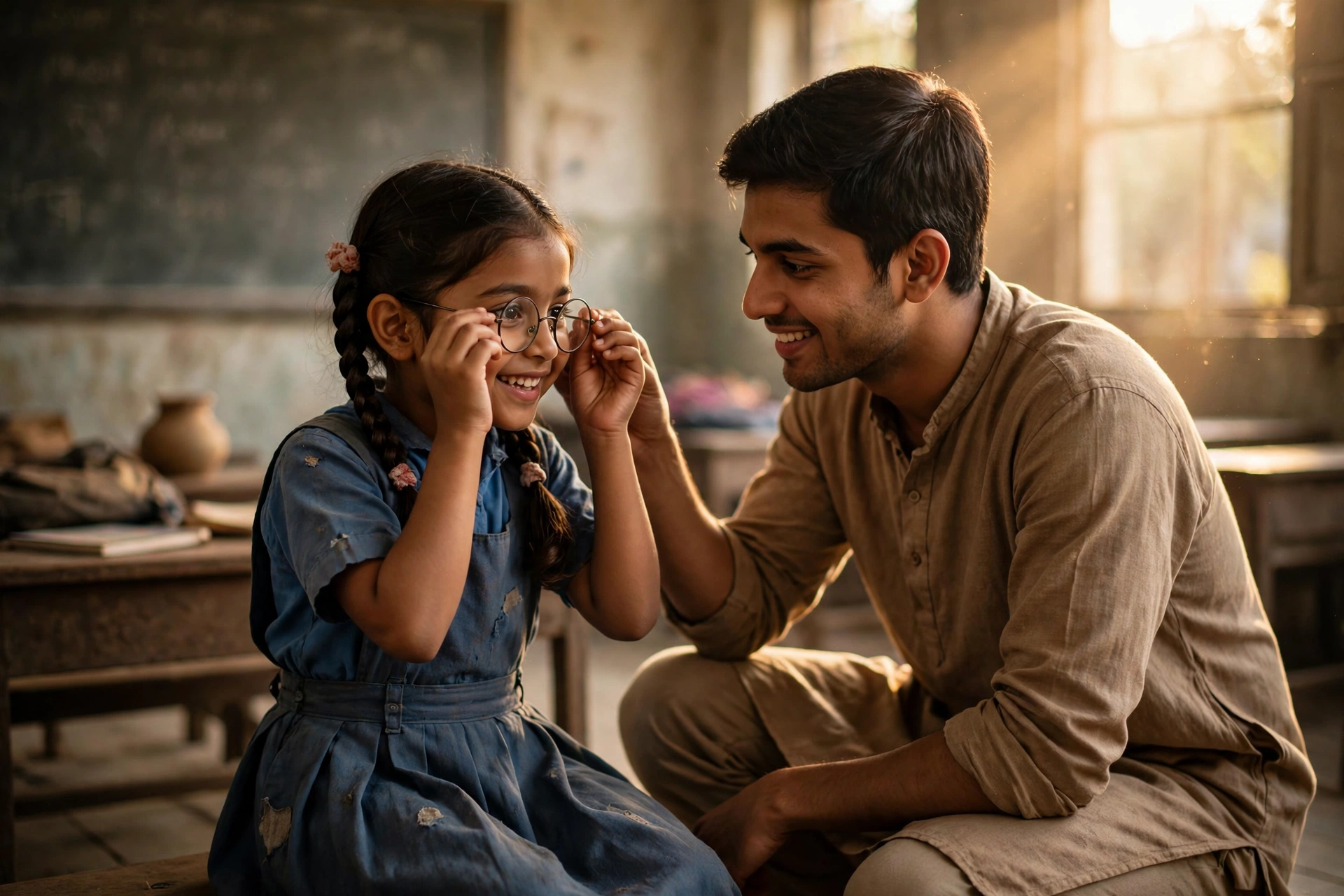
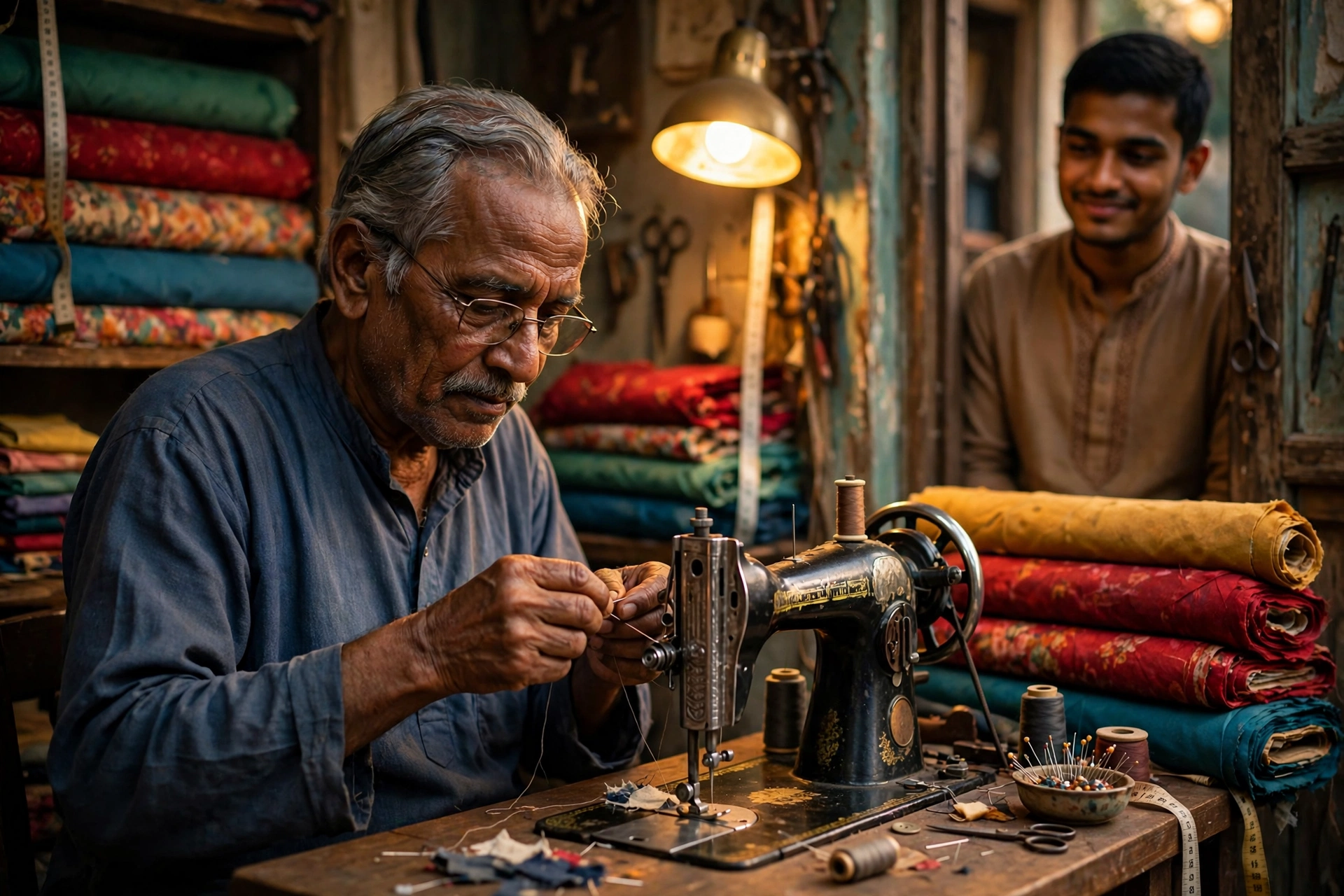
After Meher, the stall was never quiet again. There was Kareem, a tailor of sixty-eight, whose hands had sewn wedding clothes for half the street but who could no longer thread a needle. He had been ready to close his little shop, convinced his working life was over. Hamza found him a pair of strong reading spectacles, and Kareem threaded the needle on his first try. He sat very still, staring at the thread as if it were a miracle, then laughed a deep, relieved laugh. "I thought my hands had forgotten," he said, wiping his eyes. "It was my eyes that had forgotten." The next week, Kareem stitched a small shirt for Hamza's nephew, free of charge. "You gave me back my work," he said. "Let me give something back."
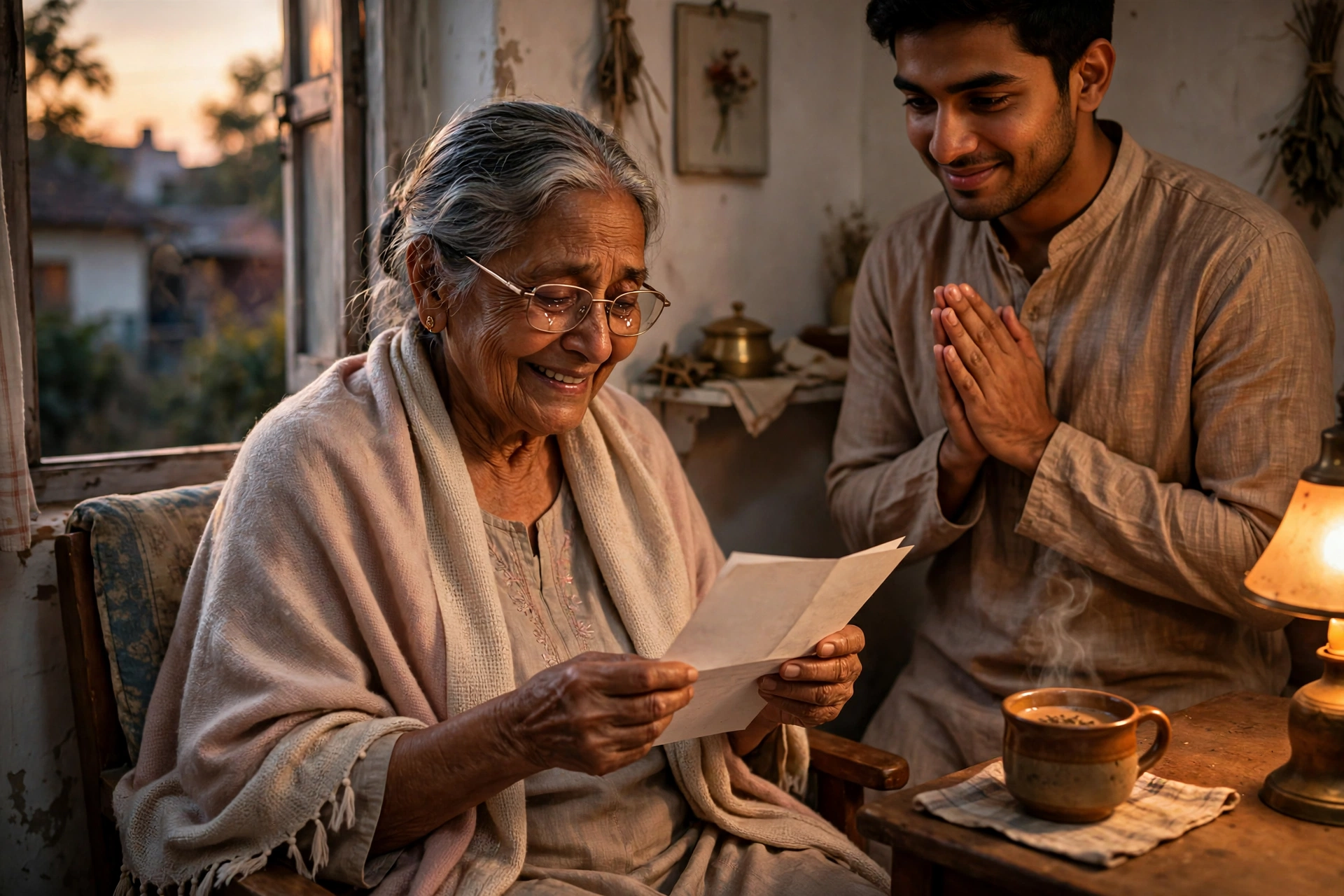
Then came Bibi Zainab, eighty years old, who lived alone in a house full of photographs. Her son had moved abroad many years earlier, and his letters still arrived every month, but for a long time she had only been able to hold them and guess at their words. She hated depending on neighbours to read something so private. Hamza walked to her house one evening with three pairs wrapped in cloth, and she tried them by lamplight until the words sharpened into meaning. She read her son's latest letter slowly aloud, her voice trembling at first, then steady. When she finished, she folded it and pressed it to her heart. "I have waited years to read his words with my own eyes," she said softly. "You have given an old woman her privacy back, and her son back too." That night, Hamza walked home slowly, thinking of Dadi Amna, and for the first time since her death, the ache in his chest felt lighter.
Not everyone believed in what Hamza was doing. One afternoon, a wealthy customer in a fine suit stopped at the stall, picked up a pair of spectacles, and sneered. "You are giving people rubbish," he said loudly. "Second-hand glasses can damage their eyes. You should be ashamed, playing doctor on a street corner." A small crowd gathered. Remembering his grandmother's saying that a kind answer turns away anger better than a loud one, he spoke quietly. "Sir, I am not a doctor, and I never pretend to be," he said. "I tell everyone to see a doctor when they can. But many people here cannot afford a doctor or new spectacles at all. For them, the choice is not between perfect glasses and old glasses. It is between old glasses and no glasses, between seeing a little and seeing nothing. I only offer what I have, honestly, and for free." The man had no answer. He put the spectacles down and walked away. The next Sunday, a box of his own old spectacles arrived at the stall, left anonymously, with no note at all.
The hardest test came in winter, when the landlord raised the rent on Hamza's little corner and he could no longer afford to keep the stall. He packed his tools into a bag, folded his cloth, and told himself the work was finished. But on his last Sunday, something extraordinary happened. Meher arrived with her whole class, each child carrying a drawing for him. Kareem arrived with a new shirt he had stitched specially. Bibi Zainab arrived with her son's latest letter, which she could now read herself. Behind them came dozens of people Hamza had helped, and people he had never met, standing together in the cold morning light. They had collected enough money to pay the stall's rent for a whole year. "You never charged us anything," Meher's mother said, pressing the envelope into his hands. "So now it is our turn. You taught us that kindness is not something you pay for. It is something you pass on."
Hamza stood there, holding the envelope, unable to speak. His grandmother's letters had not been lost. They had simply waited for him to learn their lesson. Dadi Amna had never asked for help because she did not want to be a burden. But Hamza had learned that asking for help, and accepting help, is not a burden at all. It is how a neighbourhood becomes a family. The spectacles were never really about glass and frames. They were about dignity: letting a child read her lessons, a tailor do his work, a mother read her son's words in private, without shame and without waiting.
Today, the stall on Market Road is still there, a little bigger now, with two wooden boxes instead of one. One box is for spectacles people no longer need. The other, Hamza likes to say, is for stories. People leave notes in it about what their new spectacles helped them see for the first time: a granddaughter's face, a bus number, a line of poetry, a sunset over the rooftops. Hamza keeps those notes in a folder, tied with a ribbon, beside his tools. When a visitor asks why he does all this work for nothing, he smiles and points to them. "Because someone once waited too long to see what mattered," he says. "And I never want anyone on this street to wait like that again."
If you ever walk down Market Road on a Sunday morning, you will find him there, polishing a lens with great care, as if it were something precious. And in a way, it is. For Hamza learned the simplest truth of all: we do not truly help others by giving them what we have thrown away. We help them when we look closely enough to see what they are missing, and then quietly help them see it for themselves. A pair of spectacles can change how a person sees the world. But a single act of kindness can change how the whole world sees that person, and that is a gift that never wears out, never breaks, and never needs to be returned.