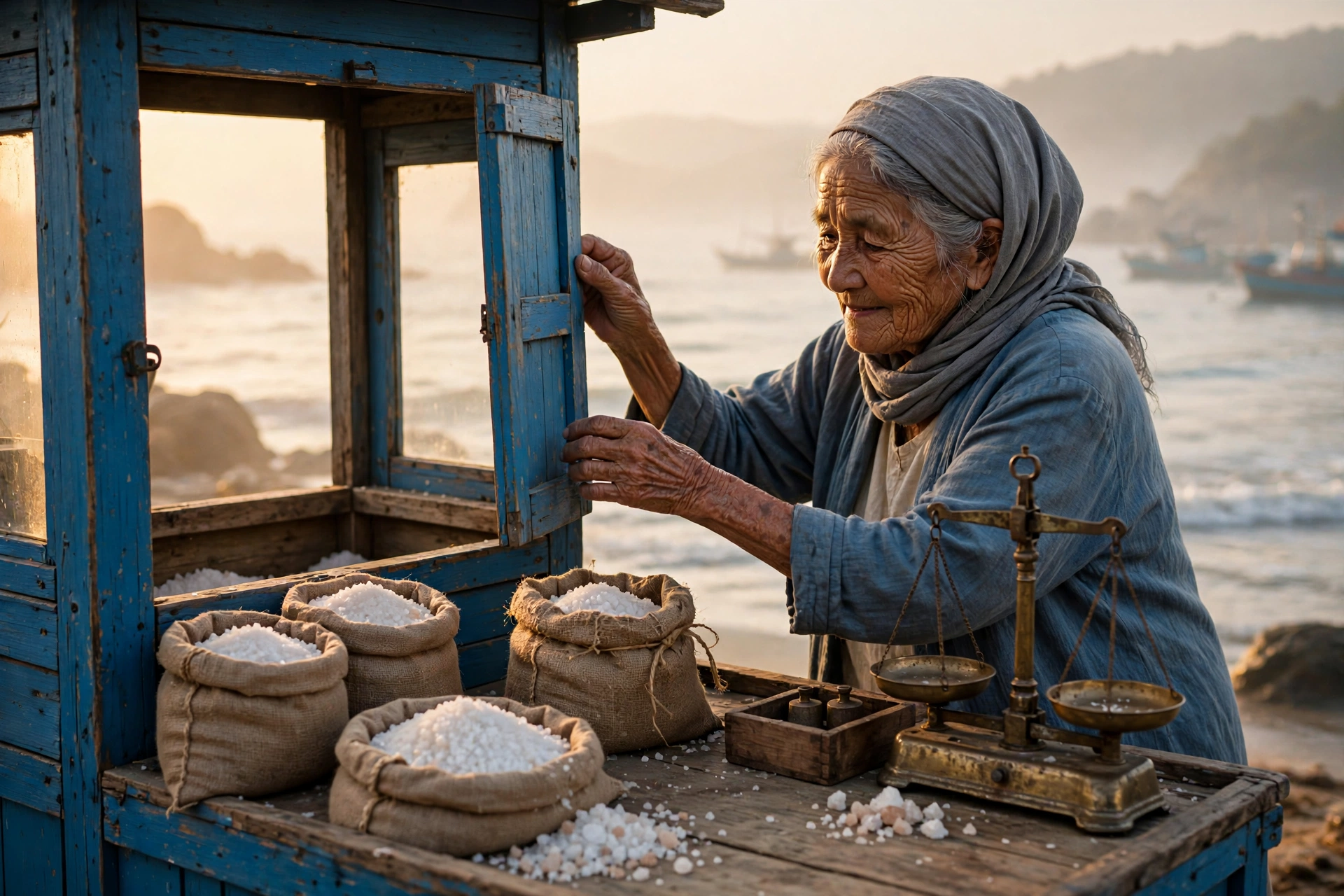
Every morning before the sun had finished climbing out of the sea, Amna opened the blue wooden shutters of her little stall at the end of Seaside Lane. The stall was no bigger than a cupboard, with a crooked roof and a sign painted in white letters that had faded over forty years: SALT. Inside, sacks of coarse sea salt stood in a neat row, and on the counter sat a brass weighing scale that had belonged to her father, polished bright by decades of use.
Amna was seventy-two years old, thin as a reed, with hands roughened by salt and work. She had sold salt on that same corner since she was a young woman, and everyone in the town knew her. Fishermen bought salt to preserve their catch. Mothers bought it for their cooking pots. Bakers bought it by the kilo. And when someone came with empty pockets, Amna did something no other seller in the market would do. She filled their bag anyway, and wrote their name in a small cloth-bound ledger, under a column headed simply: "To be paid when you can."
"Amna, you will go hungry yourself one day," the spice merchant warned her more than once, shaking his head at her ledger. "Half this town owes you money."
Amna only smiled. "A person who has no salt cannot cook for their children," she would say. "And a child who goes to bed hungry does not care about my accounts."
The ledger grew fat over the years. Pages and pages of names, some crossed out when the debt was settled, many never crossed at all. There was Karim the fisherman, who owed for three winters. There was Fatima, the widow with five children, whose name appeared on so many pages that Amna had stopped counting. There was young Bilal, who had once stolen a handful of salt as a hungry boy and then, ashamed, came back years later to pay double. Amna had torn that page out and thrown it into the sea. "A debt paid with shame is no debt at all," she told him.
Amna lived alone in a small house behind the stall, and her own meals were simple: bread, lentils, and tea. She never complained. The sea breeze through her window, the cries of the gulls, and the voices of her customers were company enough. On Fridays, children from the lane would gather around her stall, and she would tell them stories of the old days, when her father sailed out with the salt traders and came home with pockets full of shells for her. The children loved her, and she always sent them home with a pinch of pink salt wrapped in paper, "for luck," she said, winking.
But the town was changing. A big supermarket opened near the harbour, selling salt in bright plastic packets, cheaper than Amna's by a few coins. One by one, some of her customers drifted away. The young people said the supermarket was more convenient. The fishermen still came, out of loyalty, and the old families still came, out of love. But the coins in Amna's tin box grew fewer, and some evenings she sat at her table counting them twice, wondering how the month would end.
Still, she never turned anyone away. When old Uncle Rahim came shuffling down the lane, his hands trembling, and whispered that his pension had not arrived, she filled his bag to the brim and waved away his thanks. "Pay me when the pension comes, Uncle," she said. "And if it does not come, then pay me with a story."
One grey October morning, the wind changed. The fishermen, reading the sky the way other people read newspapers, shook their heads at the harbour. A storm was coming, bigger than any in living memory. The radio warned people to stay indoors, to stock food and water, and to move away from the shore. By noon, the sea had turned the colour of iron, and waves began to hammer the stone wall at the end of Seaside Lane.
Amna refused to leave her stall. "Forty years this stall has stood," she told the young policeman who came to warn her. "It will stand one more night."
But the storm did not listen to her courage. By midnight, the wind was screaming through the lane like a wounded animal, and the sea rose over the wall and crashed down the street in a black, roaring flood. Water smashed through Amna's little stall, tore the blue shutters from their hinges, and carried her sacks of salt away into the churning dark. Her father's brass scale clattered across the stones and vanished under the water. The cloth-bound ledger, forty years of names and kindness, soaked through and dissolved into pulp in her hands as she clutched it to her chest.
Neighbours pulled Amna from her flooded house before dawn, coughing and shivering, wrapped in a blanket that was not her own. When the storm finally broke and the sun rose over a drowned and battered town, Seaside Lane looked like a battlefield. Boats lay upside down in the street. Roofs had been torn away. And where Amna's stall had stood for forty years, there was nothing but broken planks and scattered salt dissolving in the puddles.

Amna sat on a wet doorstep and wept quietly, not for the salt or the stall, but for the brass scale that had been her father's, and for the ledger. "All those names," she whispered to Fatima, who sat beside her holding her hand. "All those people I trusted. Now even the record is gone."
Fatima said nothing at first. Then she stood up, wiped her own tears, and walked down the lane. She knocked on the first door, then the second, then the third. And what happened next, Amna would remember for the rest of her life.
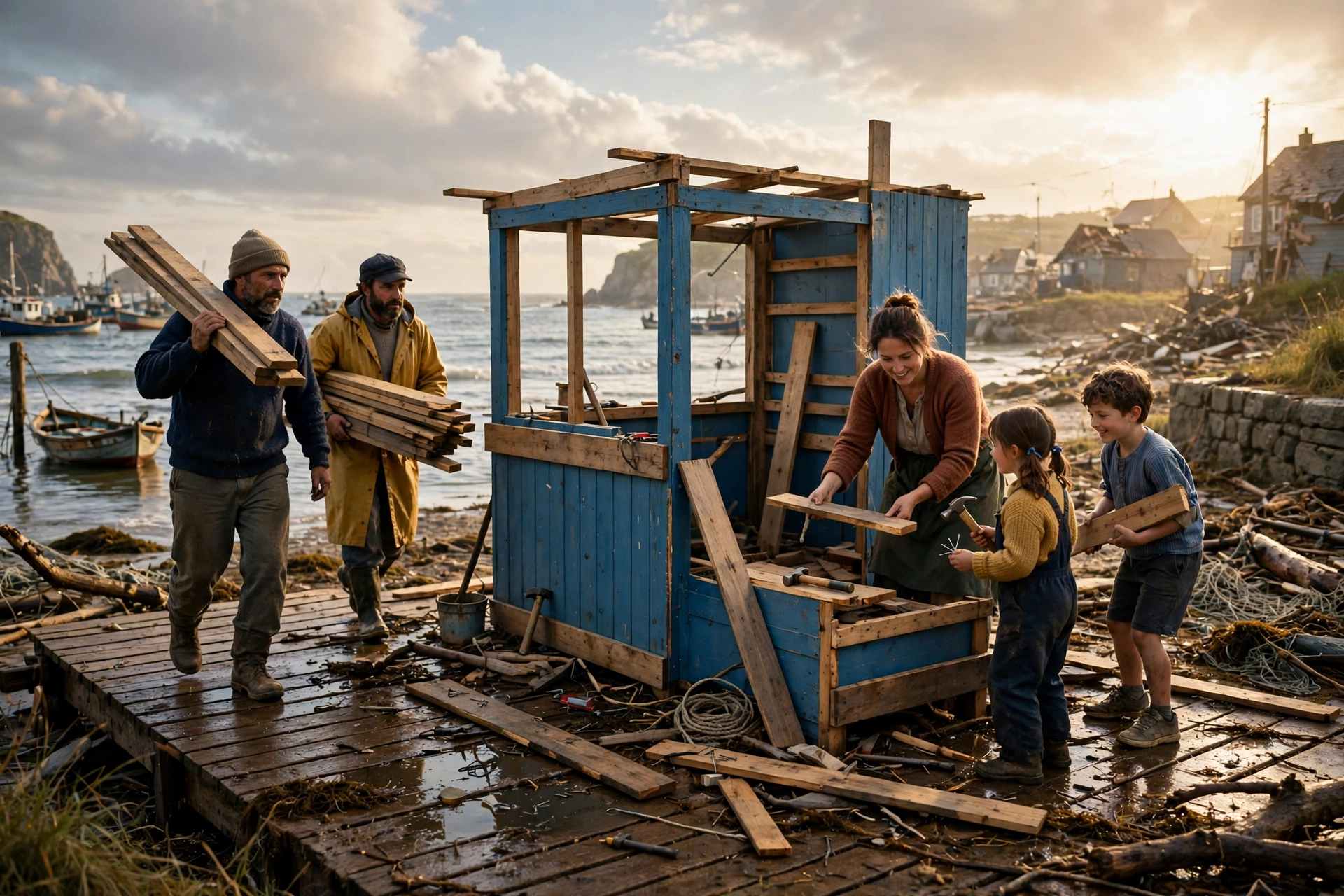
Karim the fisherman arrived first, carrying planks of wood on his shoulder and a hammer in his hand. "You gave my family salt through three winters when the catch was bad," he said gruffly, hiding his embarrassment behind work. "Today I build."
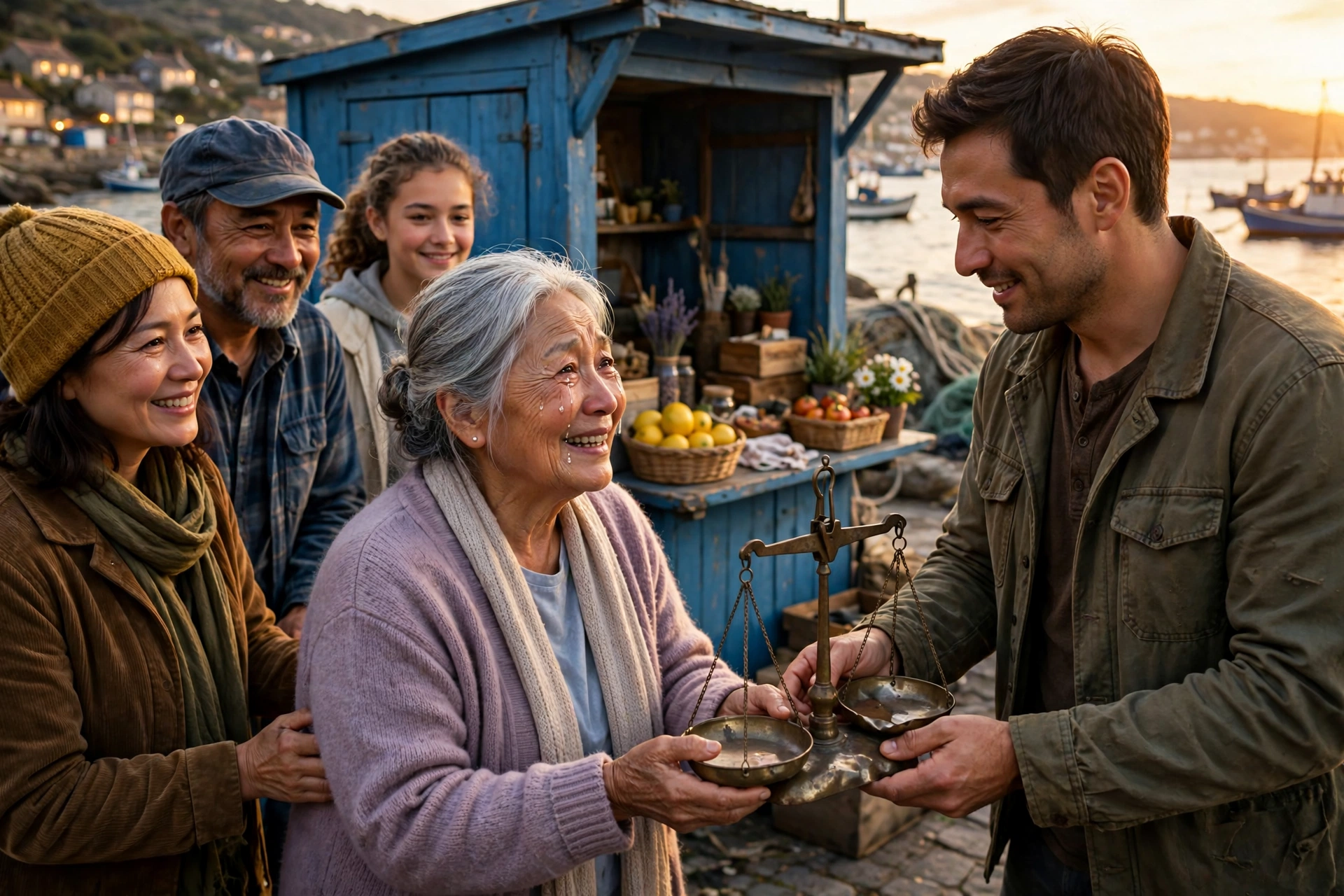
Behind him came Bilal, now a grown man with a carpenter's tools, and his two sons. Then came the baker with fresh bread, and the mothers with pots of stew, and Uncle Rahim, trembling but determined, carrying the old brass scale — dented and barnacled, but found washed up near the harbour wall, where he had searched for it since sunrise.
By midday, half the town was in Seaside Lane. The fishermen rebuilt the stall, stronger than before, with a new roof and fresh blue paint. The baker's wife scrubbed the counter. The children, solemn as soldiers, collected every grain of spilled salt they could find and poured it into a new sack, laughing when the wind blew it into their hair. And one by one, the people whose names had been in the ledger came forward — not to pay money, but to give what they had. A fisherman brought his best catch. A widow brought a quilt she had sewn all winter. The spice merchant, red-faced, brought a whole sack of fine salt and a new ledger, bound in red cloth, with the first page already written in his careful hand: "Amna — owed by all of us, forever."
Amna stood in the middle of it all, her hands over her mouth, tears running down her wrinkled cheeks. She tried to speak, to refuse, to say it was too much, but the words would not come. Fatima put an arm around her shoulders and said softly, "You wrote our names in your book for forty years, Amna. Today we write yours in ours."
That evening, when the new stall was finished and the sign freshly painted, the whole lane gathered for tea. Amna weighed out salt on her father's dented brass scale, which worked perfectly despite its journey through the storm, and she filled bag after bag for her neighbours. This time, when someone tried to pay, she shook her head and laughed through her tears. "No debts today," she said. "Today, the salt is a gift. From me to you, and from you to me."
From that day on, the stall at the end of Seaside Lane was never just a shop again. It became the place where the town gathered, where news was shared, where a hungry stranger was fed before being asked their name. And above the counter, in a small wooden frame, hung the first page of the red ledger, so that every customer would read the words the spice merchant had written: "Amna — owed by all of us, forever."
Years later, when Amna was gone and her stall passed to Fatima's eldest daughter, the people of the town still told the story of the storm to their children. They told it not as a story about a flood, but as a story about a woman who had spent her whole life giving, and who discovered, on the hardest night of her life, that kindness is the one treasure a storm cannot wash away. For what we give with an open hand does not disappear. It waits quietly in other people's hearts, like salt kept safe in a dry place, and it comes back to us, many times over, on the very day we need it most.