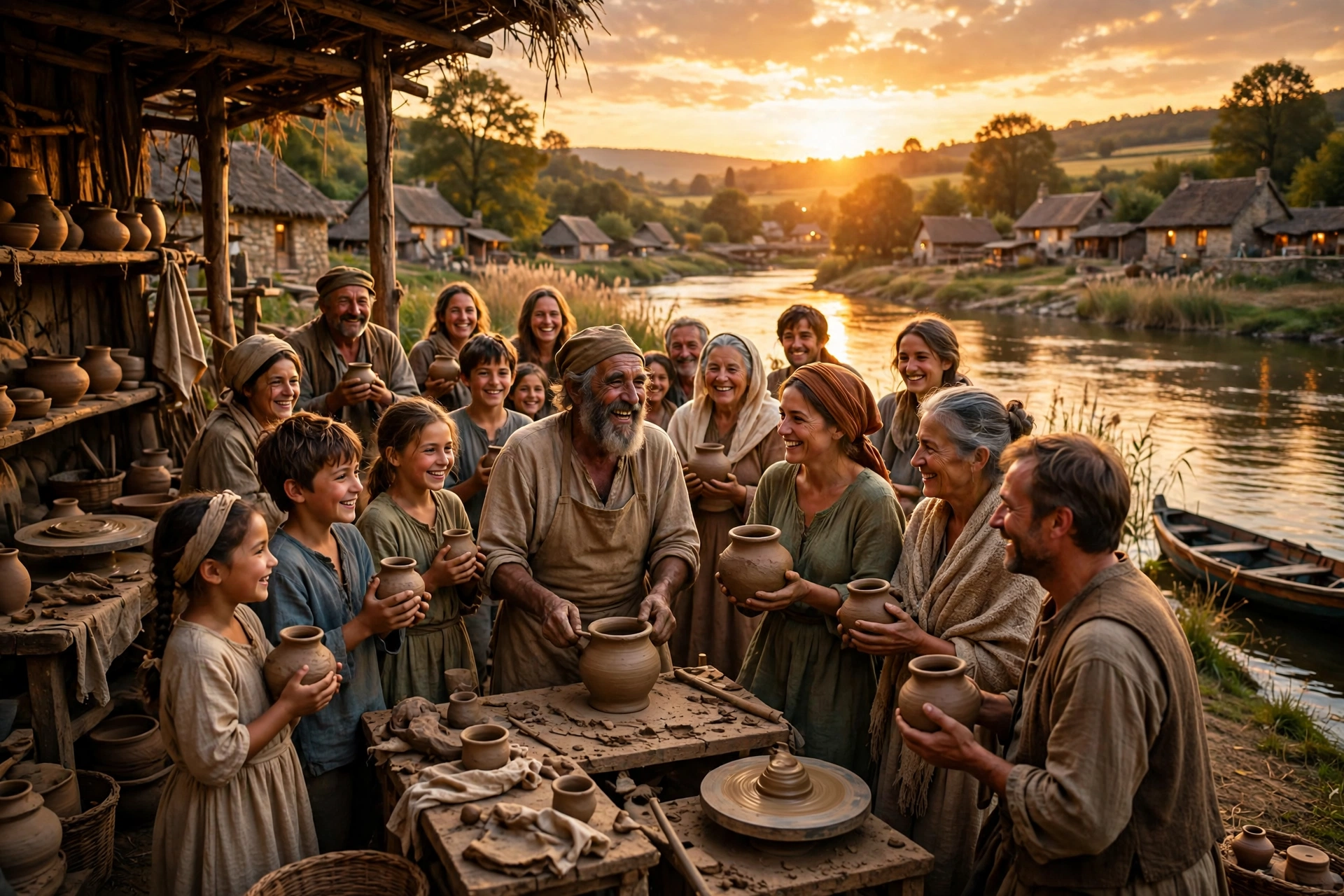
For fifty years, the first sound on Riverbank Lane was the turning of Rahim's wheel.
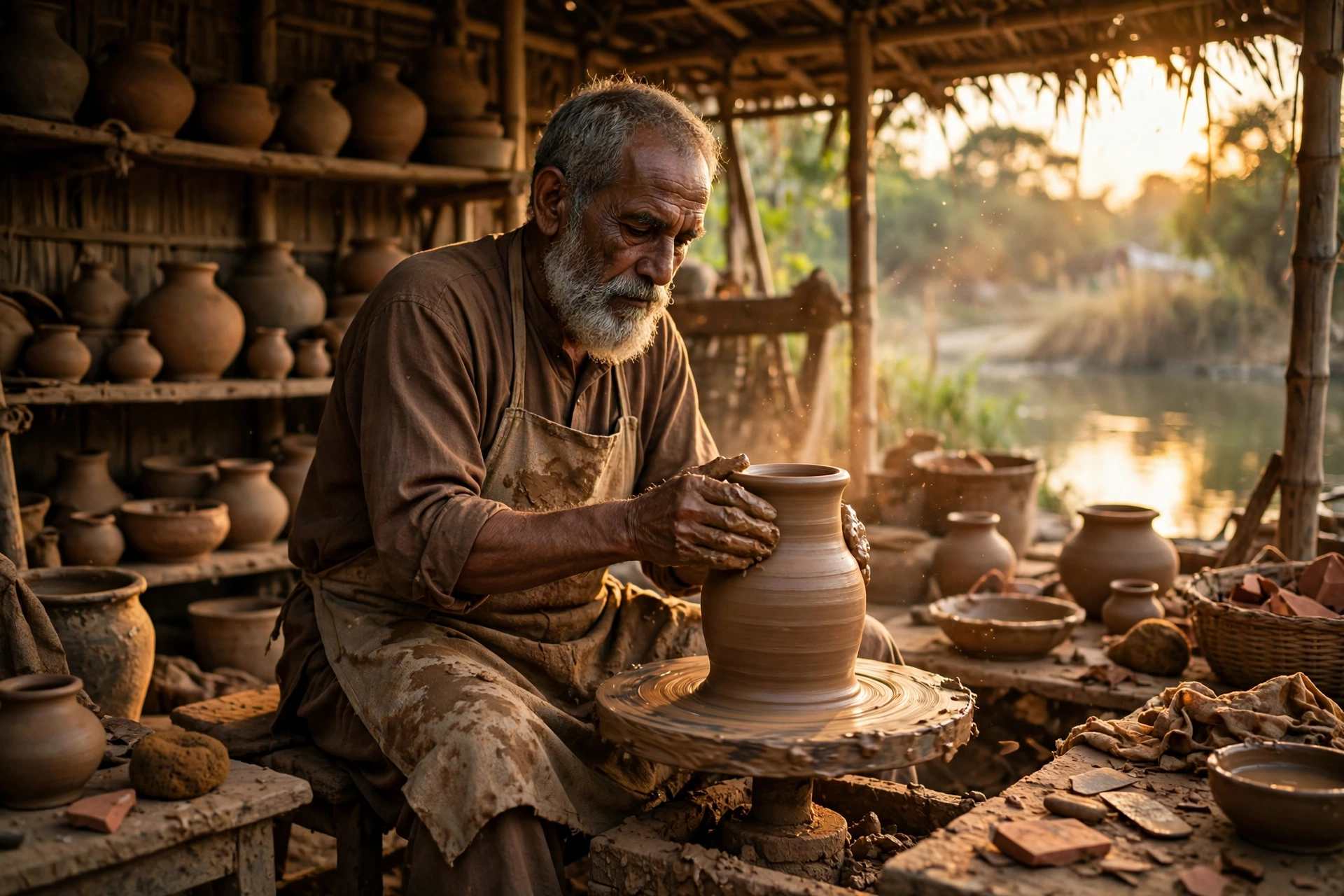
Long before the tea stalls opened and the fishermen pushed their boats into the grey-green river, the old potter would wet his hands in a bucket of cold water, press a lump of river clay onto the wheel, and coax it upward into a pot. His workshop was a small open shed at the end of the lane, its roof patched with tin, its shelves crowded with pots of every size: wide water jars, narrow-necked pitchers, small cups for children, and squat planters that his late wife Amina used to fill with marigolds. People used to come from three villages away to buy them. Now they bought plastic buckets, and Rahim's pots sat unsold, gathering dust.
Rahim was seventy-two, with a grey beard, hands mapped with fine cracks like the clay he worked, and a back that ached when he bent too long over the wheel. His son had moved to the city years ago, to a job in an office with clean hands, and called once a month to say, gently, that his father should close the shed and come and live with him. Rahim always said he would think about it, and then he never did. Amina had died three winters ago, and the house behind the workshop was quiet in a way that frightened him. But the wheel still turned, and as long as it turned, he was not entirely alone.
One rainy morning in early spring, when the river was swollen and the lane was slick with mud, a small boy came running into the shed, clutching something wrapped in a torn piece of cloth. He was about nine, thin, with wet hair plastered to his forehead and eyes red from crying. Rahim looked up from his wheel.
"What have you broken, child?" he asked, not unkindly, because the boy was holding the bundle the way children hold something they have already been scolded for.
The boy unfolded the cloth with trembling hands. Inside were the pieces of a clay water pot, its neck snapped clean off, its body cracked in two. "It was my mother's," he whispered. "She carries water in it every morning. I was carrying it home from the well and I slipped. She works all day washing clothes for other people, and this was the only pot we had that did not leak. Now I have broken it, and we have no money for another."
Rahim turned the pieces over in his hands. The pot was not one of his; it was old, factory-made, thin as an eggshell. But the boy's shame was heavier than the clay. "What is your name?" Rahim asked.
"Hassan," the boy said.
"Well, Hassan," Rahim said, "a pot that breaks is not the end of the story. Clay remembers being soft. Sit down."
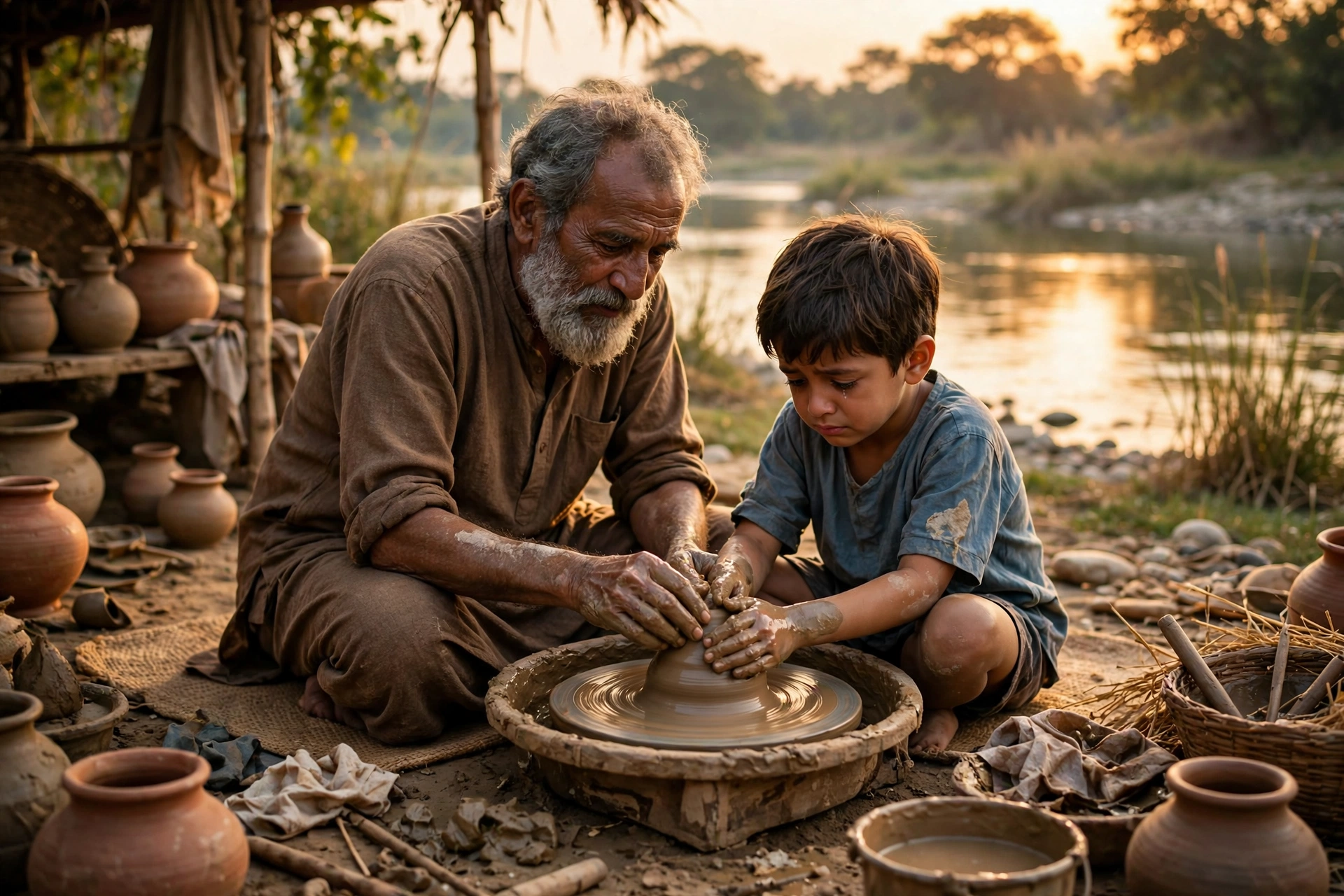
He did not simply give the boy a new pot, though he had a hundred on his shelves. Instead, he set a fresh lump of clay on the wheel and patted the stool beside him. "Put your hands here," he said, "and do not be afraid of the mess." Hassan hesitated, then pressed his small hands against the spinning clay. It wobbled, collapsed, and splattered his shirt, and to his surprise, Rahim laughed, a deep warm laugh that seemed to shake the dust off the shelves. "See?" the old man said. "Even when it falls, you can gather it up and begin again. Clay forgives you. That is its whole secret."
While rain drummed on the tin roof, they worked together. Hassan's first pot leaned, his second had a lopsided lip, and his third stood straight, a little rough but whole. Rahim fired it that evening, and next morning it waited on the shelf, with a tiny thumbprint near its rim.
"It is not perfect," Hassan said, turning it over.
"No," Rahim agreed. "It is better than perfect. It is yours. And it will carry water, which is all a pot ever needs to do."
Hassan carried the pot home like treasure. His mother Fatima, who washed clothes until her knuckles were raw, wept, not because a pot had been replaced, but because someone had taught her boy that a mistake was not the same as being worthless.
Hassan came back the next day, and the day after that, sweeping the shed and learning to centre clay without it flying off the wheel. Soon other people began to stop by the shed, not to buy, but to talk. An old fisherman named Kareem, whose boat had been damaged in a storm, sat on an upturned bucket and watched the wheel turn. A widow named Salma, who lived alone since her children had moved away, brought Rahim rice and stayed to watch. A young schoolteacher confessed she had almost given up on her rowdiest class.
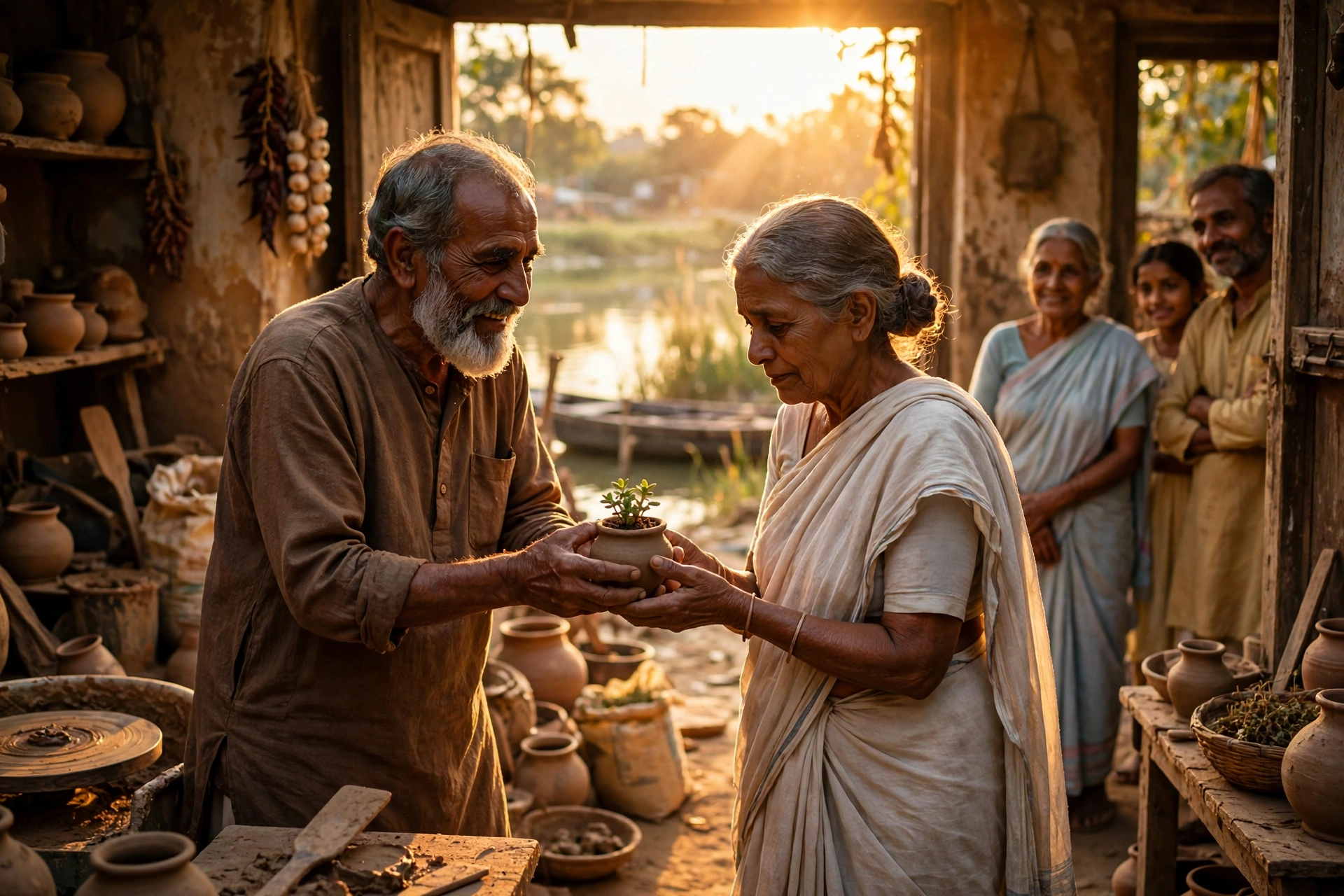
Rahim listened to them all. He had never been a man of many words, but clay had taught him patience, and patience, he discovered, was a kind of listening. One evening, as the light turned gold over the river, he had an idea that seemed foolish even to him. He took a small planter from his shelf, pressed a marigold seed into the soil inside it, and gave it to Salma. "This one is not for sale," he said. "It is for a story. If you tell me what weighs on your heart, the pot is yours, and the plant is yours to grow."
Salma laughed through sudden tears. "Old man, you will go out of business giving things away."
"I am already out of business," Rahim said, smiling. "So I may as well be useful."
Salma told him about the empty rooms in her house and the silence at her table, and she carried the planter home cradled against her chest like a child.
 The next day, Kareem came with his own story, about the river that had fed him for forty years and now seemed to have turned against him, and he left with a sturdy jar and a seed. Then the schoolteacher came, and then Fatima, and then a shy young man who had lost his job at the mill and was afraid to tell his family. Each one left with a pot, a seed, and a lighter step. Rahim called it his trade of stories, and he kept no ledger of it.
The lane began to change in small, visible ways. Marigolds appeared on windowsills that had been bare for years. Clay pots lined the steps of houses, each one a little different, each one holding something green and growing. Children who had once hurried past the shed now stopped to watch the wheel, and Hassan, proud in his new role, taught them what Rahim had taught him: gather it up, begin again, clay forgives you. Salma began cooking an extra portion of food and leaving it at Rahim's door, because, she said, a man who fed other people's hearts should not eat alone. Kareem, who could mend nets better than anyone on the river, repaired the shed's torn roof in return. The schoolteacher brought her whole class one afternoon, and twenty small hands pressed into wet clay, and twenty small pots, gloriously crooked, went home to twenty delighted mothers.
But not everyone was pleased. A wealthy shopkeeper named Seth Imran came one hot afternoon with an offer on crisp paper: he would buy the workshop and the riverside land, tear down the shed, and build a warehouse. The price was more money than Rahim had seen in his life.
"You are a sensible man, Rahim," Seth Imran said, looking around at the dusty shelves with polite distaste. "This place makes nothing anyone wants. Take the money while it is offered."
Rahim looked at the paper for a long time. He thought of Amina, who had said a home without something growing in it was not a home at all, and of Hassan's lopsided pot and Salma's marigolds, and he folded the paper and handed it back.
"This place makes something people want," he said quietly. "It just does not sell it. I am sorry, Seth. The shed is not for sale."
Seth Imran left in a fury, warning that the old man would regret his pride. For a while, it seemed he might be right. The summer that followed was hard. The river rose higher than anyone could remember, swollen by weeks of rain, and one terrible night it broke its banks and rushed down Riverbank Lane in a brown, roaring flood. Water poured into houses, swept away chickens and firewood, and surged toward Rahim's shed, where the kiln stood and a lifetime of pots waited on their shelves.
Rahim stood in the doorway in the rain, an old man against a rising river, and for a moment he thought of all his years of work dissolving into mud. Then he heard voices, and saw lights bobbing through the dark: Hassan running ahead with a lantern, Fatima behind him, Salma with her shawl over her head, Kareem, the schoolteacher, the young man from the mill, and a dozen neighbours more, all of them carrying empty sacks and baskets. They had come, every one of them, because a pot and a seed had once told them they mattered.
They worked through the night in the rain, stacking sandbags, carrying the pots to higher ground, wrapping the kiln in tarpaulin. Hassan, small and soaked, carried pot after pot up the lane. When dawn broke, grey and exhausted, the water was still lapping at the shed's threshold, but the kiln was dry, the pots were safe, and Rahim was sitting on an upturned bucket, weeping openly, surrounded by his neighbours, who were too tired to pretend they were not weeping too.
"You saved my life's work," he said, when he could speak.
"No," Salma said, taking his hand. "You saved ours first. You only gave us pots. We are giving them back."
In the weeks after the flood, the lane rebuilt itself together. And Seth Imran, who had watched the rescue from his dry shop doorway, came one quiet evening without his crisp paper and asked, awkwardly, if Rahim would teach his grandson to make a pot, because the boy was afraid of failing at everything he tried.
Rahim smiled, the same warm smile he had given Hassan on that first rainy morning, and patted the stool beside the wheel. "Sit down," he said. "And do not be afraid of the mess."
Years later, when Rahim's hands could no longer centre the clay, Hassan, now a tall young man, took his place at the wheel, while Rahim watched from the doorway. The shed never became rich, but Riverbank Lane became known as the lane where a broken pot was the beginning of a friendship, and every windowsill bloomed with marigolds grown from a freely given seed.
And if you walk down that lane today, at the hour when the light turns gold over the river, you will hear the turning of a wheel, and you will see, on a shelf by the door, a small, slightly lopsided pot with a thumbprint near its rim. It still carries water, as it has done since the morning a frightened boy learned that what breaks can be gathered up and begun again. For clay, like kindness, does not ask you to be perfect. It only asks you to try, and to believe that something whole can still be shaped from what you thought was ruined.