For forty years, the day in the small town of Roshanpur did not truly end until old Rahim took his wooden stool beneath the great banyan tree and cleared his throat. As the lamps came on in the windows, the children would slip out of their houses and gather in a circle around him, their faces turned up like flowers toward the sun. Then Rahim would smile, tap his walking stick twice against the ground, and say, "Once, long ago, in a place not far from here…" And for an hour, the whole town seemed to hold its breath.
Rahim knew a hundred stories, and each one of them belonged to Roshanpur the way the river belonged to it. There was the tale of the king who gave away his crown to a hungry stranger and woke the next morning to find his kingdom richer than before. There was the story of the river that had forgotten how to sing, and the little fish who taught it again. There was the sparrow who carried the sun on her back through the longest night of winter so that a sick child might see morning. The children knew them all by heart, and still they begged for them again and again, because a story told by Rahim was never quite the same twice.
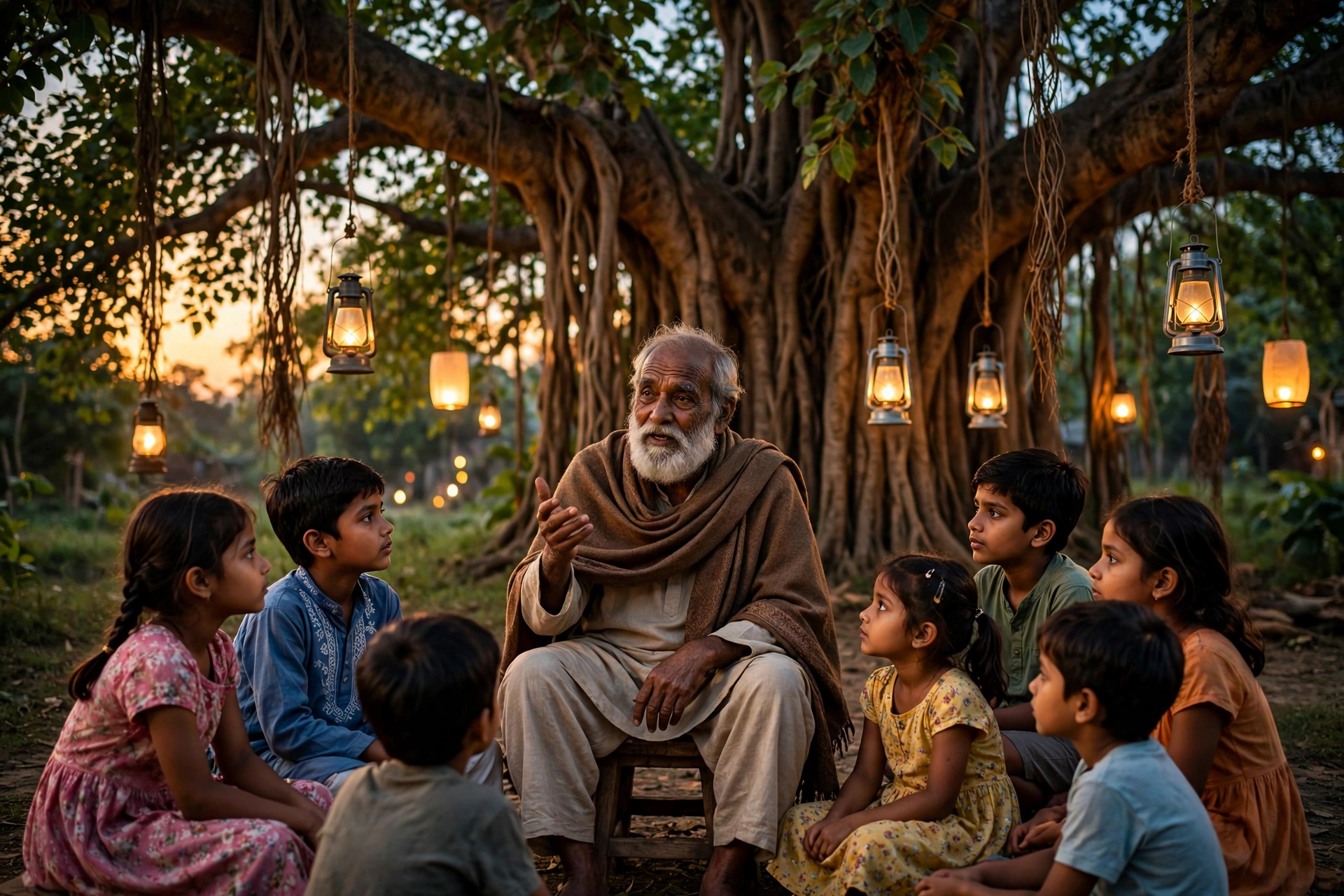
Rahim had not always been an old man with a white beard and a walking stick. Once he had been a schoolteacher, and before that a boy who had sat in this very circle listening to his own grandfather's stories. His wife, Salma, had died ten winters ago, and his only son had moved to the city and called once a month, his voice growing thinner with every passing year. Rahim lived alone in a small house with blue shutters, where he cooked his own lentils and kept his stories in his head the way other men kept money in a box. He had never written a single one of them down. "A story written on paper," he used to say, "is a bird in a cage. A story told aloud is a bird in the sky."
But in the last year, something had begun to change, so slowly that at first nobody noticed. Rahim would pause in the middle of a story, his hand hovering in the air, searching for a word that had always been there before. He would call the baker's son by his father's name. Once, on his way home from the market, he stopped at a crossroads and stood there for a long time, looking left and right, until a neighbour gently took his arm and walked him home. The town whispered about it, but no one said it to Rahim, and Rahim said nothing to anyone. He only gripped his walking stick a little tighter and came to the banyan tree a little earlier each evening, as if by arriving first he could hold on to what was slipping away.
Then came the evening in late autumn when everything changed. The children were already seated, their knees pulled up to their chests, waiting. Rahim settled onto his stool, tapped his stick twice, and opened his mouth. "Once, long ago," he began, "in a place not far from here, there lived a… a…" His voice trailed away like smoke. He looked around the circle, his eyes wide and lost, and the children looked back at him, suddenly very still. "Forgive me," he said at last, in a voice so small it hardly sounded like his own. "Forgive me, children. I have forgotten how the story goes."
Nobody laughed. Nobody even whispered. A little boy in the front row reached out and patted Rahim's knee. Rahim stood up slowly, folded his stool under his arm, and walked home through the darkening lanes, and no one followed him. That night, for the first time in forty years, the banyan tree stood empty at dusk, and the town felt the silence of it like a missing tooth.
The next evening, only three children came. The evening after that, only one. Then none. It was not cruelty. Children are not cruel; they are simply honest in the way that only children can be, and they did not know what to do with a storyteller who had no stories. But Rahim sat beneath the tree anyway, night after night, alone with his stool and his stick, staring at the empty circle of dust where small feet used to sit, waiting for words that would not come. His son called from the city and said, "Father, come and live with us," and Rahim said, "Soon, soon," because he could not bear to tell his son that he was afraid he would forget the way home.
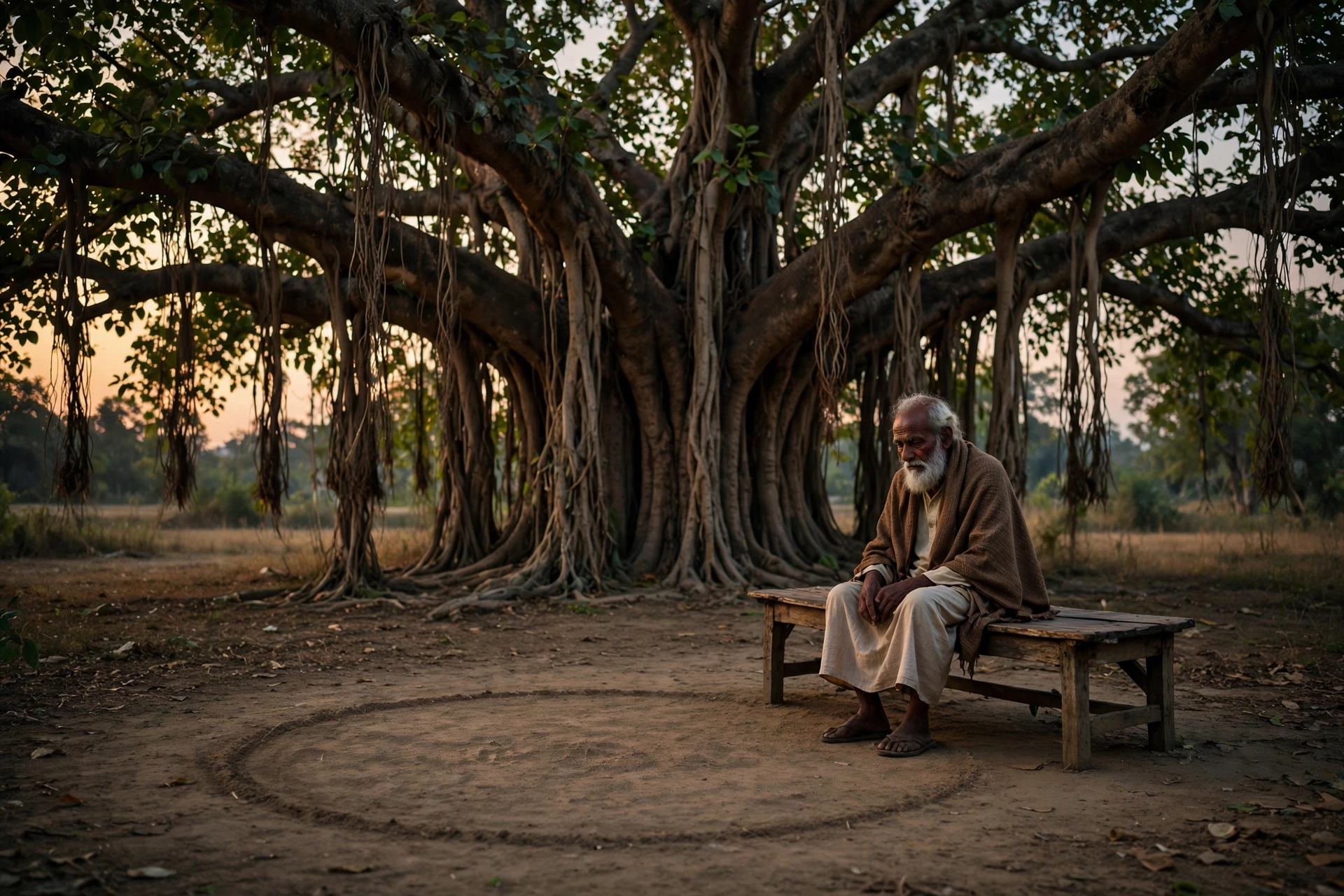
Noor was nine years old, and she had never missed a single evening beneath the banyan tree. She was the girl with the long braid and the green dress who always sat in the front row and always asked, "And then what happened, Uncle Rahim?" When the stories stopped, something in her stopped too. She would stand at her gate at dusk and look toward the tree, hoping. One evening, she could bear it no longer. She walked to the tree and sat down in the dust beside the old man, though there was no story to hear.
"Uncle Rahim," she said, "why have the stories gone away?"
Rahim looked at her for a long moment, and his eyes were like windows in a house where the lamps had gone out. "I don't know, child," he said. "It is like a lamp that has run out of oil. The light was there, and then it was not."
That night, Noor told her grandmother what he had said. Her grandmother was shelling peas into a brass bowl. She did not look up. "Memory is like a lamp, child," she said. "Sometimes the oil runs low. But a lamp can be lit again — from another lamp. If your uncle's stories are gone from his head, they are not gone from the world. He gave them away for forty years. They are living in everyone who ever heard them."
Noor put down her spoon. She understood. The next morning, before school, she took her exercise book and wrote on the first clean page in her crooked handwriting: THE STORIES OF UNCLE RAHIM. Then she went out into Roshanpur with her notebook under her arm.
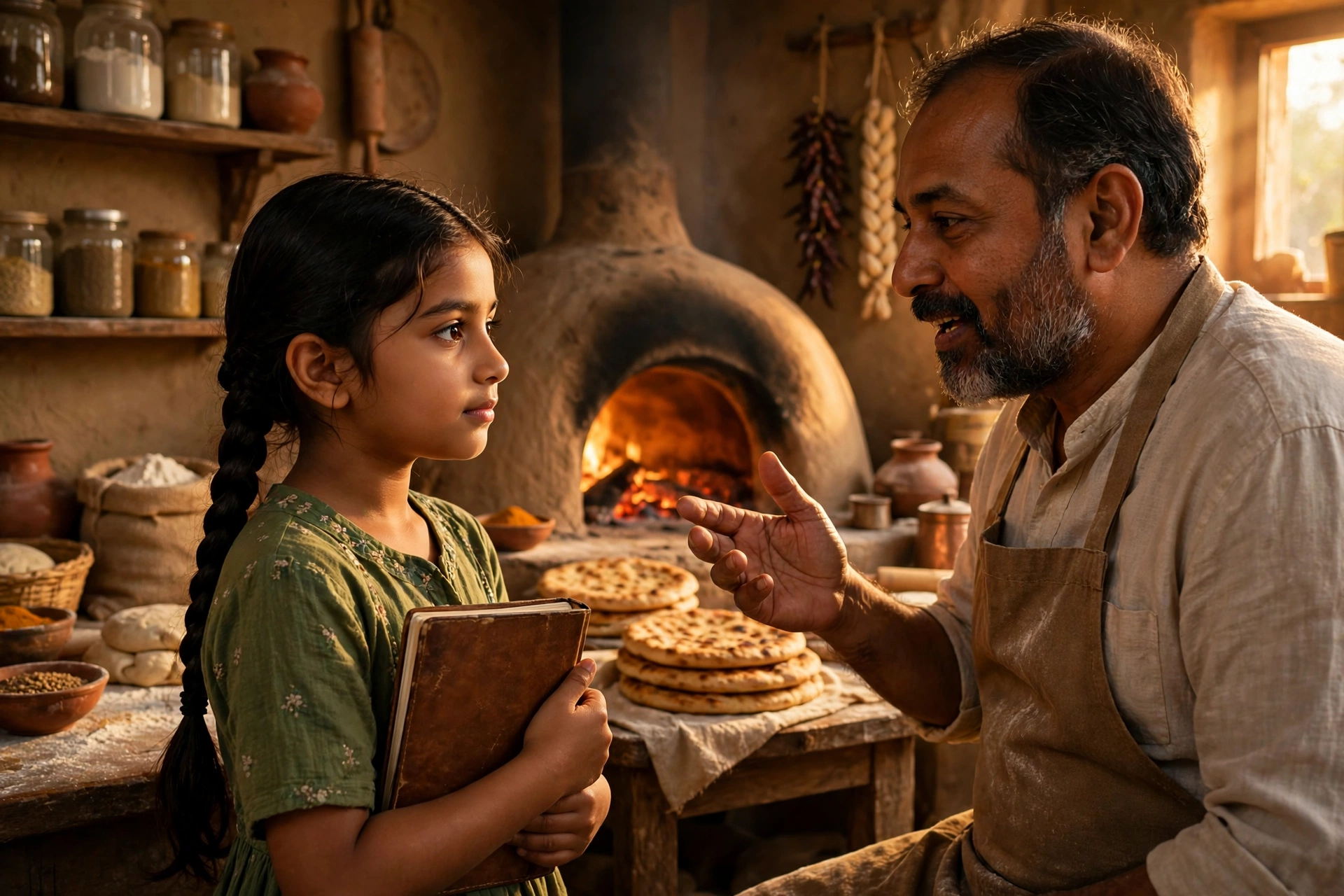
Her first stop was the baker's shop, where Kareem was pulling flatbread from the clay oven with hands as brown as the crust. "Uncle Kareem," she said, "do you remember the story of the king who gave away his crown?"
Kareem laughed so hard the flour rose off his apron like smoke. "Remember it? Child, I have told it to my own grandchildren a hundred times. The king was rich and the kingdom was poor, and one night a stranger came to the gate, hungry and cold, and the king gave him his crown to sell for bread. And the next morning, the people loved the king so much that they built him a new crown — out of their own gold, piece by piece." He told her the whole story, slowly, while the bread baked, and Noor wrote it down as fast as her pencil could move.
From the bakery, she went to the riverbank, where the old fisherman mended his nets. He remembered the river that forgot how to sing, and the little fish who taught it again, and he told it with his eyes closed, the way a man recites a prayer. The schoolteacher remembered the sparrow who carried the sun, and the widow at the end of the lane remembered the two brothers who shared one coat through a winter so cold the river froze solid. The cobbler remembered the shoes that walked home alone every night to the man who had made them. By the end of the week, Noor's notebook was fat with stories, and her pencil was worn down to a stub, and the whole town knew what she was doing. People began to stop her in the street. "Child," they would say, "I remember one too. Write this down." Everyone, it seemed, was carrying one of Rahim's stories inside them, the way a pocket carries a stone.
Each evening, when the lamps came on, Noor would walk to the banyan tree and sit beside Rahim in the dust, and she would open her notebook and read him one of his own stories back to him. At first, he listened the way a stranger listens, politely, his hands folded over his walking stick, his eyes on the ground. But Noor did not stop. She read slowly, stumbling over the long words, and sometimes she laughed at the funny parts before she had even finished reading them, because she remembered them too.
On the seventh evening, something happened. She was reading the story of the river that forgot how to sing, and she reached the part where the little fish swims up to the river and says, "You have forgotten your song, but I have not." And before she could read the next line, Rahim whispered it, so quietly she almost missed it. "You have forgotten your song, but I have not." Noor looked up. His eyes were shining. He was smiling — the first real smile anyone had seen on his face in weeks.
"Again," he said. "Read it again."
She read it again. And this time, halfway through, he joined in, his old voice rough and trembling, and together they finished the story, the old man and the little girl, beneath the banyan tree, while the evening star came out above them like a lamp being lit.
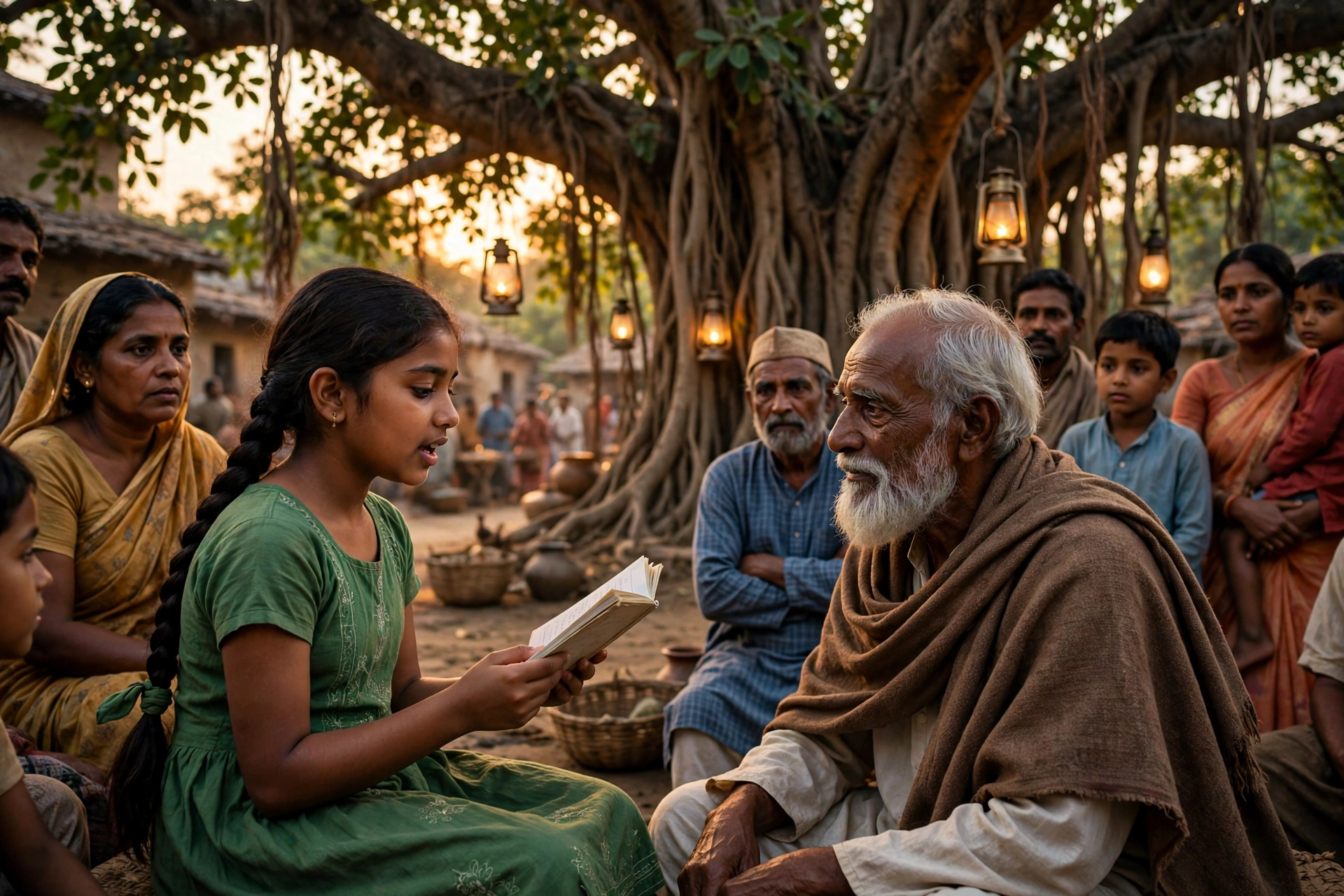
Word travels fast in a small town, and faster still when the word is good. The next evening, five children came. The evening after that, twelve. Within a fortnight, the circle beneath the banyan tree was full again, and Rahim was sitting on his stool in the middle of it, tapping his stick twice against the ground. He did not remember everything — some stories came back whole, and some came back in pieces, and some were gone for good, and he had made his peace with that. But he had learned something that no story had ever taught him before. He had spent forty years giving his stories away, and he had never once imagined that the town would keep them safe for him, the way a mother keeps a child's winter coat folded away until it is needed again.
One evening, Rahim told a story none of them had ever heard before. It was about a little girl with a long braid and a green dress, who carried a notebook through a town and gathered up all the stories that had been scattered like seeds, and planted them back in the heart of an old man who had forgotten them. The children listened with wide eyes, and Noor sat in the front row, smiling into her hands, and not one of them guessed that the story was about her.
When he finished, the children clapped. Rahim looked around the circle — at the baker's son, at the fisherman's granddaughter, at Noor with her notebook on her lap — and he said, very quietly, "A story is never truly lost while someone remembers it with love. And kindness — kindness is the one thing in this world that, when you give it away, you never lose. It only comes back to you, bigger than before, on the evening when you need it most."
Noor still keeps the notebook on the shelf beside her bed. And every evening, when the lamps come on, she walks to the banyan tree and takes her place in the front row, ready to ask the question she has asked a thousand times: "And then what happened, Uncle Rahim?"