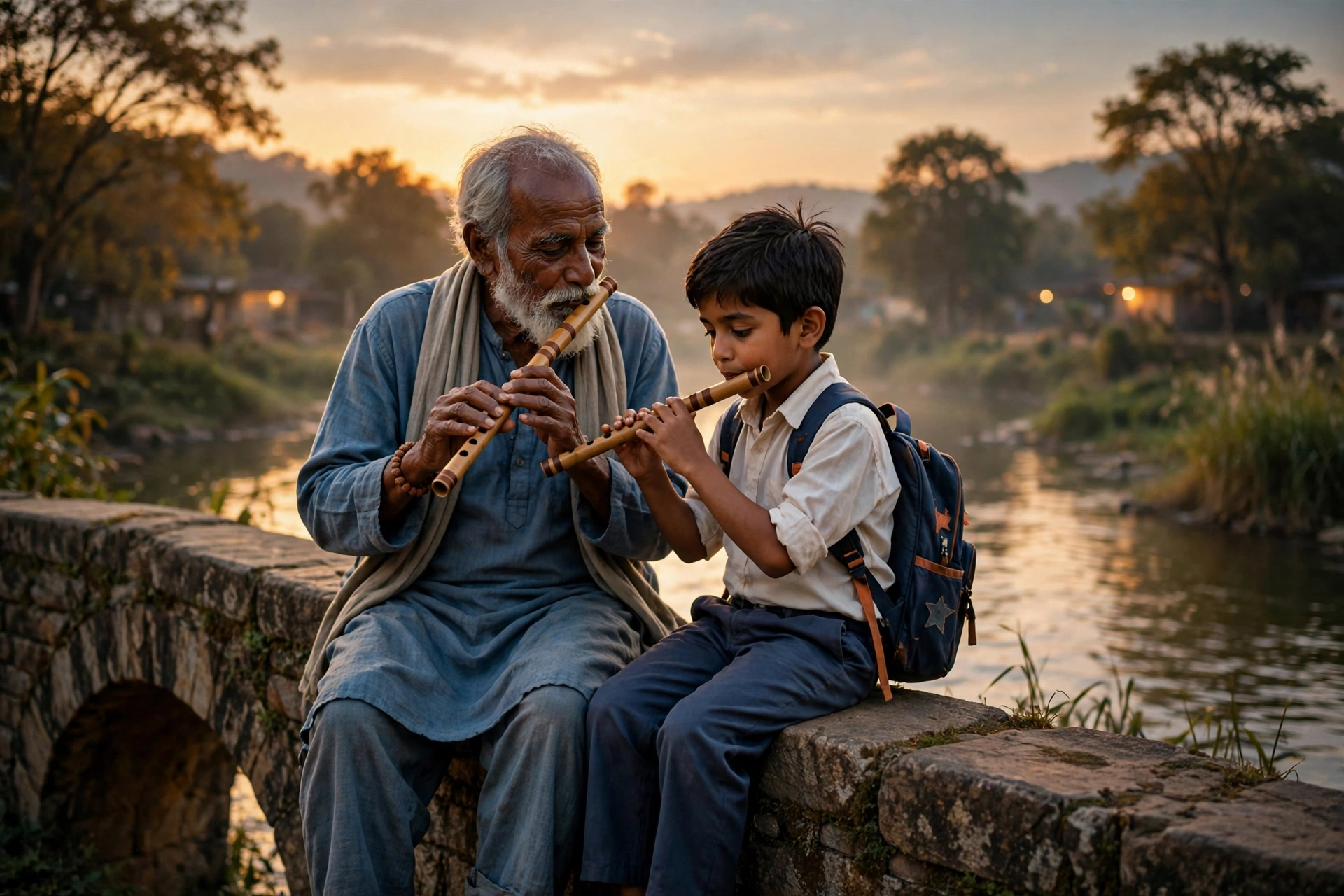
The old stone bridge over the river had stood for a hundred years, and for the last eleven of them, it had a sound.
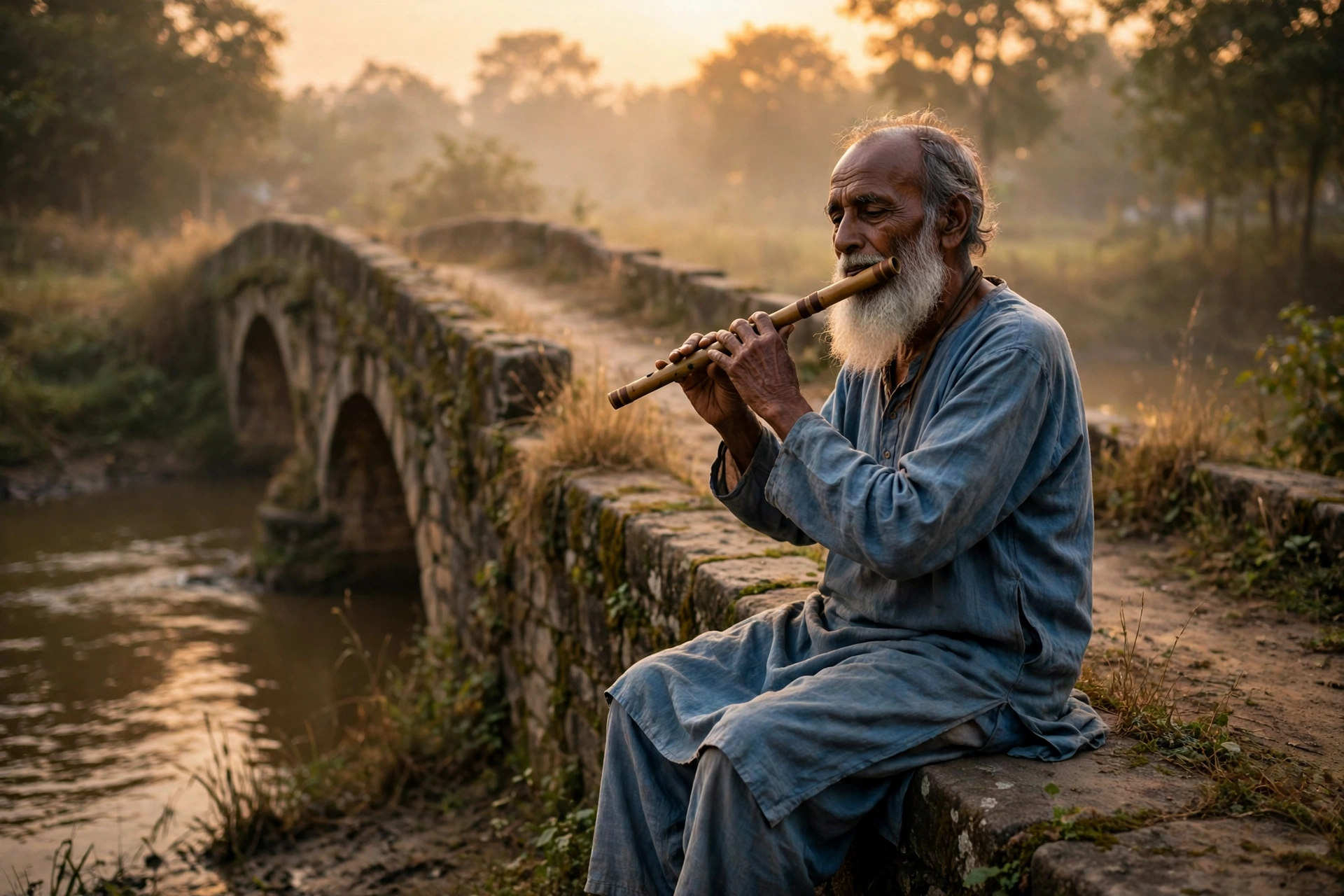
Every evening, just as the sun began to sink behind the rooftops and the light turned the color of weak tea, a man would climb the worn steps to the middle of the bridge, sit on the low wall, and take a bamboo flute from a cloth bag. Then he would play.
His name was Rahim. He had once taught music at the boys' school on Mill Road, and he was seventy now, his back bent like the neck of his flute, his white beard trimmed close, his kurta always the same faded blue. He played without an audience in mind and without a hat on the ground for coins, which confused people at first. Musicians on bridges usually wanted something. Rahim wanted nothing. He played because the river liked it, he said, and because the evening, left to itself, was too quiet.
Nobody knew why he played there, at that hour, every single day. If you asked him, he would smile and say only, "The bridge was empty. Somebody had to fill it."
But there was a reason, and it was buried eleven years deep.
Eleven years ago, Rahim had been a music teacher with a wife named Sakina and a small house near the school. Sakina loved the evenings. "Music is how the day says thank you," she would say.
Then one winter, Sakina fell ill, and no medicine in the town could hold her. She died on a cold morning in January, and the house went silent in a way Rahim had never known silence could be. He stopped teaching. He stopped playing. For months, the flute stayed in its cloth bag in the bottom of a drawer.
One evening, almost a year after her death, his feet took him to the old bridge without his knowing why. He sat on the low wall and watched the river, and the evening was too quiet. So he took out the flute and played the song Sakina used to hum while she made tea. His hands shook. The notes came out thin and broken. But when he finished, the quiet did not feel quite so heavy.
He came back the next evening. And the next. And he never stopped. The town got used to him the way it got used to the call to prayer.
Then one evening in late October, a boy stopped.
The boy was small, maybe nine, with a schoolbag that hung too heavy on his narrow shoulders. He stood at the far end of the bridge, half hidden behind one of the stone pillars, and he did not move. Rahim finished his song and started another, and the boy did not move. When the sun went down and Rahim packed his flute away, the boy was still there, watching with wide, dark eyes.
The next evening, the boy was there again. And the next. He never came closer than the pillar. He never spoke. Rahim began to notice the way he listened — not casually, the way other children listened while they passed, but with his whole body, leaning toward the music as if it were a rope thrown to someone drowning.
On the fourth evening, Rahim did something he had never done in eleven years. He stopped playing in the middle of a song, looked at the boy, and patted the wall beside him.
The boy froze. Then, slowly, he walked forward — one step, another — and sat down on the wall, a careful arm's length away, his feet dangling over the river.
Rahim held out the flute. "Would you like to try?"
The boy shook his head.
"That's all right," Rahim said, and played again, softer this time, a slow song that sounded like rain on a tin roof. Out of the corner of his eye, he saw the boy's shoulders drop, just a little, as if he had set down something heavy.
When Rahim finished, the boy slipped off the wall and walked home without a word. But the next evening, he sat beside Rahim again. And the next. He never spoke. Not once. Not a hello, not a thank you, not his name.
Rahim asked around, gently, the way old men do. The shopkeeper at the corner knew. The boy's name was Sami. His mother had died six months ago, suddenly, of a fever that came in the night and took her before morning. His father drove a rickshaw from before dawn until after dark. And Sami had not said a single word since the morning they buried his mother. The doctors said there was nothing wrong with his throat. Nothing had worked. The words had simply gone somewhere, and nobody knew how to call them back.
"He listens to you, though," the shopkeeper said. "Every evening. He runs from school to that bridge."
Rahim thought about that all night. In the morning, he went to the market and bought a second bamboo flute — a small one, sized for a child's hands — and wrapped it in a clean cloth and put it in his bag.
That evening, when Sami sat down beside him on the wall, Rahim took out the small flute and held it out without a word.
Sami stared at it. His hands stayed in his lap.
Rahim did not push. He set the flute down on the wall between them, picked up his own, and began to play — a simple tune, five notes, up and down, the kind of tune a child learns first. He played it three times, slowly. Then he stopped, and looked at the river, and waited.
A minute passed. Then Sami's hand moved. Slowly, like a bird landing, his fingers closed around the small flute. He lifted it to his lips. The first sound that came out was a thin, squeaking breath, more air than note. His eyes widened, and his hand dropped.
Rahim laughed softly — not at him, but the warm laugh of a man who remembers his own first squeak, fifty years ago. "Again," he said. "The flute is like a stubborn goat. You have to ask it nicely, twice."
Sami tried again. This time, a note came out — wobbly, uncertain, but a real note. He looked at Rahim in amazement, as if the sound had surprised him as much as anyone.
"Good," Rahim said. "Now watch my fingers."
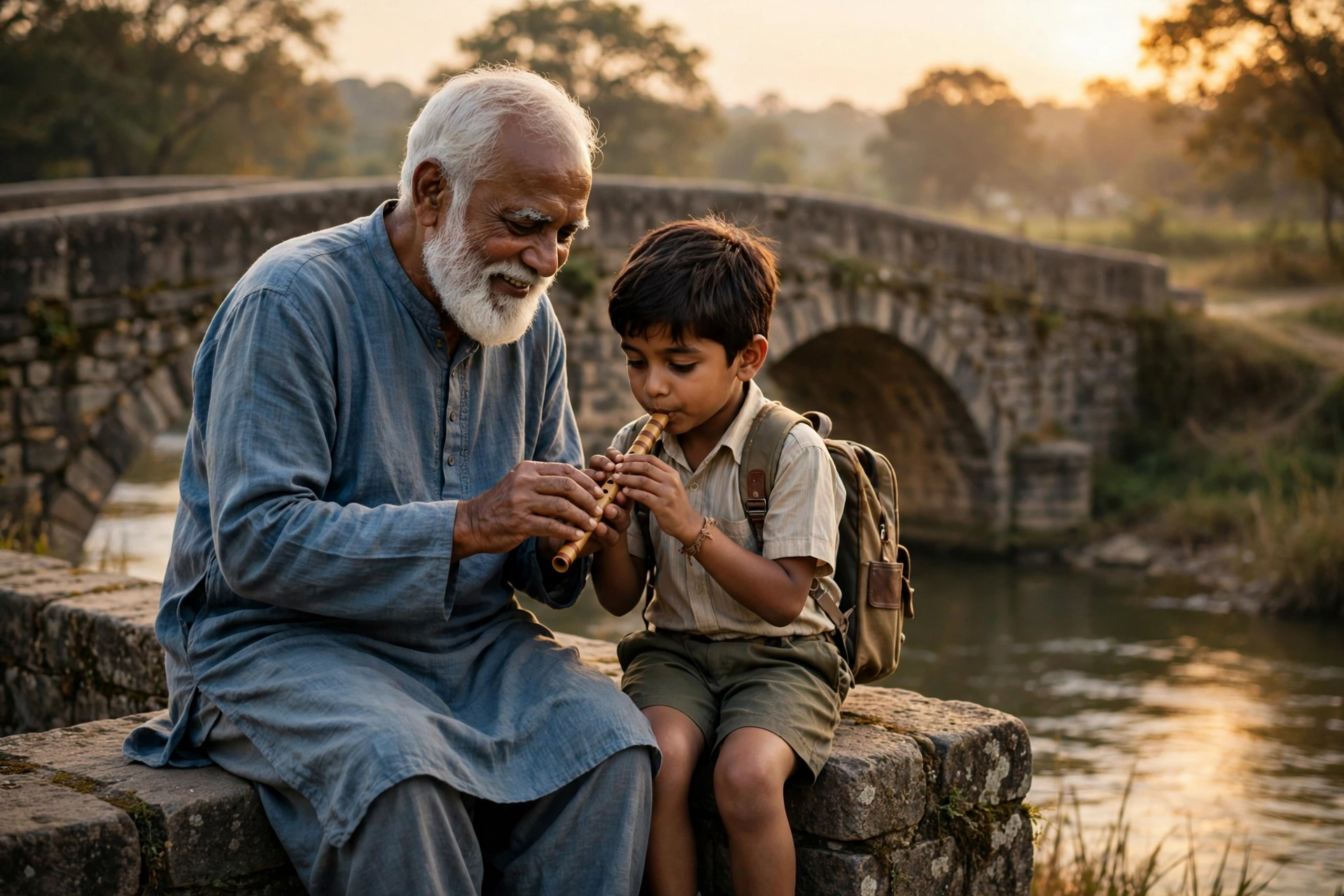
And so it began. Every evening, on the old stone bridge, the lessons went on without a single word from the student. Rahim would play a few notes. Sami would copy them. Sometimes it took ten tries. Sometimes twenty. Rahim never sighed, never hurried, never corrected with anything sharper than a smile and a slower repeat.
Sami's father noticed the change first, though he could not have said what it was. The boy came home with his shoulders a little straighter. One evening the father followed him — quietly, at a distance, standing behind a pillar the way his son once had — and watched the two flutes rising together into the dusk. He walked home with his eyes wet and his heart doing something it had not done in six months: hoping.
Weeks passed, and the evenings grew colder. The boy had learned twelve tunes now. He could play a full song without stopping. He still had not spoken a word to anyone — not to his teacher, not to his father, not to a single soul since the morning of the funeral.
But something was coming. Rahim could feel it the way old men feel rain in their knees. Sami had started arriving with a particular look — the look of a boy carrying a question too big for his chest. And one evening, as the sun set and the light turned the river gold, Sami tugged at Rahim's sleeve and pointed across the river, to the small graveyard on the far bank where the white stones stood in rows.
Rahim understood. Tomorrow would be the sixth month to the day since Sami's mother had died — the day families visit the grave, with flowers and prayers and the words they have been saving.
Sami pointed at the graveyard again, and then at the flute in his own lap, and then he nodded at Rahim with a question in his eyes so clear it needed no voice at all: Will you come with me?
Rahim put his hand on the boy's shoulder. "Yes," he said. "Tomorrow. I will come."
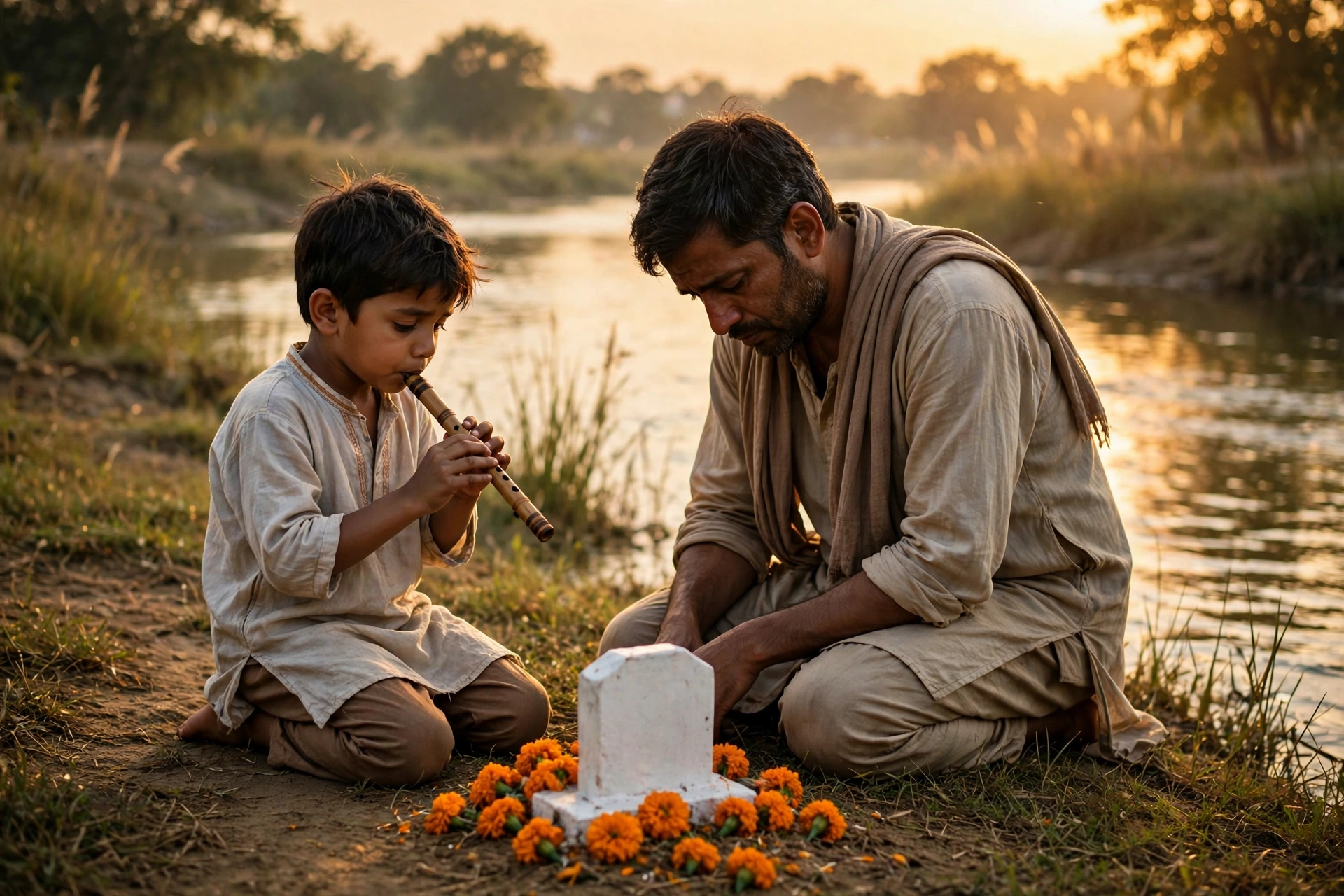
The next evening, the light was the color of honey. Rahim met Sami at the foot of the bridge, and together they crossed it — slowly, the boy's hand in the old man's — and walked the narrow path to the graveyard on the far bank. Sami's father was already there, standing beside a fresh white stone with a small bunch of marigolds in his hand. He looked up when he saw them, and his tired face did a complicated thing — surprise, then gratitude, then something like grief stepping aside to make room.
Sami knelt by the stone. He put the marigolds down. He closed his eyes for a long moment. And then he lifted the small flute to his lips.
He played the song Rahim had taught him first — the simple tune, five notes, up and down. But it was not simple anymore. It came out slow and full and steady, like water finding its way home. Then, without stopping, he moved into the second song, and the third, and then — to Rahim's amazement — he began to play a melody Rahim had never taught him. It was the lullaby his mother used to sing to him at night, the one he had not heard in six months, the one he had carried inside him all this time, waiting for a way out.
When the last note faded, Sami lowered the flute. The three of them stood in the quiet. And then Sami turned to his father, and he opened his mouth, and in a voice that was small and hoarse and unused, like a door opening after a long winter, he said one word.
"Ammi."
It was the only word he had. It was the only word he needed.
His father dropped to his knees and folded the boy into his arms, and the boy — the boy who had not spoken in six months — began to cry, and then to laugh, and then to talk, all at once, in a rush, as if six months of words had been dammed up behind his teeth and the flute had broken the dam.
Sami speaks now. Not all the time, and not to everyone — he is still a quiet boy, and he probably always will be. But he speaks to his father at dinner, and to his teacher when he knows the answer, and to the other children at school, who have stopped treating him like a ghost and started asking him to teach them the flute. He still comes to the bridge every evening, though. So does Rahim. They sit on the low wall, an old man and a boy, two flutes rising together into the dusk.
People in the town still do not know why Rahim plays on the bridge. If you ask him, he will smile and say only, "The bridge was empty. Somebody had to fill it."
But if you ask Sami, the boy will tell you the truth. He will tell you that the old man simply made a space beside him on the wall, and handed him a flute, and waited, evening after evening, until the music found its way out. And he will tell you that kindness is not always a grand gesture, not always a gift or a rescue. Sometimes it is only this: a person who stays.