The first thing Rahim lost was not his wife, or his money, or his shop. It was the smell of cardamom.
He noticed it on a cold morning in January, standing in the doorway of his little shop on Cardamom Lane with a sack of green cardamom pods in his arms. For forty years, opening that sack had been like opening a door into his childhood — his father's laugh, his mother's kitchen, the whole lane waking up to the scent of something wonderful about to be cooked. That morning, there was nothing. He pressed a pod between his fingers and held it to his nose. Nothing at all.
Rahim did not tell anyone. A spice seller who cannot smell his own spices is like a singer who cannot hear his own song, and he was afraid that if people knew, they would stop coming. So he kept the shop open the way he always had, at the first call to prayer, sweeping the step, polishing the brass bowls, and arranging the mounds of colour the way his father had taught him: turmeric like sunlight, chilli red, cumin like dark earth, and cardamom, green and precious, in the bowl closest to his hand.
He had learned long ago that spices could be known by more than smell. Turmeric stained the fingers yellow. Good cardamom pods were heavy and oily to the touch. Cumin crackled faintly when it was fresh. Chilli made the eyes water from a foot away. His hands remembered what his nose had forgotten, and for a while, that was enough.
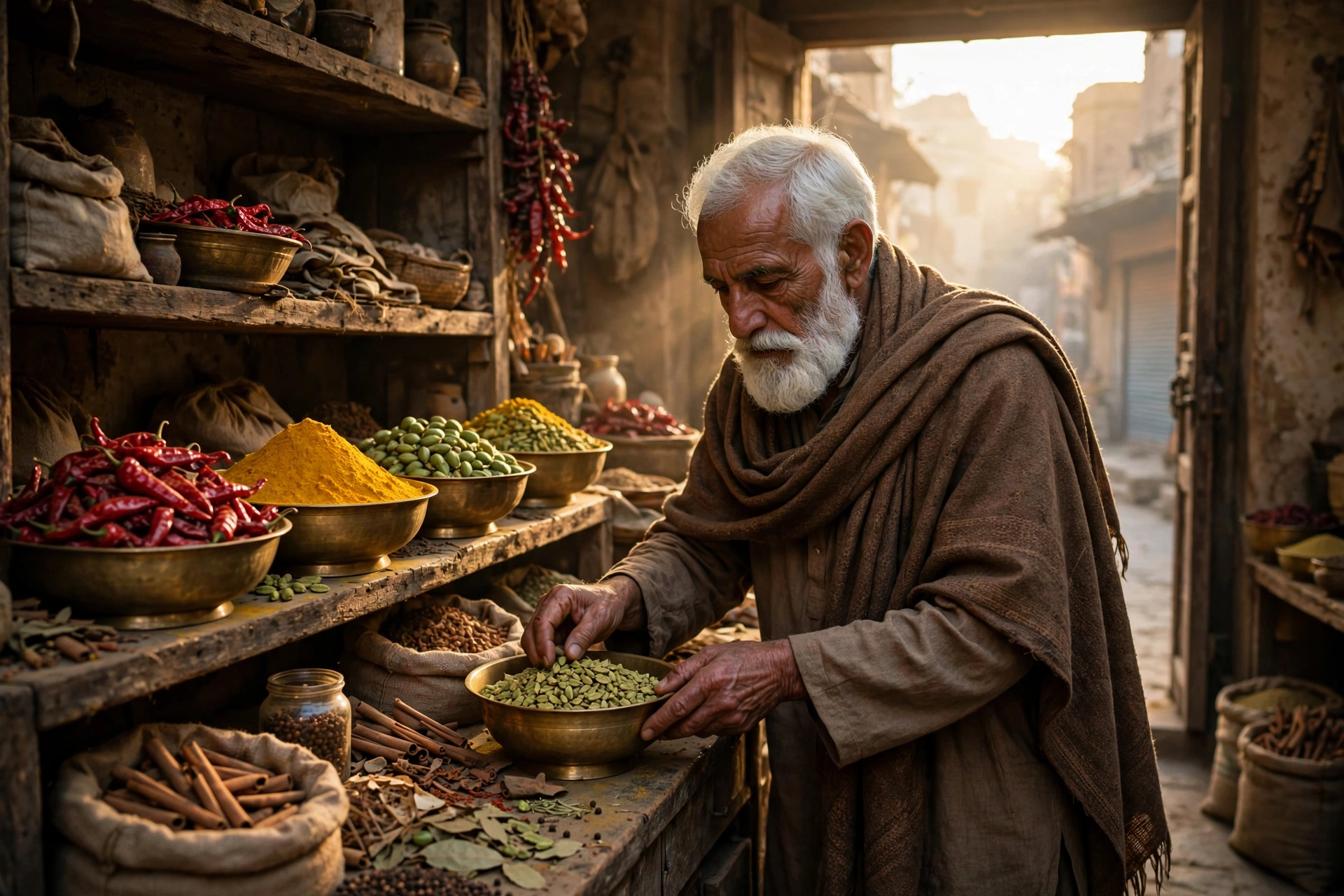
Rahim's shop was the smallest on the lane, but it was the one everybody passed through. It was not only a shop. It was where the lane came to ask questions. New brides came to ask which spices would make their first meal taste like home. Mothers with tired eyes came to ask, quietly, if they could take a little today and pay on Friday. Rahim always said yes. He wrote their names in a small blue ledger, and when Friday came and they still could not pay, he would turn the page without a word and write the amount again, smaller, as if the debt itself were shrinking out of embarrassment.
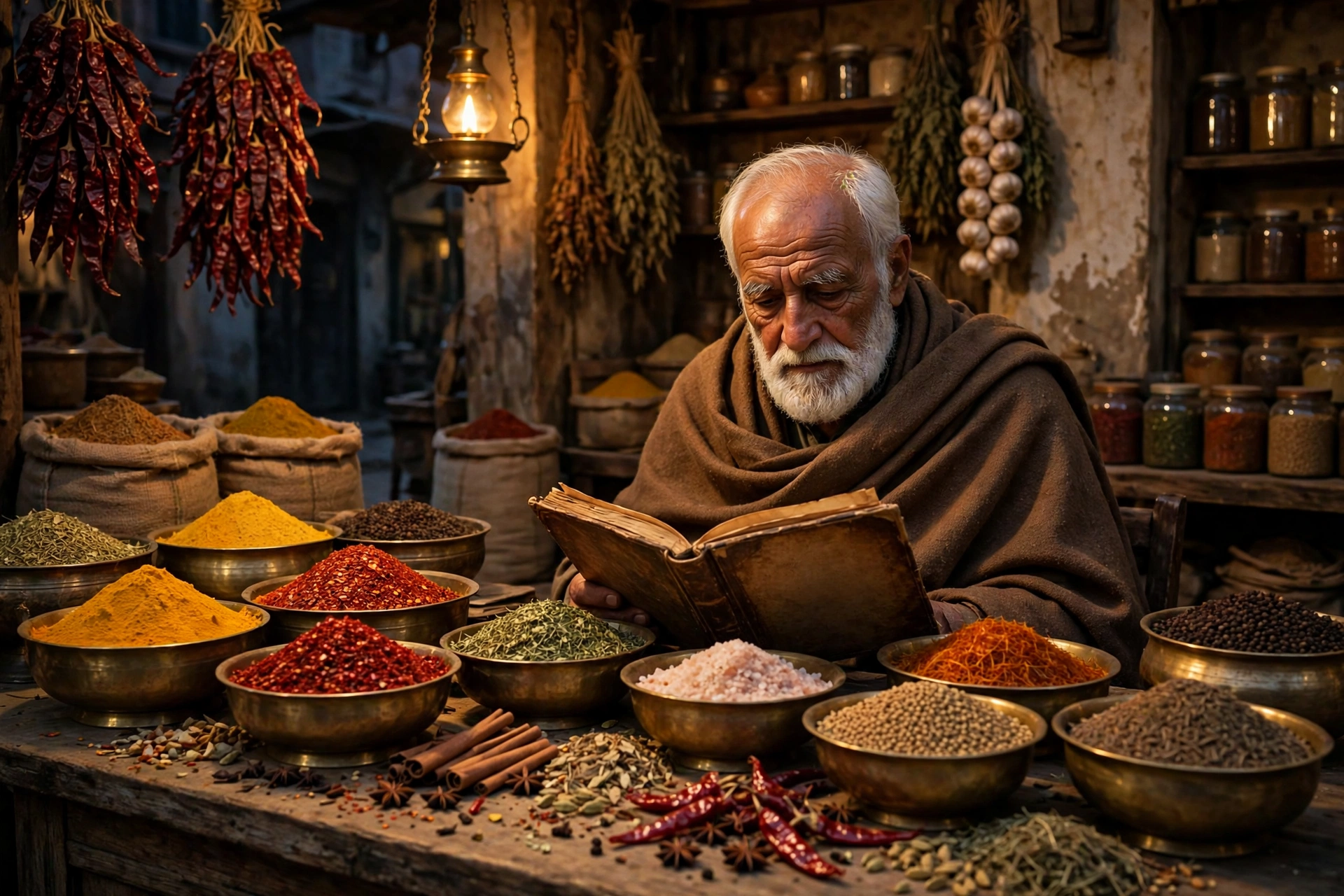
His wife Amna had kept that ledger before him. She had died three winters ago, and the shop had never quite recovered its warmth. Amna had been the one who remembered everyone's favourites — the widow on the corner who liked her tea with extra cardamom, the schoolteacher who bought cinnamon every month for his mother's rice pudding, the rickshaw driver who swore by Rahim's garam masala. After she died, Rahim kept her handwritten recipe cards in a tin box under the counter, tied with a piece of string. On lonely evenings he would untie the string and read them, not because he needed the recipes, but because her handwriting was the closest thing he had left to her voice.
It was on one such evening, with rain drumming on the tin roof of the lane, that a young woman came into the shop carrying a sleeping child and holding another by the hand. Her name was Sara, and Rahim had seen her before, though never inside his shop. She had moved into the lane that winter after her husband's death, into a single room above the tailor's shop. That evening she stood in his doorway with her eyes on the floor.
"I have only this much," she said, opening a palm that held a few small coins. "My daughter is ill, and the doctor said she must eat properly. I wanted to cook her something warm. Something that tastes like someone cares."
Rahim looked at the coins, and then at the little girl holding her mother's hand. The girl was thin, and her shoes were too big for her feet, but her eyes were fixed on the brass bowls as if they were treasure chests. Rahim thought of Amna, who had once said that no child in this lane should ever go to bed wondering whether anyone cared. He took a paper packet and filled it — not with the cheapest spices, but with the good ones: cardamom for the rice, turmeric for strength, cinnamon for sweetness, and a pinch of Amna's own garam masala.
"Pay me when you can," he said, folding the packet. "And bring the girl back when she is better, so I can see her smile."
Sara's eyes filled with tears. "But I cannot pay," she whispered. "Not this week, not next week."
"Then pay me with a story," Rahim said, smiling. "When your daughter is well, come and tell me what she said about the food. That is payment enough."
She left with the packet held to her chest like something precious, and Rahim watched her go down the rainy lane, thinking that Amna would have done exactly the same thing. That night he wrote Sara's name in the blue ledger, and beside it he wrote not a number, but a single word: daughter.
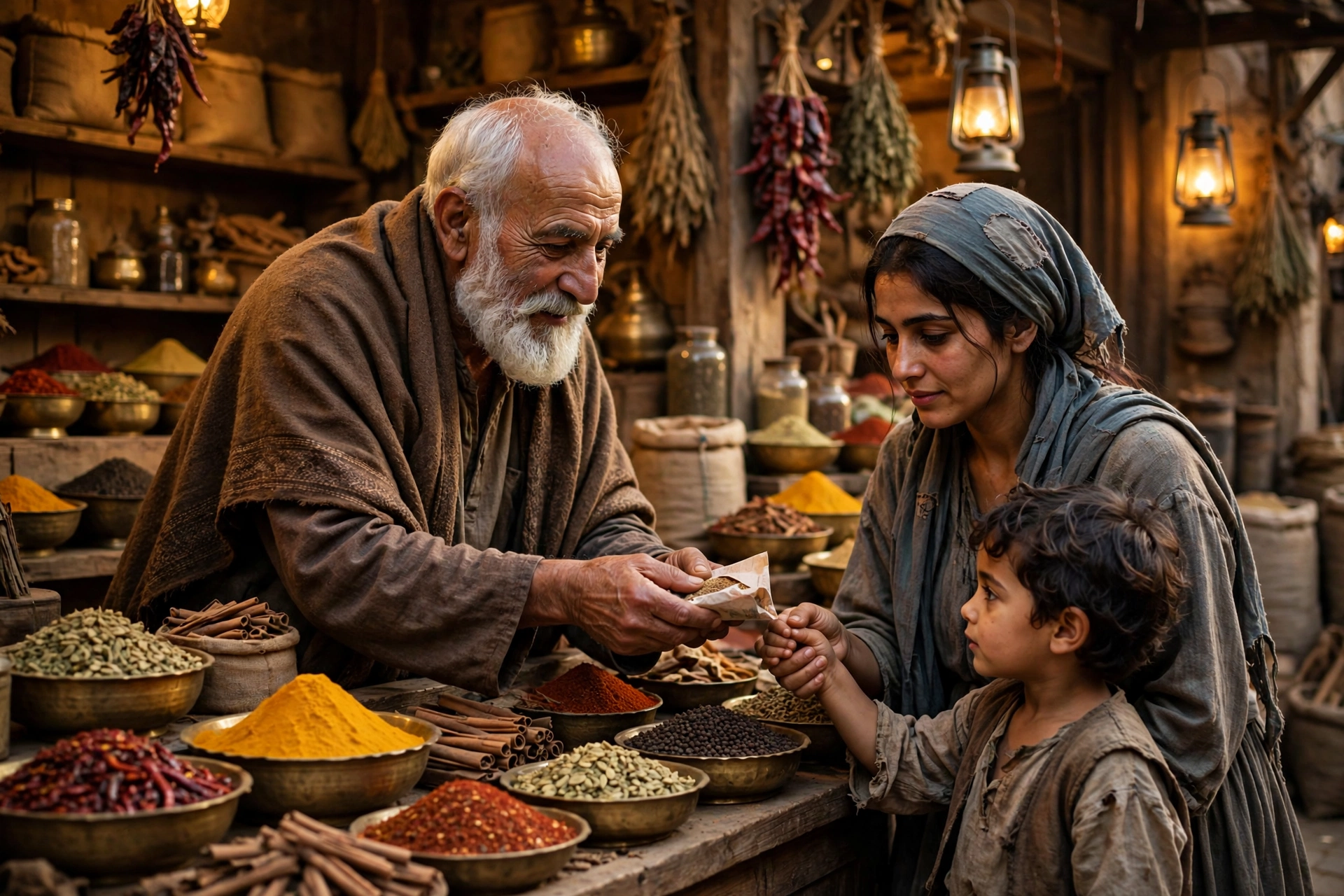
Weeks passed, and Sara did come back, just as she had promised — not with money, but with a story. Her daughter was better. She had eaten the rice and asked for more, and then asked why the house suddenly smelled like her grandmother's house used to smell. Sara laughed when she told it, and Rahim laughed too, and for the first time since Amna's death, the shop felt warm again.
But trouble was coming to Cardamom Lane, the way trouble always comes: dressed up as an opportunity. A wealthy merchant named Imran, who owned warehouses across the city, had begun buying shops on the lane, one by one. He wanted to turn the whole row into storage for his business. He offered the tailor twice what his shop was worth. He offered the baker three times. And then he came to Rahim, with a polished car and a polished smile, and laid a sum of money on the counter that made Rahim's hands tremble — enough to live comfortably for the rest of his life, enough to never worry about rent or medicine again.
"Think of yourself for once, old man," Imran said, not unkindly. "You are seventy-two. Your nose is failing — everyone can see it. You cannot even tell good cardamom from bad anymore. Sell to me, and rest."
He had hidden his failing senses, but the lane had sharp eyes. He asked Imran for a week to think, and Imran agreed, though his smile said he already considered the matter settled.
That week was the longest of Rahim's life. He sat in his shop after closing, the tin box of recipe cards open on the counter, and asked himself the question he had avoided for months: if he could no longer smell, was he still a spice seller? And if he sold the shop, what would become of the lane? Where would the new brides go with their questions? Where would the mothers with tired eyes go when Friday came and the money had run out? A warehouse has no brass bowls. A warehouse does not ask a child to come back and show her smile.
On the fifth evening, he made his decision. He told Imran no. Imran laughed, told him he would regret it, and warned him that the other shops were already sold and the lane would soon be empty anyway.
The next morning, Sara arrived at the shop before it even opened, carrying a covered pot. Behind her came the tailor, and behind him the baker, and behind them a stream of people Rahim had fed, helped, or simply listened to over forty years. The schoolteacher was there, and the rickshaw driver, and the widow from the corner, and mothers whose names filled page after page of the blue ledger. They were carrying pots and plates and bowls, all covered with cloth, all smelling — to everyone but Rahim — of the most wonderful food in the world.
"We heard about the merchant," Sara said, setting her pot on the counter. "And we heard what you said to him. So we cooked. Every dish here was made with spices from your shop, and with recipes your wife wrote down for our mothers. We wanted you to know what your shop really sells."
One by one, they uncovered their dishes. There was rice fragrant with cardamom, curry rich with garam masala, sweet pudding dusted with cinnamon, and bread still warm from the baker's oven. The schoolteacher stepped forward and opened the blue ledger, which someone had brought from the shop's counter, and read aloud the names written there — not as debts, but as a roll call of a family. "He never asked us to pay," the teacher said. "He asked us to come back. And so we have."
Then Sara's little daughter, now healthy and bright-eyed, tugged at Rahim's sleeve and held up a drawing she had made: a small shop with brass bowls and a smiling old man, and above it, in wobbly letters, the words "the shop that smells like home." The lane laughed and cried at the same time, and Rahim, who could not smell a single dish in front of him, felt his throat close with something warmer than any spice.
Imran had come to watch, curious about the crowd. He stood at the edge of the lane, and for a long moment he said nothing. Then he walked up to Rahim and did something no one expected: he apologised. "I thought this lane was just old shops waiting to be replaced," he said quietly. "I did not know it was a family. Keep your shop, old man. I will find my warehouse somewhere else."
Rahim never did get his sense of smell back. Some losses, he learned, are simply part of growing old, and no amount of wishing changes them. But something else returned to him in the weeks that followed, something he had not expected: the lane began to look after the shop the way the shop had always looked after the lane. Sara came every week to help him arrange the bowls, and her daughter, who now knew the spices by their colours and their textures, became his proud little assistant, telling customers exactly which packet their mothers used to buy.
And on quiet evenings, when the shop was closed and the lane was golden with sunset, Rahim would sit with Amna's recipe cards and Sara's daughter beside him, teaching her the recipes one by one, so that the knowledge would never be lost.
For a spice seller's true work was never only about smell. It was about making a house feel like a home, a stranger feel like a neighbour, and a hungry child feel like someone cared. And that is a kind of seasoning no illness can take away, and no money can buy.
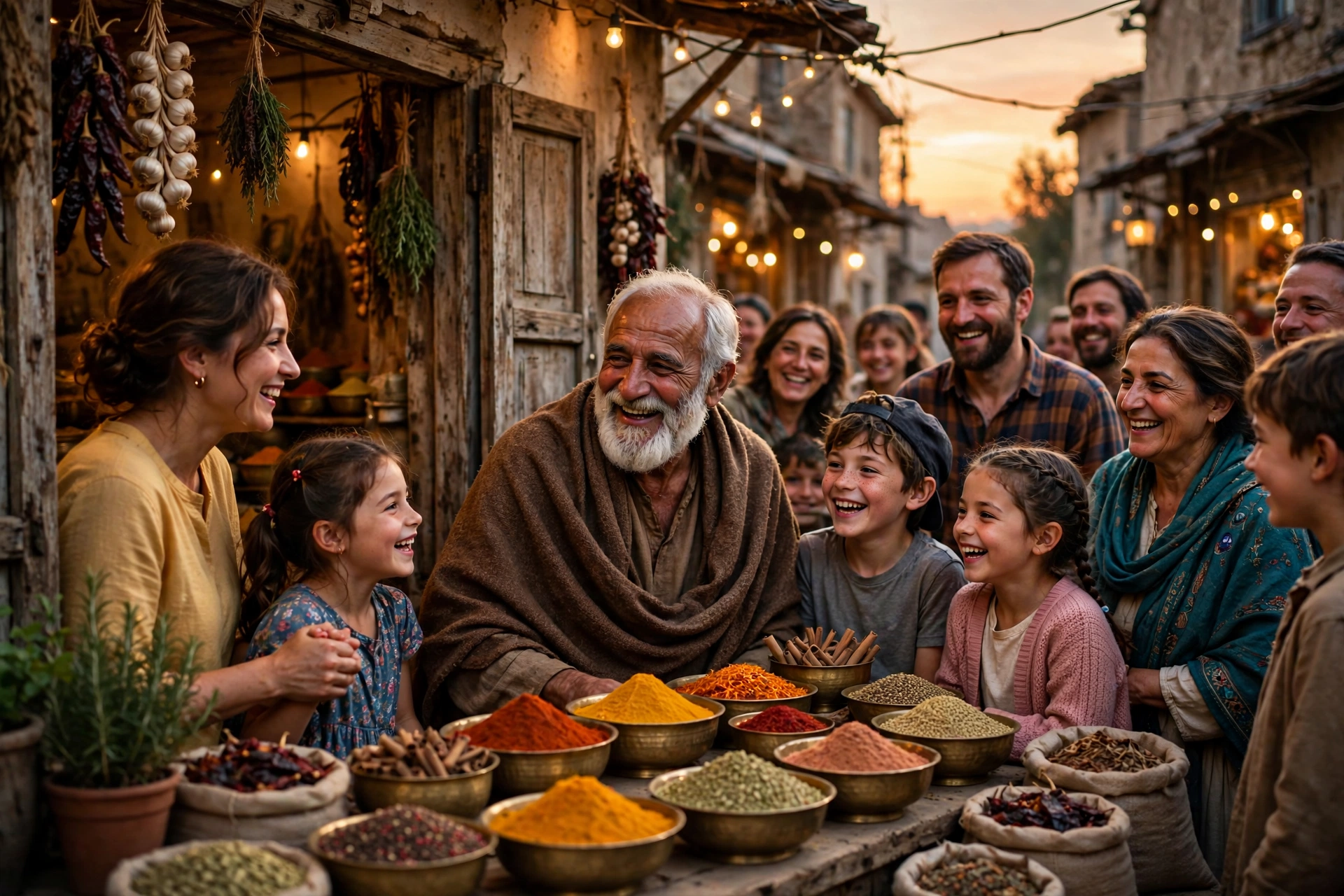
Rahim still opens his shop at the first call to prayer. The brass bowls still shine. The blue ledger still sits on the counter, though these days the names in it are written with a different kind of ink — the ink of gratitude. And if you walk down Cardamom Lane on a winter morning and ask anyone where the heart of the lane is, they will not point to a building or a bank. They will point to a small shop with a smiling old man inside, and they will say, "There. That is where we learned that kindness, like a good spice, is never wasted."