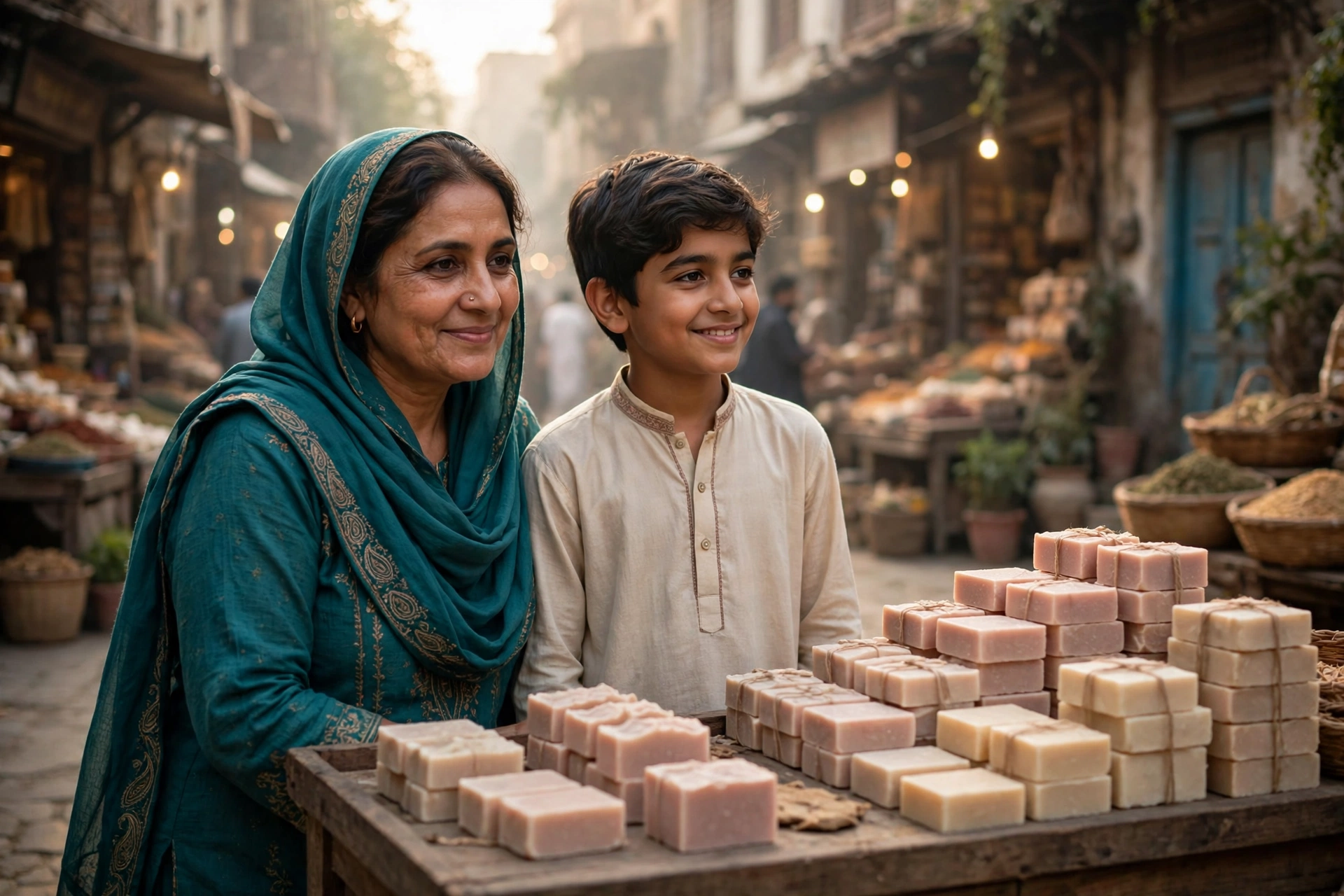
The morning Ayesha lost her last regular customer, she did not cry. She stood behind her little wooden stall on Rosewater Lane and quietly wrapped the unsold bars of soap in a clean white cloth, as if they were something precious. They were. Each bar had taken her a whole day to make, and each one carried the scent of roses from her mother's garden.
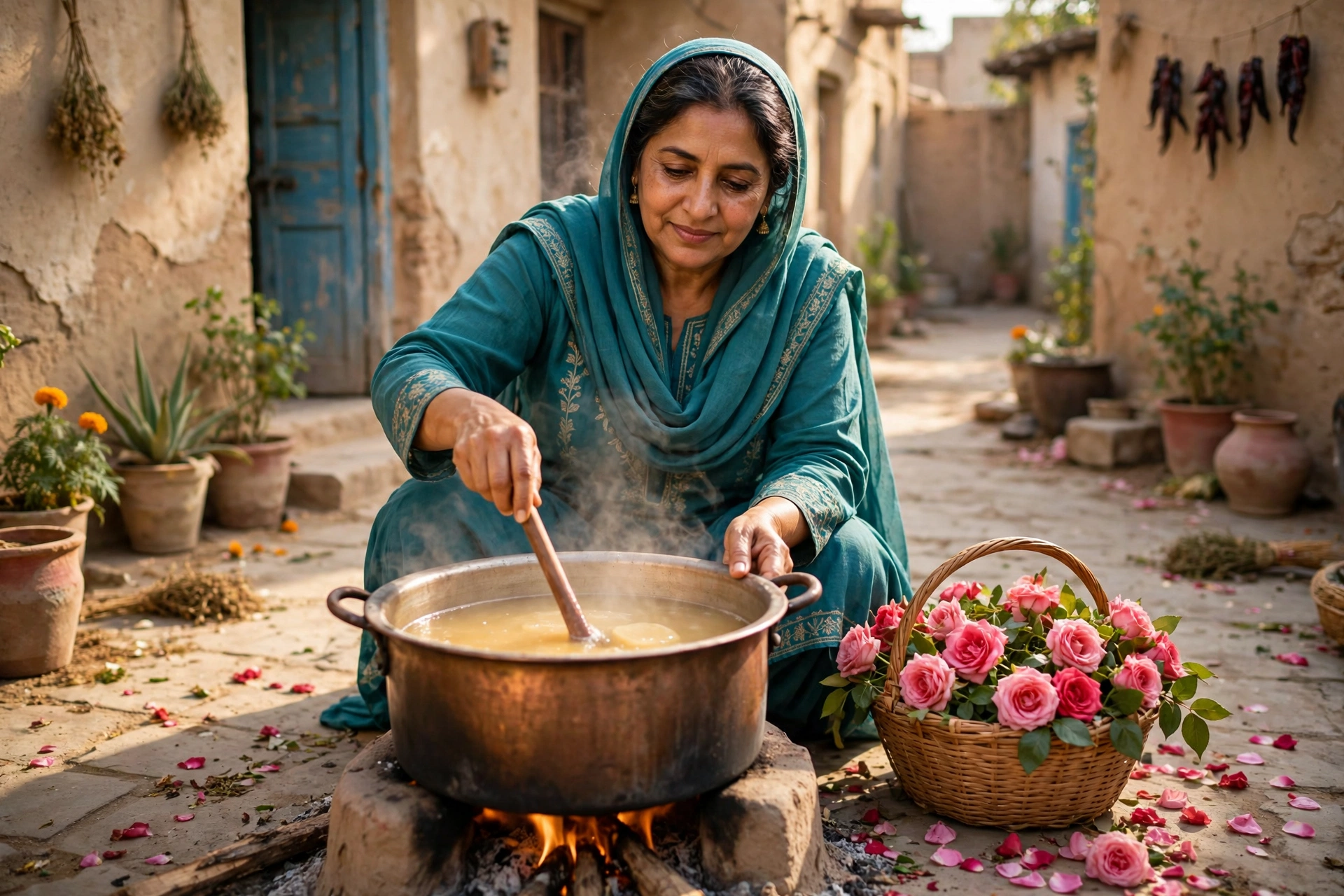
Ayesha was forty-two years old, a widow with a son of eleven, and she made soap the way her mother had taught her, in a copper pot over a low flame, with olive oil, rosewater, and crushed neem leaves. Her hands were rough from years of stirring and cutting and wrapping, but her soap was soft and pale as morning light, and it smelled of the roses that grew along the lane.
For ten years, that had been enough. The washerwomen bought her soap because it was gentle on their hands, and the mothers bought it because it did not sting their children's eyes. Ayesha earned little, but she earned honestly, and she and her son Bilal ate every night, even if the meal was only lentils and bread.
Then the factory soap came.
It arrived in bright plastic packets, stacked high in the big shop at the end of the lane, and it cost half of what Ayesha charged. One by one, her customers drifted away. The washerwomen said they were sorry. The mothers said they would come back when they had more money. A poor woman's soap, made slowly by hand, could not argue with a price tag.
The worst of it was Rafiq, the merchant who owned the big shop. He was a broad, loud man with a gold watch and a laugh that filled the whole lane. He had once offered to buy Ayesha's recipe for a small sum, and when she refused, he had laughed and said a widow's soap was not worth buying. Now he stood in his doorway every morning and called out to passers-by, "Why pay double for a widow's soap when my soap cleans twice as well for half the price?" Ayesha kept her eyes on her work, because she had learned long ago that answering a loud man only made him louder.
Bilal, her son, was eleven and thin, with his father's serious eyes. Every evening he counted the coins in the tin box beside the stall, and every evening the count grew smaller. One night he said, very quietly, "Ammi, if we sell the copper pot, we could buy rice for a month."
Ayesha looked at the pot, blackened by ten years of fire, and she thought of her mother standing over it, humming an old song while the soap thickened. "No, beta," she said. "The pot stays. A pot can be filled again. But if we sell what our hands know how to do, we will have nothing left."
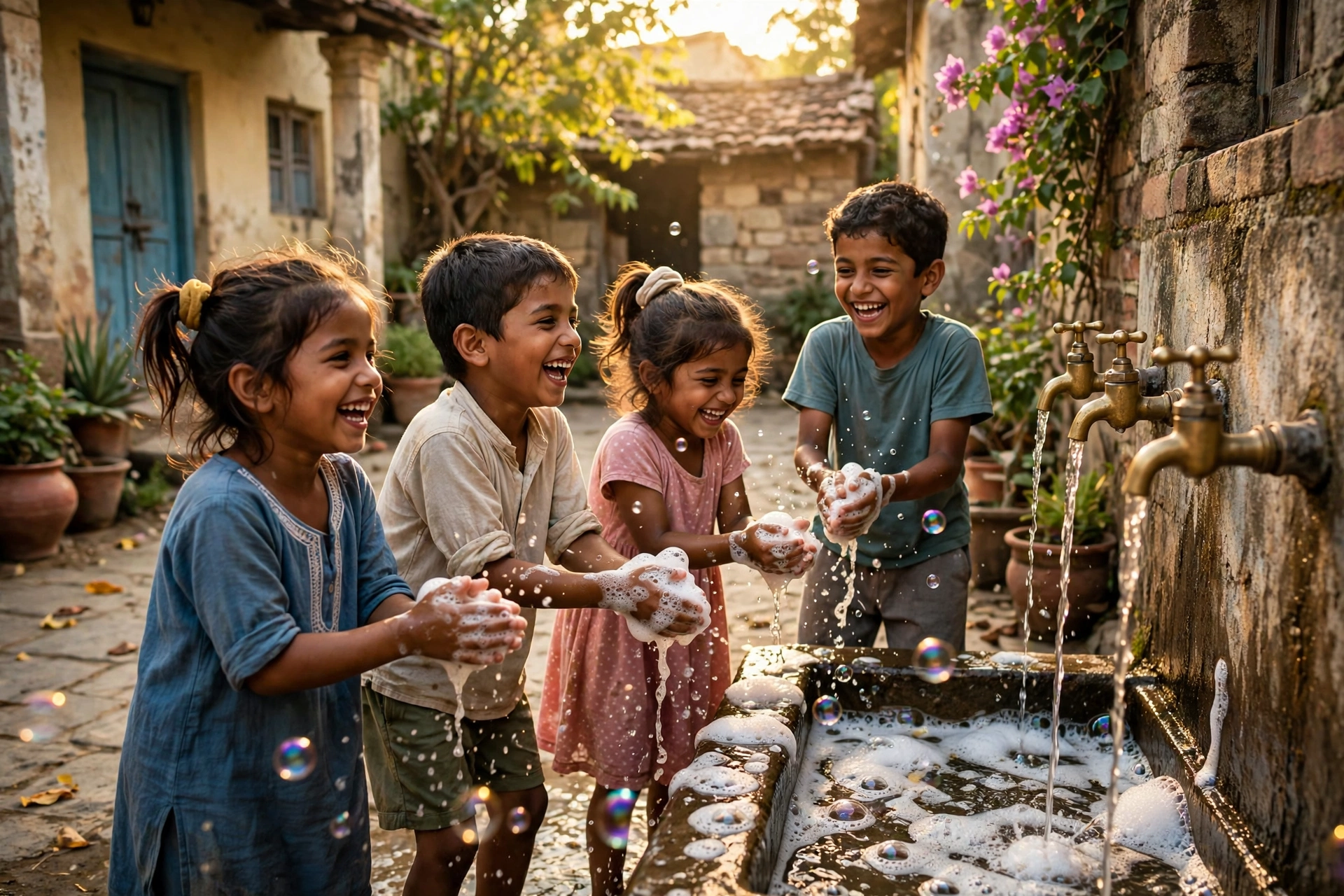
The next morning, Ayesha did something her neighbours thought was foolish. She wrapped twenty bars of soap in brown paper, tied them with string, and carried them to the children's home at the end of the lane, where forty children lived whose parents were gone or too poor to keep them. The matron, a thin woman named Sister Farida, opened the gate and looked at the parcel in surprise.
"These are for the children," Ayesha said. "No charge. Just tell them to wash their hands before they eat, and after they play."
Sister Farida frowned. "Ayesha, you cannot afford to give your soap away. Everyone knows your stall is empty these days."
"Then the soap is doing no good sitting in my house," Ayesha replied, and she pressed the parcel into the matron's hands before the woman could argue.
She did the same at the washermen's quarter, leaving bars with the women who scrubbed clothes in the river all day, their hands cracked and bleeding from harsh detergents. She left bars with old Kareem, the beggar who slept near the mosque, and with the schoolteacher for the classroom sink. She did not keep a list. She did not ask for thanks.
"Ammi," he asked at last, as they walked home in the evening, "why do we give it away when we need the money ourselves?"
Ayesha took his hand. "Because soap that is not used is only a lump in a cloth, beta. And because your grandmother used to say that a gift given in secret is like a seed. You do not see it grow, but one day you find a tree."
That was in the month before the rains. When the monsoon came, it came hard, and the lane turned to mud, and the river rose brown and angry. And with the rain came something worse: a sickness that spread through the town like smoke. It began with the children. Their hands and arms broke out in red, itching rashes. They scratched until their skin bled. The little ones cried at night and could not sleep. The doctor at the small clinic, Dr. Sana, examined child after child and shook her head.
"They need gentle soap and clean hands," she told the mothers waiting outside her door. "There is no medicine that will do what clean skin can do."
The mothers looked at one another. Gentle soap cost money they did not have. The clinic was full. The town's one pharmacy ran out of ointment in two days.
But at the children's home, something strange was happening. The forty children there were washing with Ayesha's soap, morning and night, because Sister Farida had made it a rule. And not one of them fell sick. When Dr. Sana came to examine them, she walked through the rows of children, checking arm after arm, and her frown slowly turned to wonder.
"What soap are they using?" she asked.
Sister Farida held up a pale bar that smelled of roses. "Ayesha's soap. The soap-maker of Rosewater Lane. She gave it to us for free."
Dr. Sana took the bar in her hands and smelled it, and she smiled for the first time in days. "Neem," she said. "And rosewater. This is medicine, not just soap. Tell her to make as much as she can. I will send every mother in this town to her."
Word travels fast in a small town when it carries hope. By the next morning, there was a line outside Ayesha's stall that stretched around the corner. Mothers held their scratching children by the hand. Ayesha, who had not sold a bar in weeks, stood behind her stall with tears in her eyes, cutting and wrapping soap as fast as her hands could move, while Bilal ran back and forth to the courtyard, carrying fresh batches from the copper pot.
But one person did not come to the stall. Rafiq sat in his big shop and watched the line grow, his face darkening with every passing hour. His shop was full of factory soap nobody wanted anymore. He told himself the sickness would pass, and the people would come back.
Then, on the third evening, his little daughter Zara came home from school scratching her arms until they bled.
She was seven, his youngest, the child he loved more than his shop and his pride put together. He took her to the clinic, and Dr. Sana looked at the child's raw skin and said the same words she had said to everyone else. "She needs gentle soap. Ayesha's soap. It is the only thing that is working."
Rafiq stood in the clinic doorway for a long time, holding his daughter's hand. The man who had laughed at a widow's soap now had to walk down Rosewater Lane and ask that widow for help. His feet felt like stone. His throat felt like sand. But Zara was crying, and so he walked.
When he reached the stall, the line of mothers parted silently to let him through. Ayesha looked up, and for a moment neither of them spoke. Rafiq, the loudest man in the lane, opened his mouth and found that his voice had gone very small.
"Ayesha baji," he said, and the words came out rough, as if they hurt him. "My daughter is sick. I mocked your soap, and I told people not to buy it, and now I am standing here asking you for it. I have money. I will pay whatever you ask."
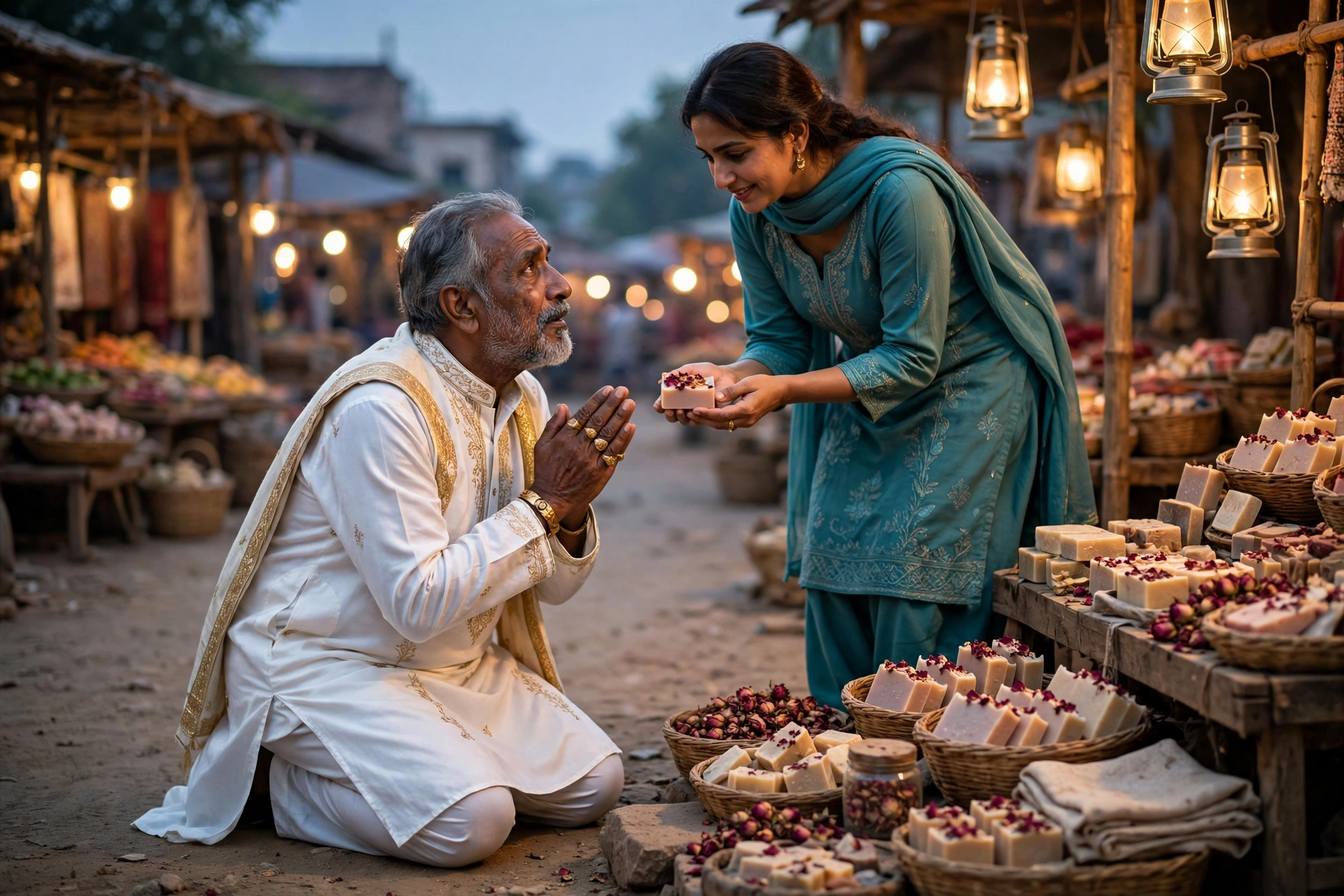
Ayesha looked at him, and she saw not the merchant with the gold watch, but a father frightened for his child. She reached under the stall, took out the finest bar she had, wrapped in clean white cloth, and held it out to him.
"Take it," she said. "There is no price for a sick child."
Rafiq stared at the bar in his hands. He had expected her to refuse him. He had expected her to name a price so high it would shame him. Instead, she was giving him the very thing he had tried to destroy, and asking nothing in return. His eyes filled with tears, and he did something no one in Rosewater Lane had ever seen him do. He knelt down, right there in the mud of the lane, and he touched his forehead to the ground before her stall.
"Forgive me," he whispered. "I was wrong about you. I was wrong about everything."
Ayesha knelt beside him and lifted him gently by the shoulders. "Get up, Rafiq bhai," she said. "A man who comes for his daughter's sake has nothing to be ashamed of. Take the soap home. Wash her hands gently, morning and night. In three days, she will be better. And when she is better, bring her to my stall, and I will teach her how soap is made, so she knows that the best things are made slowly, by hand, with patience."
Zara was better in three days, just as Ayesha had said. On the fourth day, Rafiq came back to the stall holding his daughter's hand, carrying a wooden sign painted in bright colours that read "Ayesha's Rose Soap". He had painted it himself, late at night, and he hung it above her stall with his own hands.
"From today," he announced to the whole lane, "my shop will sell Ayesha's soap beside the factory soap, and I will tell every customer which one is better. A man who was wrong should say so loudly, so that everyone can hear it."
The people of Rosewater Lane laughed and clapped, and Bilal felt his chest swell with pride. That evening, Ayesha stood at her stall with her son beside her, and she understood what her mother had meant. A gift given in secret is like a seed. You do not see it grow. But one day, you find a tree, and its shade covers everyone.
The stall on Rosewater Lane never stood empty again. Ayesha taught Bilal to stir the pot and cut the bars, and she taught Zara, too, and then the children from the home, until half the lane knew how to make soap the slow and gentle way. And whenever a stranger asked her how a poor widow's soap had become the most trusted soap in the town, Ayesha would smile and say the same thing she had told her son on the evening she gave it all away.
"Soap cleans the hands," she would say. "But kindness cleans the heart. And a clean heart is what makes everything else heal."