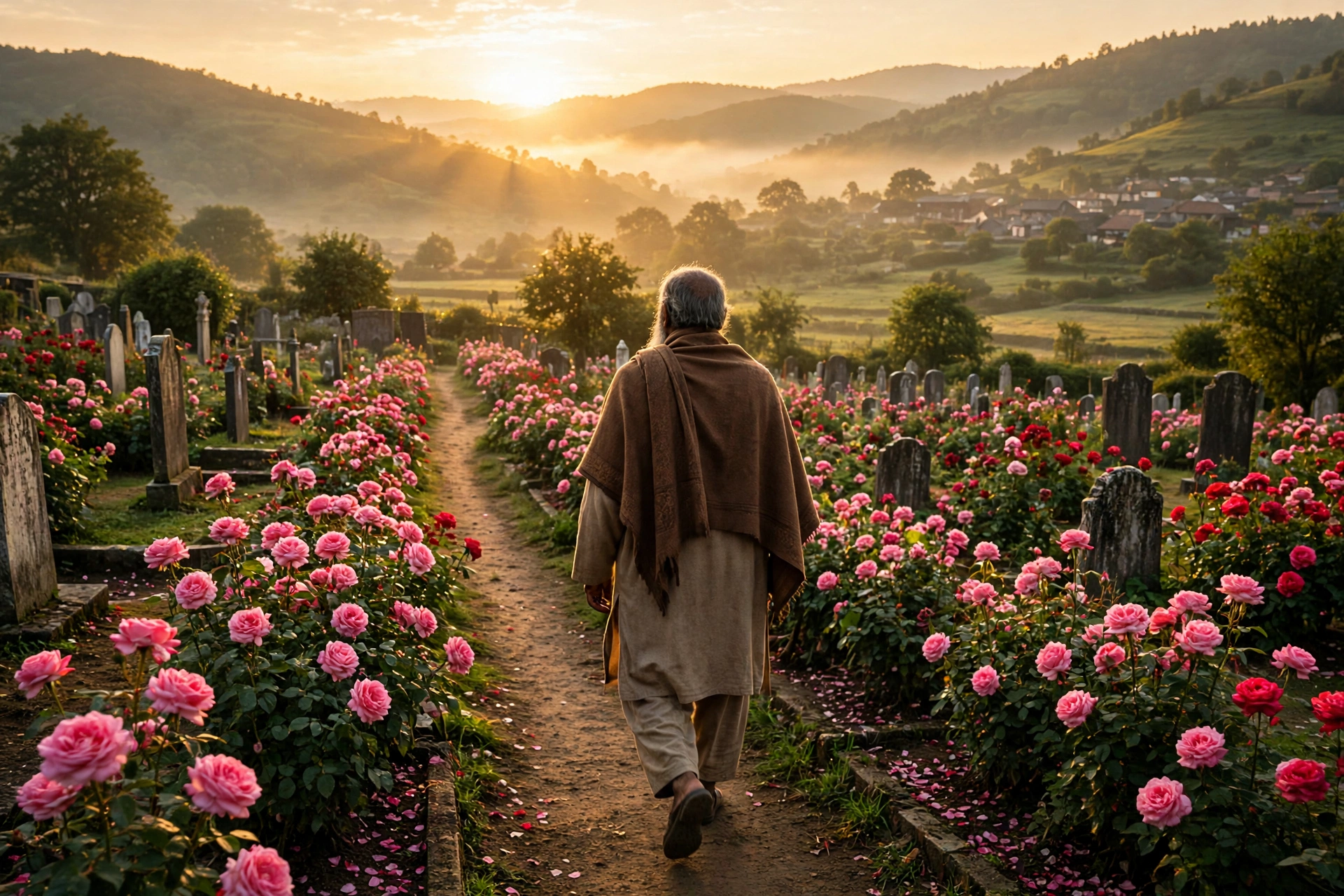
The first time Rahim buried a stranger, he did it because nobody else would. The hundredth time, he did it because nobody else could.
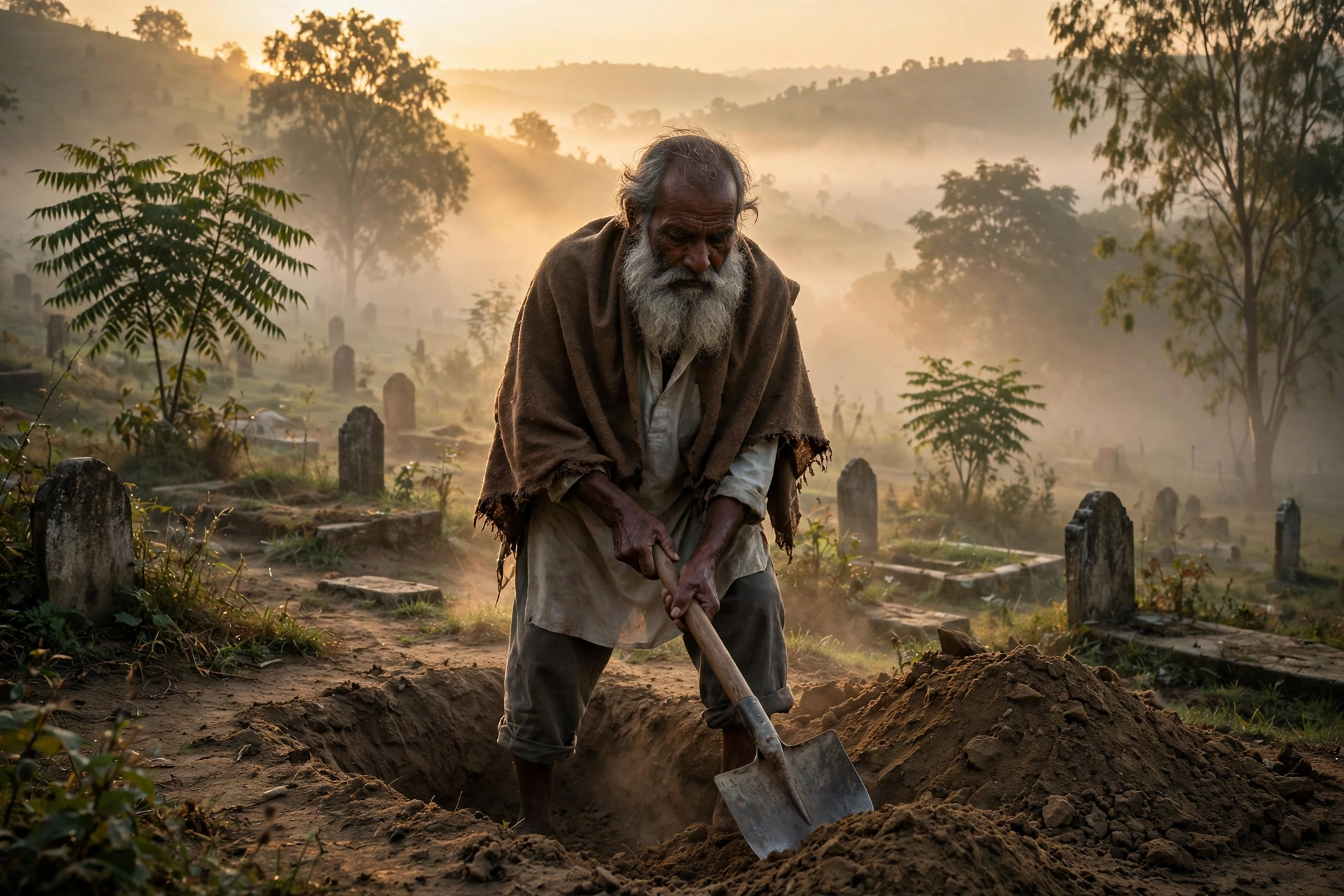
He was sixty-eight years old, thin as a winter branch, with a grey beard that reached his chest and hands shaped by thirty years of shovel and earth. Every morning before the sun rose over the low hills of Chak Noor, he walked the dirt track to the old cemetery at the edge of town, carrying his spade over one shoulder and a small clay pot of water over the other. He knew every grave — the marble headstones with fresh flowers, and the flat, unmarked earth at the far end, under the neem trees, where the grass grew wild.
That corner was his. It belonged to the ones nobody came for — the labourer who died alone in a roadside shelter, the old woman found in a rented room days after her heart had stopped, the baby left at the mosque gate before dawn. The town council paid Rahim a small wage to dig the graves, and everyone understood his job ended there. But Rahim had made his own rule long ago, and he had never broken it: no one would be put into the ground like a thing being thrown away. Every stranger got a grave dug straight and deep, a clean white cloth, a few words spoken over them, and a stone at the head. He could not give them a name, but he could give them dignity — and he gave it the way a man gives water to a thirsty traveller, without being asked and without keeping count.
Only Rahim knew the truth: he had not always been the gravedigger. Once he had been a father.
His son's name was Bilal, and Bilal had been nine when the canal took him. It was a summer afternoon, and Bilal had gone with the other boys to swim beyond the wheat fields. The water was fast that year, and by the time the men of the village reached the canal, Bilal was gone. They searched for three days and never found him — no body to wash, no body to bury, no grave for his mother to visit. Amina sat by the window for a year after that, watching the road, waiting for a boy who would never come home. Then one winter she caught a fever, and she too was gone, and Rahim buried her with his own hands in the cemetery where he had just taken the gravedigger's job.
After that, there was nothing left in Rahim's life except the cemetery and the work — and slowly, without ever deciding it, he began to bury the strangers as if each one of them were Bilal.
The winter that changed everything came early that year. The cold settled over Chak Noor in the first week of December, and the fog rolled in from the fields every evening and stayed until noon. On one such evening, when the light was already failing, Rahim was walking home from the cemetery when he saw a man sitting on the bench at the bus stop near the old banyan tree.
The man was very old and thin, his coat buttoned wrong, a cloth bundle clutched on his lap, his head fallen forward onto his chest as if he had sat down to rest and sleep had taken him by surprise. Rahim slowed. Something in the stillness of the man made him stop and look closer. He touched the man's shoulder, gently, and said, "Baba, the last bus has gone. You will freeze here."
The man did not move. His hands were cold. His eyes were open and empty, staring at nothing. The bundle slipped from his lap and fell to the ground, and a photograph slid out of it — a small, faded photograph of a little girl of about six, standing in front of a house with a blue door, smiling a gap-toothed smile. There was nothing else in the bundle — no money, no letter, no identity card. Just an old shirt, a comb, and the photograph of a little girl who had once meant the whole world to somebody.
He did not know this man's name or where he had come from. But he knew one thing: this man had been somebody's father once. Somewhere, a little girl with a gap-toothed smile had called him Baba — and nobody in the whole world knew that he had died.
Rahim reported it at the police station. The policeman wrote it down, shrugged, and said the words Rahim had heard a hundred times before. "Nobody will claim him. We will keep the body for three days, and then it is yours."
Three days later, nobody came. So Rahim washed the old man himself, wrapped him in a clean white cloth, and buried him in the quiet corner, in a grave dug straight and deep. He placed the photograph in a small tin box and buried it at the head of the grave, so the girl's smile would be close to her father, and set a smooth river stone there, scratching three words into it with a nail: A FATHER, ONCE LOVED.
That evening, his hands were shaking, and it was not the cold. He had buried a hundred strangers, but this man was different: he had left behind a photograph, and a photograph meant someone, somewhere, might still be looking for him. The next morning, Rahim planted a rose cutting from Amina's bush at the head of the stranger's grave.
He watered it every day, and by April a single pink bud had opened — and Rahim felt something crack open inside his chest, something shut tight for thirty years. He had stopped feeling like a man digging holes, and started feeling like a man waiting for something.
The woman arrived on a Tuesday.
She came in a taxi from the city, a woman of about forty, tired from the journey. At the tea stall she asked if anyone had seen an old man, very thin, with a grey beard, who had come to this town in the winter and never come back. The tea seller pointed at Rahim. "Ask the gravedigger," he said. "He knows everyone who comes to this town and never leaves."
Rahim's heart began to beat so hard he could hear it. The woman walked toward him slowly, holding a photograph in her hand. Even from a distance, he knew what it was. The little girl with the gap-toothed smile, standing in front of a house with a blue door.
"My name is Sana," she said, and her voice shook. "I have been looking for my father for twenty-five years."
They sat on the bench, and Sana told him the story in pieces. Her father, Master Karim, had been a schoolteacher in a town two hundred miles away. When Sana was six, he had quarrelled with his own father over money and pride, and walked out of the house that night, never to come back. Her mother died five years later, still waiting. Sana grew up, married, raised children of her own, and never stopped looking. A truck driver had told her he had once given a lift to an old man who spoke of a daughter named Sana — and that the man had been heading for Chak Noor.
"He was coming to find me," Sana whispered. "He was coming home. And he died on a bench, alone, before he ever got there."
Rahim said nothing. He stood up, took his spade from where it leaned against the tea stall, and said, "Come with me."
He led her to the quiet corner under the neem trees, where the rose bush was covered in pink blossoms. Beneath it stood the smooth river stone, and on it, in letters worn soft by the rain: A FATHER, ONCE LOVED.
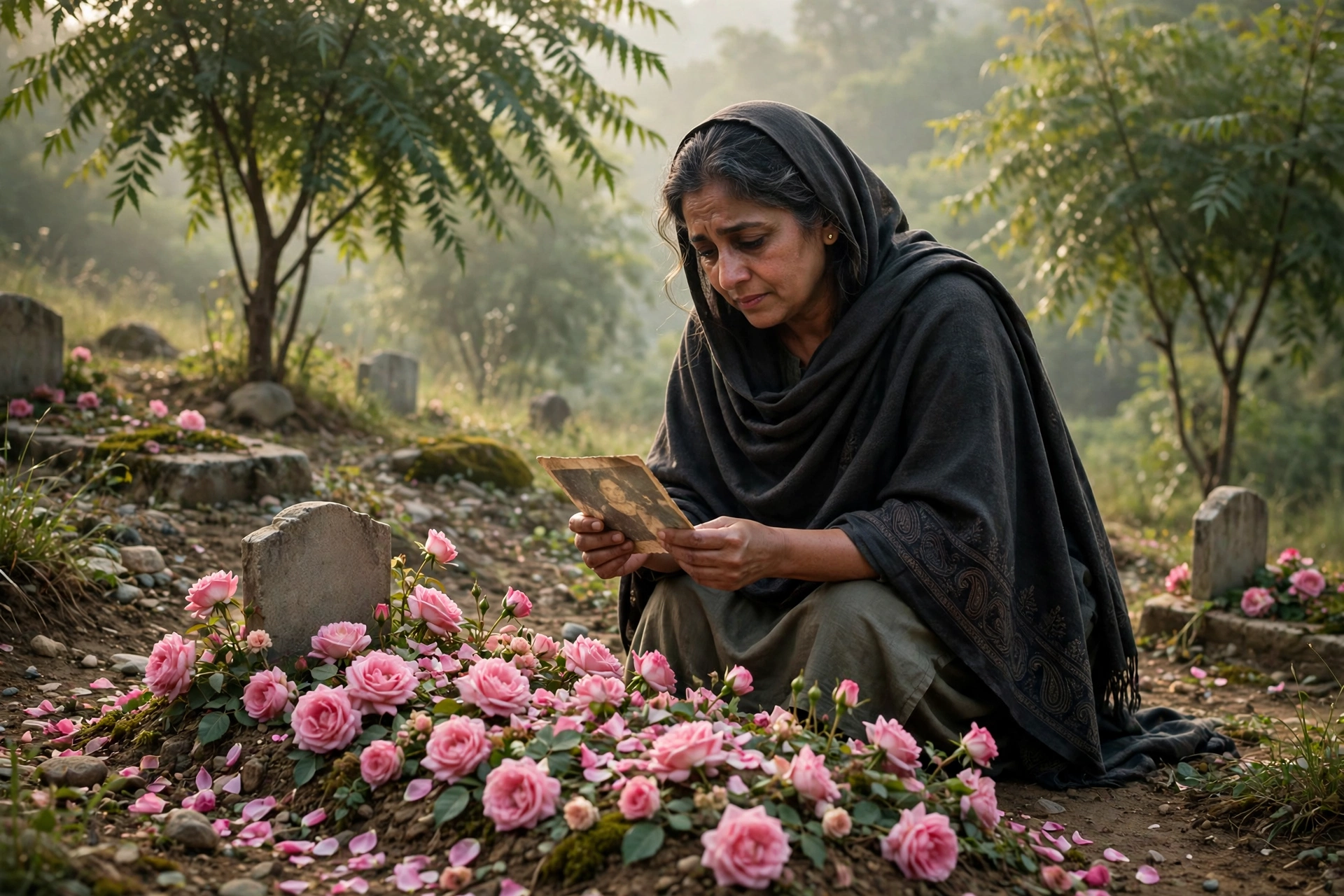
Sana fell to her knees and pressed both hands to the earth, weeping the deep, broken weeping of a daughter who had finally found her father — twenty-five years too late, and exactly in time.
Rahim dug up the small tin box and gave it to her. The photograph was still there, a little faded, the little girl still smiling. Sana held it to her chest and cried harder, and Rahim stood beside her, not knowing what to do with his own grief, which had risen up in him like floodwater.
"I buried him the way I would want my own son to be buried," Rahim said at last, and his voice was rough. "I did not know his name. But I knew he was somebody's father. That was enough."
Sana looked up, her face wet with tears. "Then you buried him the way a father should be buried. You gave him a grave, and a stone, and flowers. You gave him dignity — and you gave me a place to come and say goodbye."
Before she left, she tried to press money into Rahim's hands. He stepped back and shook his head.
"I do not take money for this," he said. "It was never a job. It was a debt."
"A debt to whom?" she asked.
He looked out over the cemetery, and for the first time in thirty years, he said the words aloud.
"To my son. He was nine when the canal took him, and I never got to bury him. There was no grave, no stone, nowhere for his mother to say goodbye. So I bury the ones nobody claims, because every one of them is somebody's Bilal — and every grave I dig is the grave I never got to dig for him."
Sana was quiet for a long time. Then she took his hand — his old, cracked, earth-stained hand — and held it between both of hers.
"Then my father is not a stranger in this ground," she said. "He is lying beside your son's memory. And that means you are not alone either. You are the man who buried my father when the whole world walked past him. From today, you are my father's brother, and I am your daughter. That is not a debt. That is a family."
She left that evening, promising to return — and she kept her promise. She came back in the summer with her two children, a boy of ten and a girl of eight, and together they planted a row of roses along the quiet corner, one for every unmarked grave. "Because the world forgot them," Rahim told the boy when he asked why the graves had no names. "But we will not forget them. A rose is a name that never fades."
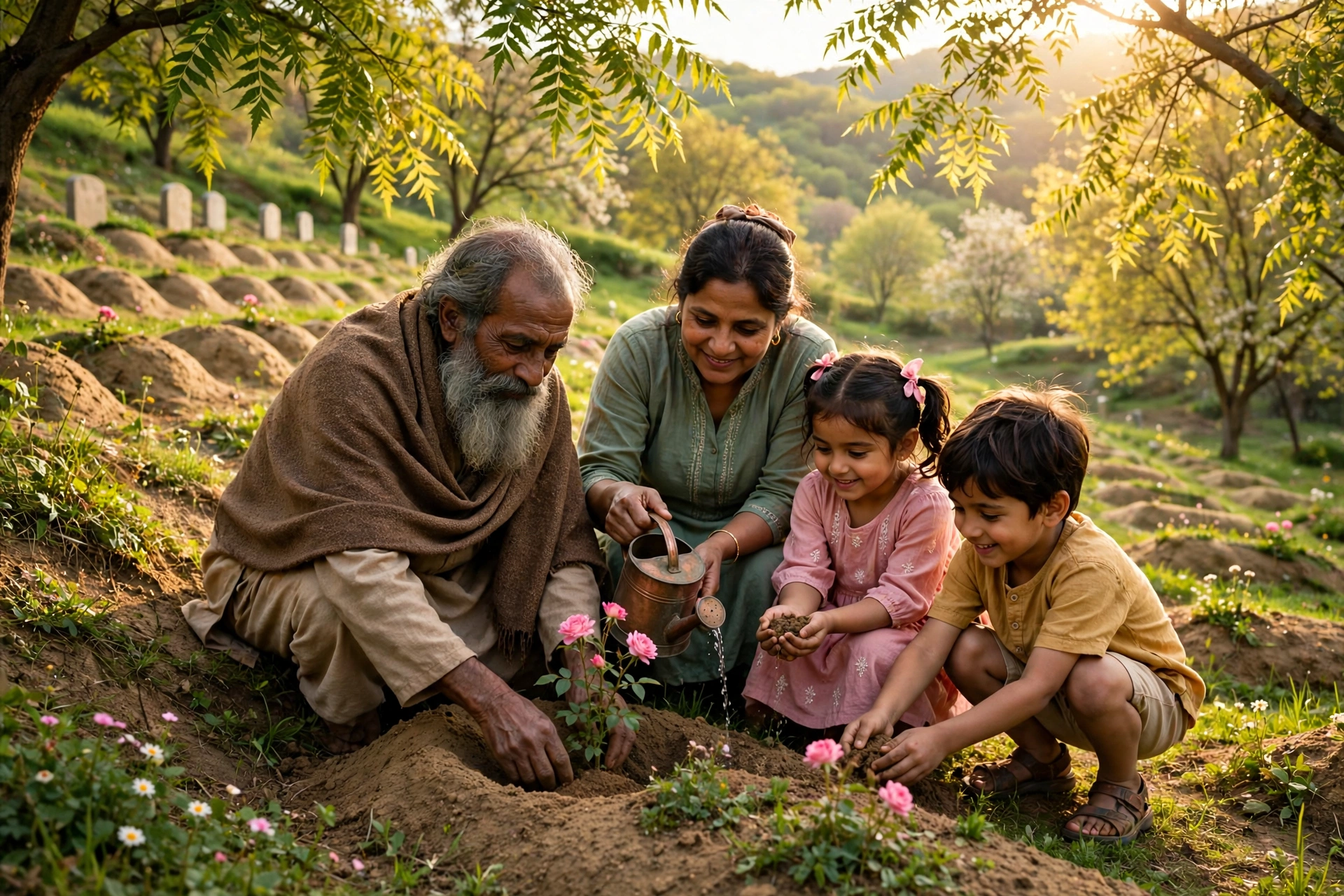
The children came back every school holiday after that. Sana had her father's stone replaced with a proper headstone — MASTER KARIM, BELOVED FATHER — and underneath, the words Rahim had first scratched with a nail: A FATHER, ONCE LOVED. She asked if she could add a small stone for Bilal too, so a father would finally have a place to say goodbye to his son. Rahim said yes, and cried, and did not hide it, because after thirty years he had learned that tears were not a weakness. They were the rain that lets the roses grow.
Years passed. The quiet corner was a garden now — roses in every colour, a bench where visitors could sit. On a small wooden board at the entrance, Sana had painted words every visitor read: HERE LIE THE ONES NOBODY CLAIMED. THEY WERE SOMEBODY'S FATHER, SOMEBODY'S MOTHER, SOMEBODY'S CHILD. THEY ARE NOT FORGOTTEN.
One spring morning, many years later, Rahim stood at Bilal's stone with Sana's grandchildren, and said something he had never said before.
"I used to think the canal had taken everything from me," he said. "But it only took my son's body. A grave is not a hole in the ground. It is a promise that someone mattered. And every time I kept that promise for a stranger, I was keeping it for him. So in the end, I did bury my son — a hundred times, in a hundred strangers, and every one of them was loved."
The old gravedigger walked home through the flowers as the sun came up over the hills of Chak Noor — a man who had nothing, and had given everything, and had been given back more than he had ever dared to ask for.
For no one should leave this world unmourned. And sometimes, the only way to heal the wound of the one we lost is to be the hands that gently lay a stranger to rest.