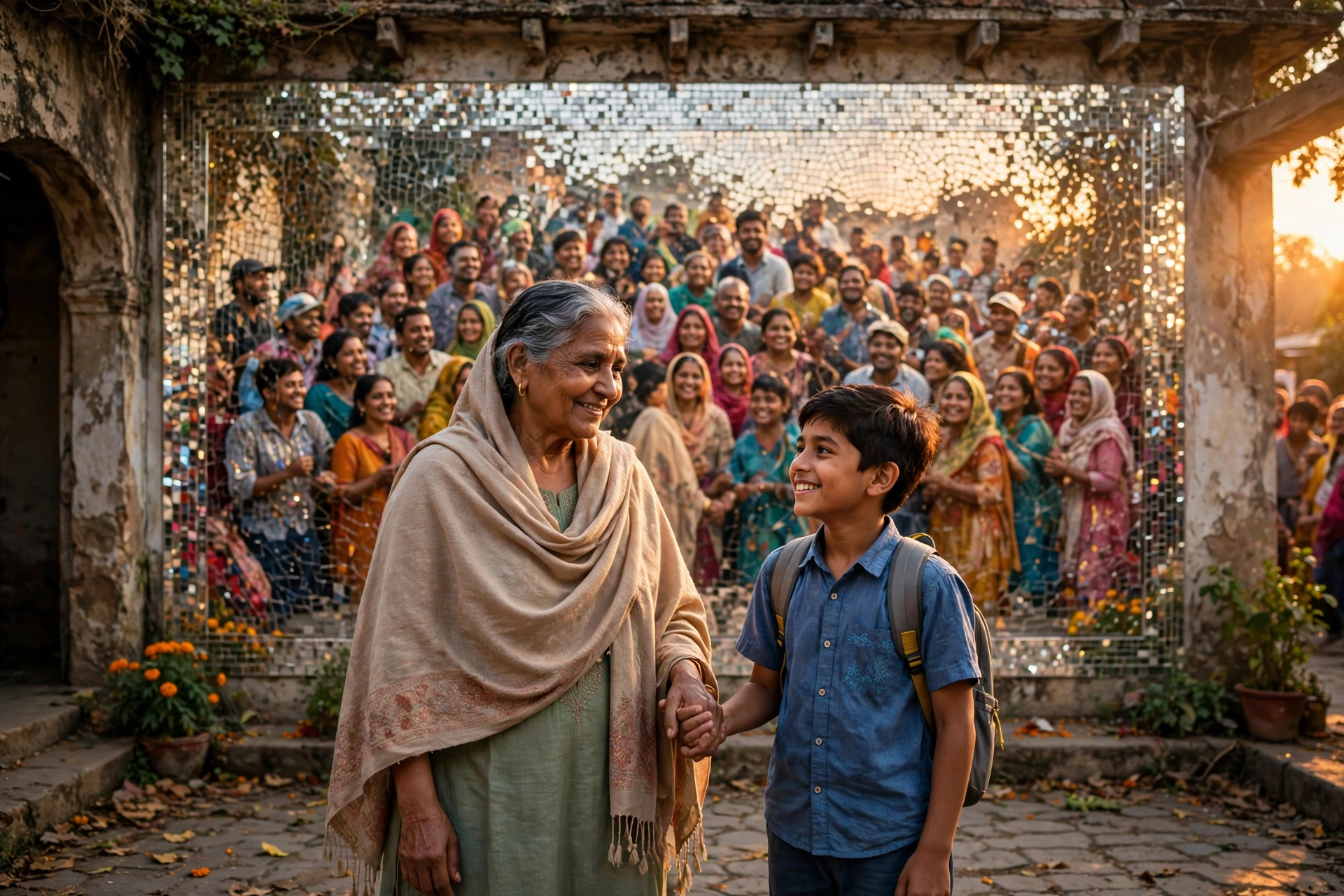
The morning they threw away the big mirror from the corner house, Amna was already out with her basket.
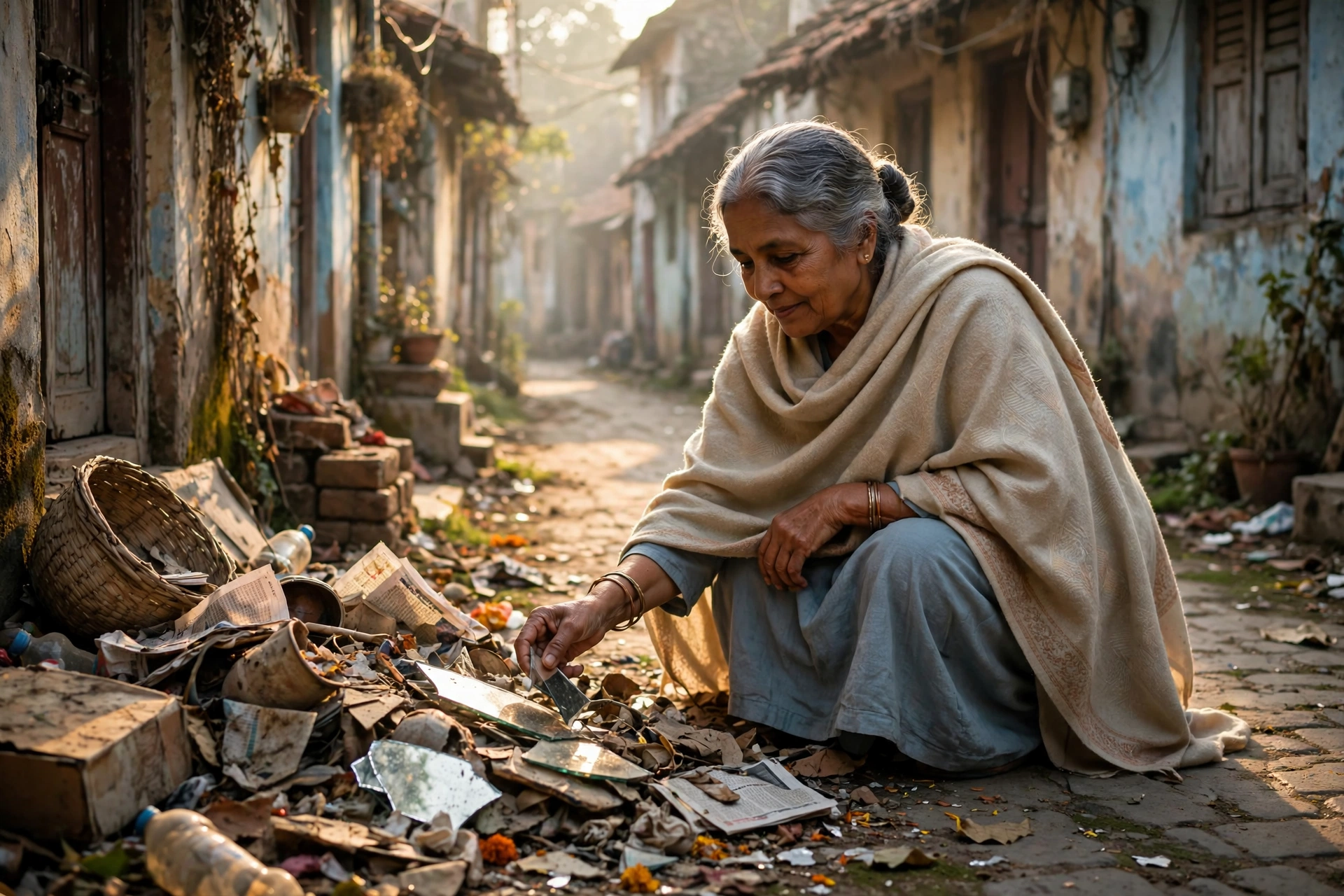
She had been awake since before dawn, as she always was. By the time the first light touched Rose Lane, she was walking slowly along it with a woven basket on her arm, stopping at every pile of rubbish, every old cupboard left out for collection, every broken thing the street had decided it no longer wanted. The neighbours were used to her by now. The children called her Amna Dadi. In their minds, she was simply a lonely old woman who collected rubbish, and lonely old women were allowed their harmless habits.
What they did not know was that Amna was not collecting rubbish. She was collecting mirrors.
She had begun the year her husband, Rashid, died. Rashid had been a glassworker, a quiet man with steady hands who could cut a sheet of glass as cleanly as another man might cut bread. For forty years he had worked in the little workshop behind their house, and Amna had swept the floor, made his tea, and watched the light move across the glass. When he died, very suddenly, on an ordinary Tuesday in winter, the workshop fell silent. The tools stayed where he had left them.
For months after that, Amna could not bear to enter the workshop. The grief sat in her chest like a stone. Then one morning, walking past a neighbour's rubbish pile, she saw a cracked hand mirror lying on top of a broken chair. She picked it up. The glass was fractured into a web of lines, but when she tilted it, the morning light still flashed back at her, bright and alive. She took it home, wrapped it in an old cloth, and placed it on Rashid's bench. That night, for the first time in months, she slept without waking in tears.
After that, she collected every broken mirror she could find. A dressing-table mirror with a chipped corner. A bathroom mirror split down the middle. A small round mirror from a child's toy, its silver backing peeling. She kept them in boxes in the workshop, each piece wrapped carefully, as if they were something precious rather than something the world had thrown away. The neighbours noticed her basket, but they never asked what was in the boxes, and Amna never told them. She was still mending something inside herself, and she did not have the words for it.
It was Hamza who changed everything.
Hamza was ten years old, and he lived three houses down from Amna with his father, Tariq, a tired bus driver who worked long hours. Hamza's mother had died the previous year after a long illness, and since then the boy had become quiet in a way that worried his teachers. The bright, noisy boy he had once been seemed to have gone somewhere far away, and no one knew how to bring him back.
One hot afternoon, Hamza came home from school to find his father asleep on the sofa, still in his uniform. In the hallway hung the tall mirror his mother had loved, the one she used to stand before every morning, adjusting her shawl and smiling at her own reflection. Hamza stood before it, trying to remember exactly how she had looked standing there. And then, without warning, the grief rose up in him like a wave, and he struck the mirror with his fist — not because he was angry at the mirror, but because he was angry at everything, at the illness, at the empty house, at the unfairness of a world that could take a mother away and leave a boy standing alone in a hallway.
The mirror shattered. His father woke with a start, came running, and stood staring at the broken glass scattered across the floor. He did not shout. He simply looked very tired, and said, "Hamza, what have you done?" And Hamza, who had never felt so ashamed in his life, ran out of the house and down Rose Lane, his eyes full of tears.
He stopped outside Amna's gate because he could go no further. She was sitting in her courtyard, sorting mirror pieces on a low table, and she looked up and saw a boy with a cut on his knuckle and grief all over his face. She did not ask him what was wrong. She simply patted the chair beside her and said, "Sit, beta. The shade is good here."
Hamza sat. For a long time, neither of them spoke. Then, in a small voice, he told her everything — about his mother, the mirror, and the shame burning in his chest. He expected a lecture. Instead, Amna took his hand gently in hers and said, "Come. I want to show you something."
She led him into the workshop and showed him the boxes, unwrapping a broken mirror, piece by piece, and laying the shards on the bench. "People think a broken mirror is finished," she said softly. "They sweep it up and throw it away, because they only see what is lost. But look." She tilted a shard towards the window, and sunlight bounced off it and danced across the wall. "It still catches the light. Every piece of it. It is broken, yes. But it is not dark."
Hamza stared at the dancing light on the wall. Something inside him loosened, just a little, as if a knot he had been carrying for a year had begun to come undone.
"Would you like to help me make something?" Amna asked. "Not to fix the mirror you broke — that mirror belonged to your mother, and its breaking was an accident of a hurting heart, not a crime. But to make something new, out of broken pieces, so that nothing beautiful is ever truly wasted?"
Hamza nodded, not trusting his voice just then, and Amna smiled.
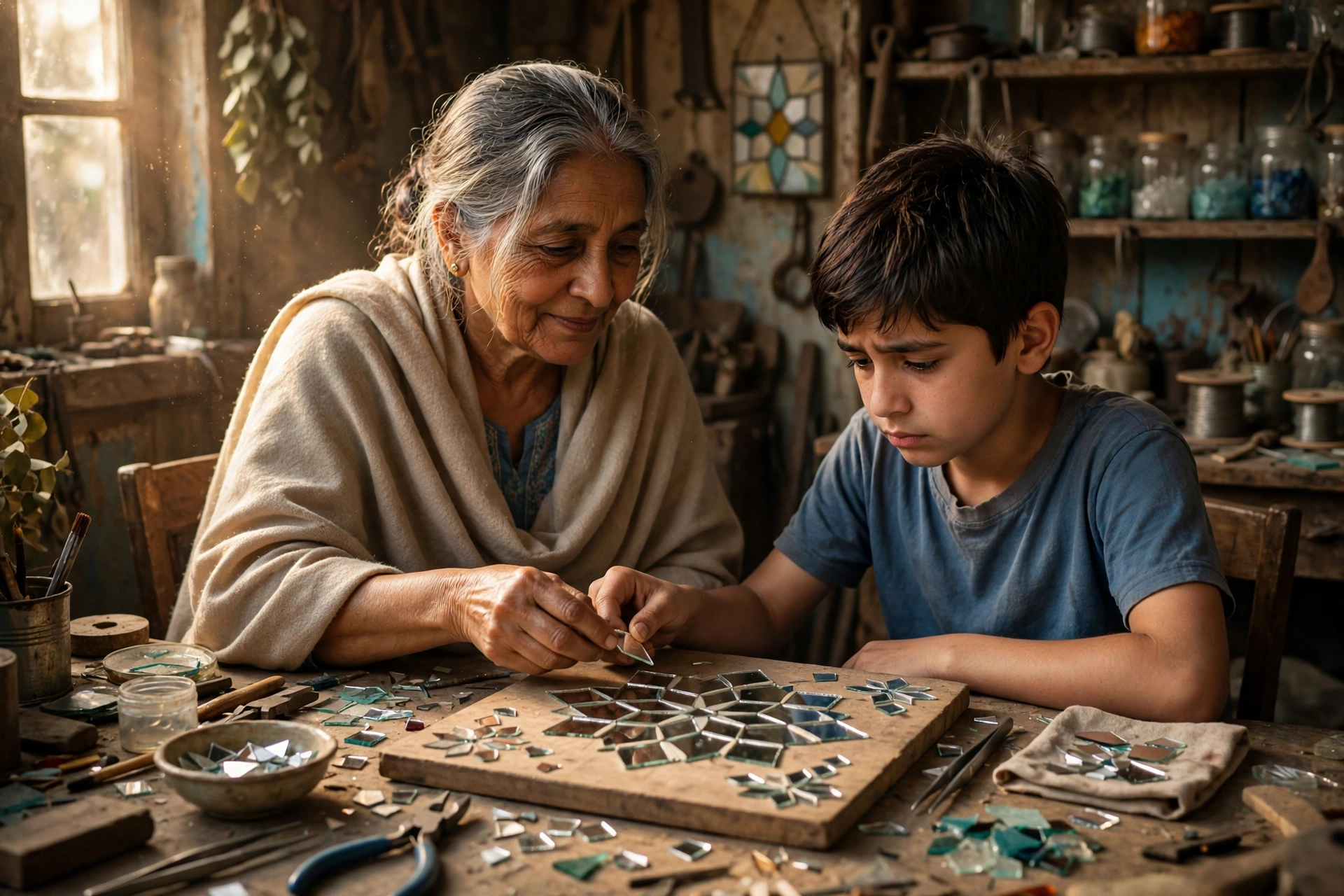
Over the following weeks, Hamza came to the workshop every afternoon after school. Amna taught him how to handle the glass safely, wearing thin gloves, smoothing the sharpest edges, sorting the pieces by shape and shade. Together, they began to lay them out on a large wooden board, fitting them together like a puzzle with no picture on the box — a great, spreading pattern of light, like a river, like a tree, like the sun rising over rooftops. Amna never told Hamza what the pattern should be. She only said, "Put the piece where your heart says it belongs," and, to his surprise, his heart often knew.
Slowly, word spread along Rose Lane. First the old shopkeeper came, carrying a cracked mirror from his shop. "I heard the boy is making something," he said gruffly, and then he stayed for tea and told them how it had hung in his shop for thirty years. Then came the young bride from number twelve, with a small broken mirror from her wedding, and she cried a little as she handed it over, and Amna held her hand and said, "Now it will be part of something that lasts." Then came the schoolteacher, the tailor, the woman who sold flowers at the corner — each carrying a broken mirror, and each carrying a story.
It turned out that Rose Lane was full of broken mirrors, and full of people who had kept them, guiltily, in cupboards and storerooms, because throwing them away had felt wrong, though they could not have said why. Now, one by one, they brought them to Amna's workshop, and the great board grew. The neighbours began to stay for tea, and to talk as they had not talked in years. The tailor told the shopkeeper about his late wife. The schoolteacher told the flower-seller about the daughter she had lost touch with. And Hamza, listening as he fitted pieces into the pattern, began to understand something important: that almost everyone on his street was carrying a crack somewhere inside them, and that most of them had simply learned to hide it well.
One evening, Tariq came to collect his son and found him in the workshop, his face lit up in a way Tariq had not seen since before his wife died. He stood in the doorway for a long time, watching. Then he stepped inside, and in a voice that was not quite steady, he said, "Amna Baji, I have a mirror too. It is the one from our hallway. My wife's mirror. I swept up the pieces, and I could not throw them away." He opened a cloth bag, and there they were — the shards, still bright, still catching the light.
Amna took the bag gently. "Then it belongs here most of all," she said.
Together, father and son placed the last pieces into the pattern. Tariq's hands shook a little as he worked, and Hamza reached over and steadied his father's wrist. Neither of them said anything.
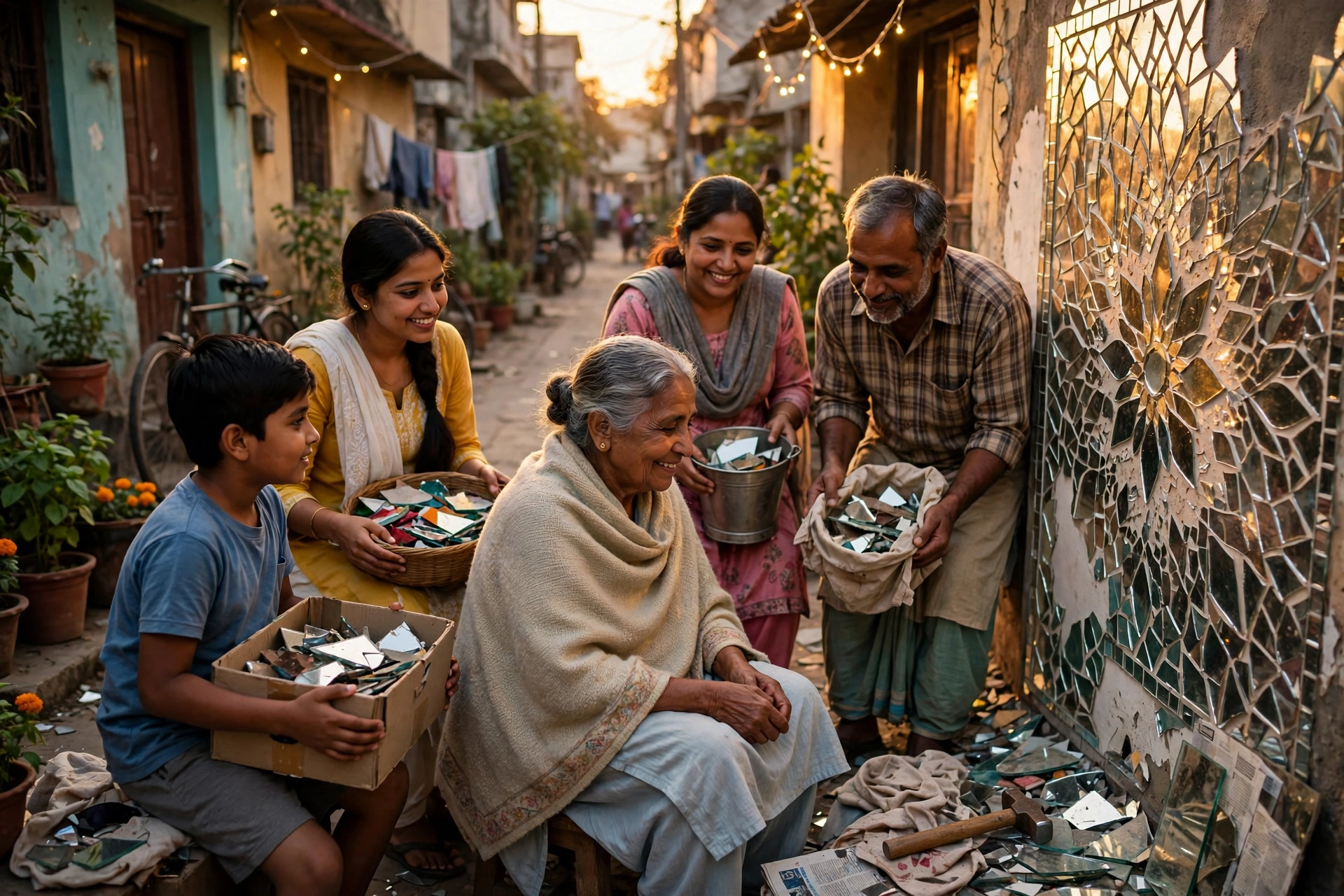
By the end of summer, the board was finished, and it was far too beautiful, and far too large, to stay in the workshop. The neighbours did something Rose Lane had never done before: they asked the council for permission to fix the mosaic to the blank, peeling wall of the old community hall at the end of the lane. Permission was granted, and on a Saturday morning the whole street turned out to help. Amna directed it all from her chair, with Hamza at her side, and by evening, the wall was transformed.
It was not a perfect mirror. It was something far better. Hundreds of broken pieces, fitted together with patience and care, caught the setting sun and threw it back in a thousand directions — a river of light, with the faces of the street reflected in it, warmly, like a memory. People stood in the lane and looked at it in silence. The shopkeeper found the piece from his shop and pointed it out to his grandson. The bride found her wedding mirror and wept quietly into her husband's shoulder. Tariq and Hamza stood together, found the pieces of the hallway mirror, and Tariq put his arm around his son, and this time, he did not let go quickly.
Amna stood a little apart from the crowd, her basket empty at her feet. Hamza came and took her hand. "Dadi," he whispered, "it is the most beautiful thing I have ever seen." She squeezed his hand. "It was always beautiful, beta," she said. "It was only waiting for someone to look properly."
That night, Rose Lane stayed out later than it ever had. Someone brought a drum. Someone else brought sweets. And Amna, sitting in her chair with a cup of tea going cold in her hands, felt something she had not felt since the winter Rashid died: not the sharp grief of the early days, but a quieter, warmer thing — the knowledge that what she had loved had not ended, but had changed its shape, and that love, like light, does not disappear when the glass breaks. It only finds a new way to shine.
From that day on, no one on Rose Lane threw a broken mirror away. When a mirror broke, it was wrapped in cloth and carried to the hall, where a new panel was begun, and the wall kept growing, piece by piece — a wall of broken things, made whole by a street that had learned, at last, to mend together.
And if you walk down Rose Lane today, on a clear evening, you will see it: a wall glittering with a thousand small lights, and beneath it, very often, an old woman and a boy, sitting side by side, watching the sun go down in the glass. If you ask them what it means, the boy will grin and say, "It means broken is not the end."