On the morning his hands first betrayed him, Yusuf dipped his reed pen into the ink and watched a single black drop fall where it should not have, right in the middle of a bride's name.
He was sixty-eight, and for fifty years he had sat at the same wooden desk in the same narrow shop on Ink Lane, writing names the way other men built houses: slowly, carefully, as if each letter had to hold weight. Wedding invitations, shop signs, birth announcements, school certificates — if a name mattered to someone in this part of the city, sooner or later it came to Yusuf's desk.
But that morning, his hand shook. The drop spread across the paper like a small, dark cloud. Yusuf stared at it for a long time, then folded the paper quietly, threw it away, and started again. No one ever saw the things Yusuf threw away.
His shop was the smallest on Ink Lane. The paint on its door had faded to the colour of old tea, and the bell above it rang whenever the wind pushed the door open. Inside were jars of ink in black, deep blue, and dark green, reed pens, brushes worn soft by decades of use, and stacks of cream and pale gold paper. On the wall behind his desk hung his father's old sign, painted by hand: "Names written here with care."
Yusuf had learned the art from his father, who had learned it from his father before him. As a boy, he had practised one letter at a time until his fingers ached. His father used to say, "Anyone can write a name, Yusuf. But to write it beautifully, you must first believe the person deserves beauty." Yusuf had never forgotten that.
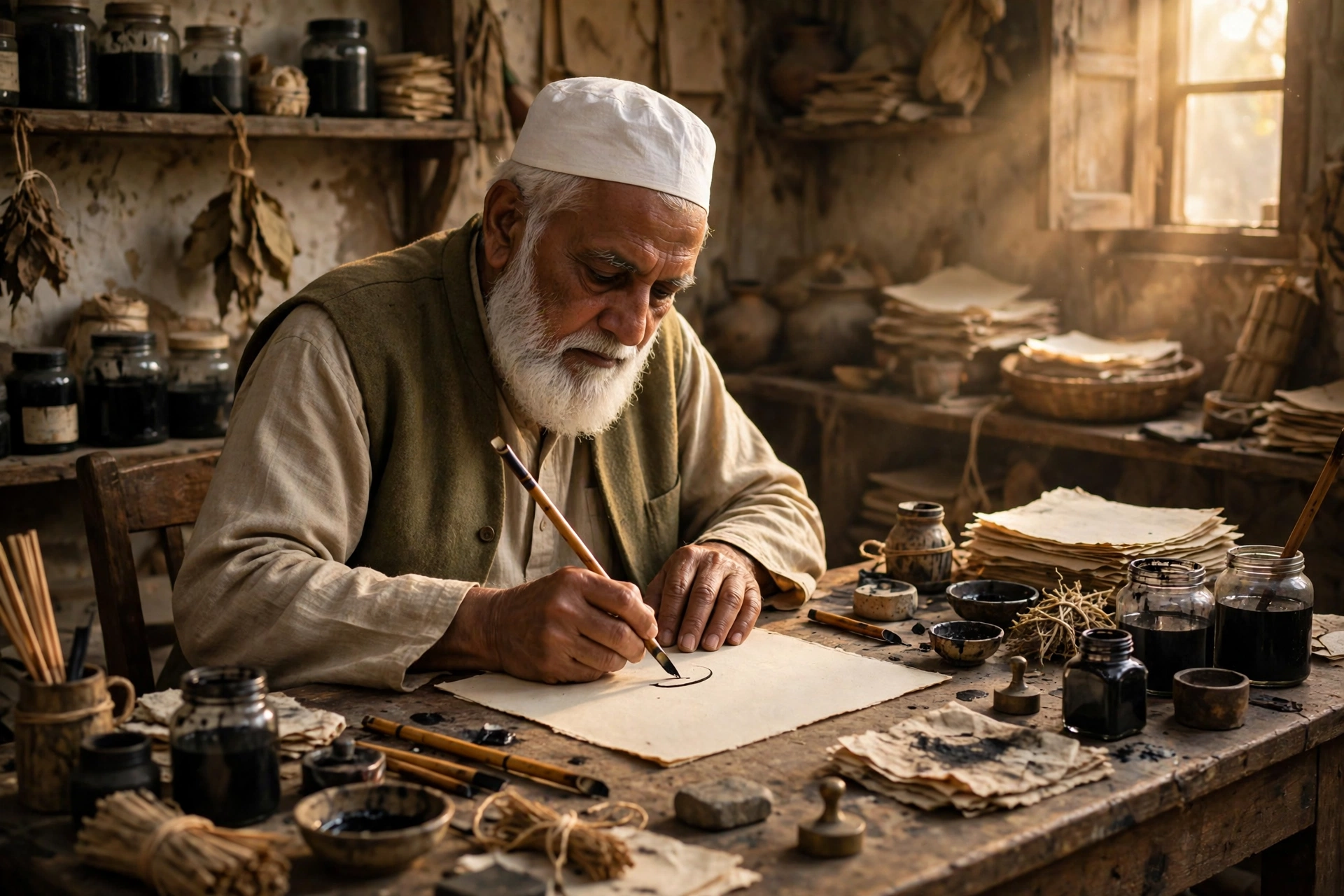
The world, however, was changing around Ink Lane. Down the street, a new printing shop had opened with machines that could print a hundred banners in an hour. Shopkeepers who once waited a week for Yusuf to paint their signs now ordered printed ones in a day, for half the price. Young couples ordered their wedding cards online. Fewer and fewer people climbed the two worn steps to Yusuf's shop, and some weeks the bell above his door rang only twice.
Yusuf never complained. He swept the floor each morning, arranged his pens in a neat row, and waited. He still charged the same small price he had charged for years, and when someone came in with empty pockets and an important occasion, he often waved the money away and said, "Pay me when you can. Or pay me by telling someone else about this shop." Most of them never paid, but they did tell someone else, and that was how his shop had survived, on stories passed from mouth to mouth.
One hot afternoon in late summer, a young man came in who Yusuf had never seen before. He was tall and thin, with dust on his shoes and sunburn on his neck, and he stood in the doorway as if he were not sure he was allowed to enter. His name was Imran, and he worked on a building site three streets away, carrying bricks from morning until evening for wages he sent home to his village.
"I need a letter," Imran said quietly, looking at the floor. "For my daughter. Her birthday is next week. She is turning nine."
Yusuf smiled and reached for his paper. "What would you like it to say?"
Imran hesitated. His hands, rough from bricks and cement, twisted together. "I don't know how to write," he whispered. "I never went to school. My daughter writes to me, and my neighbour reads her letters to me. But I have never written back. She thinks I don't care, that I forgot her."
Yusuf put his pen down. He looked at the young man standing in his shop, a father who had carried bricks all summer so his daughter could go to school, and who feared his daughter believed he did not love her. "Then we will write her the most beautiful letter she has ever received," Yusuf said.
For the next hour, Yusuf asked questions, and Imran answered them slowly. What did his daughter like? Mangoes, and the colour yellow, and the stories her grandmother told about a clever fox. What did he want her to know? That he thought of her every night before sleeping, that he was proud of her marks in school, that he missed the sound of her laugh more than he missed home itself, and that he would bring her a yellow dress when the building was finished.
Yusuf wrote it all down in his finest script, each letter shaped like a small gift. When he finished, he read it aloud to Imran, slowly, so the young man could hear his own heart in someone else's handwriting. Imran wept openly, and Yusuf pretended to be busy cleaning a pen so the young man would not feel watched.
"How much?" Imran asked, reaching for his pocket.
"Nothing," Yusuf said. "A father's first letter to his daughter is priceless. You cannot pay for it, and I will not let you try."
But before Imran left, Yusuf did one more thing. He took a fresh sheet of paper and, letter by letter, taught Imran to write his own name. I-M-R-A-N. The young man's hand shook worse than Yusuf's, and his letters leaned like tired workers at the end of a long day. But by the fifth try, the name stood upright. Imran stared at it as if it were a photograph of himself. "Now she will know it is from me," he said, and he folded both papers into his shirt pocket, close to his heart.
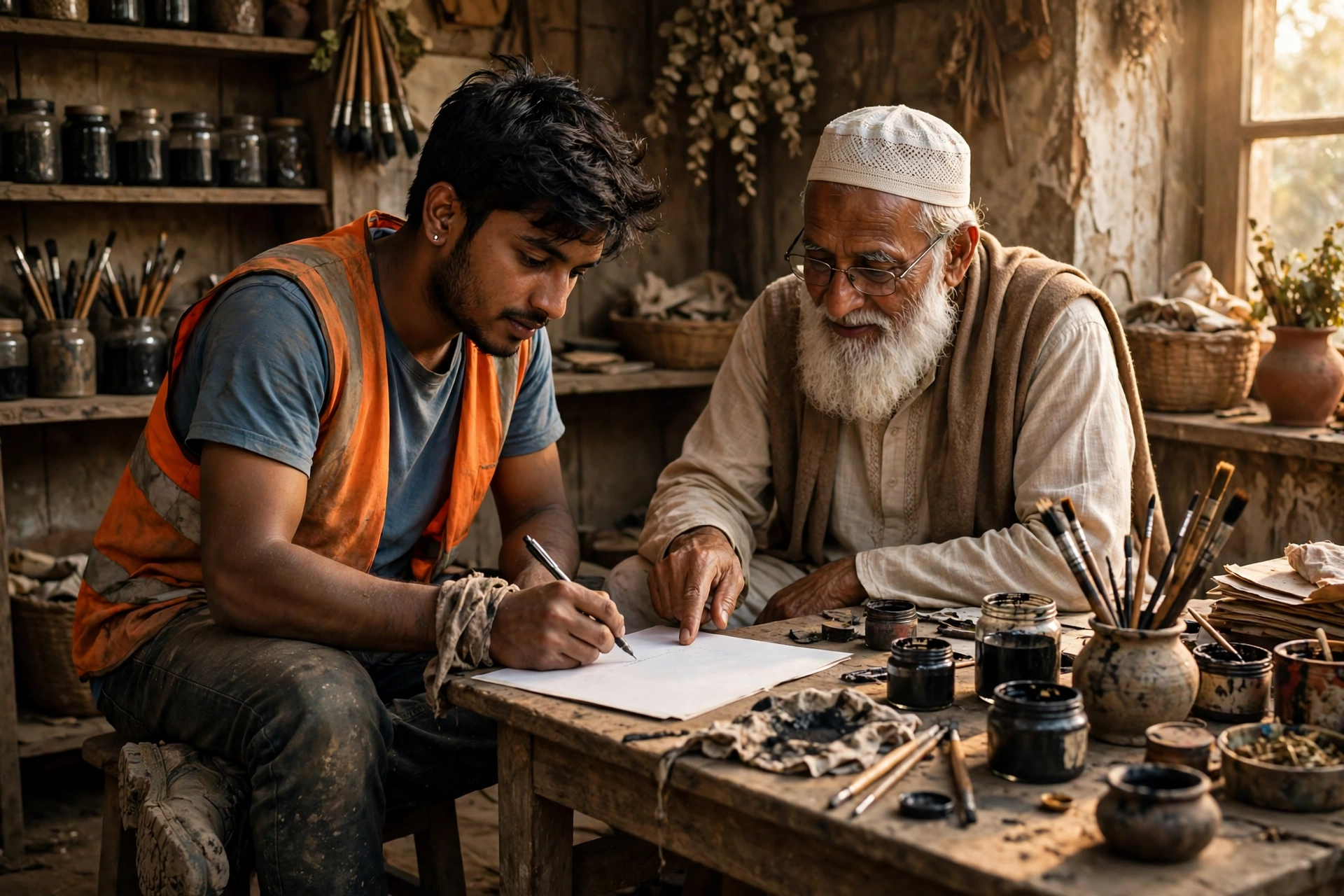
After that day, Imran came back every week. Sometimes he brought a new sentence for the next letter. Sometimes he just practised writing his name, and then his daughter's name, Maryam, until the letters stopped leaning. Yusuf never charged him. Watching a man learn to write his own name felt like watching a door open that had been locked for years.
Meanwhile, Yusuf's eyesight was quietly getting worse. The letters began to blur at the edges, especially in the evening light. He started working only in the mornings, when the sun fell directly on his desk. Then even the mornings became difficult. One day, he mistook a customer's name and had to rewrite a whole invitation. The customer was kind about it, but Yusuf went home that night and sat in silence, his hands in his lap, his pens untouched.
The doctor was gentle but clear. "Your eyes are tired, Yusuf. Fifty years of fine work. You must rest them, or you will lose the sight altogether." The landlord, less gentle, reminded him that the rent was due and that a printing company wanted the shop. Yusuf did the arithmetic in his head, and for the first time, the numbers did not add up. There were not enough customers left. His shop, his father's shop, would have to close.
He did not tell anyone at first. He simply kept sweeping the floor, arranging his pens, and waiting for the bell. He finished the invitations he had promised, wrote one last sign for the baker across the street, and quietly began to pack his inks into a box. On his final evening, he sat at his desk and wrote his own name one last time, slowly, in his finest script, as if saying goodbye to an old friend. But Ink Lane had been watching, the way streets always watch the people who love them.
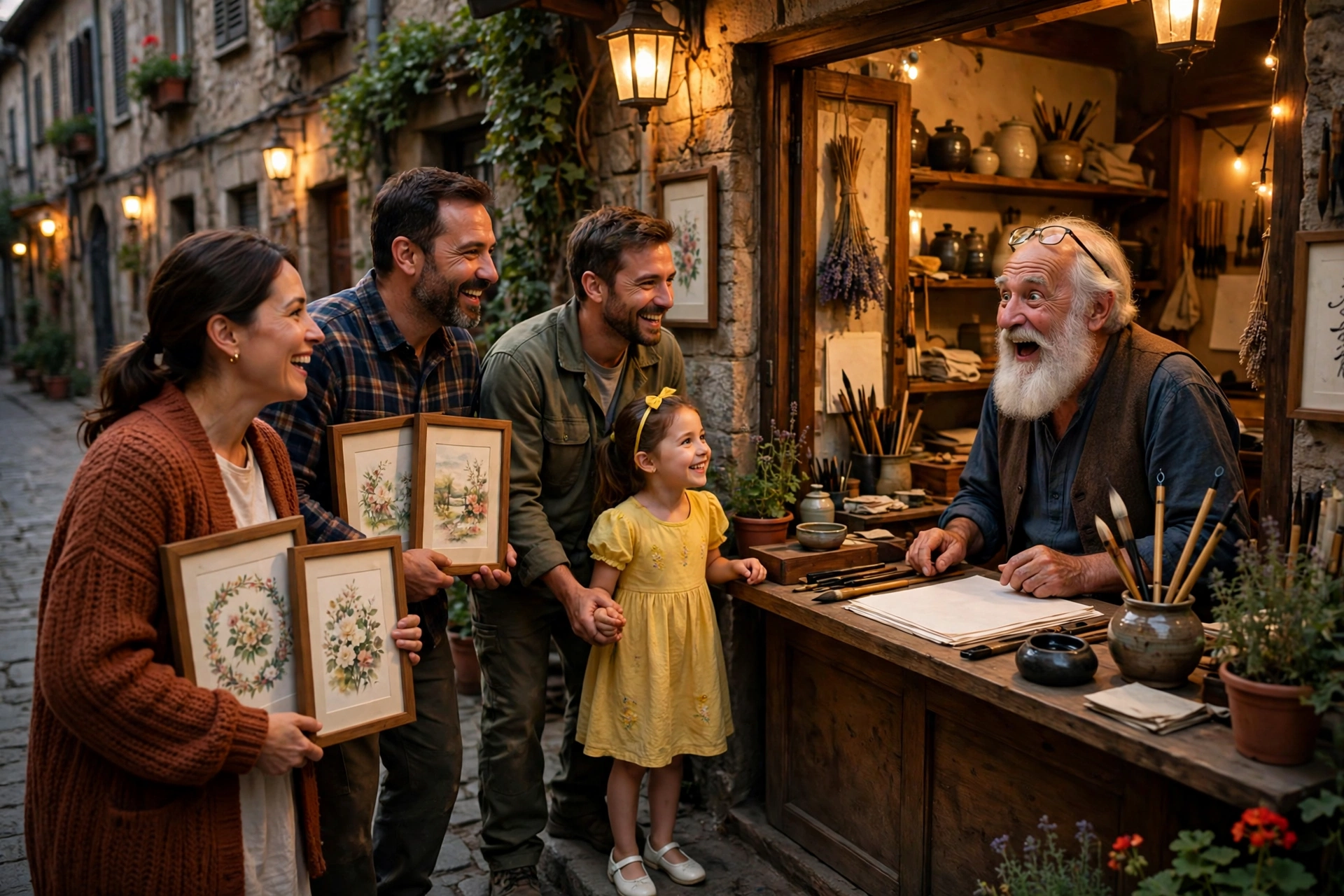
The next morning, Yusuf arrived to find his shop door open and the bell ringing again and again, not from the wind, but from people. The baker was there, and the schoolteacher, and the tailor, and the woman who sold flowers at the corner. Imran was there too, holding the hand of a small girl in a yellow dress. It was Maryam. She had come to the city with her grandmother, clutching a bundle of letters tied with string, the letters Yusuf had written for her father.
One by one, the people of Ink Lane stepped forward, each carrying something. The baker carried the first sign Yusuf had ever painted for him, thirty years ago, carefully framed. The schoolteacher carried a stack of certificates Yusuf had written for her students. The tailor carried his wedding invitation. And Imran carried a single sheet of paper, on which he had written, in his own leaning but upright hand, his daughter's name, and beneath it, "Thank you for teaching my father to write."
Maryam stepped forward last. She looked up at Yusuf with serious nine-year-old eyes and said, "My father says you wrote my name so beautifully that I wanted to learn to read it myself. So I did. I can read all your letters now." Then she read one aloud, standing in the middle of the little shop, her voice clear and proud, while her father wiped his eyes with his sleeve.
The schoolteacher cleared her throat. "Yusuf," she said, "we have an idea. The street committee wants a wall at the end of Ink Lane — a wall of names. Every family on this street, and every family whose children go to our school, will have their name written on it, by hand, by you. They will pay what they can. It will take months."
Yusuf looked around his little shop, at the faces of people whose names he had written for weddings and births and farewells, and he understood something his father had tried to teach him long ago. A name is not just letters on paper. It is proof that someone exists, that someone matters, that someone is remembered. He had spent fifty years giving people that proof, one name at a time, and now they were giving it back to him.
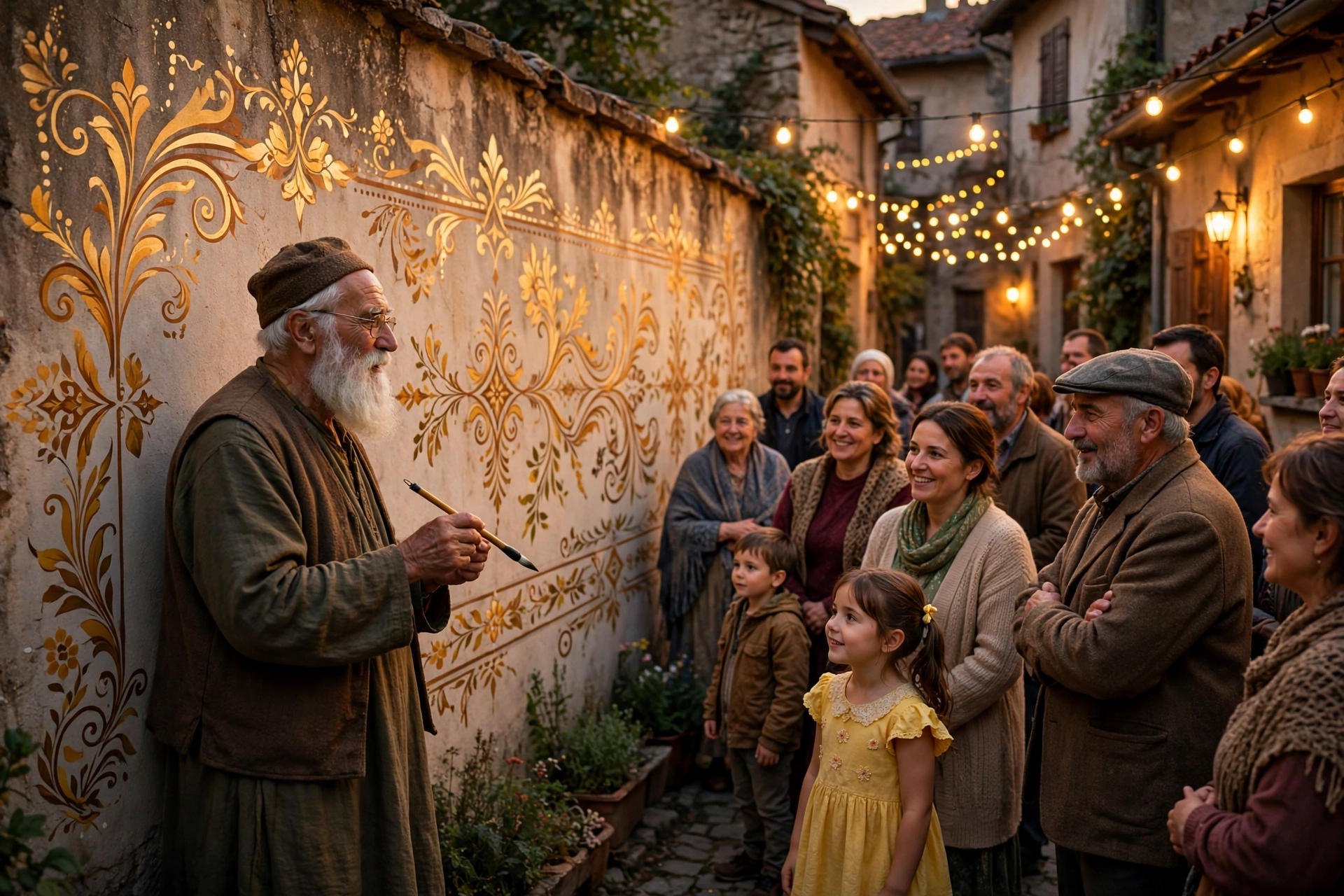
He did not close his shop. He worked more slowly now, in the morning light, with a magnifying glass beside his desk and Imran sitting nearby, learning to write a little more each week. The wall at the end of Ink Lane grew slowly, name by name, in black and deep blue and dark green ink. Children stopped to find their names, old people stopped to touch them, and visitors came from other streets just to see it.
Imran's letters to Maryam continued, and as the months passed, more and more of the words in them were in Imran's own hand. The last letter Yusuf ever wrote for him was short, and Yusuf kept a copy of it on his desk. It said only: "My dear Maryam, your father can write now. The rest of this letter is in his hand, because his love no longer needs mine to reach you."
On the day the wall was finished, the whole street gathered in Ink Lane. Someone had hung lights between the buildings, the baker had brought sweets, and Maryam had brought her father a yellow flower. Yusuf stood before the wall and read the names aloud, one after another, until his voice broke and the crowd finished them for him.
Long after the celebration ended, Yusuf returned to his shop alone and sat at his desk. He picked up his reed pen, dipped it in the ink, and wrote two names side by side on a fresh sheet of paper: Imran, and Maryam. Beneath them, he wrote a single line, not for a customer, not for money, but for himself: "I did not build a house or leave a fortune. I wrote names. And the names remembered me."
He folded the paper and placed it in the drawer where he kept what mattered most. Outside, the bell above his door rang softly in the evening wind, and Ink Lane glowed in the warm light, every name on its wall shining like a small, steady promise: that no one who is loved is ever truly forgotten.