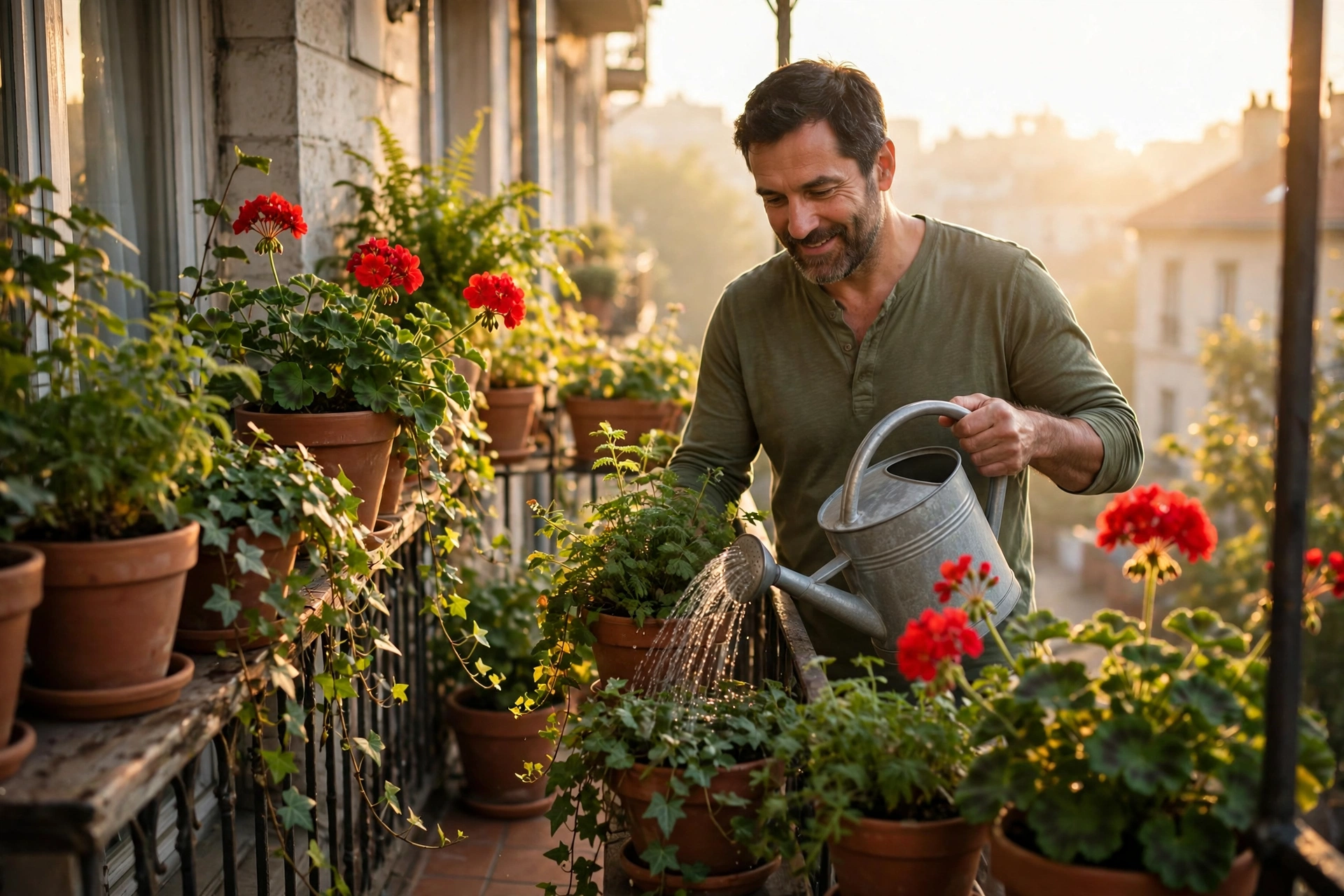
Every morning at six o'clock, Daniel unlocked a door that was not his, stepped onto a balcony that was not his, and watered plants that were not his. He had done it for four years, through summers that scorched the leaves and winters that turned the pots cold, and he had never once thought of it as a burden. It was, in the quietest way, the best part of his day.
Daniel was thirty-eight and lived alone in a small third-floor flat in a building where everyone knew each other's footsteps but few knew each other's stories. Two years before the watering began, his marriage had ended, and he had moved in with two suitcases, a kettle, and a silence he carried everywhere like a second coat. He went to work, he came home, he ate standing at the kitchen counter, and he told himself he was fine. He was not fine. He was simply quiet about it, the way some men are quiet about a wound they have stopped expecting anyone to notice.
Mrs. Elena lived on the top floor, directly above him, and her balcony was famous in the building. It was a small jungle spilling over the railing: geraniums in chipped clay pots, a lemon tree in a wooden tub, trailing ivy, basil, rosemary, and a stubborn rose bush that bloomed red even when the rest of the street looked tired. In the evenings, the scent of her basil drifted down to Daniel's window, and sometimes he would stand at his own empty balcony, holding a cup of tea, and look up at all that green and feel something he could not name — not envy, but something closer to homesickness for a place he had never lived.
They met properly on a Tuesday in late spring, when a storm knocked one of her pots off the railing and it shattered on the pavement below Daniel's window. He came downstairs with a broom, swept the soil into a pile, and carried the rescued geranium up four flights of stairs in his cupped hands. Mrs. Elena opened her door, took one look at him — soil on his shirt, the plant trembling in his palms — and laughed, a warm laugh that sounded like it had not been used in a while.
"You saved her," she said. "She is the dramatic one. She faints at the first sign of trouble."
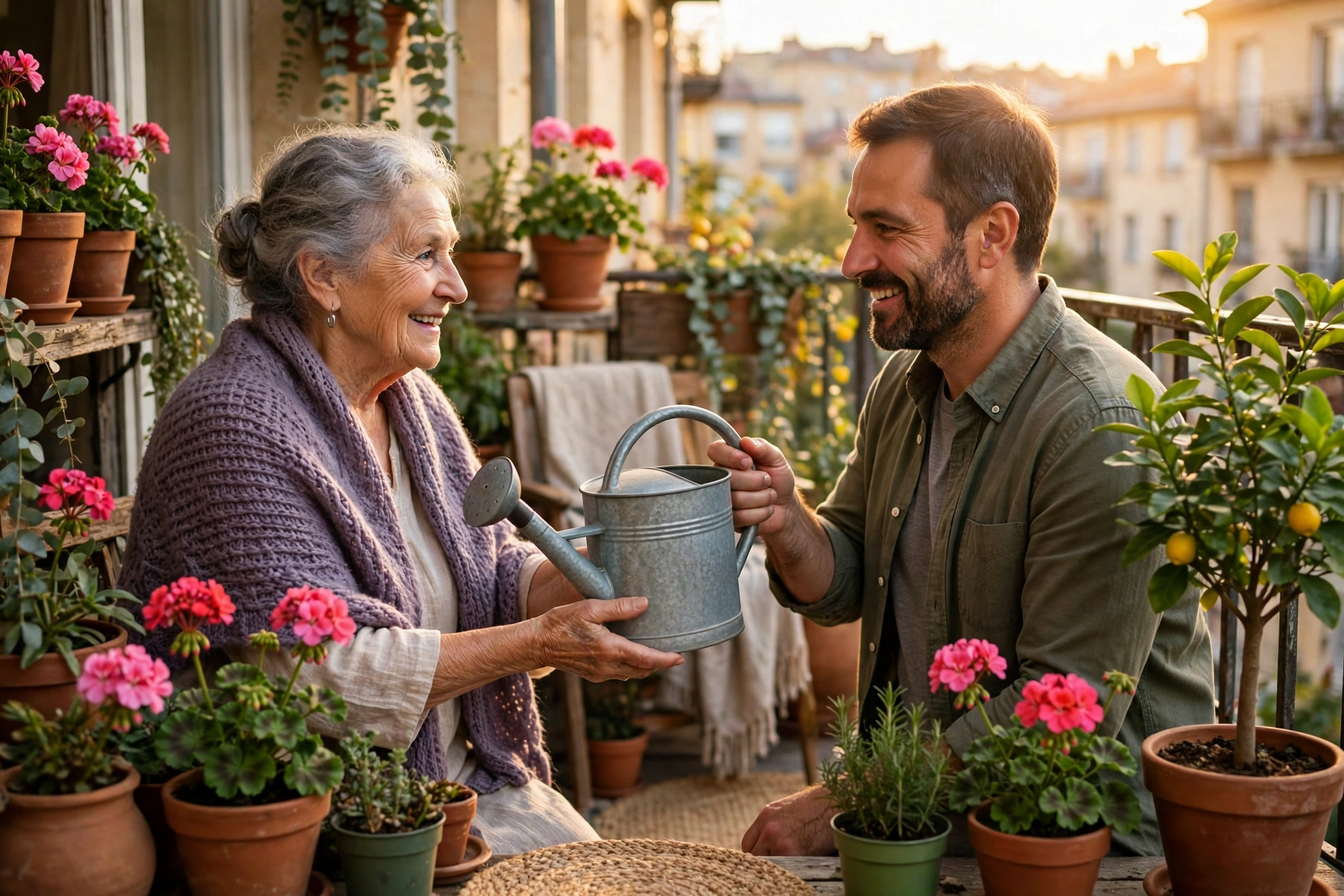
From then on, they talked. First a nod in the hallway, then a few words about the weather, then tea on her balcony among the plants, where she told him the story of every pot. The lemon tree had come from her late husband's village. The rose bush had been a gift from her daughter on her sixtieth birthday. The basil, she said, tapping the pot fondly, was for soup, for neighbours, for anyone who knocked. She was eighty-four, her back bent like a question mark, but her hands were steady on the leaves, and her eyes were sharp enough to notice that Daniel's smile did not quite reach his eyes.
"You water plants the way a man waters something he is afraid of losing," she told him one evening, and he laughed it off, but the words stayed with him on the walk downstairs.
That autumn, Mrs. Elena fell in her kitchen and broke her hip. The ambulance came in the night, and the building held its breath. A week later, her daughter arrived from another city, a kind, tired woman named Maria, who packed suitcases and spoke softly on the phone and told the neighbours that her mother would come to live with her now, where someone could be nearby all the time. On the last morning, Mrs. Elena sat in a wheelchair by her balcony door, wrapped in a shawl, looking at her plants as if she were memorizing their faces.
Daniel stood in the doorway. She reached out and took his hand, her grip sure despite her thin, cool fingers.
"Promise me one thing," she said. "Do not let them die."
"I promise," Daniel said, and he meant it the way people mean vows, fully and without conditions.
Maria gave him the spare key. "Just until we decide what to do with the flat," she said. "A few weeks, maybe a month." Then the door closed, the flat went quiet, and the building went back to its footsteps and its silences.
Daniel kept the promise the way he kept everything: quietly, and every day. Each morning he climbed the stairs, unlocked the door, and watered the plants. He learned their moods. The geraniums wanted water every other day and sulked if he gave them too much. The lemon tree drank deeply and thanked him with new leaves. The rose bush was proud and needed pruning, which he learned from a library book, cutting carefully, apologizing under his breath each time. He talked to them sometimes, small ordinary sentences — "There you go," "Easy now," "Look at you today" — and he was startled, one morning, to realize he had not spoken aloud to another living thing in days, and that these one-sided conversations were keeping something inside him from closing up entirely.
Weeks became months. Maria called rarely, and then not at all. The flat was never sold, never emptied; it simply waited, dust gathering on the furniture, while the balcony stayed green. Neighbours began to notice. The woman on the second floor left a bag of lemons from the tree on Daniel's doorstep with a note: "For the man who keeps the garden alive." A boy from the ground floor started following him upstairs on Saturdays, asking questions about the plants, and Daniel found himself teaching the boy how to pinch back the basil, the way Mrs. Elena had once taught him. He did not think of himself as a kind man. He thought of himself as a man keeping a promise.
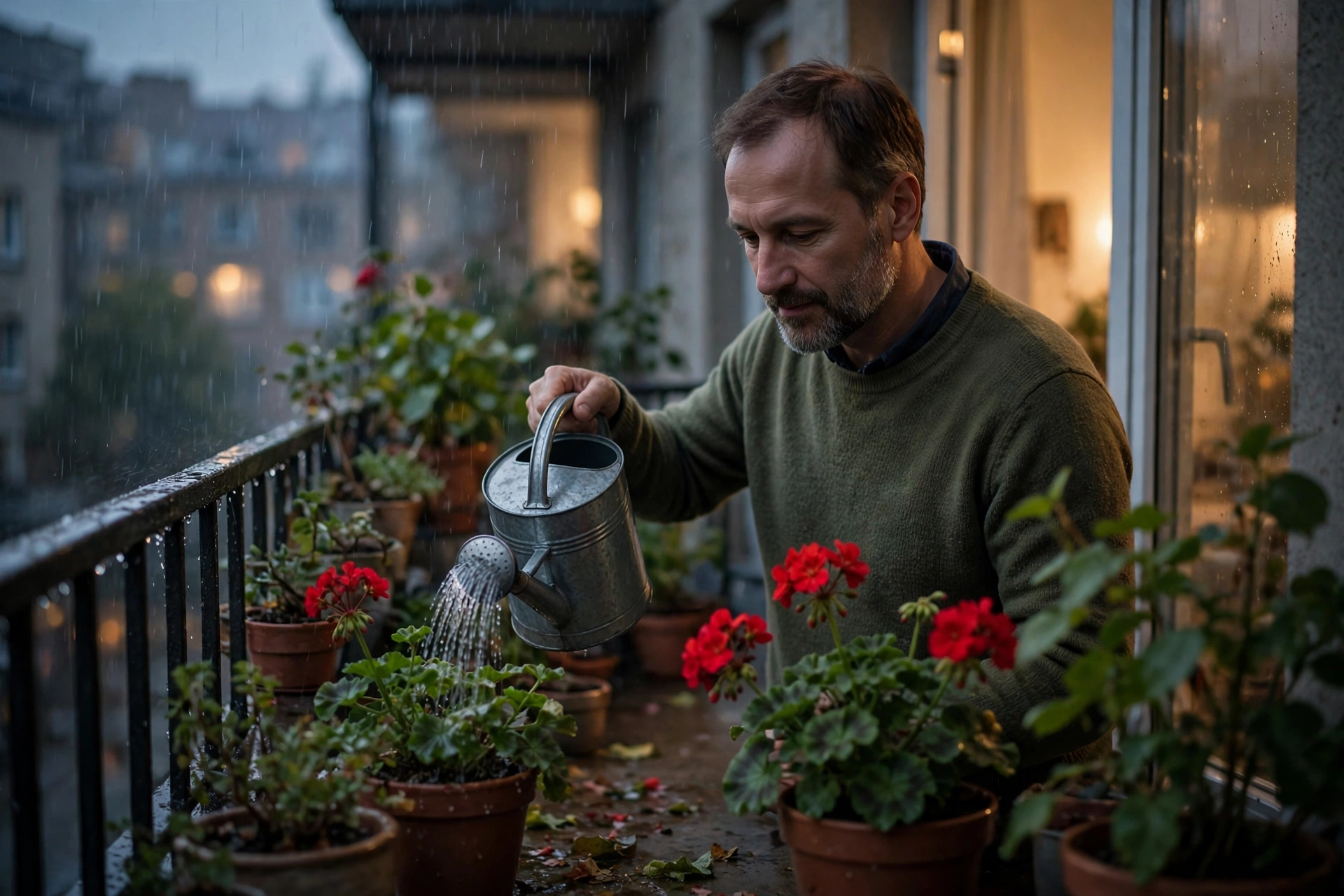
There were hard days. One winter, a frost killed half the geraniums overnight, and Daniel stood on the cold balcony holding a dead stem, feeling a grief that surprised him with its size. It was not only about the plants. It was about everything he had lost and never properly mourned, arriving all at once through something small and green. He sat on the balcony floor for a long time, and for the first time in years, he cried — not loudly, but honestly, the way a man cries when no one is watching and he has finally stopped pretending. Then he wiped his face, bought new geraniums with his own money, and replanted them in the chipped pots. When the first new buds opened in spring, he felt something shift inside him, a small, stubborn green shoot of his own.
Four years passed this way. Daniel's life changed without him announcing it. He started cooking real meals instead of eating at the counter. He fixed the dripping tap in his own flat. He joined the boy and his mother for tea sometimes. He laughed more easily. He never connected any of it to the morning ritual upstairs, but the ritual was the thread: a promise made to someone else had become a reason to get up, to care, to tend something every single day, and tending something had quietly taught him how to tend himself.
Then, on a bright morning in early summer, Daniel climbed the stairs and found a young woman standing outside Mrs. Elena's door with a suitcase and a set of keys. She introduced herself as Sofia, Mrs. Elena's granddaughter. Her eyes were red, and she was trying very hard to be composed.
"Grandma passed away three months ago," she said gently. "We have only just managed to come. My mother — Maria — she has been unwell herself, and things got delayed. I am here to clear the flat."
Daniel stood very still, the watering can heavy in his hand. Three months. He had been watering the plants of a woman who was already gone, and no one had told him. For a moment, the grief was sharp and almost embarrassing — how could he mourn someone he had only known for one spring and one summer of teas on a balcony? But grief does not check credentials. It arrives where love has quietly grown, even love as small as a shared pot of basil.
From her bag, Sofia took a sealed envelope, yellowed at the edges, with Daniel's name written on it in a shaky, careful hand. Daniel opened it there in the hallway, his hands unsteady.
The letter was short, and it was everything.
"Dear Daniel," it began. "If you are reading this, then I am gone, and you have kept your promise longer than anyone expected you to. When I left, I was afraid — not of the new city, but of being forgotten, of my little garden turning to dust while I was still alive somewhere else. Every time my daughter told me the balcony was still green, I felt I was still home. You gave an old woman her home back, from four floors away, with nothing but water and mornings. And I watched you, too, in that first summer. You arrived like a man carrying something heavy. I saw it get lighter. Do not be surprised. That is what tending a living thing does — it teaches the heart to open again. The plants are yours now. They always were, from the day you carried my geranium upstairs in your hands. Keep them, or give them away, but never believe that what you did was small. Love that asks for nothing is the largest thing there is. With all my thanks, Elena."
Daniel read the letter twice, then folded it carefully into his pocket, over his heart. Sofia was crying quietly, and he found himself comforting her — this stranger who was family to the woman who had changed his life.
That afternoon, they emptied the flat together, but the balcony stayed. Sofia insisted. "Grandma would want them with you," she said, and she helped him carry the pots down to his own flat, one by one — the lemon tree, the rose bush, the geraniums, the basil, the ivy — until his own empty balcony, which had looked out on the street for years with nothing on it, was suddenly green and alive and smelling of summer. The boy from the ground floor came up to help, and the woman from the second floor brought tea, and by evening, Daniel's balcony looked like a small jungle spilling over the railing.
Daniel still waters the plants every morning at six o'clock. The door is his own now, and the balcony is his own now, but in his heart, the promise has not changed. Sometimes neighbours stop him on the stairs and ask why he bothers, why he spends so much time on pots of leaves when the world is full of bigger things. He smiles, and he thinks of a bent old woman in a shawl, and a letter folded over his heart, and a grief that turned, slowly and greenly, into a life.
On the railing, beside the rose bush that still blooms red, there is a small wooden sign he carved himself. It says only one word, in slightly uneven letters: "Elena."
And every morning, when the first light touches the leaves, Daniel picks up his watering can, steps out among the plants, and begins again — not because anyone asked him to, but because kindness, once it takes root, keeps growing long after the person who planted it is gone.