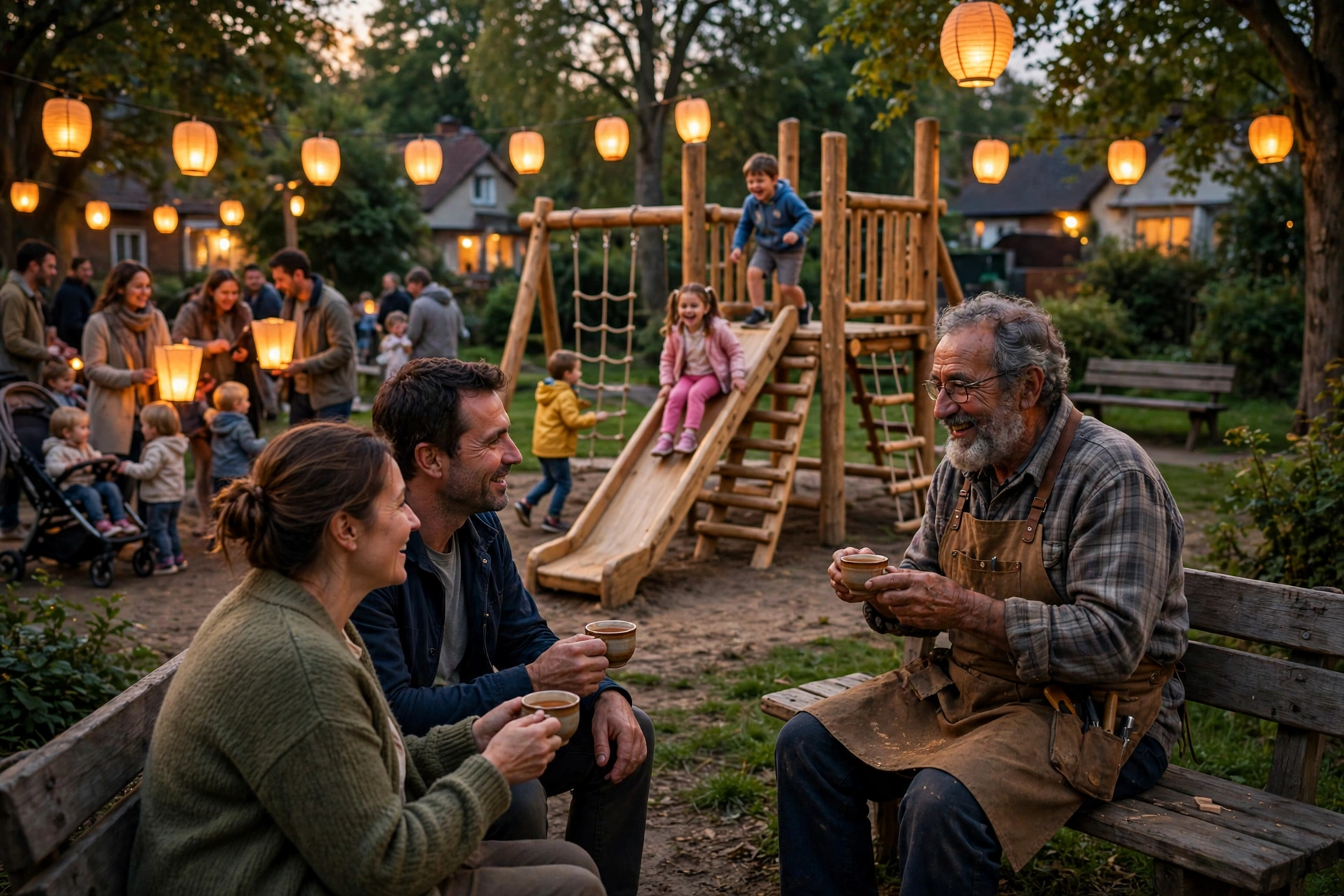
For forty years, Yusuf could tell the time of day by the sounds coming from Rosewood Park. In the morning there was the creak of the swings and the thud of small feet on the slide. In the afternoon there was shouting and laughter. In the evening, when the sun turned the colour of honey, there was the softer sound of parents calling children home. Yusuf's little carpentry workshop stood right across the street, and for most of his life its door had been open, its air full of sawdust, while the music of children played outside like a radio left on all day.
But that summer, the music stopped. One hot afternoon, the chain of the oldest swing snapped while a boy named Bilal was swinging on it. He fell and scraped his knee badly. Nobody blamed the swing, exactly, but the next morning a man from the council came with yellow tape and a sign that said CLOSED UNTIL REPAIRED. The tape went around the swings, the slide, the climbing frame, and the benches too. The children pressed their faces against the tape for a few days, hoping someone would come and fix everything. Nobody came. The council said there was no money that year. The weeks passed, the tape faded in the sun, the rust spread a little further, and the park grew quiet in a way that felt wrong, like a house where someone has stopped singing.
Yusuf noticed the silence more than anyone. He was sixty-eight now, retired, with hands that ached when the weather changed and a workshop that stood mostly empty. His wife, Amina, had died two winters before, and since then his days had fallen into a lonely shape: tea for one, the newspaper read slowly, a walk to the market, and home to a house that was too quiet. His son lived far away and called every Sunday, but a phone call is not the same as a person sitting across the table from you. Yusuf still went to his workshop every day out of habit, sharpened tools that had nothing to cut, and swept a floor that was already clean. He told himself he was too old to be useful anymore.
One evening in early autumn, as the light turned gold over the rooftops, Yusuf was walking home with his shopping bag when he saw a little girl sitting on the pavement outside the taped-off park. She was about eight years old, with a drawing book on her knees, and she was drawing the playground as it used to be: swings flying high, children on the slide, a sun with a smiling face in the corner. Yusuf stopped, because there was something about the drawing that caught at his chest. The girl looked up and said, quite simply, "I am drawing it the way I remember it, so I don't forget."
"What is your name?" Yusuf asked.
"Maya," she said. "I used to be the queen of the swings. Now I am just the queen of the pavement."
Yusuf smiled. "A queen should have a kingdom," he said.
Maya shrugged. "My father says the council will fix it one day. But one day is taking a very long time."
That night, Yusuf could not sleep. He lay awake listening to the silence of his house and thinking about Maya's drawing, about Bilal's scraped knee, about all the children who now played in the street between passing cars because they had nowhere else to go. And then, very quietly, a thought he had not had in years came back to him: he knew how to fix things. That was what his hands had always been for. He was not a council, and he was not rich, and he could not rebuild the whole park in a day. But he could tighten a bolt, replace a chain, and sand down a splintered bench until it was smooth again. One pair of willing hands was, at least, a beginning.
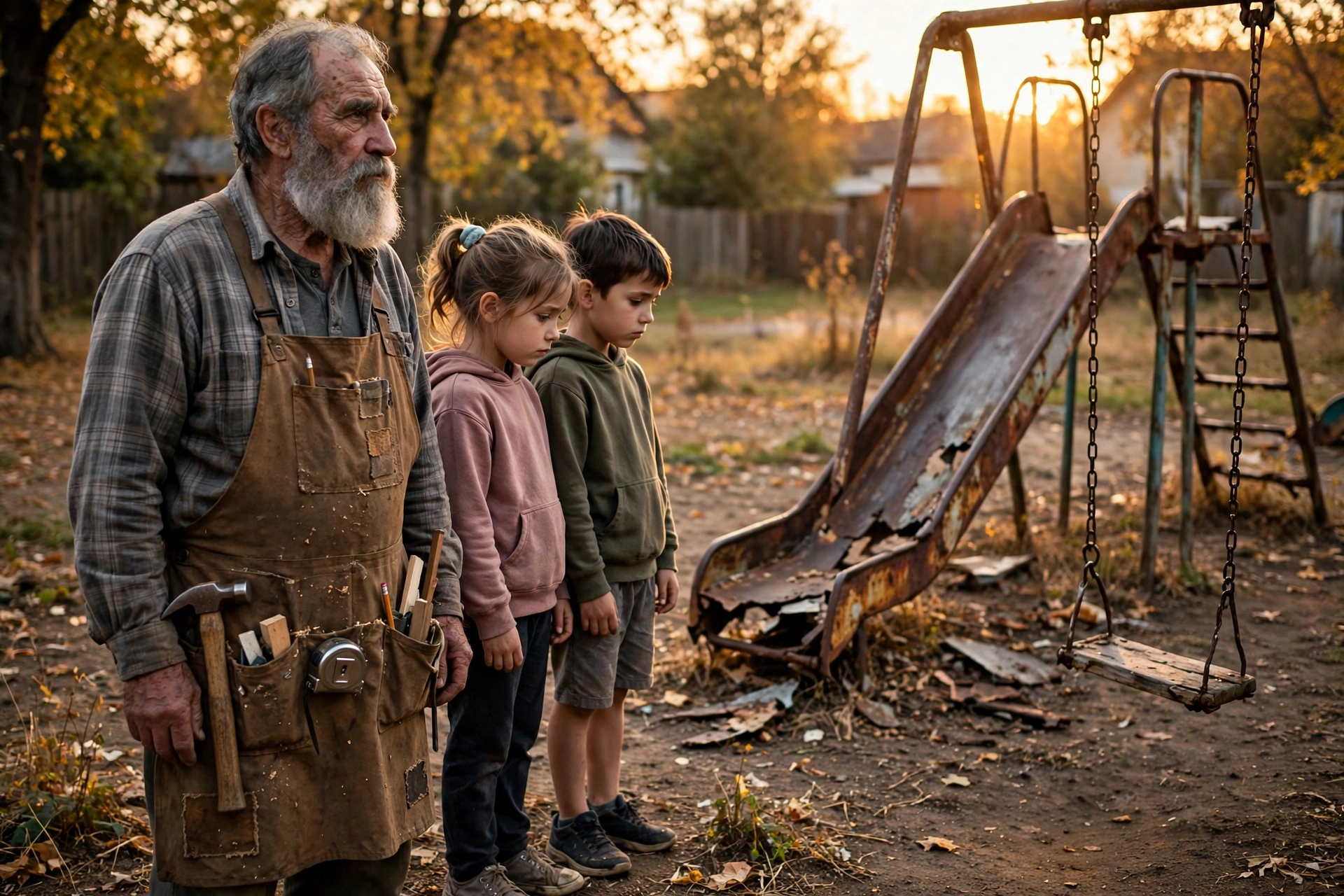
The next morning, Yusuf did something he had not done since Amina died: he opened his workshop before breakfast, put on his old brown apron, and carried his toolbox across the street. The yellow tape was still there, fluttering in the breeze. He ducked under it and walked slowly around the playground, touching everything the way a doctor examines a patient. The slide was rusty but solid underneath. The climbing frame needed two new planks. The swings needed new chains and new seats. The benches needed sanding and paint. It was a week's work, maybe two, and his back complained at the very thought of it. But his hands, when they closed around the handle of his hammer, remembered exactly what to do.
He started with the smallest swing, the one Maya used to call her own. He took off the broken chain, measured a new one, and fixed it link by link, humming under his breath without noticing. He was so absorbed that he did not hear the footsteps until a small voice said, "Are you allowed to do that?" It was Maya, with her drawing book, and behind her was Bilal, the boy who had fallen, his knee now healed and his eyes wide.
"I am not sure," Yusuf said honestly. "But the park is not getting any better by waiting, is it?"
Bilal thought about this with great seriousness. "My father says if you touch council property you can get in trouble."
"Then your father can tell me off himself," Yusuf said, smiling. "Until then, would you two like to hold this steady for me?"
That was how the work began, not with a grand announcement, but with two children holding a swing seat steady while an old man tightened bolts. Maya handed him tools one by one, calling out their names. Bilal sanded a bench leg with such concentration that his tongue stuck out of the corner of his mouth. By lunchtime, the smallest swing was fixed, and Maya sat on it very gently, then pushed off and flew up into the air, laughing, and Yusuf felt something warm and forgotten rise in his chest. It was the feeling of being needed again.
Word travels fast on a street where everyone knows everyone else's business. By the second day, Mrs. Rao from the corner house came across with a tray of tea and biscuits, because, she said, no man should work on an empty stomach. On the third day, Imran, who ran the hardware shop, arrived with a tin of paint and two planks of good wood, and refused to take any money for them. "My own children played here," he said gruffly, and then he stayed for an hour, holding a plank while Yusuf sawed. On the fourth day, two teenagers who usually spent their afternoons staring at their phones turned up with a ladder and offered to repaint the climbing frame. Even Bilal's father came, and after watching his son sand a bench with such care, he rolled up his sleeves and said, "Well, if we are all in trouble, we might as well be in trouble together."
It was not easy work. Some days it rained, and the paint would not dry, and Yusuf's knees ached from crouching. One morning he found rubbish left on the half-finished slide, and for a moment his heart sank. But Maya arrived, looked at the mess, and said, "We will just clean it, Yusuf Uncle. Cleaning is also fixing." And so they did, and the work went on. Yusuf began to understand something he had forgotten: kindness is not a single great deed. It is a hundred small acts, done day after day, until one morning you look up and the place around you has changed.
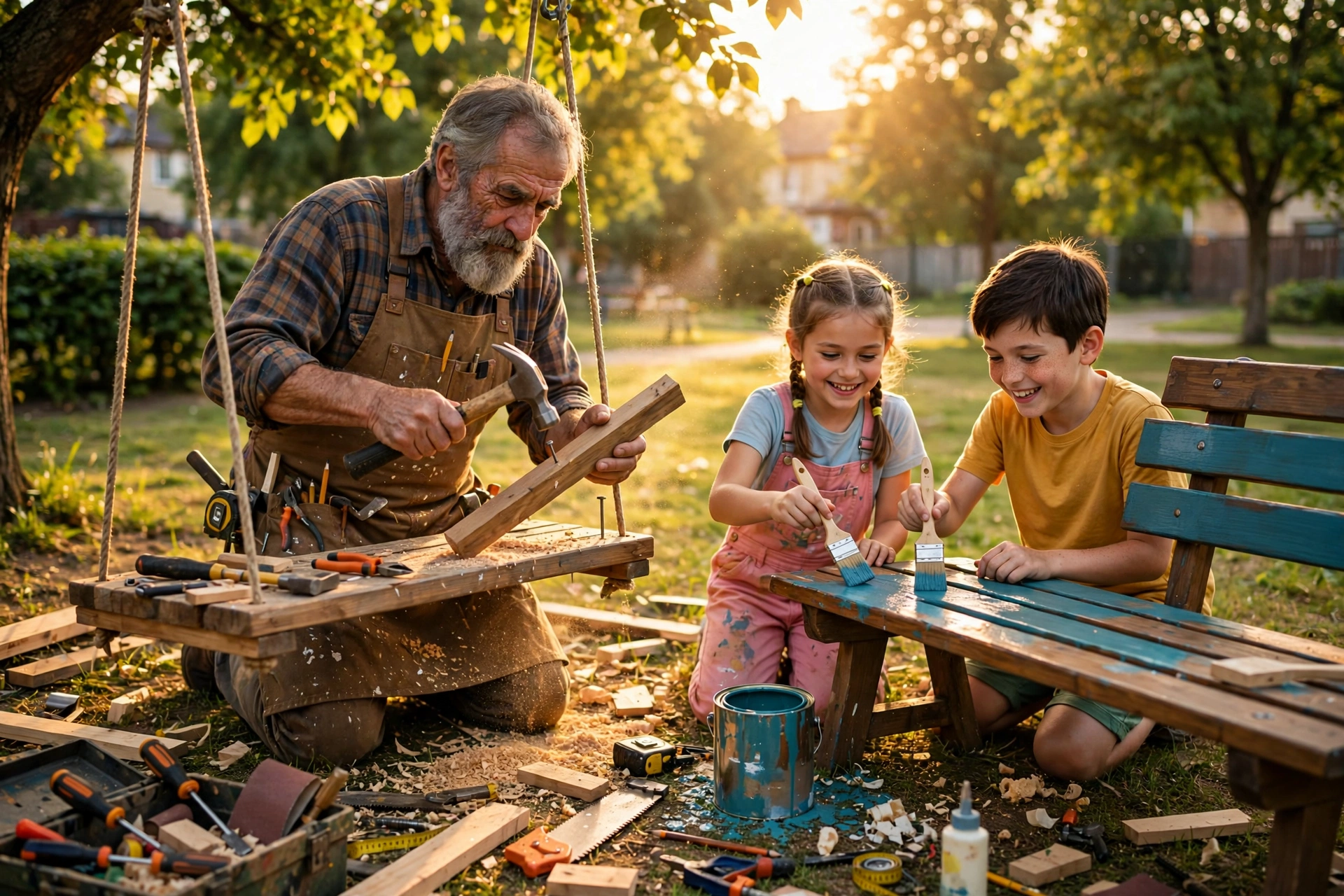
By the end of the second week, the transformation was something to behold. The swings had new chains and brightly painted seats, one red, one blue, one yellow. The slide shone where the rust had been scrubbed away, and the benches had been sanded smooth and painted a warm green. Someone had planted flowers along the fence, and Maya had painted a small wooden sign by the gate that said: THIS PARK BELONGS TO EVERYONE. TAKE CARE OF IT. Yusuf stood back on the last evening of work, his apron dusty, his hands sore, and looked at what had once been a taped-off ruin. He had not done it alone, not in the end. But he had started it alone, and that was the whole secret. If he had waited for permission, for money, for a crowd, the park would still be closed.
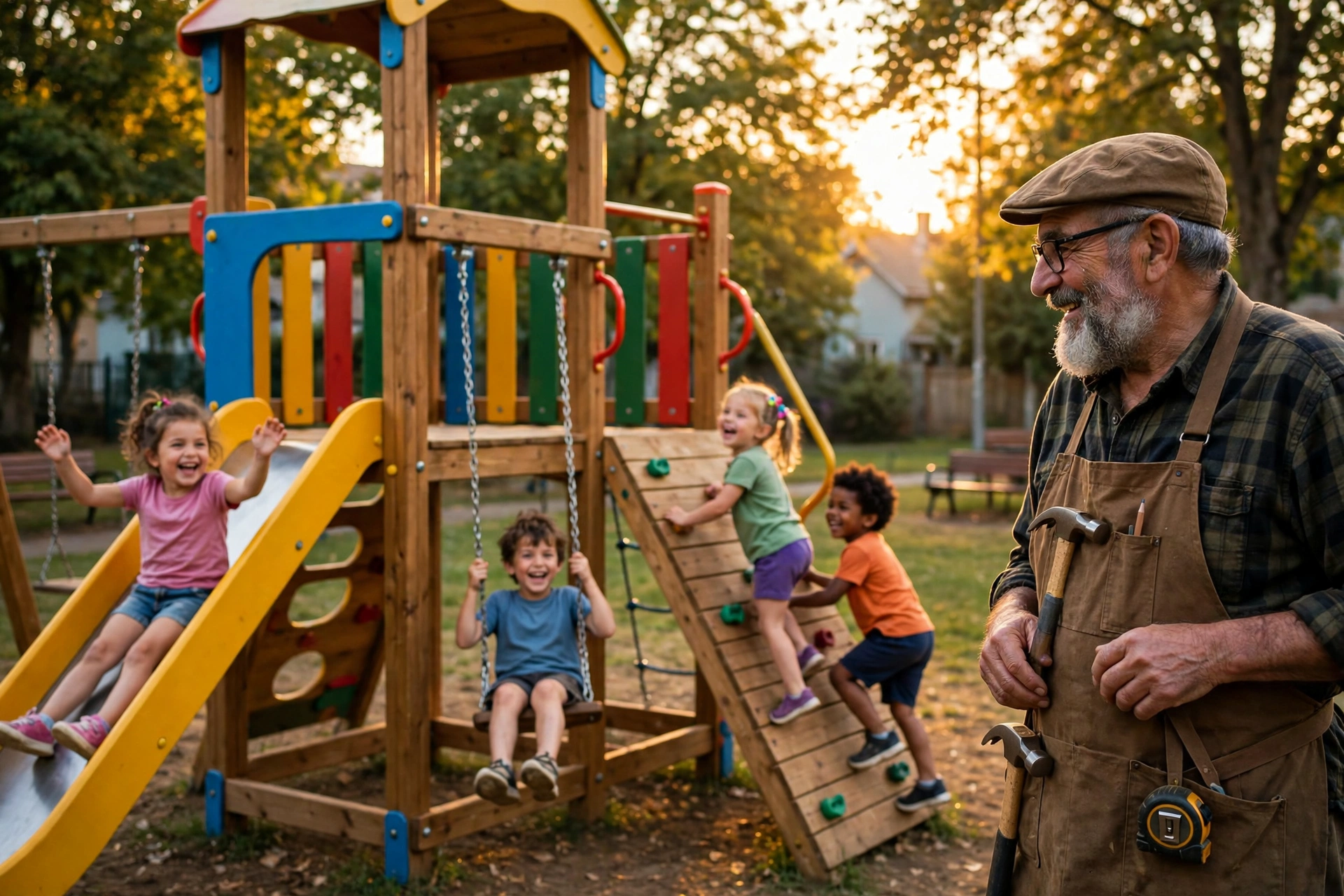
The next day was a Saturday, and the whole neighbourhood gathered for what Maya insisted on calling the Grand Reopening, even though there was no ribbon and no important person to cut it. Mrs. Rao brought sandwiches, Imran brought lemonade, and one by one the children ran through the gate, shouting, and filled the park with noise again, the beautiful, ordinary noise of swings creaking and laughter rising into the autumn sky. Maya flew highest on her swing and shouted, "I am the queen again!" Yusuf sat on one of the green benches, a cup of tea in his hands, watching them, and he thought of Amina, who had always said that the saddest thing in the world is a pair of hands with nothing kind left to do.
As the sun began to set, Maya climbed off her swing and came to sit beside him. She held out her drawing book, open to a new page: a drawing of the park as it was now, full of children, with a small figure in a brown apron standing by the gate, smiling. Underneath, in careful letters, she had written: THANK YOU, YUSUF UNCLE. YOU FIXED OUR PARK. Yusuf stared at the drawing for a long time, and his eyes filled with tears, and he did not try to hide them, because some tears are not sad at all.
"Do you know what the best part is?" Maya asked, swinging her legs.
"What?" Yusuf said.
"Now the park is not just fixed," she said. "It is ours. We all helped. So we will all look after it."
She was right, and in the months that followed, she proved it. The teenagers took turns checking the bolts every Sunday. Imran kept a tin of paint in his shop for touch-ups. Mrs. Rao planted more flowers. And Yusuf, who had once swept an empty workshop out of habit, now opened its doors every morning with a purpose. Children came to him with broken toys, and he fixed them all, sometimes with a child's help, always with a story. His house was still quiet at night, and he still missed Amina. But the loneliness did not stay as long as it used to.
One Sunday, Yusuf's son called, as he did every week, and asked how his father was doing. Yusuf looked out of his window at the park, where the last children were being called home and the evening light lay golden on the green benches, and he said, "I am well, my son. I thought I was too old to matter anymore. But it turns out an old man with a hammer can still change a street. He only has to be willing to cross the road and begin."
And that is the story of the carpenter who rebuilt the broken playground. It is not a story about a hero, because Yusuf would laugh at that word. It is a story about an ordinary man who refused to wait for someone else to care. The park did not need a miracle. It needed one person to duck under the tape, pick up a hammer, and start. So if you ever walk past something broken in your own neighbourhood, remember Yusuf and his toolbox. You do not need to fix everything. You only need to begin, with whatever you have, wherever you are.