For forty-one years, Rahim stood on platform three and waved at trains. He was not the station master, and he was not a driver. He was a porter, the man in the faded grey uniform who carried suitcases and helped old women climb into coaches, and who knew the timetable by heart without ever owning a watch. The station was his whole world, and he loved it the way a man loves a house he built with his own hands.
When Rahim retired, the station gave him a small farewell. The station master shook his hand and said kind words. The tea seller gave him a free cup of tea, which was the highest honour the tea seller knew how to give. Rahim smiled and thanked everyone, and then he walked home through streets that suddenly felt too quiet. His house was small and clean, with a courtyard where his wife, Fatima, had once grown roses in old paint tins. Fatima had died two winters before, and the roses had died with her, or so Rahim thought. The courtyard was empty now, and Rahim discovered something he had never expected: after forty-one years of noise and crowds and trains, silence could be the heaviest thing a man ever carried.
He tried to fill his days. He repaired the gate, swept the courtyard twice, and bought vegetables he did not need at the market. He visited old colleagues at the station, but the station had moved on without him, as stations do. In the evenings, he sat in his courtyard and looked at the empty paint tins, and he thought about Fatima, who had loved flowers the way some people love music. She used to say that a flower was a small prayer you could see.
One morning, without quite planning it, Rahim walked to the station. He did not go to the platform. He went to the stretch of land beside the track, just beyond the station, where the ground was dry and dusty and covered in stones and old wrappers. It was the ugliest piece of land in the whole district, the kind of place people looked away from as the train passed. Rahim stood there for a long time, looking at the dust. Then he went home, found a small spade in his shed, and came back with a bag of marigold seeds that Fatima had kept in a drawer for years, saved from her own flowers, waiting for a season that had never come.
He dug the first hole with hands that shook a little, not from weakness but from the strangeness of it. A porter carries things; he does not plant them. But Rahim pressed the seed into the soil, covered it gently, and poured water from an old bottle, and something inside him, something that had been tight since Fatima died, loosened just a little. He planted ten seeds that day, in a crooked line beside the track.
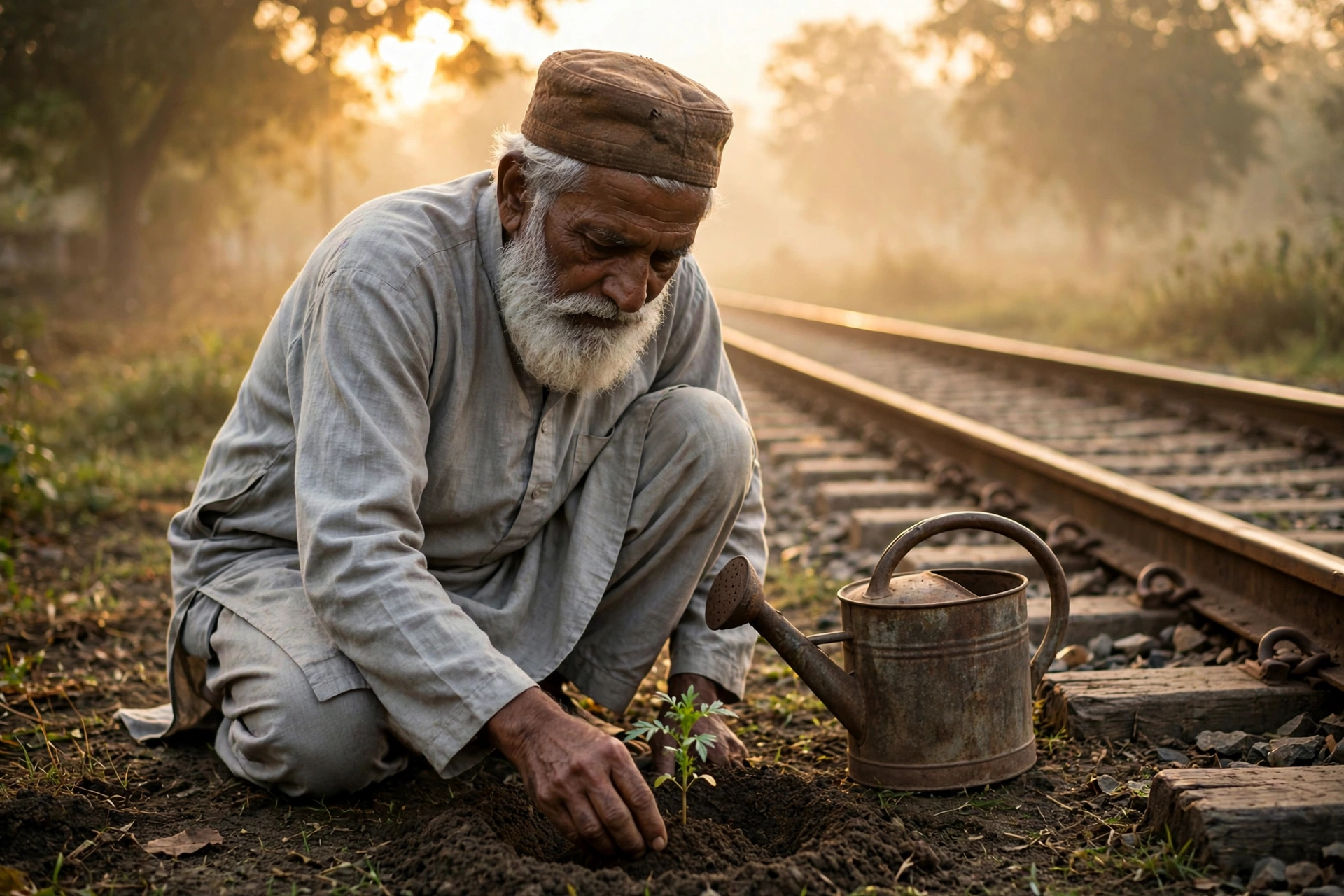
The next day, he planted ten more. The day after that, ten more. Soon, a small routine grew around the flowers, the way a routine had once grown around the trains. Every morning, Rahim walked to the track with his spade and his watering can, and every evening he walked back to check on them, the way a father checks on a sleeping child. People at the station began to notice. The tea seller noticed first, because the tea seller noticed everything. "Rahim sahib," he called out one morning, "are you gardening on railway land?" Rahim smiled. "I am gardening on nobody's land," he said. "And the flowers do not mind whose land it is."
The station master was less amused. He was a young man, new to the station, and he liked rules the way Rahim liked timetables. "You cannot just plant things here," he said, frowning at the little green shoots. "This is railway property. There are regulations." Rahim nodded politely, the way he had nodded at a thousand passengers, and said, "Then let the railway have the flowers, sir. I am only giving them away." The station master opened his mouth, closed it again, and walked off. He did not order Rahim to stop. Perhaps he could not find a regulation about marigolds.
Weeks passed. The shoots grew into plants, and the plants grew into bushes, and one morning, as the dawn train rattled past, the first marigold opened, orange as a small sun, right beside the track. Rahim stood and looked at it for a long time. He thought of Fatima, who would have clapped her hands and said, "Look, Rahim, your prayer has been answered."
It was a boy named Ali who changed everything. Ali was nine years old, thin as a reed, and he lived in the lane behind the station with his grandmother. Every day, on his way to school, he walked past the track, and every day he stopped to look at Rahim's flowers. One morning, he stopped for longer than usual, and Rahim, who missed talking to people the way a singer misses singing, called out, "Do you like them?" Ali nodded shyly. "My grandmother says flowers are a waste of time," he said. "She says they die." Rahim considered this seriously, the way one should always consider a child's words. "Everything dies," he said at last. "But while they live, they make the world less ugly. That is not a waste, is it?" Ali thought about it for a moment, and then he shook his head. "No," he said. "It is not."
The next morning, Ali arrived with a small plastic bottle of water. "For the flowers," he said, as if it were the most natural thing in the world. The morning after that, he brought his friend Sana, who brought her younger brother, who brought a biscuit for Rahim. Soon, a small group of children came every morning, watering, weeding, and arguing loudly about which flower was the tallest, even though Rahim kept telling them, laughing, that the flowers belonged to everyone, even to the trains.
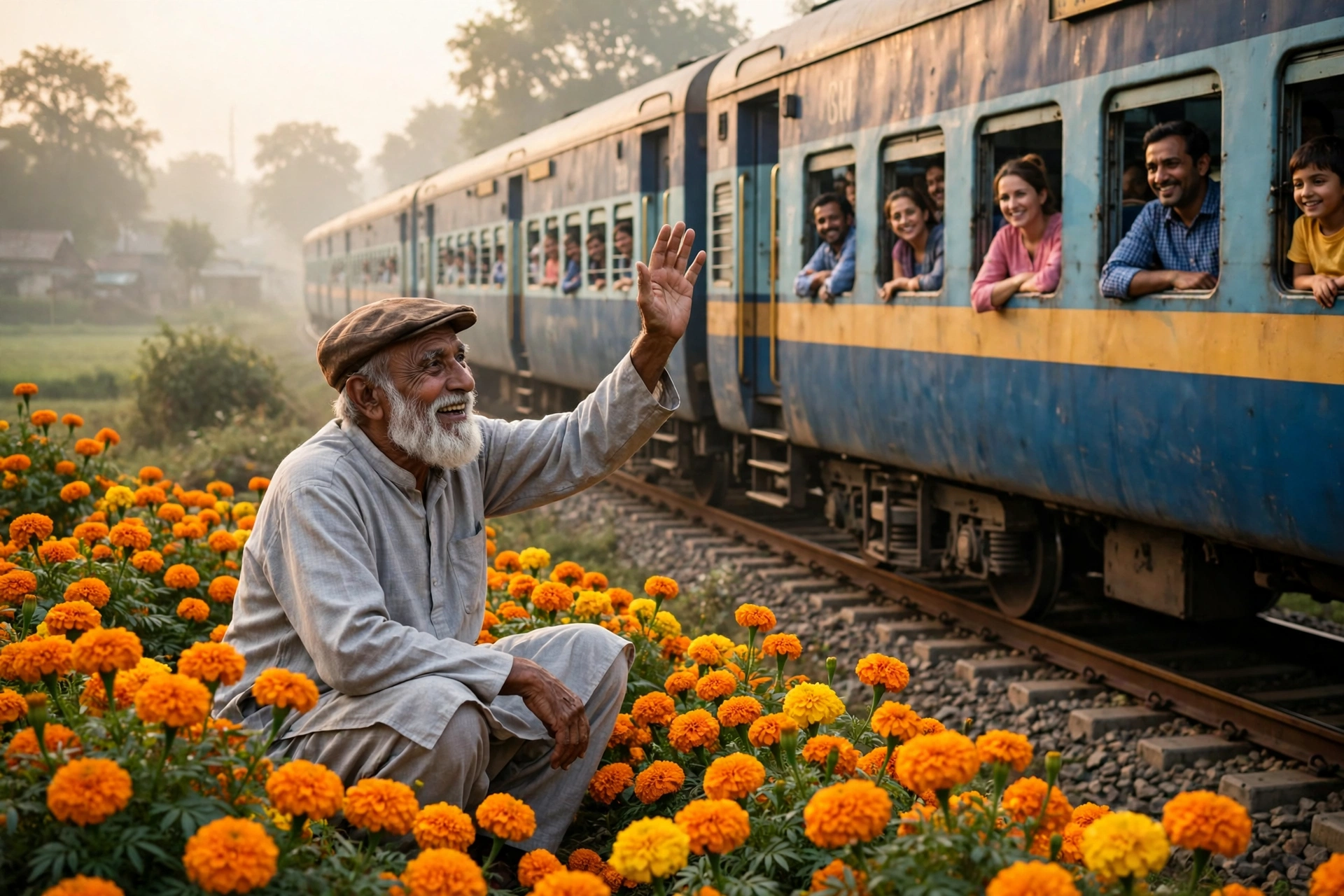
Then something happened that no one had expected. The drivers of the morning train began to slow down as they passed the flowers. Soon, the passengers noticed too. People pressed their faces to the windows and pointed. "Look," a mother said to her child, "flowers!" A businessman, who had travelled that route for twenty years without ever looking out of the window, looked out and smiled, and he did not know why. A tired nurse, coming home after a night shift, saw the orange and yellow flowers flashing past and felt that the day might not be so bad after all. The flowers had become something the railway had never had before: a reason to look up.
One day, the driver of the morning train did something extraordinary. As the train slowed beside the flower bed, he leaned out of his cabin and waved at Rahim. Rahim, who had waved at trains for forty-one years, waved back, and he laughed out loud, because for the first time in his life, a train had waved at him first. The passengers cheered, and Ali and the children cheered louder.
Word spread, the way good news always spreads, quietly at first and then all at once. A newspaper wrote a small story about the man who planted flowers beside the track. People from other stations came to see it, and a schoolteacher brought her whole class.
One morning, the station master came with a letter from the railway office, and he was smiling. They wanted Rahim to help plant flowers at three other stations, and to put up a small board beside the track with his name on it. "My name?" Rahim said. "I only planted some seeds." "You planted a reason for people to slow down," the station master replied.
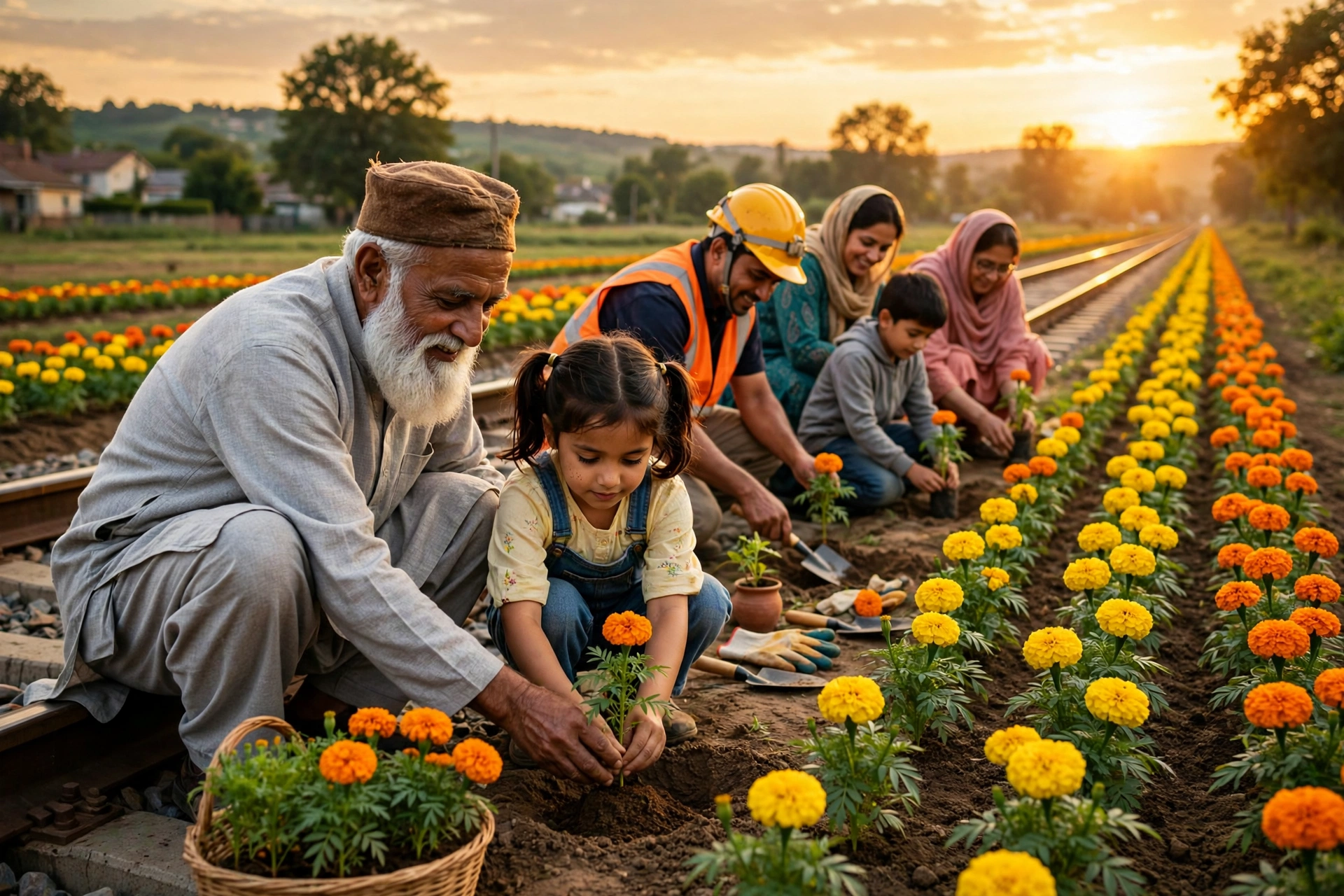
But the finest day of all came later, in the spring, when the flower bed had grown so long that it stretched further than the eye could follow. That morning, the children arrived with their bottles and their biscuits, followed by their parents, shopkeepers, railway workers, and passengers who had got off one stop early just to walk beside the flowers. Together, nearly a hundred people planted new seedlings along the track, laughing, getting mud on their shoes, and Rahim moved among them with his old watering can, showing a child how deep to dig, and feeling, in a way he had not felt since Fatima was alive, that he was exactly where he was supposed to be.
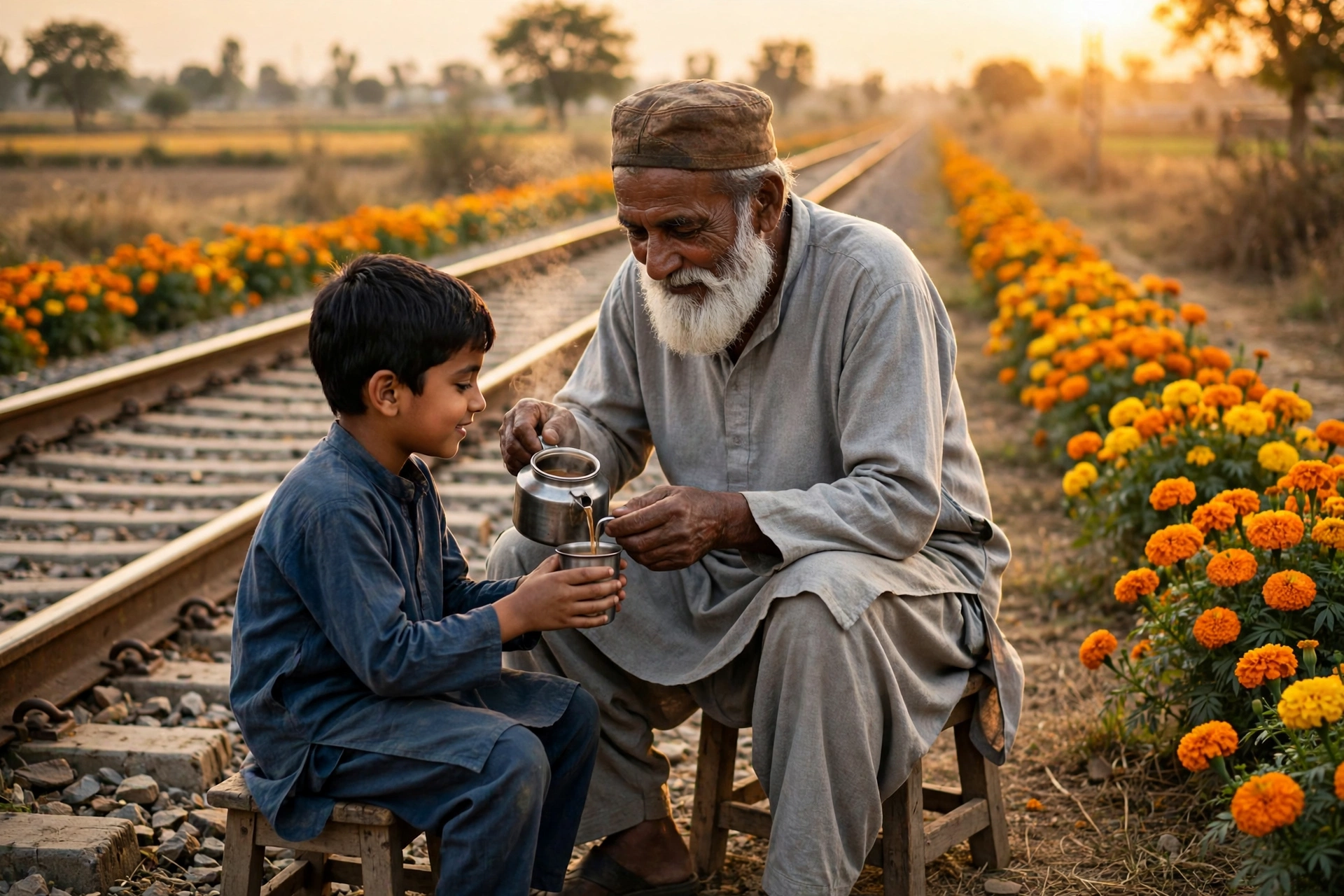
That evening, when everyone had gone home and the track was quiet, Rahim sat on his small wooden stool among the flowers, and Ali sat beside him, swinging his legs, quiet for once. "Rahim uncle," the boy said at last, "will the flowers be here forever?" Rahim thought about Fatima's roses in the paint tins, and about his own forty-one years on the platform. "Nothing is here forever, Ali," he said gently. "But kindness is like a seed. You plant it in one place, and it grows in places you never imagined. Long after these flowers are gone, someone who saw them will plant something of their own, somewhere else."
The next morning, Ali's grandmother came. She stood at the edge of the flower bed with her arms folded, looking at the marigolds as if they had personally offended her. Rahim did not argue with her. He simply handed her a seedling and a spade, with patience and without fuss. She planted it in silence, watered it, and stood back to look at it, and something in her face softened, the way hard ground softens after rain. "Well," she said at last, in the voice of a woman who does not give praise easily, "it is not the ugliest thing I have ever seen." And the grandmother, who had not smiled in a very long time, smiled too, and came back the next day, and the day after that, until she became one of the regulars.
Years passed, as years do. Rahim grew older, and his hands grew slower, but the flowers never stopped, because by then they no longer belonged to him alone. The children grew up and brought their own children. The railway planted flowers at other stations, just as the letter had promised. The small board with Rahim's name on it went up beside the track, though Rahim always waved it away when people mentioned it. "The flowers did it," he would say. "I only dug the holes."
Today, if you travel on that railway line, you will see it. Just beyond the station, where the track curves gently toward the fields, there is a long bed of marigolds, orange and yellow, stretching further than the eye can follow. The trains slow down there. The passengers look out of the windows and smile. And if you come in the early morning, you might see an old man with a white beard and a worn brown cap, moving slowly among the flowers with a watering can, stopping now and then to wave at a train. He will wave at you too, if you wave first, because that is what he has always done.
And somewhere, in a drawer in a small house near the station, there is still a bag of seeds, saved by a woman who loved flowers and believed that a flower was a small prayer you could see. Her husband planted them, one by one, beside a railway track, and the prayers grew until they brightened the journeys of thousands of strangers he would never meet. That is the most beautiful thing about kindness: it never stays where you plant it. It travels, like a train, to places you will never see, carrying a little light with it, all the way down the line.