There are two hundred and fourteen steps up the hill behind the old market, and Yusuf knew every one of them by heart. He knew which stones were loose, which ones turned slippery after rain, and where the wild mint grew through the cracks near the top. He knew them because for six years he had climbed them every single morning, carrying water to people who could no longer climb them themselves.
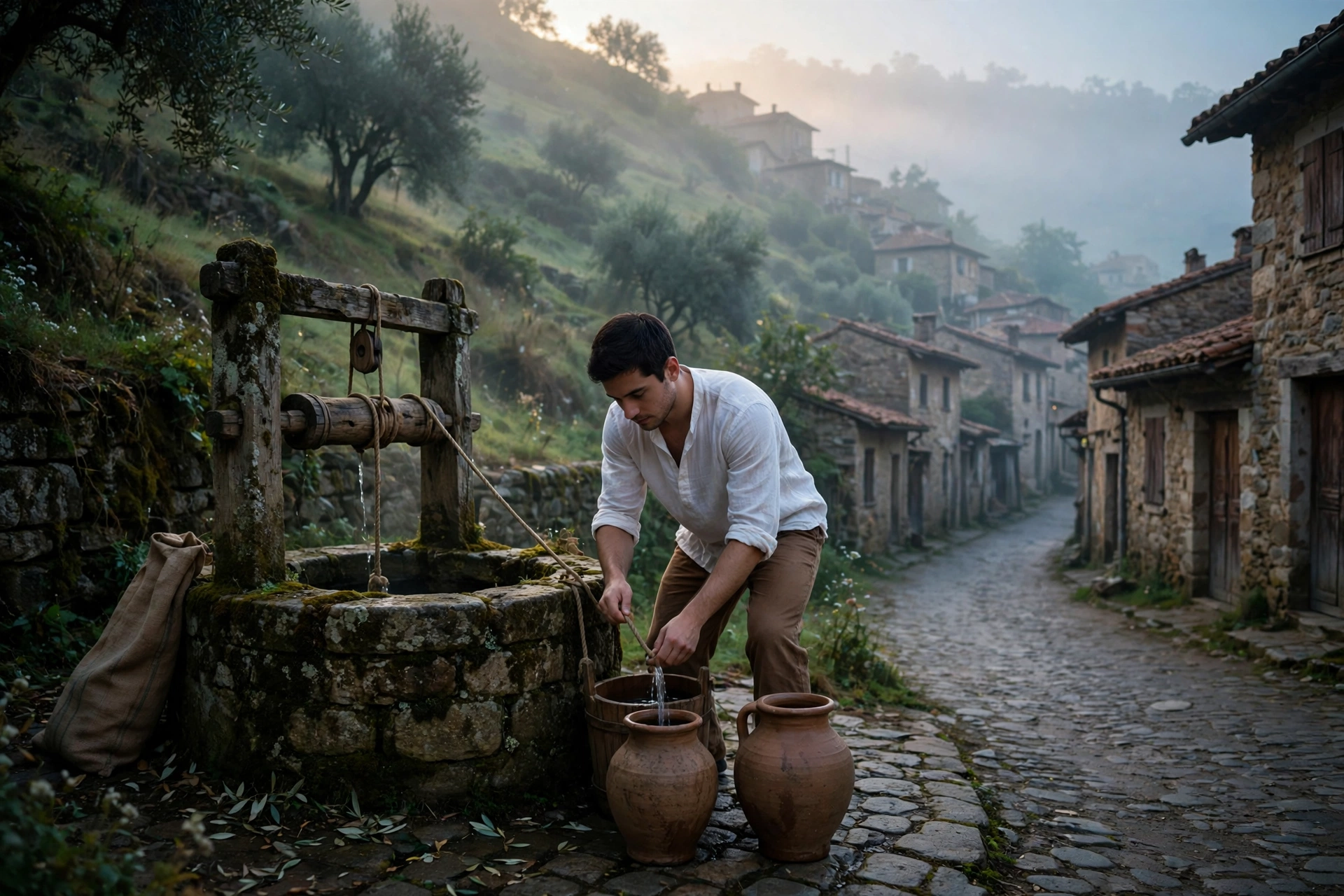
He was twenty-seven, broad-shouldered and quiet, the kind of young man shopkeepers nodded to but rarely stopped to talk with. He worked as a porter in the market below, hauling crates and sacks for a few coins at a time. It was honest work, but it was not the work that mattered most to him. The work that mattered began before dawn, when the town was still dark and the only sounds were the call of the first birds and the creak of the old well's wooden wheel.
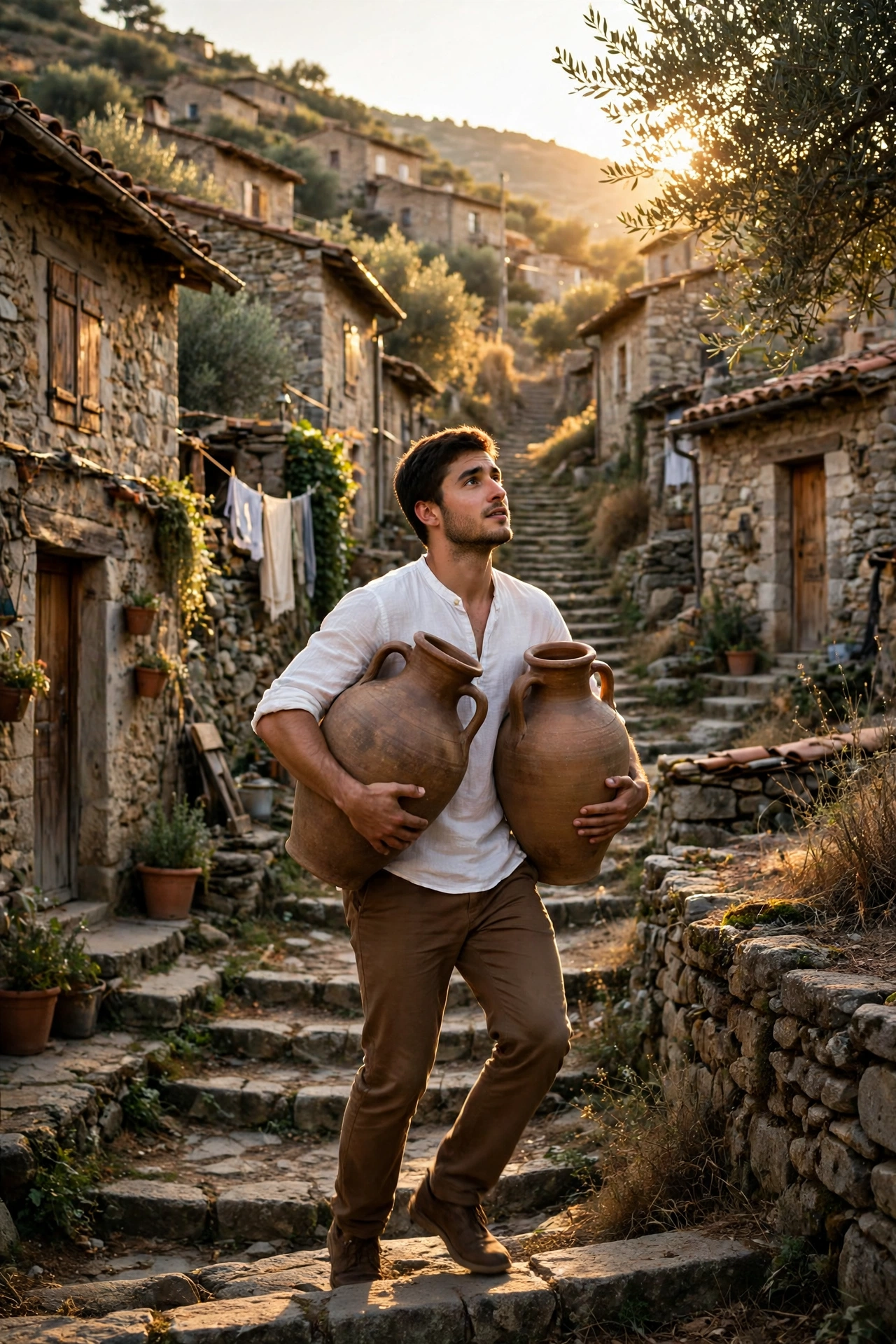
The hill had once had its own spring, but the spring had dried up years before Yusuf was born. The water pipes that the town had promised never quite reached the top. The young families moved down to the flats near the market, one by one, until only the old people remained in the stone houses at the top — people whose knees had given out, whose children had moved far away, whose whole lives were in those small rooms with their views of the valley.
Yusuf's father had been the one who carried their water before him. Every morning, old Kareem would fill two clay jugs at the well, sling them onto his shoulders, and climb. He never complained, not even in the heat of summer or the bitter cold of January. "Water is heavy," he used to say to his son, "but thirst is heavier." When Kareem's heart gave out on a winter morning, halfway up the steps with a jug in each hand, the hill's old people wept as if they had lost a son of their own. And Yusuf, who was twenty-one and grieving and did not know what else to do with his sorrow, picked up his father's jugs the very next morning and climbed.
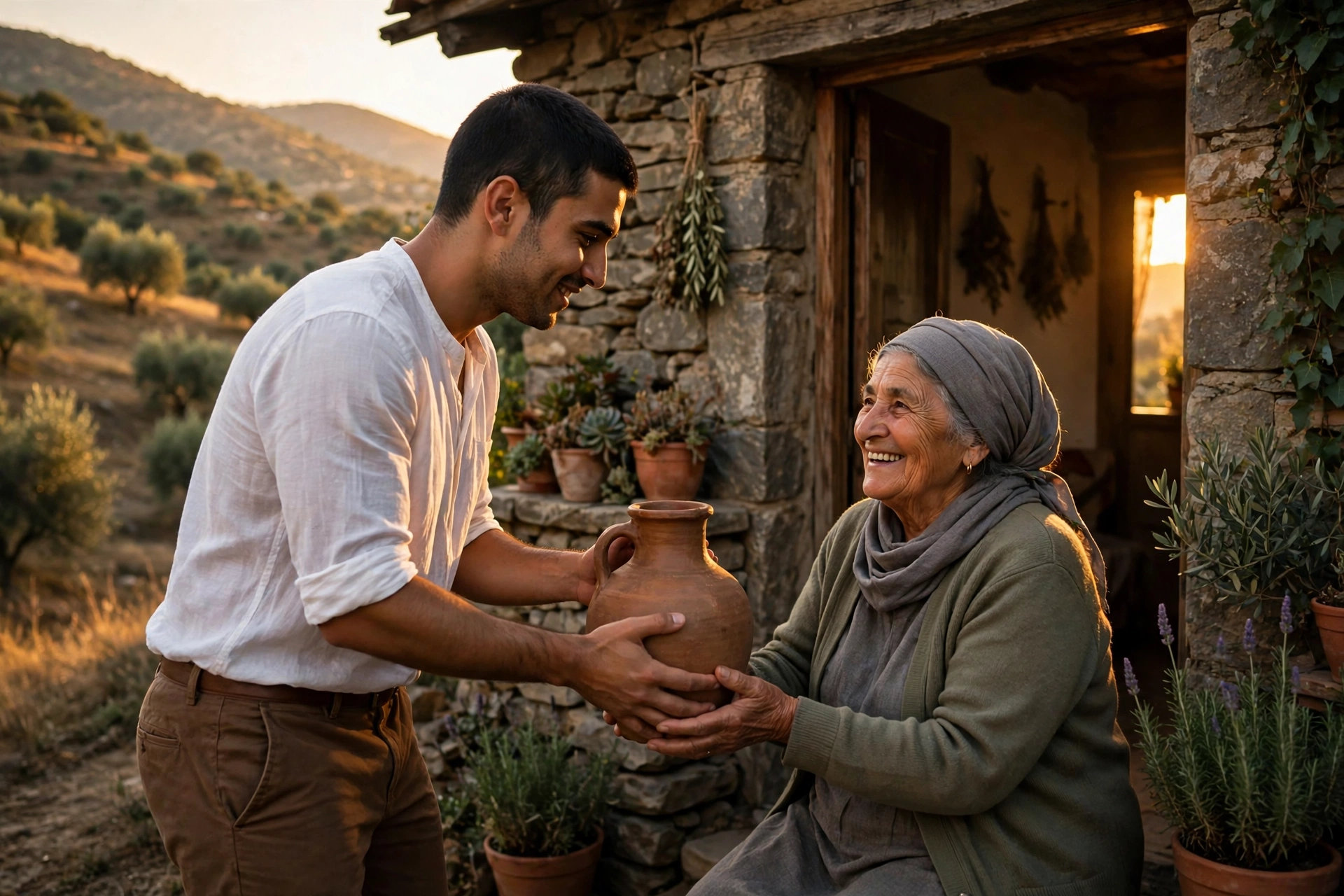
He never announced it. He simply appeared at the well at dawn, filled the jugs, and started up the steps. The first house belonged to Amma Salma, eighty-two years old, who lived alone with a cat and a lemon tree in a cracked pot. She had been his father's first stop too. When she opened her door that first morning and saw the young man standing there with the jugs, breathing hard, she put a hand over her mouth and said nothing for a long moment. Then she said, "Your father's feet knew these steps better than his own name." Yusuf nodded, because he could not speak past the tightness in his throat, and poured the water into her clay pot.
After Amma Salma came Uncle Rafiq, whose eyesight was nearly gone; then the sisters, Maryam and Zainab, who shared a house and argued cheerfully about everything; then old Master Ilyas, the retired schoolteacher who still kept a stack of exercise books by his window. Seven houses in all. Two trips each morning, sometimes three in summer. Yusuf never took a coin for it. When Amma Salma tried to press a few folded notes into his palm, he closed her hand gently over them and said, "Keep it for the cat's milk." She laughed, and the laugh turned into a cough, and he waited on her step until the coughing passed, the way his father used to wait.
The days fell into a rhythm as steady as the turning of the well's wheel. At dawn he filled the jugs at the well, and by mid-morning he was down in the market again, hauling crates.
People in the market began to notice. A tea seller started keeping a cup ready for him when he came down, refusing payment with a wave of his hand. A vegetable seller slipped extra tomatoes into his bag. Yusuf accepted these things the way he accepted the morning light: quietly, without making a fuss. He did not think of himself as a kind man, only as a man doing what someone had to do.
One winter morning, everything changed. It had rained in the night, and a thin skin of ice had formed on the steps near the top. Yusuf was on his second trip, carrying the jugs to Master Ilyas, when his foot slipped on step one hundred and ninety. He heard the crack before he felt the pain — a sharp, clean sound, like a branch snapping — and then he was sitting on the cold stone with water spreading around him and his ankle already swelling inside his shoe. The jugs had rolled down a few steps and shattered. He sat there for a while, staring at the broken clay, more upset about the water than about his own leg.
He managed to get himself down the hill somehow, half-hopping, half-sliding, holding the stone wall for support. The doctor at the small clinic shook his head. "A bad sprain, maybe worse," he said. "No climbing for at least a month. No carrying anything heavy. If you climb those steps now, you may damage it for good." Yusuf nodded, but all he could think about was the seven houses at the top of the hill, and the clay pots that would be empty by nightfall.
He spent that evening sitting by his window, angry at his own ankle and at the ice and at the whole unfair shape of the day. He told himself he would rest one day and then find a way. The old people had survived before; they would manage one day.
But the hill had its own memory. Early the next morning, before the sun was up, there was a knock at Yusuf's door. It was the tea seller from the market, holding a jug in each hand. "I heard about your ankle," he said gruffly, not meeting Yusuf's eyes. "Show me which houses." Before Yusuf could answer, the vegetable seller appeared behind him with a bucket, and behind her, a boy who swept the market lanes, carrying a smaller jug with both hands like it was something precious.
Yusuf tried to protest. He said the steps were steep and the jugs were heavy and this was not their burden. The tea seller snorted. "You have carried our water up that hill for six years," he said. "Did you think nobody noticed? Sit down, boy, and tell us the order of the houses before we forget it."
So Yusuf sat on his doorstep with his bandaged ankle stretched out in front of him, and he told them: Amma Salma first, then Uncle Rafiq, then the sisters, then Master Ilyas, and the rest in turn. He told them about the loose stone at step ninety, and the slippery patch near the top, and the lemon tree in the cracked pot, and the cat that would try to trip them. And one by one, the people of the market climbed the hill with water, the way he had climbed it, and the way his father had climbed it before him.
Amma Salma was waiting at her door when the tea seller arrived, and when she saw that it was not Yusuf, her face fell. Then she looked past him, down the long staircase, and saw the vegetable seller behind him, and the boy behind her, and more people still coming up behind them, all carrying water. She stood there with her hand over her mouth, exactly as she had stood on that first morning six years before. "What is this?" she whispered. The tea seller set the jug down carefully and said, "This is your water, Amma. It just has more hands carrying it today."
Word spread through the market the way good news sometimes does, quietly and then all at once. The next morning there were even more people at the well. A schoolteacher who had finished her classes for the day came with her two sons. A tailor closed his shop for an hour. An old fisherman who had not climbed the hill in twenty years climbed it slowly, resting at every tenth step, carrying a single small jug with great dignity. Nobody was paid. Nobody asked to be thanked. The hill's old people, who had spent years quietly accepting help, now found themselves pouring tea for strangers on their doorsteps and telling stories they had not told in years.
Yusuf watched all of this from his window at the bottom of the hill, frustrated at first, and then slowly, quietly amazed. He had thought he was the only pair of hands the hill had. He had never realized that all those years of climbing had been planting something in the town below — not just water in clay pots, but a habit of looking uphill. People had watched him pass every morning with the jugs on his shoulders, and without ever discussing it, they had learned the route by heart, the way he had once learned it from his father.
By the third week, his ankle had healed enough for him to hobble to the well, and then to the bottom of the steps, where he stood looking up at the long staircase with his hands empty for the first time in six years. He felt strangely lost. Then he heard footsteps behind him, and the tea seller appeared with two jugs, and the vegetable seller with her bucket, and the schoolteacher's sons racing each other to the first step. "We are going up," the tea seller said, as if it were the most ordinary thing in the world. "Are you coming?" Yusuf laughed — a real, surprised laugh — and said, "Slowly. I am coming slowly." And they climbed together, at his pace, stopping at every tenth step the way the old fisherman did, talking and resting and carrying the water up between them.
When his ankle had fully healed, Yusuf went back to his morning climb, because it was his father's work and his own, and some promises are not meant to be handed away. But he never climbed alone again. There was always someone beside him now: sometimes the tea seller, sometimes the boy who swept the market lanes, sometimes a stranger who had heard the story and simply turned up at the well at dawn with empty hands. The seven houses at the top of the hill were never short of water again, and their doors, which had once opened only to one quiet young man, now opened to the whole town.
Years later, when people in the market told the story, they always told it the same way. They said there was a man who carried water up a hill for people he owed nothing, and when he fell, the hill carried the water back down to him — not in jugs, but in hands. Many hands. And Amma Salma, who lived to be ninety-one and whose lemon tree finally bore fruit in its cracked pot, would smile whenever she heard it and say, "He thought he was carrying water. He was carrying us. And in the end, we carried each other."
The steps are still there, all two hundred and fourteen of them. The spring never came back, and the pipes never quite reached the top. But every morning at dawn, if you stand at the bottom of the hill and look up, you will see a line of people climbing with jugs and buckets in the morning light, and somewhere among them, a man with his father's steady pace, who no longer counts the steps, because he is too busy talking to the friends walking beside him.