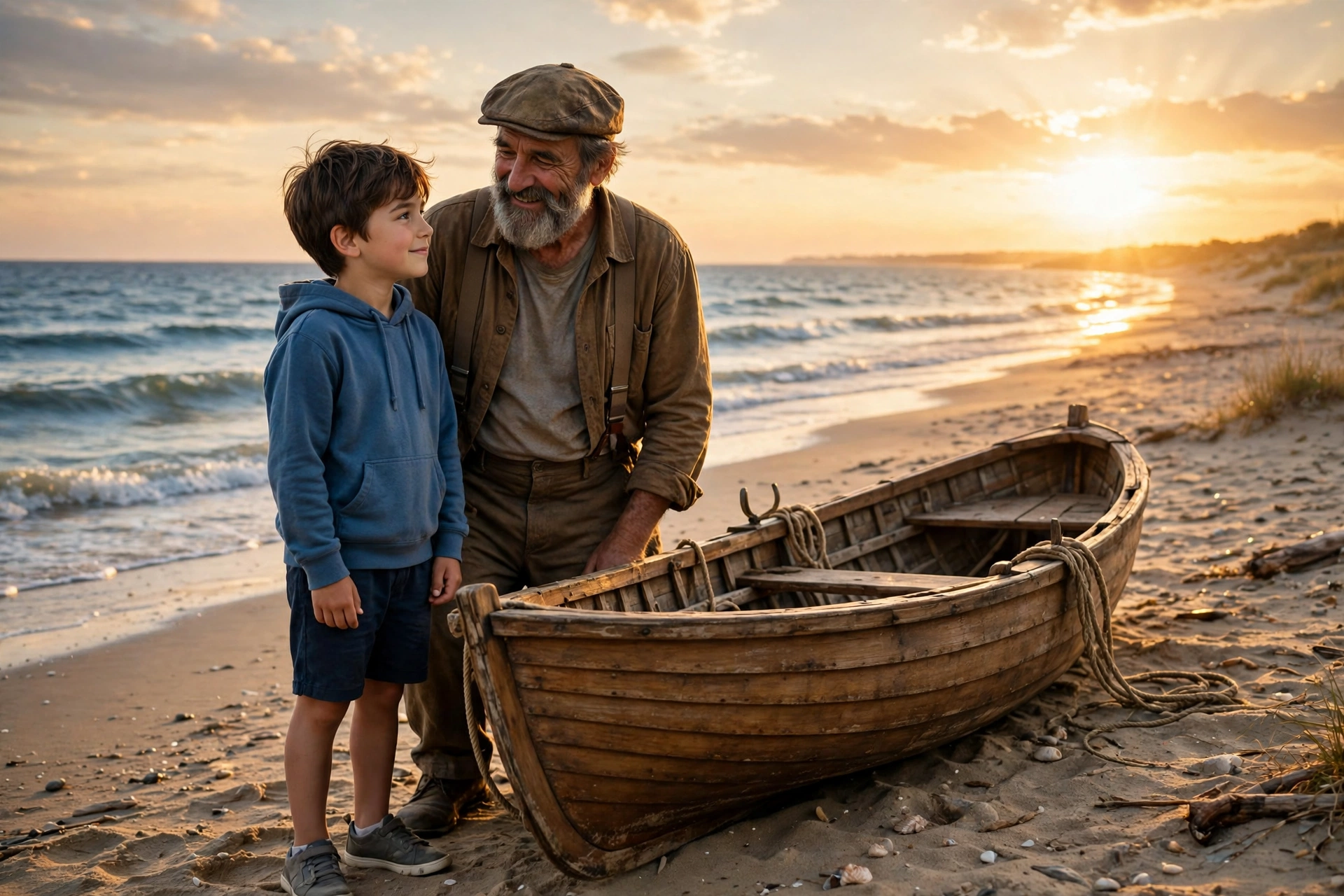
Amir had never seen the sea, but he knew exactly how it sounded.
He knew it from the stories his father used to tell him at night, before his father left for work in the city and never came home again. His father had once worked near the harbour, unloading crates from ships. "The sea is bigger than all our fields put together," his father would say. "And when the waves come in, they sound like the whole world breathing."
Amir was nine now. He lived with his mother and his grandmother in a small inland village where the roads turned to dust in summer and to mud in winter, and where the nearest river was a thin brown stream that dried up by June. There were wheat fields, a school with peeling blue paint, and a carpenter's workshop at the end of the lane. There was no sea. And yet every evening, when the wind moved through the wheat, Amir closed his eyes and listened for waves.
Yusuf the carpenter was seventy-four, and his workshop smelled of sawdust and linseed oil. He had built doors for half the village and cradles for babies who were now grown men. His hands were knotted and scarred, his beard was the colour of wood ash, and he wore the same brown shawl in winter and summer alike, because, he said, a man should not change what still keeps him warm.
Amir began visiting the workshop after school. At first he only stood in the doorway, watching. Yusuf did not chase him away. Old men who have worked alone for a long time learn to recognise a particular kind of visitor: not a customer, not a nuisance, but a child who has nowhere else he would rather be.
"Come in, boy," Yusuf said one afternoon, without looking up from the plank he was planing. "Standing in a doorway never taught anyone anything."
So Amir came in. He swept the floor and handed Yusuf nails, one at a time, in the order Yusuf pointed for. He learned the names of tools the way other children learned the names of cricket players: saw, chisel, plane, mallet, square.
"Uncle Yusuf," he said, "can you build a boat?"
Yusuf stopped planing. He looked at the boy for a long moment, the way a man looks at something he has not seen in years and suddenly remembers.
"I have not built a boat in forty years," he said quietly.
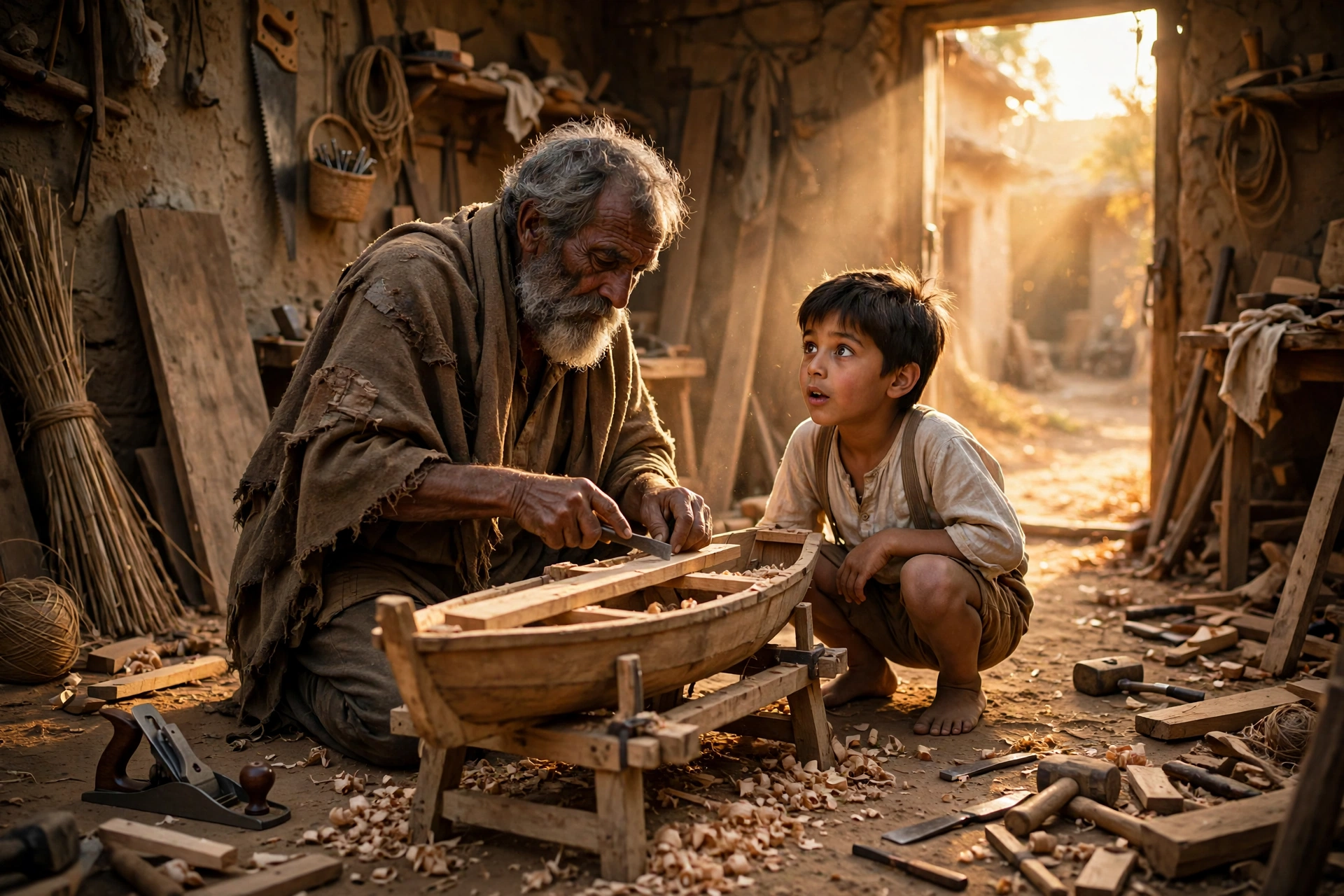
"Why not?" Amir asked.
"Because there is no water here worth floating on," Yusuf said. "A boat in this village is like a song with nowhere to be sung."
Amir nodded, as if he understood, but he did not leave. He stayed until the light went out of the workshop, and when he walked home through the wheat fields, he thought about his father's voice and the sound of the whole world breathing.
The next morning, Yusuf woke earlier than usual. He went to the back of his workshop, to a corner he had not opened in years, and pulled out a bundle wrapped in old cloth. Inside were his boat-building tools, and beneath them, a drawing he had made when he was a young man: a small fishing boat, curved and proud, with room for two people. He had drawn it the year he left his own coastal village to come inland for work, telling himself he would return to the sea one day. He never had. Work had become marriage, marriage had become children, and the sea had become a story he told other people.
Yusuf spread the drawing on his workbench and stared at it until his eyes stung. Then he did something he had not done in a very long time: he changed his mind about what was possible.
When Amir arrived after school, the workbench was cleared, and a pile of fresh timber stood waiting.
"We are building a boat," Yusuf said, as simply as if he were announcing the weather.
Amir's mouth fell open. "A real one?"
"A real one," Yusuf said. "Small, but real. It will float. I promise you that."
Word travels fast in a village, and faster still when it sounds impossible. By the end of the week, everyone knew: old Yusuf had lost his mind and was building a boat in a place with no sea. The tea stall men laughed into their cups. One or two of them came to the workshop to see for themselves, and stayed longer than they meant to, watching the curve of the hull take shape under Yusuf's hands.
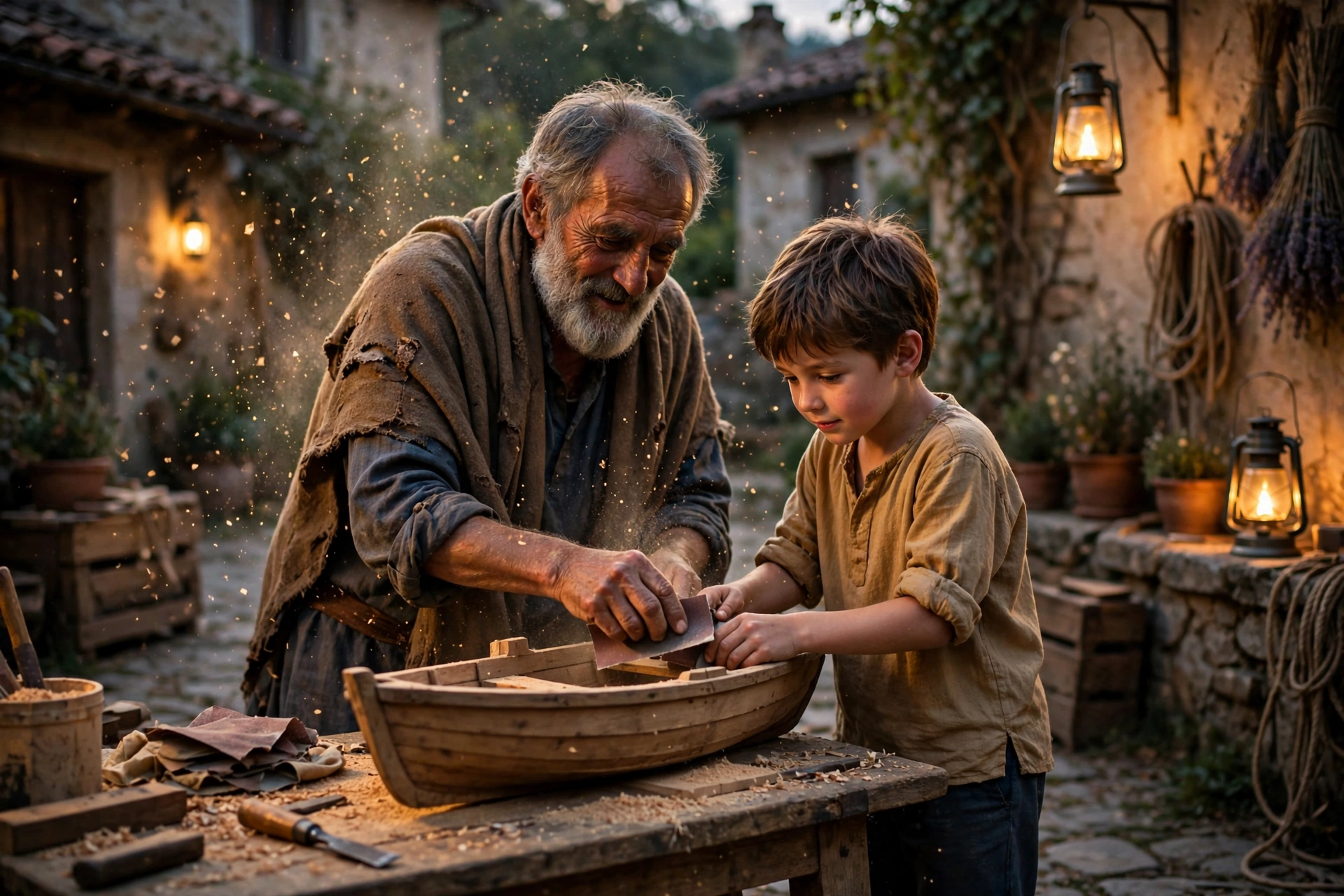
Amir worked beside him every day. He learned to sand without pressing too hard, to hold a plank steady while Yusuf nailed it, to measure twice before cutting once. Yusuf taught him slowly, the way a man teaches something he loves, and Amir listened the way a child listens when he knows he is being trusted with something precious.
But it was not all easy. One afternoon, the hull cracked along a seam, and Yusuf sat down on his stool and put his head in his hands. Amir did not know what to do. So he fetched Yusuf a glass of water, sat beside him on the dusty floor, and waited.
"We can fix it," Amir said at last, very quietly. "My father used to say that when something breaks, it is just telling you how it wants to be mended."
Yusuf looked at the boy, and something in his old face softened. "Your father was a wise man," he said. And together they took the plank apart, cut a new one, and fitted it more carefully than before. The boat was stronger for the break, Yusuf told him, the way people often are.
Weeks passed, and the boat grew. It was painted a deep, hopeful blue, with a white stripe along its side and a small wooden mast. Amir's mother came one evening to see what all the fuss was about. She stood in the doorway, watching her son sand the hull with a concentration she had not seen on his face since before his father died, and that night Amir heard her crying softly in the kitchen — not from sadness alone.
"When I was young," he said, "I promised myself I would go back to the sea. I kept waiting for the right time. The right time never came, because I kept waiting for it instead of walking towards it."
Amir was quiet for a moment. Then he said, "Then let us walk towards it."
Yusuf laughed, a sound like dry leaves rustling. "It is a three-day journey to the coast, boy. By bus, by train, and then on foot."
"Then we will take the bus, and the train, and then walk," Amir said, as if it were the simplest thing in the world. "The boat can come too."
And so, to the amazement of the entire village, that is what they did.
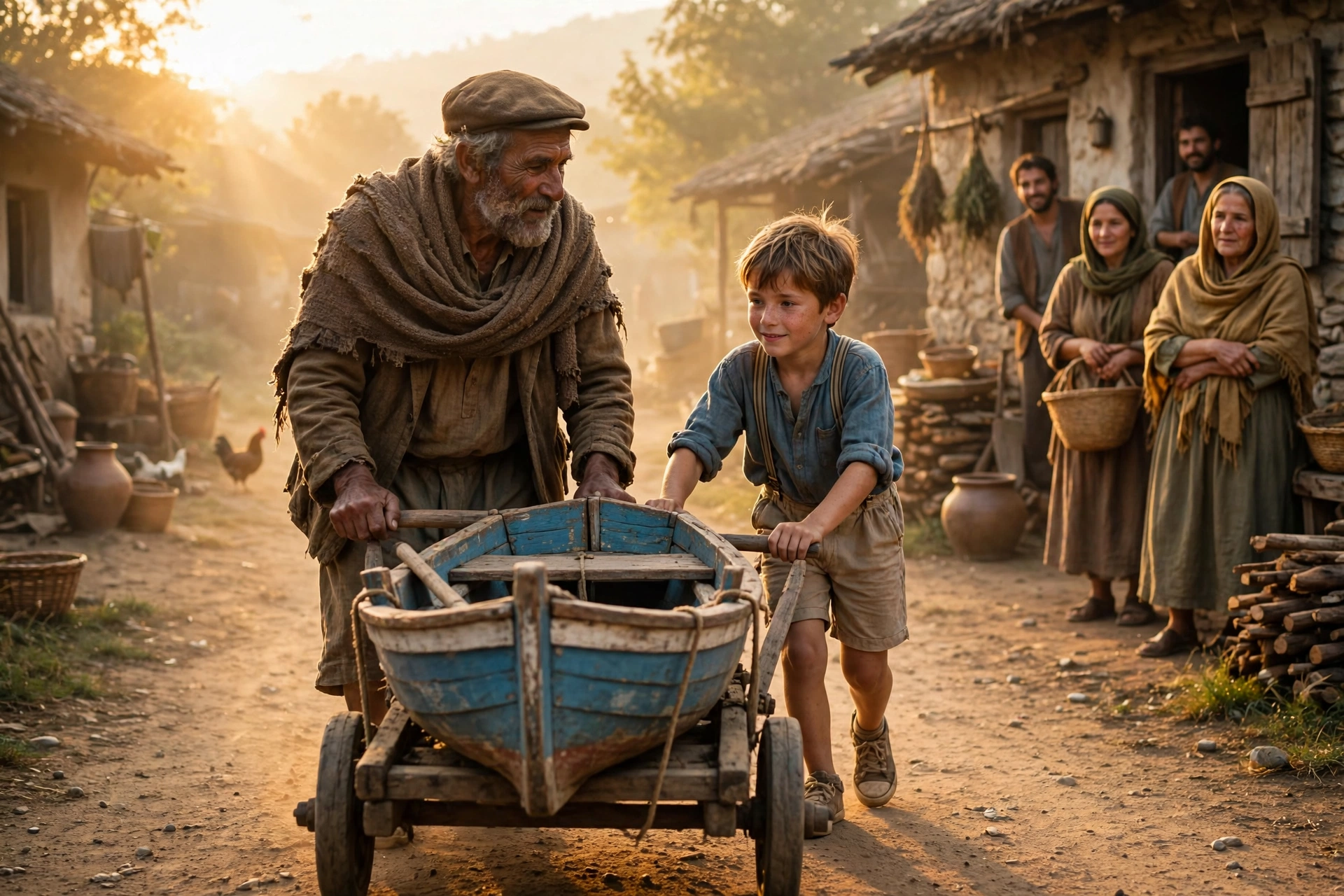
The journey was not easy. Yusuf's knees ached on the bus. Amir carried their food in a cloth bag and counted the stations on the train like treasures. The boat, wrapped in blankets and tied to a borrowed cart, drew stares everywhere it went. People asked where they were going, and when Yusuf answered, "To the sea," some laughed, and some went quiet, as if they had just remembered a promise they too had left waiting.
On the third morning, they walked over the last dune, and the world opened up in front of them.
Amir stopped. He did not run. He did not shout. He simply stood there, his small hands hanging at his sides, while the wind lifted his hair and the great blue water stretched out further than any field he had ever known. And then he heard it, for the first time in his life, not in a story but real: the waves coming in, like the whole world breathing.
"Abba was right," he whispered.
Yusuf stood beside him, and his eyes were wet, though he would later deny it. Forty years he had waited. And now here it was, and here was this boy, and here was the boat they had built together, waiting on its cart like a promise kept.
They carried the boat down to the water together, Yusuf at one end, Amir at the other, the way they had carried every plank in the workshop. The fishermen on the shore watched as the old man and the boy set the little blue boat into the surf. For a terrible moment, Amir held his breath, afraid it would tip or sink.
It floated.
It bobbed, and steadied, and rode the waves as if it had been born for them. Amir laughed then, a wild, free laugh that startled the gulls into the air, and Yusuf laughed too, and the two of them waded in ankle-deep and held the boat's rope like men holding something holy.
They did not sail far. They did not need to. Amir sat in the boat while Yusuf held it steady in the shallows, and the boy trailed his fingers in the cold, salty water and looked out at the horizon where the sky met the sea and there was no edge at all.
"Uncle Yusuf," he said, "when I grow up, I will bring my mother here. And my grandmother. And I will tell them what my father told me."
Yusuf nodded, because his throat was too full for words. He thought of all the years he had spent building doors for other people's houses while his own dream sat wrapped in cloth at the back of his workshop. He thought of how a child's question, asked in a doorway after school, had unwrapped it. And he understood, finally, something he wished he had understood at thirty instead of seventy-four: a dream does not die because you leave it waiting.
That evening, as the sun went down over the water and turned the whole sea to gold, Yusuf gave Amir the boat.
"It is yours," he said. "You helped build it, plank by plank. And a boat belongs to the person who will take it further than its maker ever could."
Amir shook his head fiercely. "But you built it for me. I cannot take it from you."
"You are not taking it from me," Yusuf said, placing his old, scarred hand over the boy's small one. "You are carrying it for me. That is a different thing entirely. I built doors all my life, Amir. Doors stay where you put them. But a boat — a boat goes. That is why I built it. So it could go, even when I cannot."
They left the boat with a fisherman at the shore, who promised to look after it until Amir's family could return. On the journey home, Amir was quiet, not with sadness but with fullness, the way a cup is quiet when it is filled to the brim. Yusuf, too, was quiet, but his step was lighter than it had been in years.
And Amir? He kept the drawing of the boat on his bedroom wall, and every evening he told his mother and grandmother something new about the sea: how it smelled of salt and distance, how it was bigger than all their fields put together, and still not too big for a small blue boat built by an old man who had almost forgotten how to dream.
Some dreams are too big for one lifetime, and that is all right. We do not have to reach every shore ourselves. Sometimes the kindest thing we can do is to build the boat, teach a young pair of hands to hold the tools, and then stand on the sand, smiling, as someone we love sails a little further than we ever did.