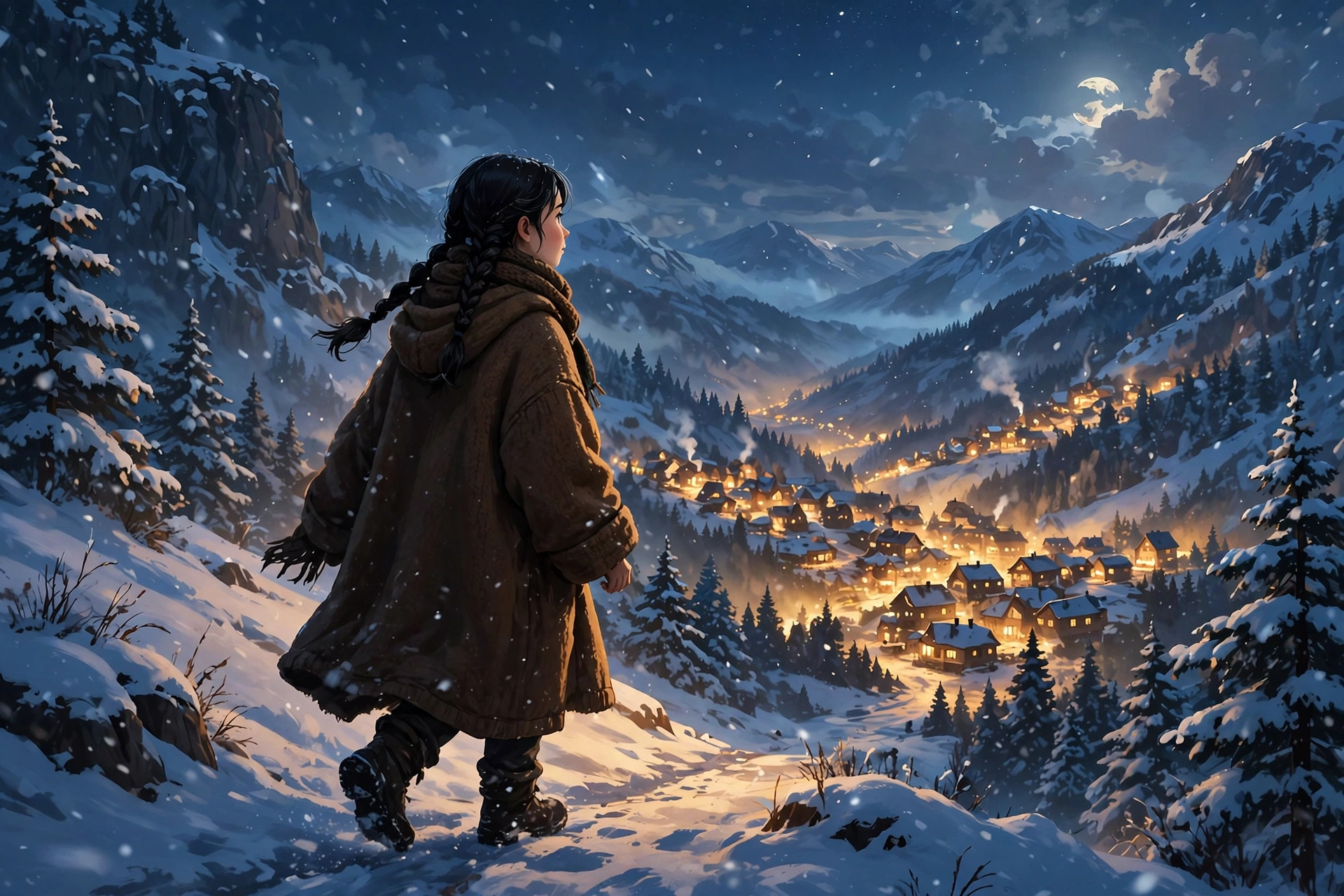
The fever came in the night, quiet as snowfall, and by morning it had taken hold of Arman so completely that his small body burned beneath the blankets while his lips trembled with cold. Meera pressed her palm to his forehead and felt the heat travel straight into her own chest, sharp and frightening. His breath came fast and shallow, and his eyes opened only for a moment before sinking closed again, as if staying awake cost him more strength than he had left to spend.
Their village lay cupped in a high valley, a scattering of stone houses with smoke rising thinly into a pale winter sky. Beyond it, the only road out was a narrow track that climbed over the mountain pass to the town clinic in the next valley. In summer the walk took four hours. In winter, when snow fell thick and the wind sharpened itself against the rocks, the pass became a place people spoke about in low voices. That morning, the snow had fallen all night, and the track had vanished under drifts as high as a child's waist.
Meera's grandfather stood at the window, watching the white world as if he could argue with it. He was seventy-two, his knees stiff from a lifetime of walking those hills, and he had already tried the path at first light and come back with snow in his beard and defeat in his eyes. "The drifts are too deep for me now," he said quietly, and Meera heard what he did not say: that he would have gone if his body had allowed it. Her father was away in the lowlands, working through the winter to send money home. There was no phone signal in the village and no vehicle that could climb a buried track. The village doctor had already come and gone, leaving behind a damp cloth, a worried face, and the plain truth. "He needs the medicine from the clinic," he had said. "Without it, this fever will not turn on its own."
Meera looked at her brother, at the way his small fingers clutched the edge of the blanket, and something inside her went very still and very clear. She was sixteen. She had crossed the pass before, but only in summer, holding her grandfather's hand, stopping to pick wildflowers and drink from the spring halfway up. She knew the route well: the crooked pine at the first bend, the flat rock shaped like a sleeping dog, the shepherd's hut near the top where travellers sheltered from storms. She also knew the winter pass was a different creature altogether, and that everyone in the village would tell her not to go. She did not wait for them to tell her.
She packed quickly, because ceremony would have given her time to be afraid. Into her father's old rucksack she put a flask of hot tea, two pieces of bread wrapped in cloth, a spare shawl, and the small tin box in which her mother, long gone, had once kept dried apricots. Her grandfather watched her in silence, and then he took his own thick woollen coat from its peg and held it out to her. "Follow the markers," he said, his voice rough. "The stone cairns. If the wind rises, you stop at the hut. You do not try to be brave in a storm, Meera. You wait it out." She nodded, and he pressed her hand once, hard. Then she stepped out into the snow.
The first hour was the hardest, not because of the cold but because of the silence. The village fell away behind her, its smoke and voices swallowed by the white, and soon there was only the crunch of her boots, the sound of her own breathing, and the vast quiet of the mountain. The snow reached her knees in places, and each step had to be lifted high and placed carefully, or she would stumble and lose the path entirely. Twice she lost the track and found it again by the dark tip of a marker stone poking through a drift. Her legs ached. Her cheeks burned and then went numb. She kept walking.
By midday the wind had found her. It came down off the ridge in gusts that pushed her sideways and threw fine snow into her face so that it stung like sand. She pulled the coat's collar up around her ears and bent her head, counting her steps the way her grandfather had once taught her to count sheep when she could not sleep. One, two, three, four. One small step, then another. When she reached the crooked pine, half-buried and bowed under its load of snow, she laughed out loud, because something familiar in that wild white place felt like a hand reaching back to her.
The shepherd's hut was near the top of the pass, a low stone shelter with a roof of timber and turf, and Meera reached it just as the light began to thin and the wind rose into something angrier. She pushed the door open with her shoulder and stumbled inside, grateful for walls, for stillness, for the faint smell of old smoke in the hearth. She was unwrapping her bread with shaking hands when she heard it: a sound outside that was not wind. It was thin and broken, almost lost, but unmistakably human. She went to the door.
Outside, half-buried in a drift near the path, lay an old shepherd she did not know, his leg twisted beneath him and his face grey with cold. He had been crossing with his flock's last stragglers when the storm caught him, and he had fallen and could not rise. Meera knelt beside him, and for a moment the whole weight of her journey pressed down on her at once. She had medicine to fetch, a brother waiting, a pass still to cross, and now a stranger who needed her too. She could not carry him. She could not leave him. So she half-dragged and half-coaxed him, step by painful step, back to the hut, laid him by the hearth, wrapped him in her spare shawl, and gave him the flask of hot tea she had been saving for herself. She built a small fire from the dry wood stacked in the corner, and as the flames caught, colour came slowly back into the old man's face. He gripped her wrist and whispered, "You saved my life, child. May God protect yours." Then, though every part of her wanted to stay in the warmth, she went back out into the storm, because Arman was still waiting on the other side of the mountain.
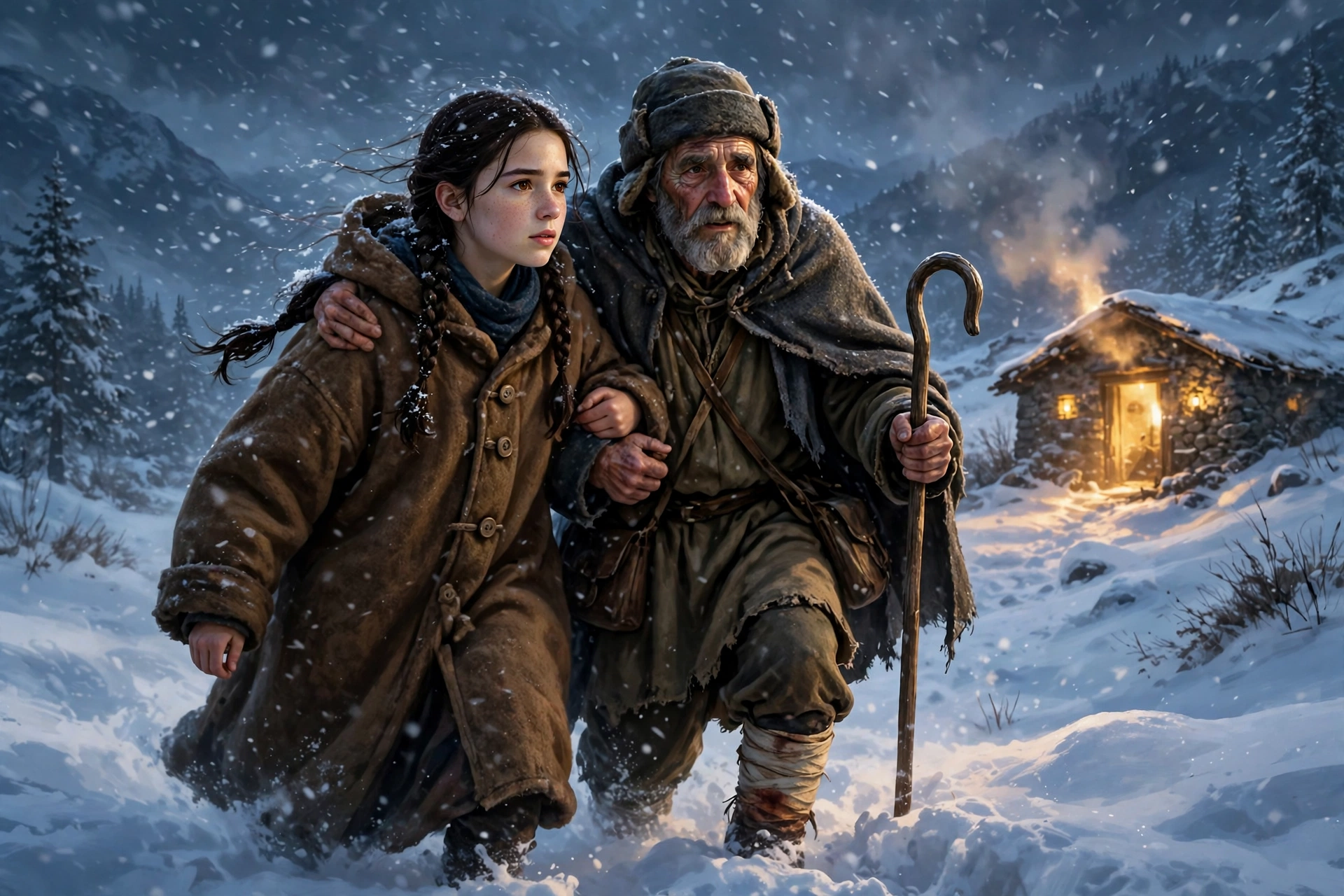
The climb to the top of the pass was the worst part of all. The wind screamed across the ridge, the snow blinded her, and twice she fell to her knees and had to crawl forward until she found a marker stone to pull herself up by. She remembered her grandfather's words and understood them differently now. Bravery was not a feeling that arrived before the hard thing. It was the decision made in the middle of it, when turning back would be easier and going on would cost everything you had. She stood up, wiped the snow from her eyes, and took one more step. Then another. Then another.
And then, suddenly, the ground began to fall away beneath her feet, and the wind dropped, and through a gap in the clouds she saw it: the next valley, spread out below in the late afternoon light, its rooftops dusted with snow, its clinic a small white building with a lamp already burning in the window like a promise. Meera almost wept. She made her way down to the town and pushed open the clinic door.
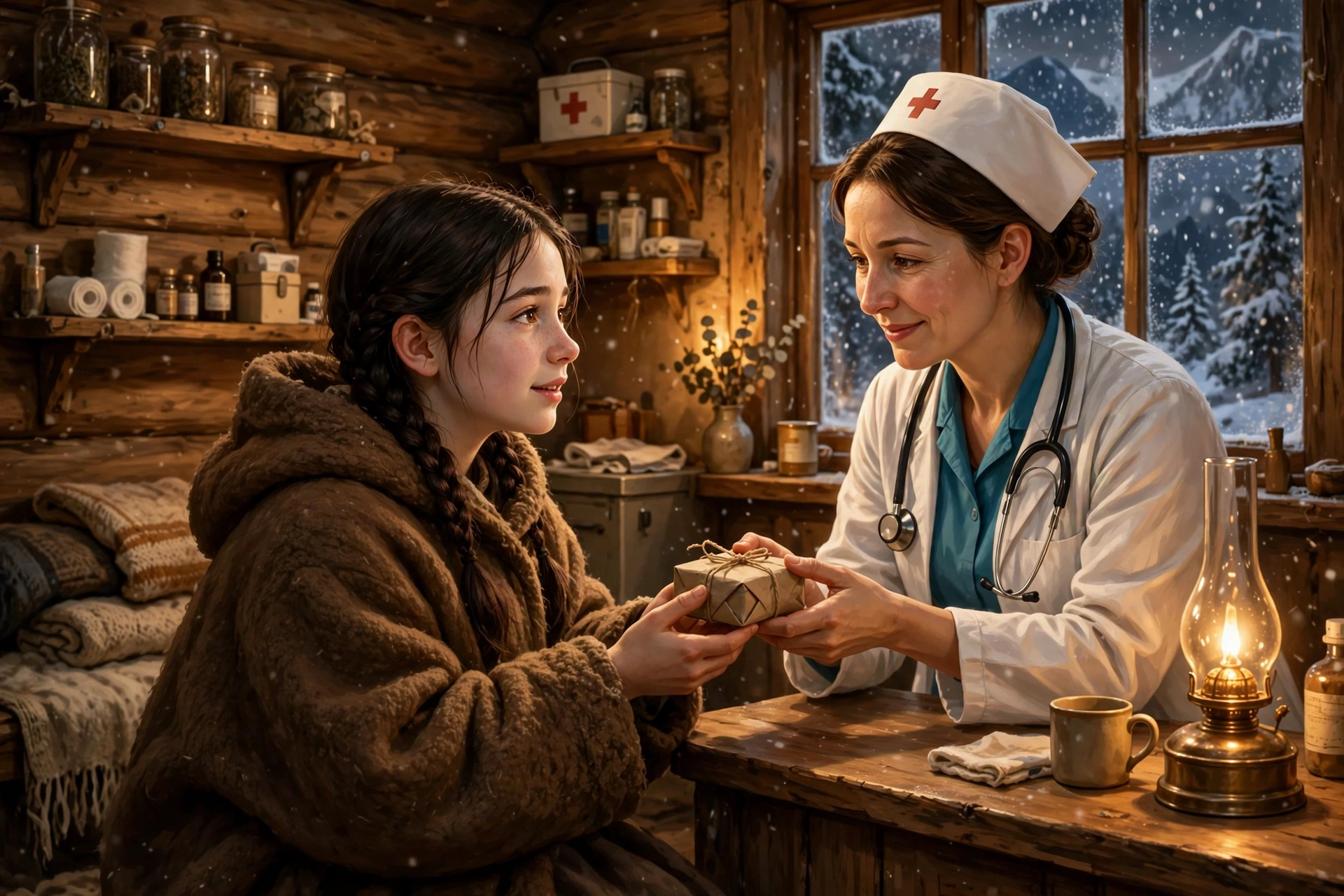
The nurse took one look at her and did not ask a single unnecessary question. Meera told her about Arman, and the nurse listened, nodded, and disappeared into the back room. She returned with a small brown bottle and a packet of tablets, and wrapped them carefully in cloth and then in plastic, so the snow could not reach them. "Keep them close to your body," she said, tucking the bundle into the inside pocket of Meera's coat. "And you must rest before you go back." But Meera shook her head. The storm had eased on this side of the mountain, the moon was rising, and every hour she waited was an hour Arman waited too. The nurse did not argue. She gave her tea and bread and walked with her to the edge of the town. "Go with God, brave girl," she said.
The journey back was longer in the dark, but the moon lit the snow so brightly that the markers cast long shadows, and Meera followed them home like a trail of friends. She stopped again at the shepherd's hut, and found the old man sitting up by a fire that still burned, his leg splinted with two straight sticks and a strip of cloth. "My sons will come for me at first light," he told her. "They know this hut. Go to your brother, child. And when you are old, tell this story the way I will tell it: that a girl crossed a mountain in winter, and stopped to save a stranger, and still came home in time." She nodded, left him the rest of her bread, and walked on into the moonlit night.
It was past midnight when she saw the lights of her own village below, small and golden and impossibly dear, and her grandfather was waiting at the edge of the track with a lantern, because he had never once gone to bed. He pulled her into his arms without a word. Inside, Arman still burned with fever, but his breathing was steady, and when Meera unwrapped the medicine with trembling hands and the doctor, woken from his sleep, measured out the first dose, the whole house seemed to hold its breath. Meera sat beside her brother's bed through the rest of the night, holding his small hand.
By dawn, the fever broke. It did not break all at once, but in the slow, sure way that morning light breaks over a mountain: first a lessening of the heat, then a dampness on Arman's forehead, then a long, deep sleep that was not exhaustion but healing. When he opened his eyes in the grey early light and whispered, "Meera, I'm thirsty," she laughed and cried at the same time, and her grandfather, standing in the doorway with tears on his weathered face, turned away quickly so the children would not see. The village learned the story the way villages learn everything, in pieces and retellings, and by evening the women were bringing soup, and the old shepherd's sons arrived with gifts of cheese and wool.
Meera never thought of herself as brave. But the village remembered differently. They remembered the girl who had walked into a storm for her brother, who had stopped to save a stranger when stopping cost her the most, and who had come home in the moonlight with medicine in her pocket and snow in her hair. And Arman would later tell his children that courage is not the absence of fear, but the quiet decision to keep walking anyway, one small step at a time.