The rain had been falling since noon, and by six o'clock it had turned the whole city into a mirror. Ayan could see the wet road shining under his motorcycle headlight and the shop signs smeared into long ribbons of colour. His jacket was soaked at the shoulders, his gloves were wet, and the phone strapped to his handlebar was flashing a number he could not ignore: twelve minutes left.
Twelve minutes to reach the other side of town, or the order would be marked late. Late meant a lower rating, and a lower rating meant losing the weekly bonus. And the weekly bonus meant his younger sister's school fees, paid on time, without his mother having to borrow from anyone again.
Ayan leaned forward and pushed the bike a little faster. He knew every shortcut in this part of the city, and he had done this run a hundred times. Tonight, he told himself, he would do it perfectly. He would not stop for anything.
That was when he saw her.
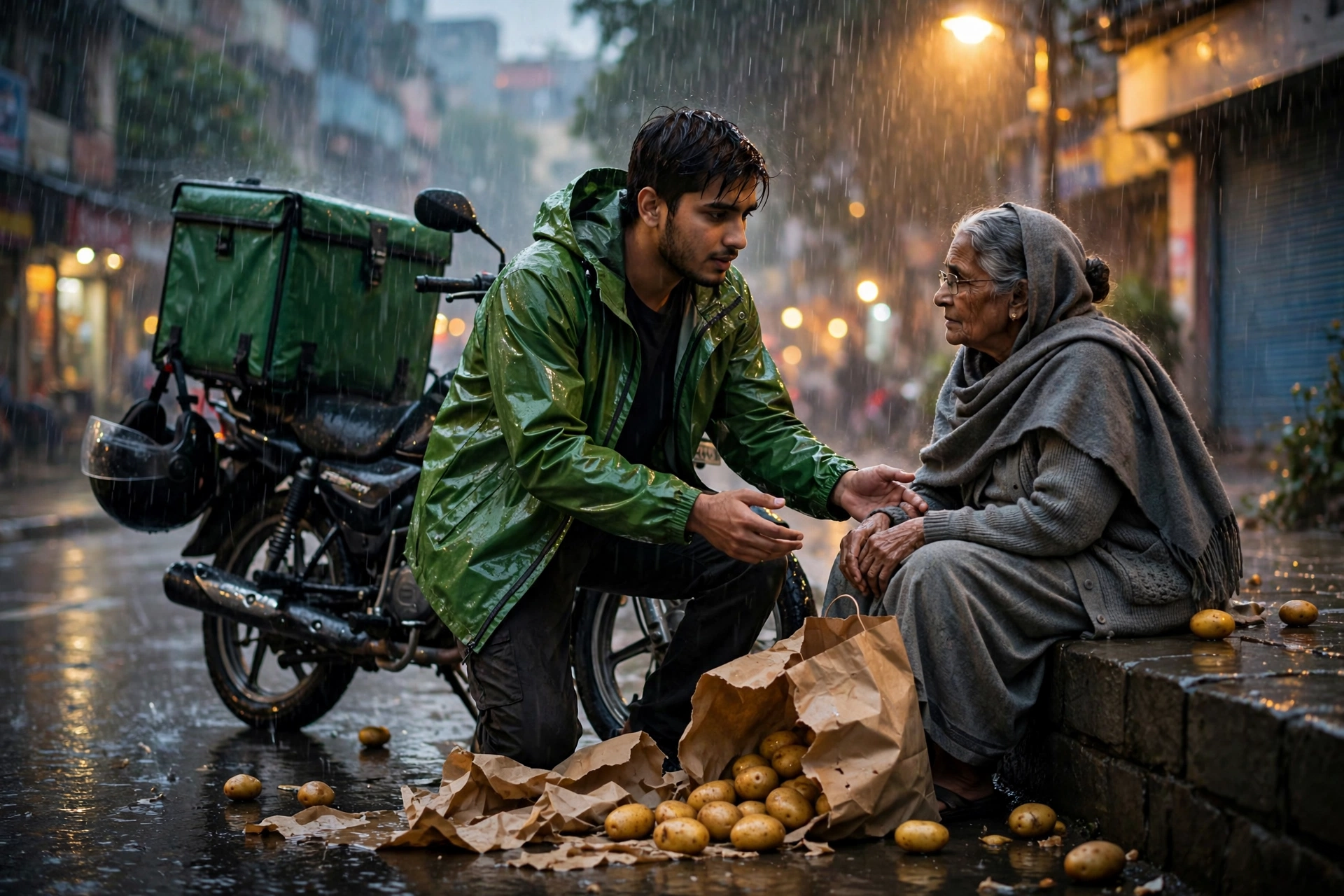
She was sitting on the low wall beside the pavement, just past the corner where the streetlights flickered. An old woman in a grey shawl, her clothes dark with rain, a torn shopping bag at her feet. Potatoes had rolled out of the bag across the wet pavement. A bottle of milk lay on its side, its contents mixing with the rainwater. She was not crying out or waving for help. She was simply sitting there, very still, one hand pressed to her ankle and the other holding tightly to the wall, as if trying hard not to fall and not to be a trouble to anyone.
People passed her. A man with an umbrella hurried by without looking down. Two boys on a bicycle swerved around the potatoes. A woman with shopping bags glanced at her, then walked on, faster than before. The rain gave everyone a perfect excuse to keep moving.
Ayan's thumb hovered over the accelerator. Eleven minutes left.
He thought of his sister doing her homework by lamplight, and his mother counting coins at the end of the month. He thought of the bonus, and the manager's voice that morning: one more late delivery this week and you lose the bonus, Ayan. He had nodded and promised. He had meant it.
And then he thought of his own grandmother, who used to say that a person is not measured by how fast he reaches his destination, but by what he does on the way there.
Ayan stopped the bike.
He pulled over, switched off the engine, and walked back through the rain to the old woman. Up close, she looked even smaller, and much more frightened than she had from a distance. Her hands were shaking, not only from the cold.
"Amma, are you all right?" he asked gently, crouching down so he was not towering over her. "Did you fall?"
She looked up at him with eyes that were cloudy with age but still sharp with pride. "I slipped on the wet step outside the shop," she said. "My ankle — it will not hold me. I tried to stand, but it would not listen. So I sat down. I did not want to make a scene."
"You are not making a scene," Ayan said. "Let me help you."
He gathered the potatoes and put them back into the bag with the damp bread, picked up the milk bottle, and tied the torn handle into a knot. Then, very carefully, he helped her to her feet. She winced and leaned heavily on his arm, but she did not complain. She only whispered, "Thank you, beta."
"Where do you live, Amma?" he asked. "I will take you home."
"Not far," she said. "Two streets from here. But you need not — you look like a man in a hurry."
"I am," Ayan admitted, smiling. "But not in so much of a hurry that I cannot walk two streets."
So they walked, slowly, with the old woman leaning on his arm and Ayan matching his steps to hers. Twice she had to stop and rest against a shop shutter. Twice Ayan thought of the timer on his phone, still counting down somewhere in the rain, and twice he pushed the thought away. Some clocks do not matter as much as we think they do.
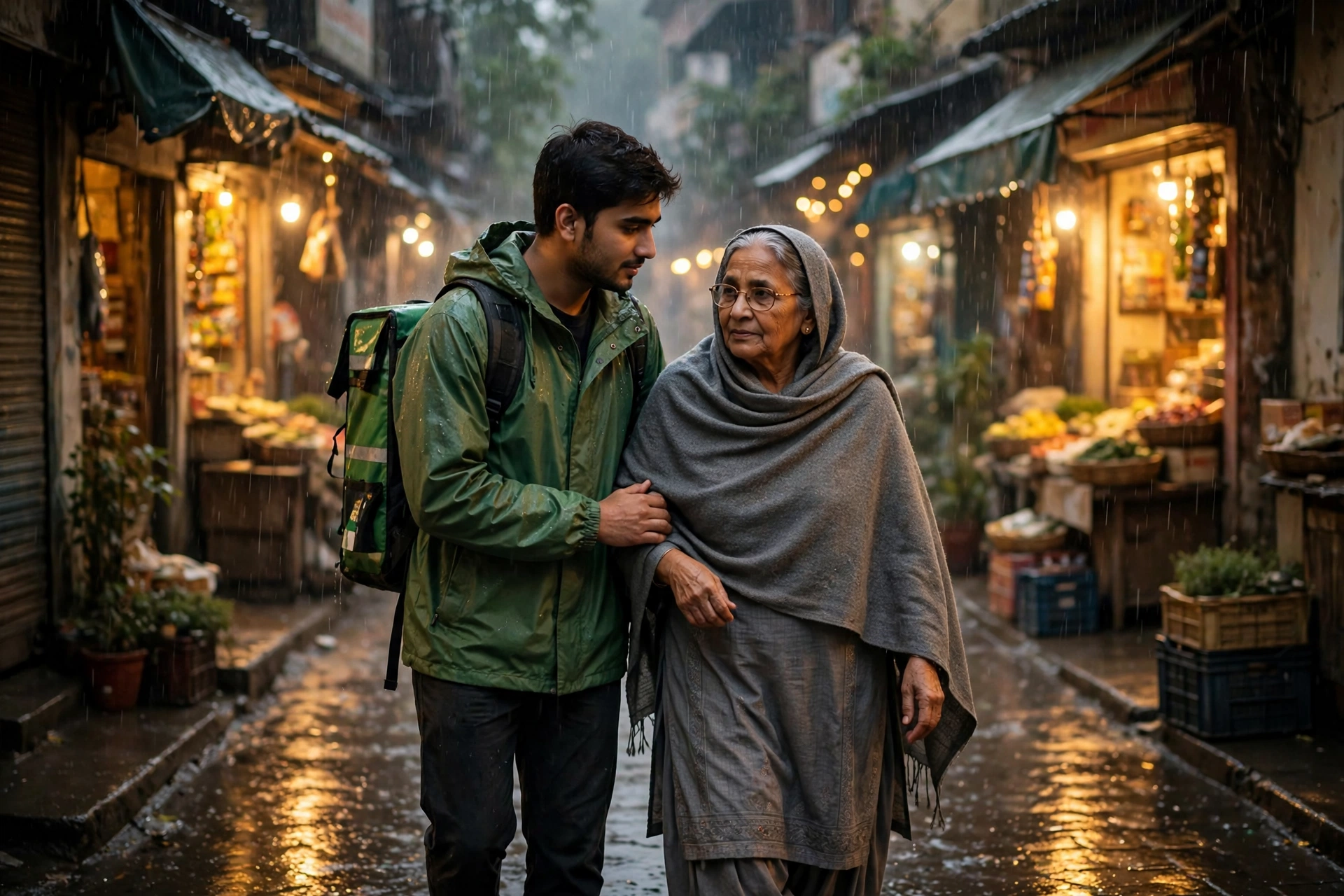
Her house was small and plain, at the end of a quiet lane, with a blue door and a single light burning in the window. Before Ayan could even knock, the door flew open, and a small boy of about eight came running out, his face wet with tears he was trying hard to hide.
"Dadi! Dadi, where were you? I was so worried!" he cried, throwing his arms around the old woman's waist.
"I am here now, Bilal," she said, stroking his hair with a trembling hand. "This kind young man brought me home."
Bilal looked up at Ayan with wide, grateful eyes. "Thank you," he said solemnly, as if he were a grown man making a promise. "Dadi is all I have."
Inside, the house was warm and smelled faintly of cardamom. The old woman — her name, Ayan learned, was Zainab — insisted that he sit down, just until the rain eased. She made tea with hands that still shook a little, and Bilal set out three chipped cups as carefully as if they were made of gold. Ayan tried to explain about the delivery, but Zainab waved his words away.
"You stopped in the rain for a stranger," she said. "The least this house can do is give you a cup of tea."
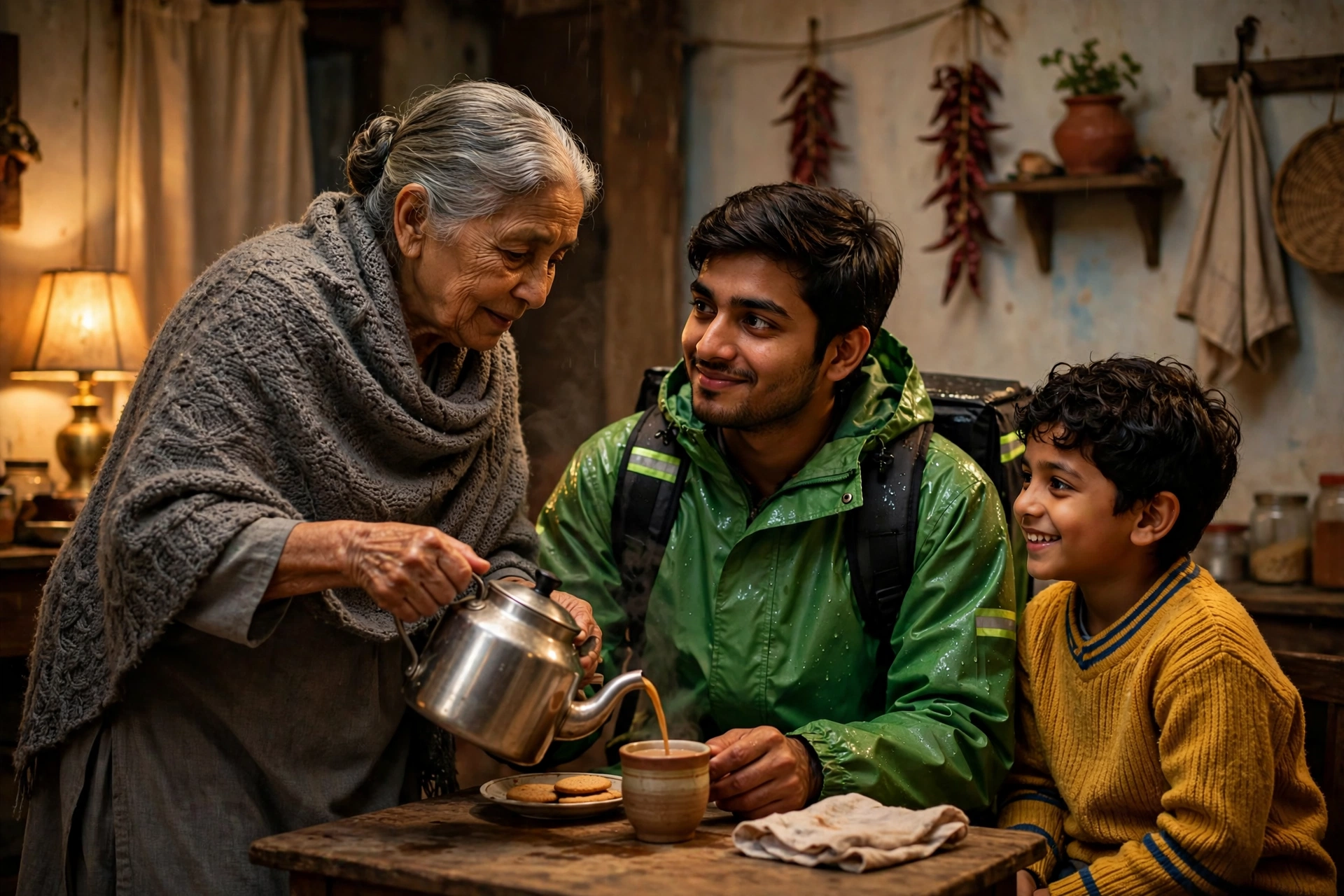
As they drank, Zainab told him that her son had once been a delivery rider too. He had loved the speed of it and the feeling of being needed by strangers. And one rainy night, much like this one, hurrying to beat a timer, he had taken a corner too fast and never come home. She did not tell the story to make Ayan sad. She told it quietly, the way a person hands over a lamp in a dark place, so that someone else might see a little further.
"My son used to say the road would wait," she said, looking into her tea. "But people cannot wait, beta. When someone needs you, that moment will not come again. A delivery can be late. A person cannot be left."
Ayan sat very still. The tea was warm in his hands, and outside the rain kept falling, and for the first time that evening he was not thinking about minutes at all.
When he finally left, Zainab pressed a small packet of biscuits into his hand, and Bilal walked him to the door and said, "Will you come again, bhai?" Ayan promised he would try, and he meant it.
By the time he reached his bike, the order was long past late. The customer had cancelled, and his phone showed a message from his manager: come to the office in the morning. Ayan rode home through the rain with the biscuits in his pocket and a heaviness in his chest. He had done the right thing, he was sure of it — and still, he had lost the bonus. His sister's fees would have to wait. That night, lying awake listening to the rain, he wondered if doing the right thing was supposed to hurt quite this much.
In the morning, he went to the office expecting the worst. The manager did not waste words. "Your rating dropped," he said. "The customer complained. The bonus is gone. One more incident like this and we will have to let you go."
Ayan nodded. He did not argue, and he did not tell the manager about Zainab or Bilal or the tea, because some things sound like excuses even when they are true.
He was about to leave when the manager's phone rang. The manager listened, frowned, and then looked at Ayan with an expression Ayan had never seen on his face before: something close to surprise.
"That was the customer," the manager said slowly. "The one from last night. He says he wants to withdraw his complaint."
Ayan stared at him. "Why?"
"Because," the manager said, reading from his notes, "he says he was at the clinic last night, visiting his own mother, and he saw you there — no, wait, he saw you helping an old woman home in the rain. He recognised your jacket. He says he was wrong to complain about a man who stops for his mother when the whole street walks past."
It turned out the customer had not been waiting at home at all. He had been sitting in the clinic corridor, worried about his own mother, when a nurse mentioned an old woman walked home by a rider who had missed his delivery to do it. The story had travelled the way such stories do in a small neighbourhood, until it reached the very man who had cancelled the order. And the man, thinking of his own mother, had felt ashamed of his anger.
The bonus was not restored — rules were rules, the manager said, and Ayan accepted that. But the complaint was withdrawn, and his job was safe, and that was more than he had dared to hope for that morning.
That was not the end of the story. A few days later, as Ayan was passing Zainab's lane, Bilal came running out with a drawing: a motorcycle in the rain, an old woman holding a young man's arm, and a sun drawn far too big and yellow, the way children draw suns when they want the day to be bright. Ayan laughed and folded it carefully into his jacket pocket, where it stayed for a very long time.
And Zainab had a friend named Rashid, who ran a small delivery company and had been looking for months for a rider he could trust. Not the fastest rider, Rashid said when they met, but the kind of rider who would stop. Within a month, Ayan was working for Rashid: a fixed salary, regular hours, no flashing timer on his handlebar, and enough each month to pay his sister's fees on time, without borrowing.
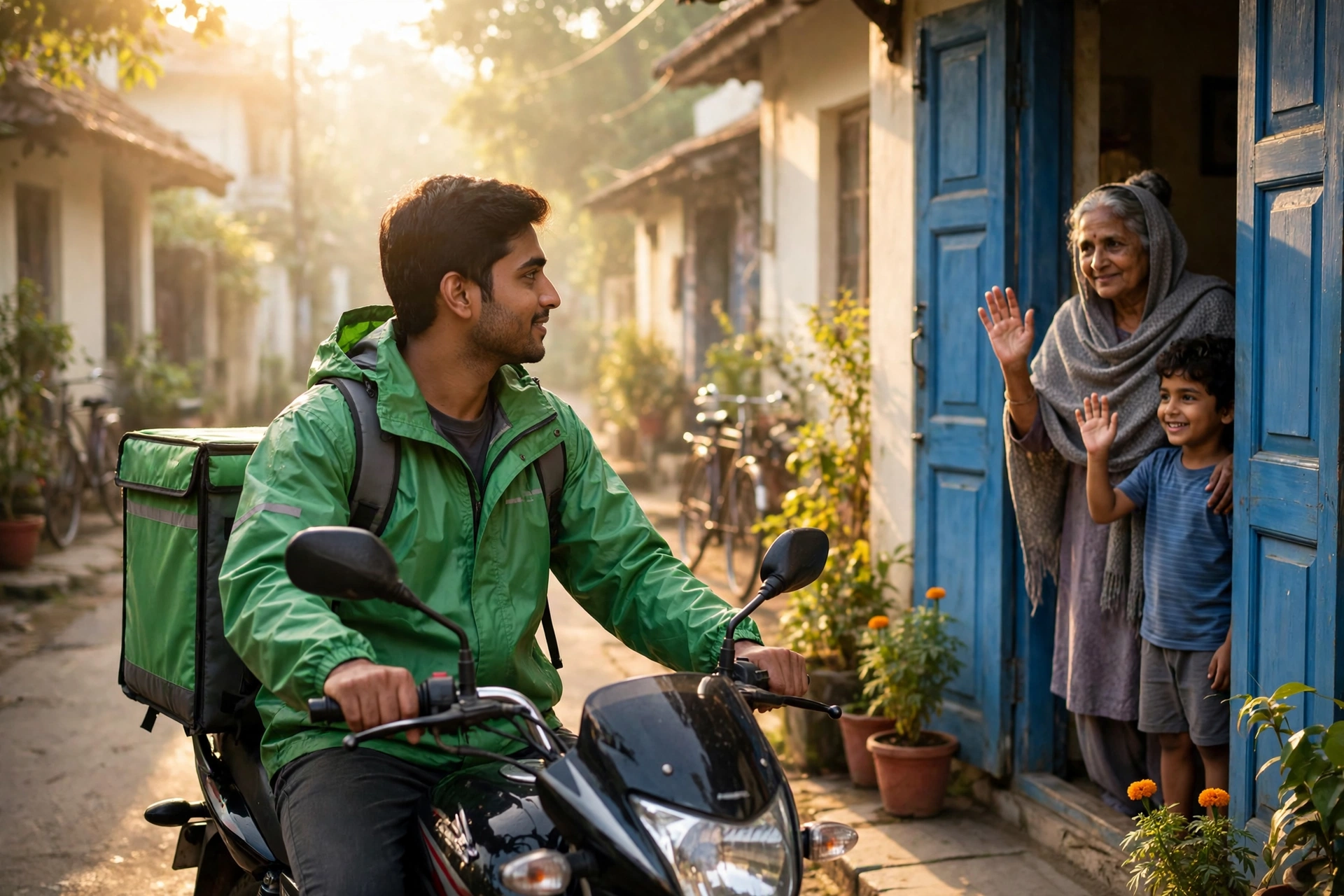
He still rides in the rain. He still hurries, because honest work deserves hurry. But he no longer believes that being late is the worst thing that can happen to a man. He has learned something better, something his grandmother tried to teach him and Zainab taught him again: that the road will always be there tomorrow, but the person beside it, sitting quietly in the rain with a torn bag and a twisted ankle, may not be.
You will find, as Ayan did, that kindness has a way of coming back to you. Not always at once, and not always in the way you expect. Sometimes it comes back as a withdrawn complaint, sometimes as a child's drawing folded into your pocket, sometimes as a new road opening quietly in front of you when the old one has run out. It is never wasted. It is never late. It simply arrives by a different road, in its own good time.
So the next time you are in a hurry — and we are all in a hurry, these days — look to the side of the road. Someone may be sitting there, very still, trying hard not to be a trouble to anyone. Slow down. Stop. Offer your arm. Years from now, you will not remember the deliveries you made on time. You will remember the evening you stopped in the rain, and the small boy who ran to the door crying, "Dadi, where were you?" — and you will know, with a certainty no timer can measure, that you were exactly where you were supposed to be.