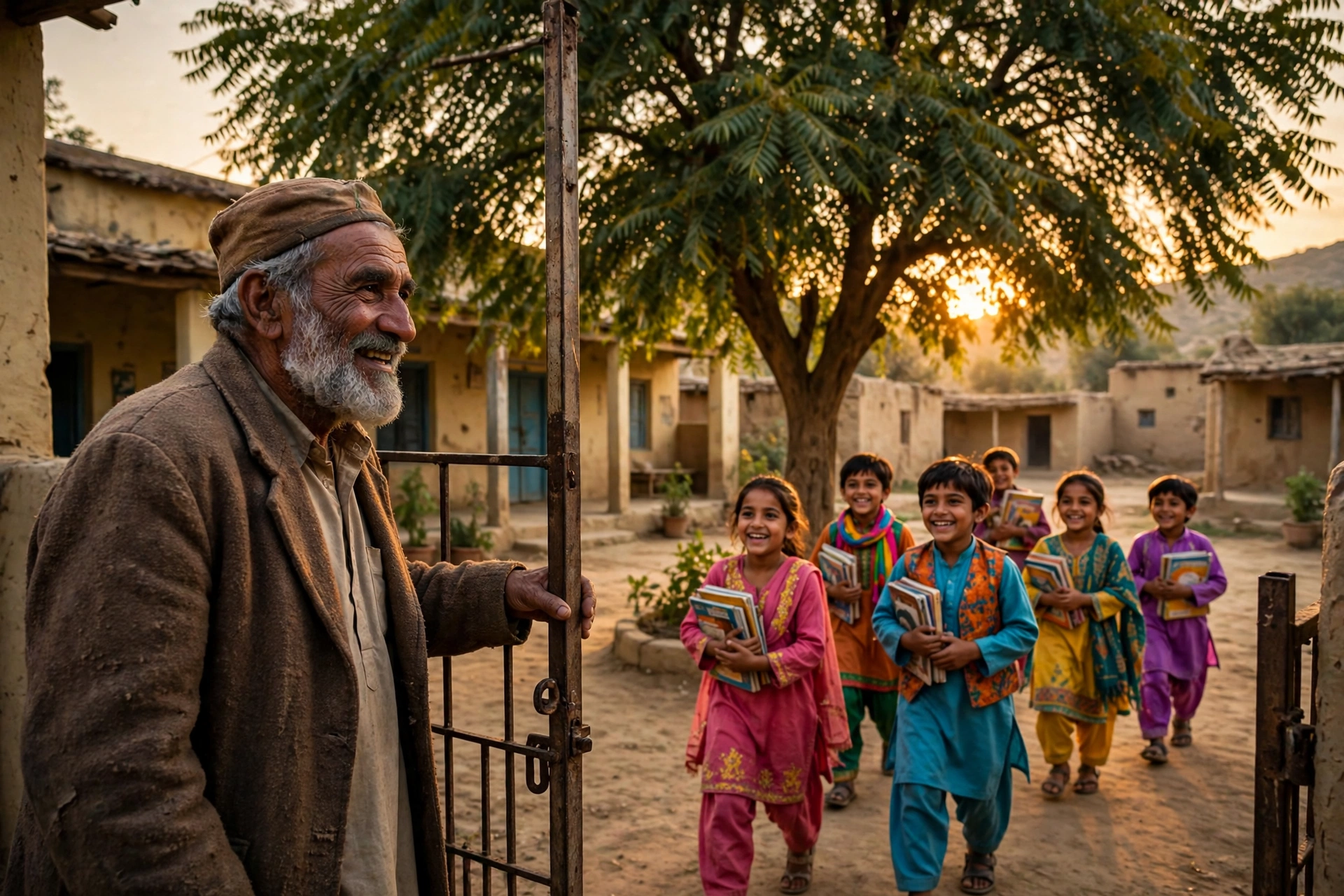
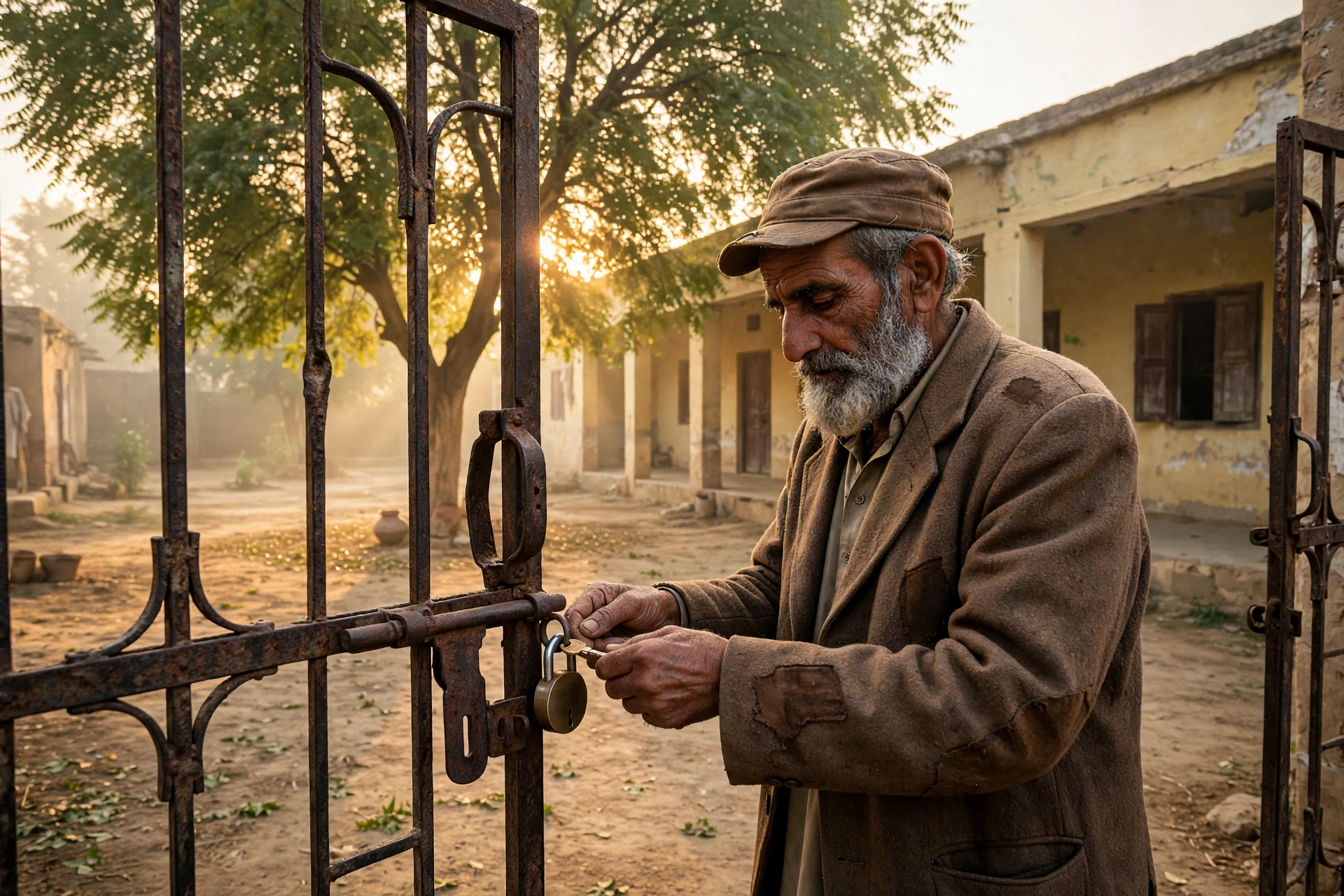
Every morning at six, long before the village woke, Rahim unlocked the gate of the school that had no children. The key was heavy and rusted, and it turned with a groan that he had come to love, because it was the only sound in the courtyard that still meant beginning. He pushed the gate open, propped it with the same stone he had used for thirty-one years, and stood for a moment in the doorway of the morning, listening to the neem tree shake its leaves above the empty yard.
The school had closed three years earlier. The district had built a bigger school beside the main road in the town, with buses and computers and a roof that did not leak when it rained. One by one, the village families had sent their children there instead. First the numbers fell from sixty to forty, then to twenty, then to nine. And then, on a quiet Friday in spring, a man in a clean shirt had come from the district office with a letter, and the last teacher had packed her books, and the gate had been chained shut.
Rahim had been the caretaker since he was thirty-seven. He had swept these floors, mended these benches, painted these walls, and rung the brass bell that hung beside the head teacher's office. His wife, Zainab, had taught in the smallest classroom for twenty-two years, and she had died the winter before the school closed, leaving him with a house full of silence and a heart that only felt steady when he was inside these walls. When the district offered him a small pension and told him his work was finished, he had nodded politely, taken the key home, and returned the next morning anyway.
His son, who drove a truck in the city, called every Sunday and begged him to move. "Abba, come and live with us," he would say. "There is a room ready, and the grandchildren ask for you. Why do you stay in a village where even the school is gone?" Rahim always gave the same answer. "A school is not gone while someone still opens its gate," he said. "And besides, who will water the neem tree?"
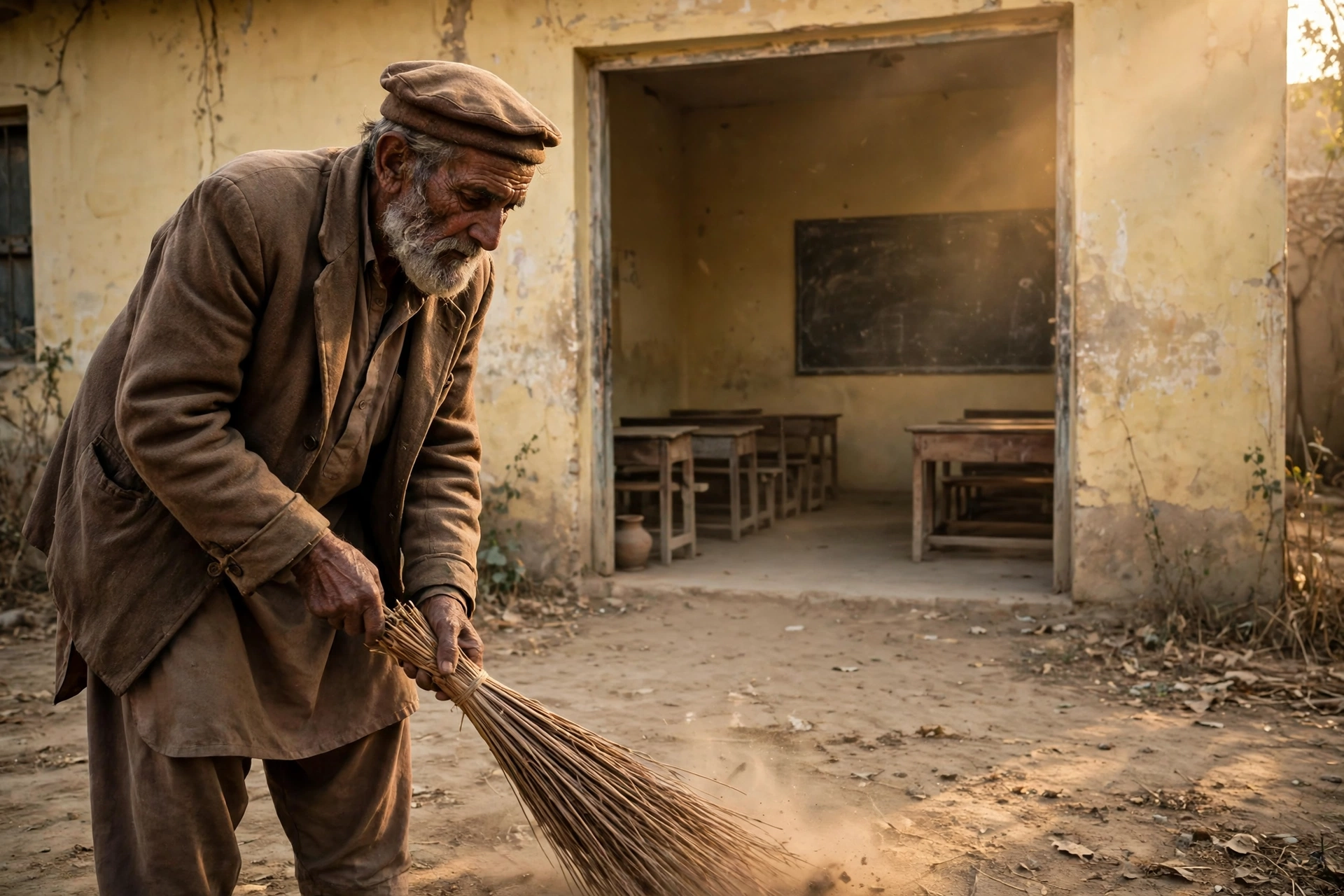
So he kept his routine. He swept the courtyard until the dust rose in pale clouds and settled again. He wiped the blackboards, though no lesson had been written on them for years, and the chalk dust still clung to the grooves of the old wood. He sat under the neem tree at noon with his lunch of bread and onions, and he talked to Zainab in his mind, telling her about the sparrows that nested in the roof and the crack in the wall that needed lime before the rains.
The villagers thought he was kind, and a little mad, and mostly they left him alone. Children on their way to the bus stop sometimes pressed their faces to the gate and laughed at the old man sweeping an empty yard.
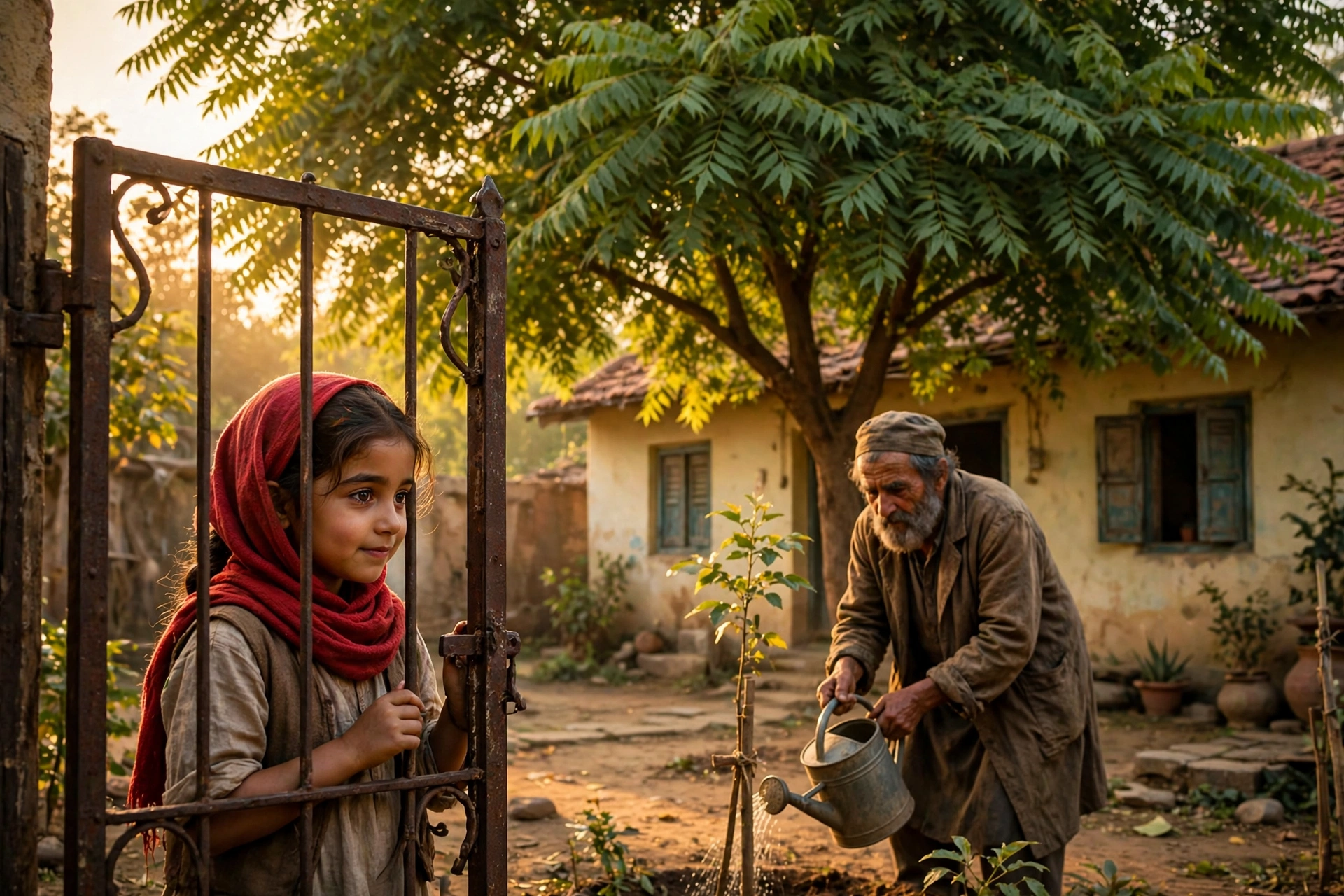
Then, on a morning in early autumn, a small girl stopped outside the gate. She could not have been more than nine, with two thin braids and a red scarf that kept slipping off her shoulders. She watched Rahim sweep for a long time, her chin resting on the bars, before she finally spoke. "Why do you open a school with no children?" she asked.
Rahim leaned on his broom and smiled. "Because schools are like lamps, little one," he said. "You do not throw a lamp away just because the room is dark for a while."
"My name is Meher," the girl said. "I live with my grandmother at the end of the lane. The bus to the town school leaves before my grandmother wakes, and she cannot walk me to the stop. So I stay home and help her with the goats."
Rahim felt something tighten in his chest. Here was a child, right here in the village, who wanted to learn and could not reach the school that had replaced this one. He looked at the empty courtyard, at the benches waiting in the dark classrooms, at the blackboard that had not held a word in three years. And then he did something he had not planned at all. "Come in tomorrow," he said. "Just for an hour. I will teach you your letters under the neem tree."
Meher came the next morning, and the morning after that, carrying a slate her grandmother had found in a trunk. Rahim wrote the alphabet on the old blackboard he dragged into the courtyard, large and slow, the way Zainab used to do it. Meher traced each letter with a trembling hand, her tongue caught between her teeth in concentration, and when she wrote her own name for the first time, she laughed so loudly that the sparrows burst out of the roof all at once. Rahim laughed too, and it surprised him, because he had almost forgotten what his own laugh sounded like.
Word travels fast in a village, even faster than the town bus. By the end of the week, two more children were waiting at the gate: a boy named Bilal, whose father worked in the fields and could not spare the bus fare every day, and a quiet girl named Sana, whose younger brother needed her at home in the mornings but who was free for an hour before noon. Rahim did not turn them away. He dragged out more benches, sharpened more pencils, and began each morning by ringing the brass bell, just once, the way he used to when the school was full. The sound rolled over the lane and into the fields, and people stopped what they were doing and listened, as if they were hearing a voice they had thought was lost.
Rahim was not a trained teacher. He had left school himself at fourteen to work, and everything he knew about teaching he had learned from watching Zainab for twenty-two years. But he knew patience, and he knew stories, and he knew that a child who is praised for trying will try again. He taught Meher to read the words on the seed packets in his garden. He taught Bilal to count with stones from the courtyard. He taught Sana to write a letter to her mother, who worked in another town, and when Sana read it aloud under the neem tree, her voice shaking with pride, Rahim had to turn away and pretend there was dust in his eyes.
Then trouble came, as trouble often does, wearing a clean shirt. The same district officer returned, this time with a different letter. The building, he explained, had been empty for three years. The land was valuable. A warehouse company wanted to buy it, and the district had agreed in principle. Rahim had thirty days to hand over the key. "It is a pity," the officer said, looking at the swept courtyard with something like embarrassment. "But an empty school helps no one."
That night, Rahim sat under the neem tree long after dark, the key heavy in his pocket, and thought about Zainab. He thought about the thousands of children who had passed through this gate, some of them now teachers and drivers and shopkeepers themselves. He thought about handing the key to a stranger and watching a warehouse rise where the bell used to ring. And for the first time in three years, he felt truly afraid, not for himself, but for the small light that had just begun to burn again.
The next morning, he told the children. Meher went very quiet. Bilal kicked a stone across the yard. Sana asked, in a small voice, "Will the bell stop ringing, Uncle Rahim?" He knelt down so his eyes were level with hers. "Not if we can help it," he said. "A school belongs to the people who learn in it. Let us show them."
What happened next, Rahim would later say, was not his doing at all. Meher told her grandmother, who told the women at the well, who told the men at the tea stall. Bilal's father, who had never spoken at a village meeting in his life, stood up and said his son could now read the labels on the fertilizer bags, and that this mattered more than any bus fare saved. Sana's mother sent a letter from the town, in Sana's own careful handwriting, asking the district not to close the only place her daughter had ever loved going to. The shopkeeper who had once called the school a grave brought a sack of flour for the children's lunch. The mothers began to take turns sitting under the neem tree, mending clothes while the lessons went on, so that no one could say the children were alone with an old man.
On the twenty-ninth day, the district officer returned, expecting a key and an empty yard. Instead he found fourteen children sitting in neat rows under the neem tree, reading aloud together, their voices rising and falling like a song. Meher stood at the blackboard and wrote a sentence she had composed herself: "This school is our home." The officer stood at the gate for a long time, his clean shirt wilting in the heat, watching Bilal help a smaller boy sound out a difficult word, watching Sana read her letter without stumbling once. He did not say anything at first. Then he took out his notebook, crossed out something he had written, and wrote something else.
"I will recommend that the building be kept," he said at last, his voice quieter than before. "Not as a warehouse. As a learning centre, for the children who cannot reach the town school. We will send a teacher twice a week, and books, and a small grant for repairs. The rest," he added, looking at Rahim, "will still need a caretaker who opens the gate at six in the morning."
Rahim did not trust himself to speak, so he only nodded, and rang the brass bell, once, twice, three times, until the whole village could hear it. The children cheered. Meher threw her arms around his waist. And under the neem tree, in the courtyard he had swept alone for three years, Rahim finally understood what Zainab had always told him: that a teacher does not need a full classroom to matter, and a caretaker does not keep a building alive by sweeping its floors, but by keeping its door open for the one child who still needs to walk through it.
Today, if you pass through the village in the morning, you will hear the bell before you see the school. The gate stands open, propped with the same old stone. The neem tree still shakes its leaves over the courtyard, and beneath it, in rows that grow a little longer every term, children learn their letters from a teacher who visits twice a week, and from an old caretaker who never stopped believing that an empty room is only a room waiting for its children to come home. Rahim still sweeps the yard at dawn, still waters the sapling Meher planted on the day the school was saved, and still talks to Zainab in his mind at noon. Only now, when he tells her about the sparrows and the crack in the wall, he also tells her about the laughter, and the reading aloud, and the small girl in the red scarf who stopped at his gate and asked the question that changed everything.
Because sometimes, all it takes to save a place is one person who refuses to let it close, and one child brave enough to ask why it ever did.