In the village where Ayaan lived, the summer evenings arrived like a soft sigh. The heat of the day slowly loosened its grip, the buffaloes lumbered home from the fields, and the women called their children in from the lanes for supper. But for Ayaan, the most beautiful hour began after supper, when the sky turned the colour of bruised plums. That was when the fireflies came out.
Ayaan was eleven years old, thin as a reed, with dusty feet and a laugh that could be heard from two courtyards away. He lived with his mother and his grandmother in a small mud-brick house at the edge of the village, where the fields began. His father worked in the city and came home only once a month, but the person Ayaan loved most in the whole world was his Dadi, his grandmother, who sat every evening on the wooden veranda in her white headscarf, listening to the village settle down for the night.
Dadi had not always been blind. Six years ago, after a long fever, the light had quietly left her eyes. The doctors in the town had shaken their heads, but Dadi herself had never once complained. "Allah gave me eighty years of seeing," she would say, patting Ayaan's hand, "and now He has given my other senses a chance to work harder. I can hear a sparrow land on the roof. I can smell rain three streets away."
Ayaan believed her, mostly. But one evening, as they sat together on the veranda and the fireflies began to blink in the tall grass beyond the courtyard, Dadi turned her face toward the fields and said something that stayed in his chest like a small stone. "Ah," she whispered, "the fireflies are out tonight. I can almost hear them." She paused, and her smile grew a little sad around the edges. "Of all the things I have lost, Ayaan, I miss those the most. They were like stars that got tired of heaven and came down to rest in our grass for a while."
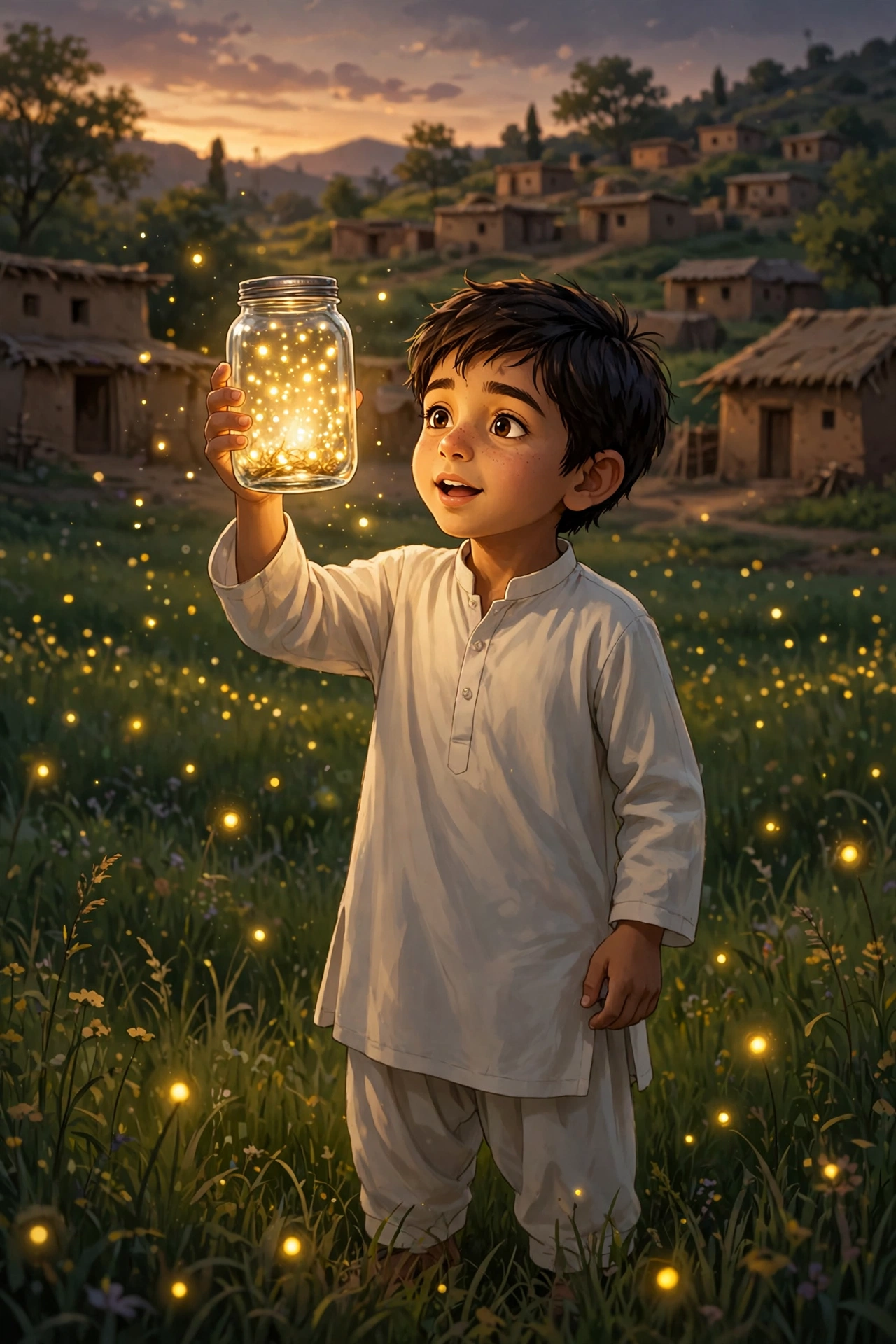
That night, Ayaan lay awake on his charpoy on the roof, staring at the sky, and an idea took root in his heart. If the fireflies were stars that had come down to rest, then surely he could catch a few of them and bring them to Dadi. She might not be able to see them, but she could hold them close. She could feel their tiny light warm in her hands. He was sure, with the complete certainty that only an eleven-year-old can feel, that this would make her happy.
The next morning, he asked his mother for an old glass jar. She gave him one that had once held pickles, and together they poked tiny holes in the metal lid with a nail so that air could get in. "Do not keep anything in it for long," his mother warned him. "Living things are not toys, Ayaan. If you catch them, you must let them go the same night."
That evening he chased the little lights until his legs ached, but his jar held only two tired fireflies.
He carried the jar to Dadi like a treasure anyway. "Dadi, here," he said. "I brought you fireflies."
Dadi reached out and closed her wrinkled hands gently around the jar. She held it for a long time, her face tilted toward it, as if she were listening to a very faint song. Then she smiled, and it was the kind of smile that made Ayaan's heart both lift and sink at the same time. "They are warm," she said softly. "I can feel them moving, like tiny heartbeats in my hands."
But later, when Ayaan lay on his charpoy again, the stone in his chest felt heavier, not lighter. Two fireflies were not enough. He wanted to give her something real, something that would truly take her back to the evenings when she could see.
The next day, he went to old Rahim Chacha, who kept the fields at the edge of the village and knew everything about the small creatures that lived in them. Rahim Chacha was sitting under the banyan tree, mending a fishing net, and he listened to Ayaan's plan without laughing once. "Fireflies are shy, boy," he said. "You cannot chase them like a goat. You must be still. Sit in the grass and wait, quiet as a stone, and let them come to you. And never grab them with your hands. Cup them gently, or you will hurt them, and a hurt firefly will not shine for anyone."
Ayaan practised stillness that evening, and it was the hardest thing he had ever done. He sat cross-legged in the tall grass, the jar beside him, and forced himself not to move. Slowly, the fireflies grew bolder. One landed, trembling, on the back of his hand, its little lamp pulsing green and gold. Ayaan held his breath and cupped it as gently as Rahim Chacha had taught him, and lowered it into the jar. By the time the moon had risen, his jar glowed with more than twenty fireflies.
He ran home, careful not to jolt the jar, and placed it in Dadi's hands. This time, her whole face changed. She laughed, a real laugh, soft and surprised, like a girl. "Oh, Ayaan," she whispered, "there are so many. I can feel the light on my face. It is warm, like holding the sun in a jar." She sat there for a long time, turning the jar slowly in her hands, and Ayaan sat beside her, watching her face, feeling as though he had finally done something that mattered.
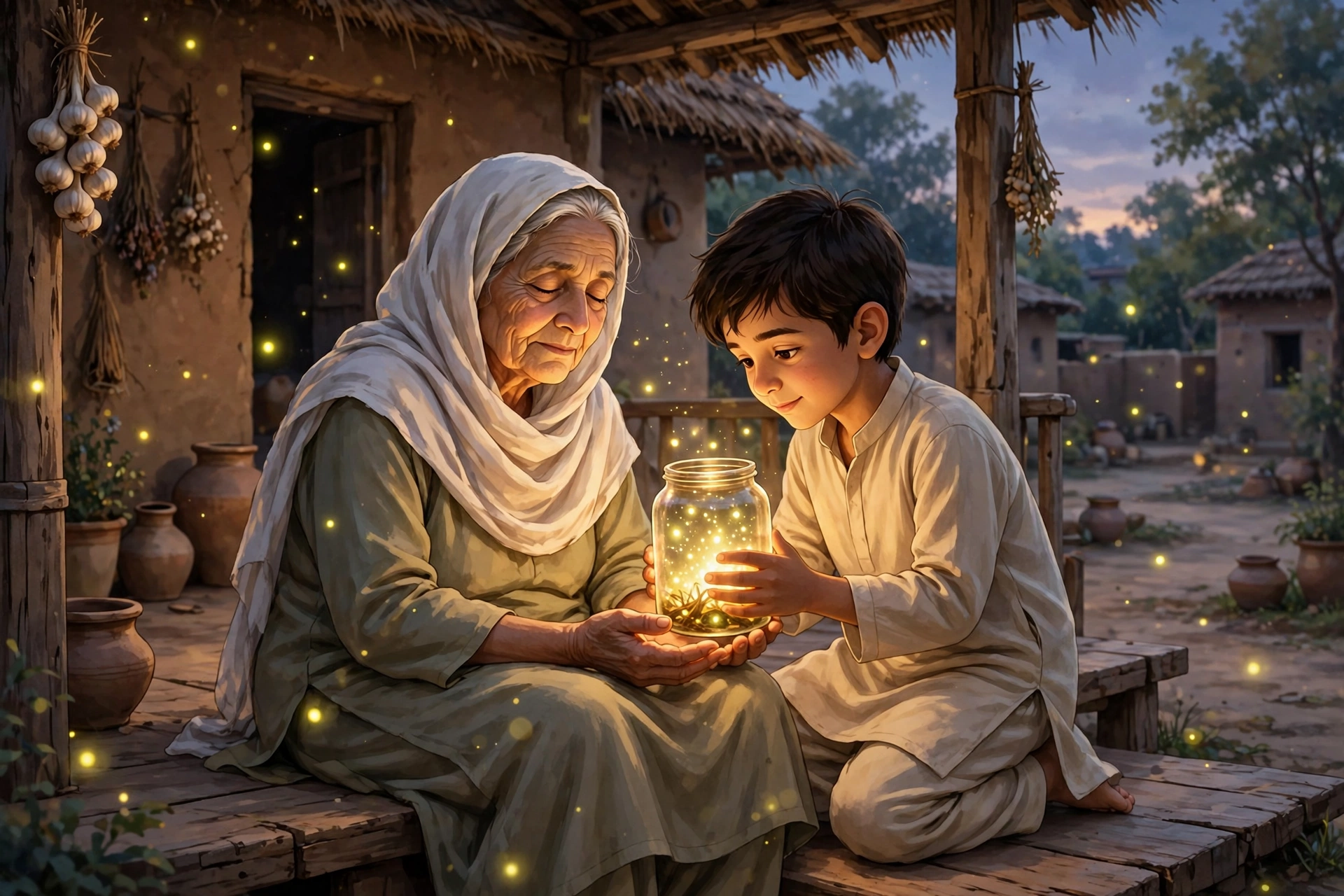
From that evening on, catching fireflies became their ritual. Every night after supper, Ayaan would sit still in the grass and fill his jar, then bring it to the veranda, where Dadi would hold it while he described everything he had seen: how the fireflies blinked like messages in a language only the night understood, and how the sky above the fields looked as if someone had spilled sugar across black cloth. At first his descriptions were clumsy. But night by night, he learned to notice more, the smell of wet earth, the cool grass against his ankles, the crickets singing louder when the moon was full, so that he could tell her better. "Now I can see it, beta," Dadi would say, closing her eyes and smiling. "You are my eyes now."
One week, a dry wind settled over the village, and the fields turned the colour of old paper. The pond at the edge of the meadow shrank to a muddy puddle, and night after night, fewer and fewer fireflies appeared. On the third empty night, Ayaan came home with an empty jar and tears standing in his eyes.
Dadi, of course, knew at once. She reached out and found his hand in the dark. "No fireflies tonight?" she asked gently.
"They have gone away," Ayaan said, his voice thick. "I waited and waited, Dadi. The grass is dry. Maybe they have gone to another village, where there is still water."
Dadi was quiet for a moment, and then she patted the empty space on the charpoy beside her. "Sit with me anyway," she said. "Tell me about the evening. Tell me about the wind and the smell of the dust and the sound of the crickets. A night without fireflies is still a night, and I would rather hear about it from you than sit here alone."
So Ayaan sat with her and told her about the dry grass rustling like paper and the one stubborn star low over the well, and slowly he realised something that surprised him. Dadi was smiling. She was not disappointed. She was simply glad he was there. That night, Ayaan understood, for the first time, that the jar had never really been the point. The point was that he came, every evening, and sat beside her, and tried.
Still, he did not give up. Each evening he carried water from the well and poured it around the wild bushes at the edge of the meadow, where the fireflies hid by day. Rahim Chacha came to help. "You cannot command the fireflies to return, boy," he said, "but you can take care of the place where they live. That is all any of us can do for the things we love." Ayaan kept watering the patch, and kept sitting with Dadi, who told him stories from when she was a girl and the whole village gathered in the fields on summer nights to watch the fireflies.

Then, one evening, the sky broke open. Rain drummed on the tin roofs, flooded the lanes, and filled the pond at the edge of the meadow until it shone like a mirror. "Wait until tomorrow," his mother said. "After rain like this, the night belongs to the fireflies."
She was right. The next evening, the meadow was alive. Hundreds of fireflies rose out of the wet grass, turning the whole field into a sky that had fallen to earth. Ayaan sat very still and filled his jar until it glowed like a small sun, then ran home and placed it in Dadi's hands.
But this time, Dadi did something different. She held the jar for a moment, feeling its warmth, and then she held it out toward Ayaan. "Open it, beta," she said. "Let them go."
Ayaan stared at her. "But Dadi, I caught them for you. They are yours."
Dadi shook her head, smiling. "They were never mine to keep, and they were never yours either. We borrowed their light for a little while, and that was enough. Now let them go, so that tomorrow night there will be fireflies for someone else's grandmother too."
With hands that trembled a little, Ayaan unscrewed the lid. For a second, nothing happened. Then one firefly rose, then another, then all of them, spiralling up into the dark, blinking as they went, until the whole courtyard seemed full of floating stars. Dadi turned her face upward, and though her eyes could not follow them, her smile was so wide and so full of peace that Ayaan knew she was seeing them in the only way that mattered, through the warmth on her skin and the love of the boy who had brought them home.
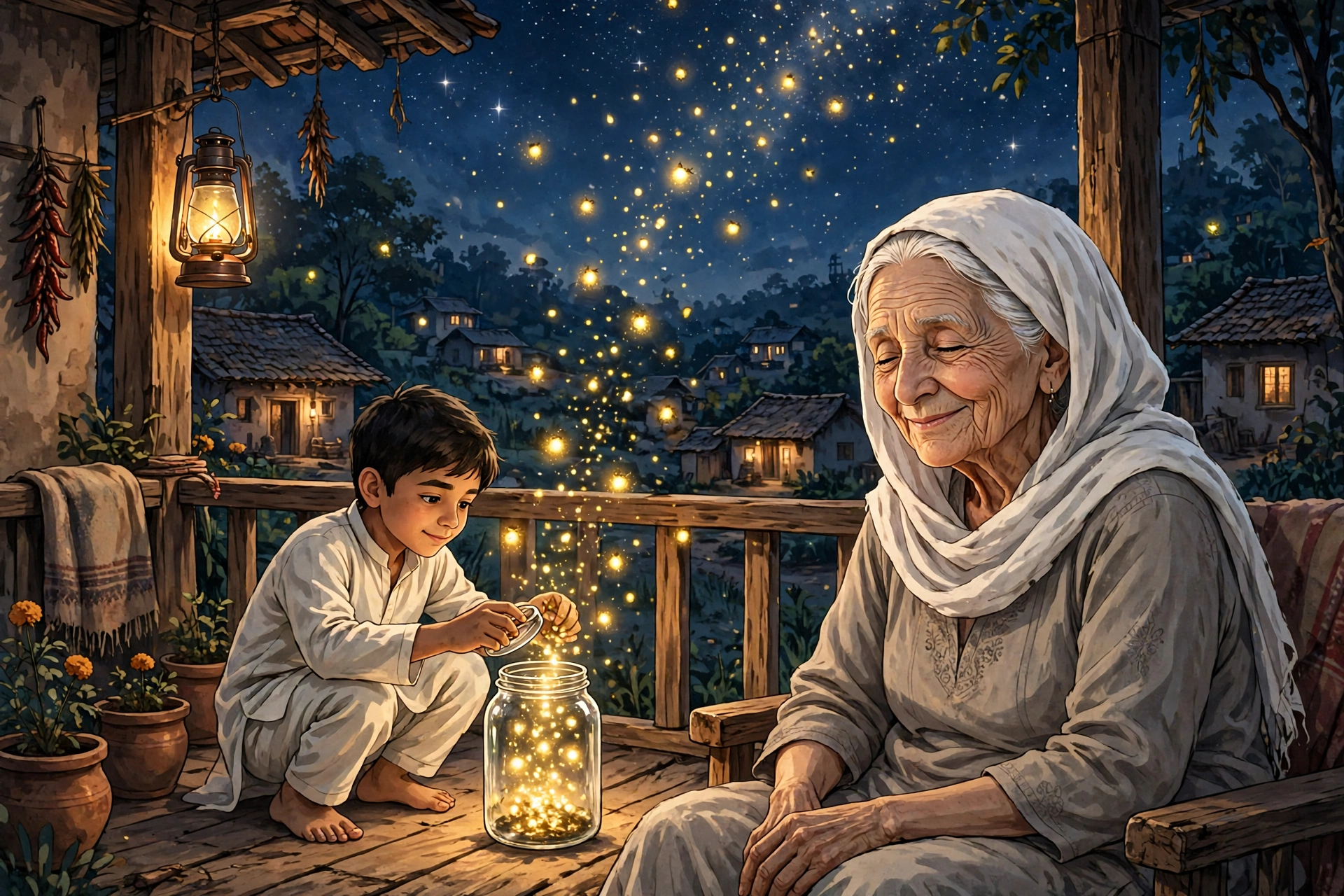
After that night, their ritual changed, but it did not end. Ayaan still went to the meadow every evening and still brought his jar, but now they always opened it together at the end, and watched, in their own ways, as the light returned to the night where it belonged. And the neighbours began to say that the old woman on the veranda at the edge of the village was the happiest woman in all the lanes, though she could not see a thing.
Years later, when Ayaan was grown and living in the city himself, he would come home on summer evenings and sit on that same veranda, and he would think of his Dadi, who had taught him the most important lesson of his life without ever opening a book: that kindness is not measured by what you can give, or what you can keep. It is measured by whether you show up, evening after evening, with an open heart, willing to give it all away again. And sometimes, the greatest gift you can offer someone is not to make them see the world as you see it, but to sit beside them in the dark and help them feel that they are not alone in it, not for a single night.
For light, Ayaan learned, was never really something you could hold in a jar. It was something you carried in your hands long enough to share, and then, gently, you let it go, so that it could light someone else's way home.