The first book Arman ever owned cost him nothing, and it nearly cost him his courage to ask for it. He was twelve years old, thin as a reed, with dusty shoes and a school bag whose strap his mother had mended three times. Every afternoon, on his way home from school, he passed old Rafi's scrap cart at the corner of their lane. The cart was a mountain of broken things: rusted pots, tangled wire, chairs with missing legs, and, at the very bottom, a pile of books tied together with twine. To Rafi, they were only paper, sold by weight. To Arman, they looked like closed doors waiting to be opened.
That afternoon, the rain had washed the lane clean, and the late light turned the puddles gold. Arman stopped, as he always did, and stared at the books. One cover caught his eye. It was faded blue, with a picture of a ship sailing toward a horizon he had never seen. He reached out, then pulled his hand back. He had no money. His mother worked long hours cleaning houses, and every coin in their home already had a job to do. But something in him refused to walk away that day. "Uncle," he said quietly, "can I look at just one?"
Rafi, a big man with kind eyes hidden under bushy eyebrows, laughed. "Looking is free, boy. Looking never hurt anyone." Arman untied the twine with trembling fingers and opened the blue book. The first page smelled of dust and old rain. The words pulled him in at once, a story of a sailor who had lost everything and found his way home by following the stars. Arman read standing there in the lane, forgetting the time, forgetting his heavy bag, forgetting everything except the sea on the page. When Rafi finally cleared his throat, the sun was low. "You read like a hungry man eats," Rafi said, studying him. "Take it."
Arman shook his head. "I can't pay." "Then don't pay," Rafi said. "A book nobody reads is just paper. A book somebody loves is worth more than its weight. Take it, and when you finish it, tell me how it ends." Arman clutched the book to his chest all the way home, as if it might fly away. That night, by the light of a single bulb, he read until his eyes burned. When he finished, he sat very still. He had travelled across an ocean without leaving his small room, and he understood something that changed him: stories did not belong only to people who could buy them.
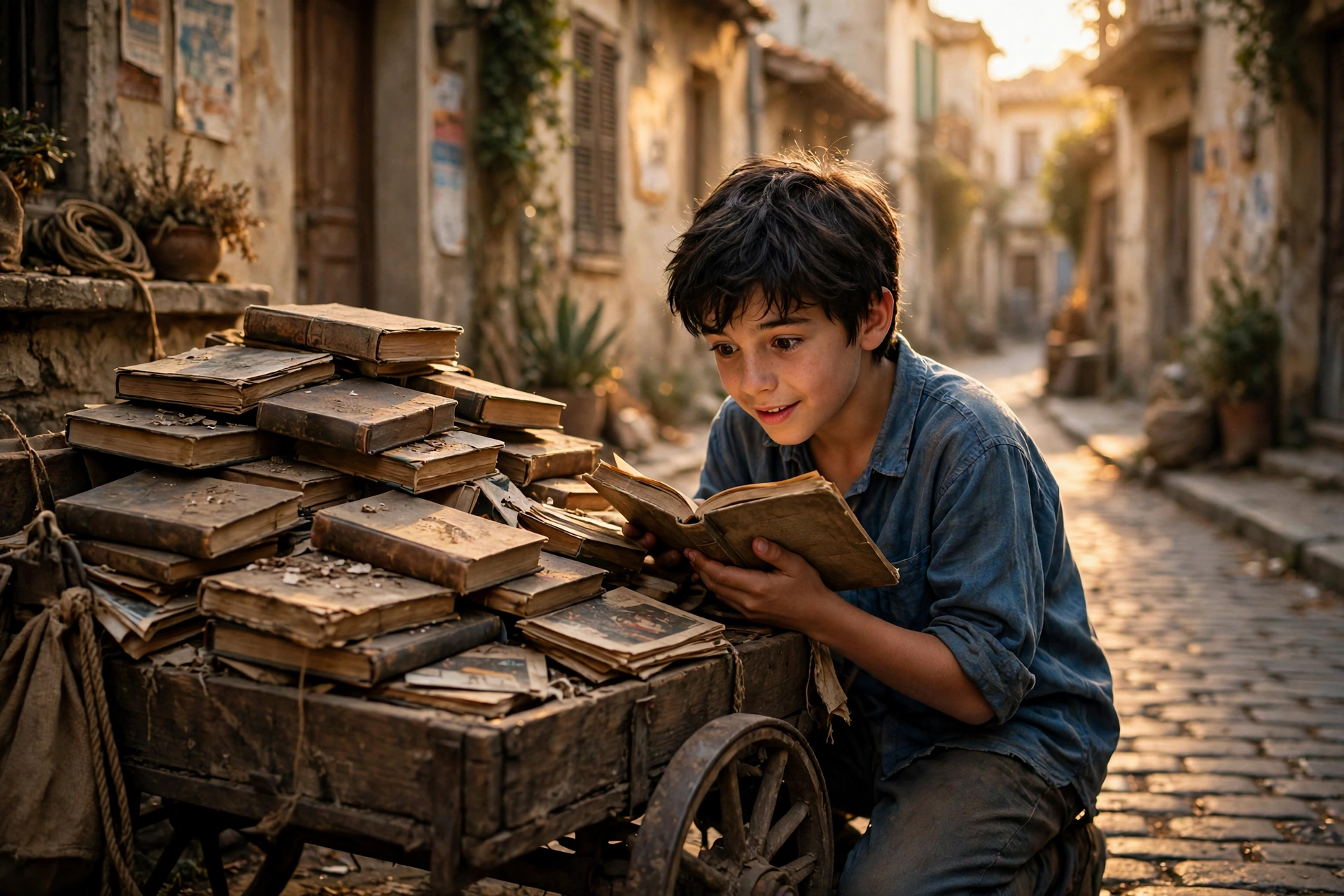
The next day, Arman went back to Rafi's cart with an idea that felt both foolish and wonderful. "Uncle," he said, "if people throw books away, will you keep them for me instead of selling them for paper?" Rafi scratched his beard. "And what will you do with them, boy? You can't eat books." "I'll lend them," Arman said. "To anyone on our street who wants to read." Rafi looked at him for a long moment, then nodded slowly. "Come every Saturday. Whatever books come in that week, you can have first pick. But you must promise me one thing. You will take care of them, and you will never sell them." Arman promised, and he kept that promise the way people keep promises that matter.
Every Saturday he arrived early, and Rafi would point to a new pile: schoolbooks with torn covers, novels missing their last pages, a dictionary with a broken spine, a book of poems, a storybook for small children with pictures of animals. Arman carried them home in his arms and stacked them on the floor of his room. Soon the stack reached his waist. His mother, Fatima, watched with worry at first. Their home was small, and space was precious. But one evening she found Arman reading a poem aloud to his little sister, Sara, who laughed and clapped at the funny rhymes. Fatima said nothing, but the next morning she cleared a corner of the courtyard and said, "Put them here. A home should have room for good things."
The courtyard became Arman's library, though it did not look like one yet. The books sat in cardboard boxes, sorted as best he could: stories here, schoolbooks there, picture books for the little ones. He made a notebook, just like a real librarian, and wrote down each book's title in his careful handwriting. He announced his one rule proudly to anyone who would listen: anyone could borrow any book, for as long as they needed, as long as they brought it back so someone else could read it too. There was no fee, no form, no fine. Trust, he said, was the only membership card.
At first, almost nobody came. The neighbours smiled politely and hurried past. People were busy, tired, or convinced that a library made of old books in a courtyard was just a child's game. Arman sat beside his boxes every evening after school, waiting, reading by himself. Some days he felt silly. Some days he wondered if books nobody wanted were simply books nobody wanted. But he remembered the sailor following the stars, and he kept waiting.
The first reader was not who he expected. It was old Uncle Kareem, a retired watchman with white hair and hands that shook a little. He shuffled into the courtyard one evening, looked at the boxes, and said gruffly, "Boy, do you have anything about the sea?" Arman placed the blue book in his hands. Uncle Kareem sat on a low stool and read until the light faded. He came back the next day, and the next, and soon he was telling Arman about the sea he had seen as a young man, working on ships. Then came Sara's friend Meena, who borrowed a picture book and returned asking for "the one with the elephant." Then a schoolboy who needed a science book for his exams, and a young mother who wanted a storybook for her baby at night. Word travelled the way good news always travels in a lane: from one doorway to another, from one child pulling his friend by the sleeve. Within a month, the courtyard was busy every evening, with children reading aloud to each other, old men arguing happily about history, and women exchanging novels like precious gifts.
But a library made of cardboard boxes cannot survive the rain. One monsoon evening, the sky opened without warning. Arman and Sara ran to cover the boxes with plastic sheets, but the wind tore at them, and water seeped in at the edges. Three books were ruined. Arman sat among the wet pages that night and cried, quietly, so his mother would not hear. Those books had been trusted to him, and he had failed to protect them. The next morning, he decided that if this library was going to last, it needed shelves, a roof, and real protection. And he had no money to build it with.
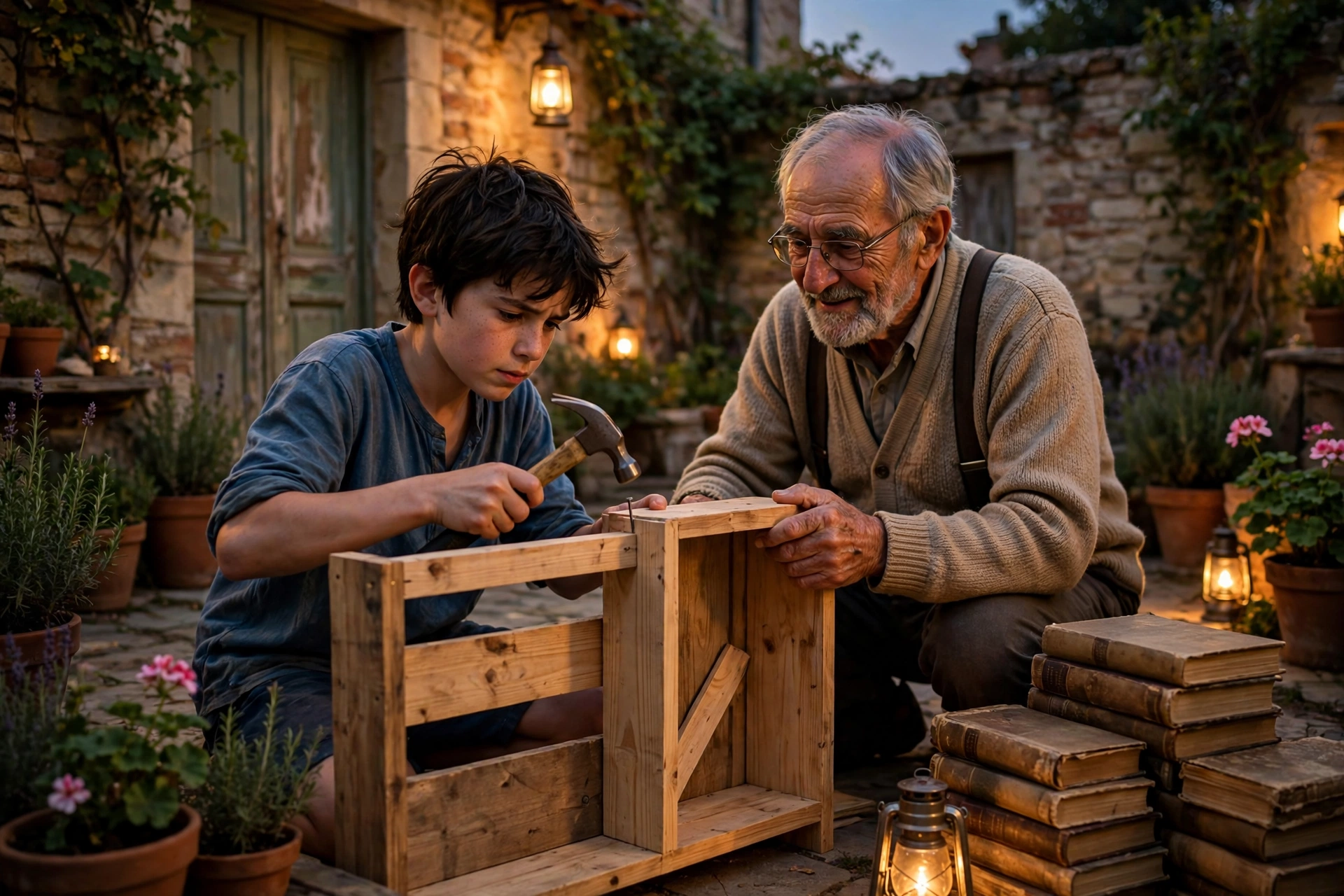
That was when the street surprised him. Uncle Kareem arrived with an old carpenter's tools and a pile of wooden planks he had been saving for years. "A library deserves shelves," he said, as if it were the most obvious thing in the world. Rafi brought nails and a sheet of tin for a roof. A neighbour who worked as a mason helped build a low brick platform so the shelves would never sit in water again. Fatima cooked a big pot of rice for everyone who came to help, and Sara handed out glasses of cold water. For three whole days, the courtyard rang with hammering and laughter. By Sunday evening, there stood a row of strong wooden shelves under a tin roof, painted a cheerful green, filled with books that had once been thrown away. The library had a name now, painted carefully on a board by Meena: "The Courtyard Library — Free for Everyone."
Then came the hardest test of all. A man from another part of the city visited the courtyard and offered Arman good money for the whole collection. "These old books sell well in my shop," he said. "You could buy many new things for your family." For a moment, Arman imagined what that money could do. Then he looked at the children reading on the mats, at Uncle Kareem asleep over his book, at his sister sounding out words with Meena, and he understood that selling the library would feed his family for a month, but keeping it would feed his whole street for years. "These books are not mine to sell," he said, his voice steady. "They belong to everyone who reads them now."
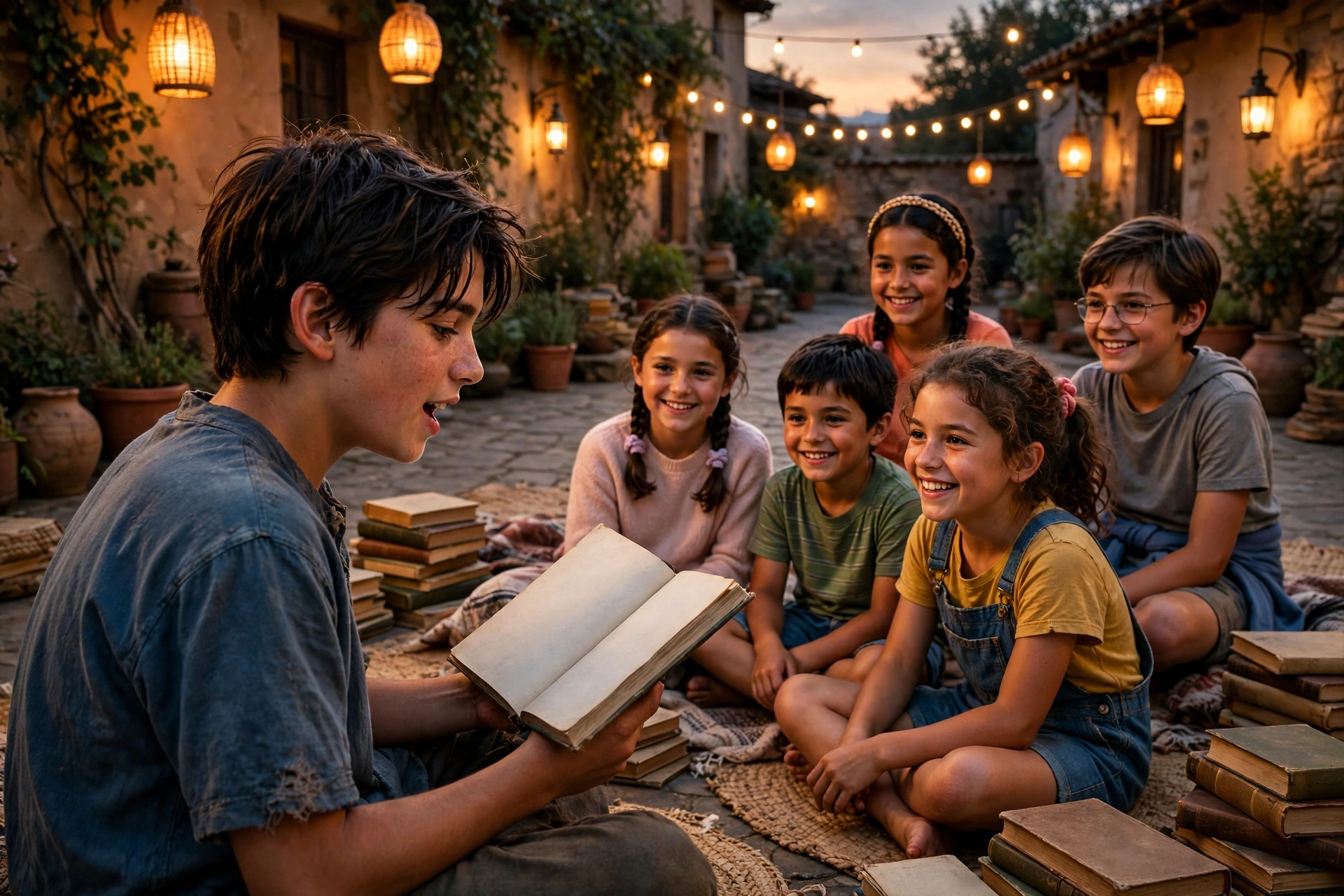
New books began to arrive in a different way: a teacher donated her old textbooks, a family moving away left two boxes at Arman's door, and children began bringing books they had finished, placing them on the shelves themselves. Arman started a reading hour every evening, where one person read aloud and everyone else listened. Even Rafi began to stop by, sitting quietly with a newspaper. "I never had time for books when I was young," he admitted one night. "I did not know I was throwing away treasure."
Years passed, quietly and then all at once. Arman grew taller, finished school with good marks helped by the very books he had rescued, and won a scholarship to college. On the day he left for the city, the whole lane gathered in the courtyard. Uncle Kareem, older now and slower, pressed the blue book into Arman's hands. "Take this one with you," he said. "It started everything. But leave the library behind, because it was never really yours. It was always ours." Arman promised to come home every holiday and read to the children, and he kept that promise.
Meena took charge of the notebook, Sara ran the Friday reading hour, and more shelves were added along the courtyard wall. Nobody remembered exactly when a pile of discarded books had become a library. They only knew that it had changed their street: children who had never owned a book now read every day, and neighbours who had once only nodded at each other now knew each other's favourite stories.
One evening, many years later, Arman returned to the lane as a teacher himself, carrying a box of new books. He stood in the courtyard as the evening light turned gold, watching a small boy read aloud to a circle of children under the lanterns, stumbling over a hard word while the others helped him through it. It was, almost exactly, the scene he had dreamed of when he sat alone beside his cardboard boxes. He smiled, thinking of Rafi's words: a book nobody reads is just paper, but a book somebody loves is worth more than its weight.
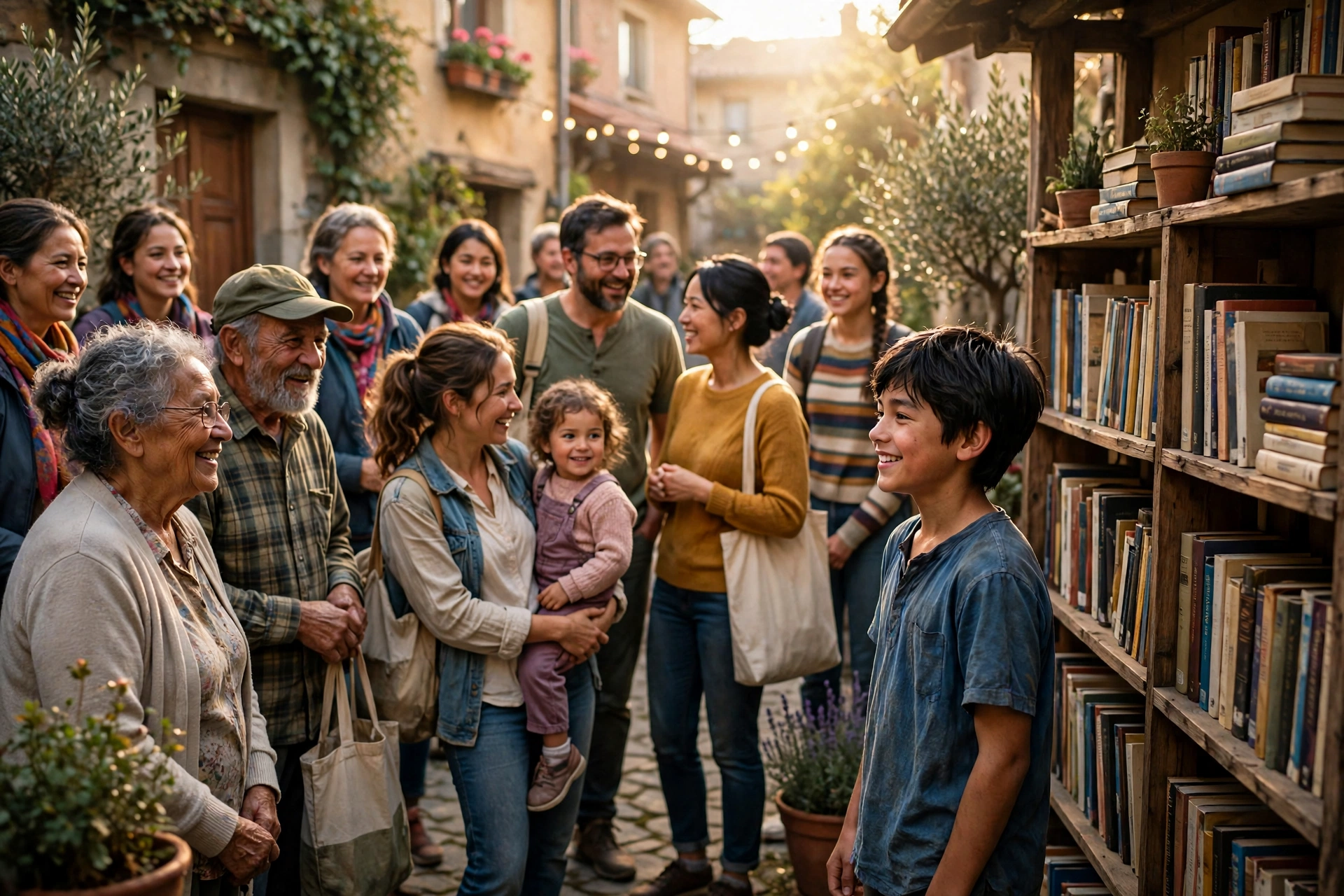
The moral of Arman's story is a quiet one, but it stays with you long after the last page. You do not need wealth to give something valuable, or permission to begin something good. All you need is the courage to ask, the patience to keep going when nobody is watching, and the generosity to share what you have, even when it is small. For a book that is shared is never truly finished, and kindness passed from hand to hand only grows richer with every reader it touches.