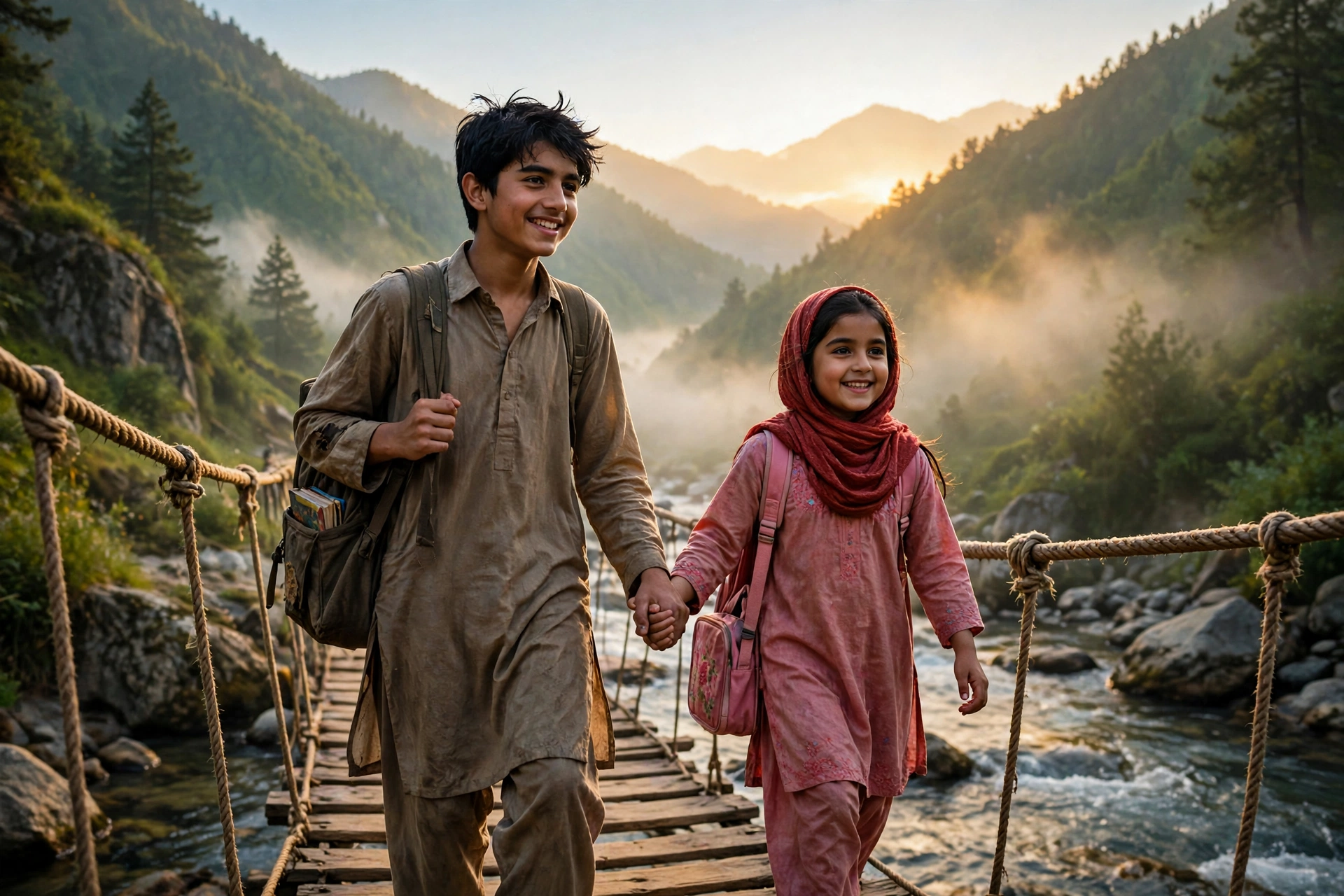
Every morning before the sun had finished climbing over the mountains, Bilal stood at the edge of the river with his little sister on his back and the whole village still asleep behind him.
The river was not wide. A strong man could wade across it in twenty steps when the water was low. But the current was fast and cold, and the stones underfoot were slick as soap, and Amna was eight years old and small for her age, with legs too short and a school bag almost as big as she was. So every morning, Bilal bent down, Amna climbed onto his shoulders and wrapped her arms around his neck, and he carried her across.
He had been doing it for two years, ever since the old wooden bridge washed away in the flood and nobody in the village had the money or the wood to build a new one. The men talked about it sometimes, standing outside the tea shop, shaking their heads at the price of timber. Then they went home. And every morning, Bilal carried his sister across the river.
"Hold tight, little sparrow," he would say, and she would laugh against his ear, and the cold water would bite at his ankles, then his knees, then his thighs, and he would feel for each stone with his toes before trusting it with his weight.
On the far bank, he would set her down, wring out the bottom of his shalwar, and walk her the last half mile to the schoolhouse, a whitewashed building with a tin roof that rattled in the wind. He would watch until she disappeared through the blue door. Then he would turn around, cross the river again alone, and walk to the fields where he worked for a landowner named Chaudhry Sahib, carrying sacks, digging channels, doing whatever needed doing, for wages that were never quite enough.
Bilal had once sat in that same schoolhouse, on a bench near the window. He had been good at numbers — Master Kareem had said so in front of the whole class once, and Bilal had carried the praise home like something precious in his pocket. But when their father died of a fever, the money stopped, and someone had to work, and Bilal was the eldest. So he had folded his schoolbooks into a cloth bundle and put them on the shelf, and he had never opened them again. That was three years ago. He was fifteen now, and his hands were already rough.
Amna did not know any of this the way grown people know things. She knew only that her brother carried her across the river every morning, that he waited for her every evening at the same spot under the same bent willow tree, and that when she told him what she had learned — new words, new sums, a poem about a kite — he listened like it was the most important news in the world.
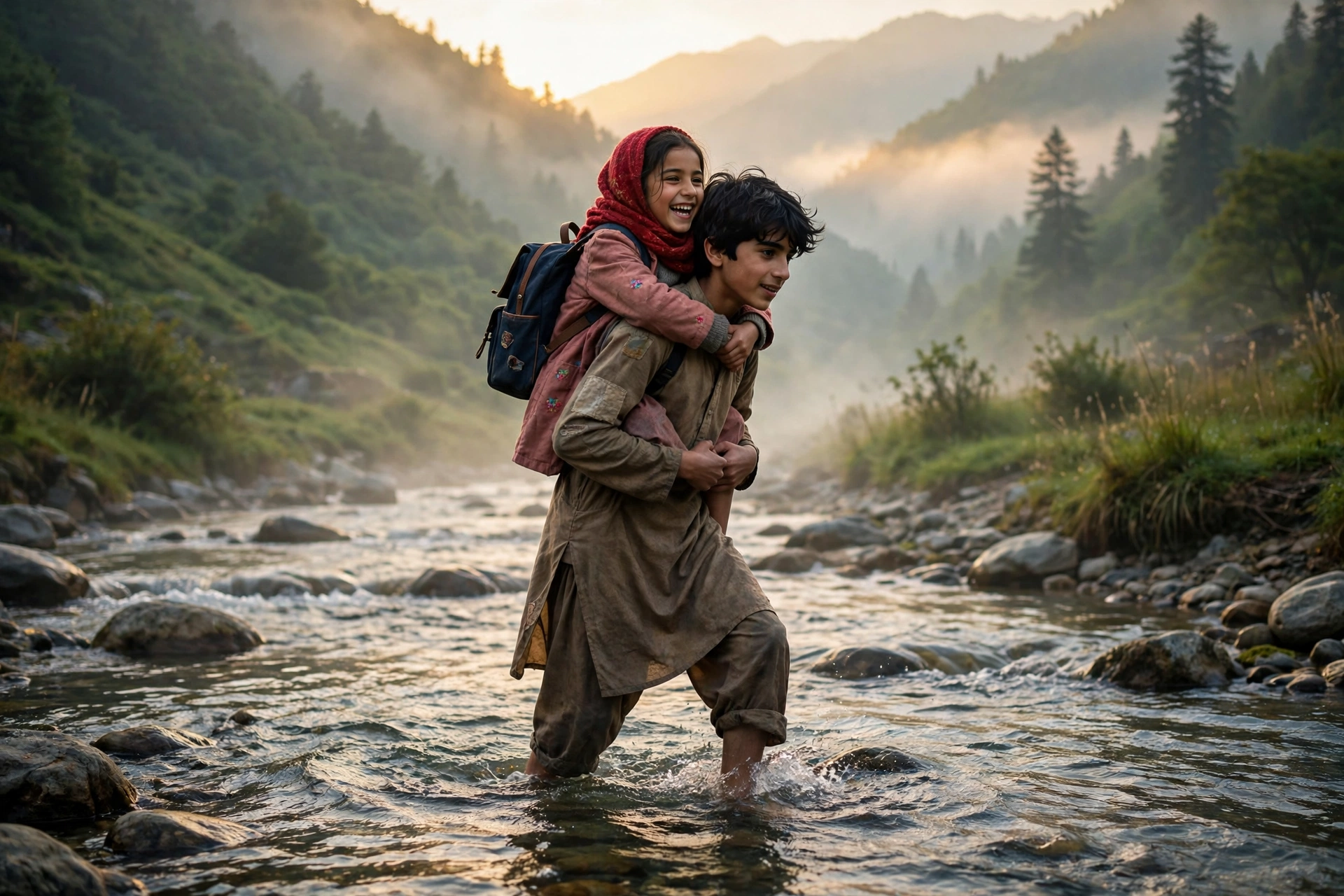
The monsoon came late that year, and when it came, it came all at once. For three days the rain fell without stopping, drumming on tin roofs, turning the dirt lanes into streams, swelling the river until it ran brown and angry between its banks, tearing at the roots of the willow tree. On the fourth morning the rain had thinned to a drizzle, but the river was still high, still fast, still growling over the stones.
Amna stood at the bank in her wet sandals, looking at the water. "Bilal, it is too big today."
"It is only water," Bilal said, though his own stomach had tightened when he saw it. "Hold tight, little sparrow. Tighter than ever."
She climbed onto his shoulders. He stepped in. The water hit his knees at once, colder and harder than he had ever felt it. He took one step, then another, feeling for the stones. Halfway across, the current caught his foot and slid it sideways, and for one terrible second he was falling, the river pulling at his legs, Amna's arms locked around his neck, her scream small and sharp in his ear.
He planted his other foot hard, threw his weight forward, and caught himself. His heart was pounding so loudly he was sure Amna could hear it through his back.
"Are you alright?" she whispered.
"I am alright," he said, though his legs were shaking. "We are almost there."
He carried her the rest of the way, one careful step at a time, and when they reached the far bank he set her down and sat on a rock, breathing hard, water streaming off him. Amna stood in front of him, her school bag dripping, her eyes wide.
"You were scared," she said.
"A little," he admitted.
She put her small hand on his wet shoulder. "Then I will walk with you in the evening. So you are not scared alone."
That evening, the rain came back harder. Bilal waited under the willow tree, watching the river rise, watching the sky darken, watching the minutes pass. The school bell had rung long ago. The other children who lived on the far side had already been collected by their fathers, their mothers, their older brothers. But Amna had not come, and the river was now so high that the water reached the trunk of the willow tree, and Bilal knew he could not cross it. Not today. Not carrying her. Not without risking them both.
He stood there in the rain, helpless, for the first time in his life understanding what his father must have felt when there was no money for medicine — the feeling of loving someone with your whole heart and having nothing in your hands to save them with.
Then, through the rain, he saw a figure on the far bank. An old man with a white beard, holding a lantern, holding Amna's hand. It was Master Kareem, the retired schoolteacher, who lived in the last house on the far side, the house closest to the school.
The old teacher cupped his hands and shouted across the water, "She is safe with me, Bilal! She will sleep at my house tonight! Go home before the river takes the path too!"
Bilal shouted back his thanks, his voice cracking, and then he stood a moment longer in the rain, watching the lantern grow small on the far bank, watching his little sister wave at him until the rain swallowed her. Then he turned and walked home alone, wet through, his shoulders strangely light and strangely empty.
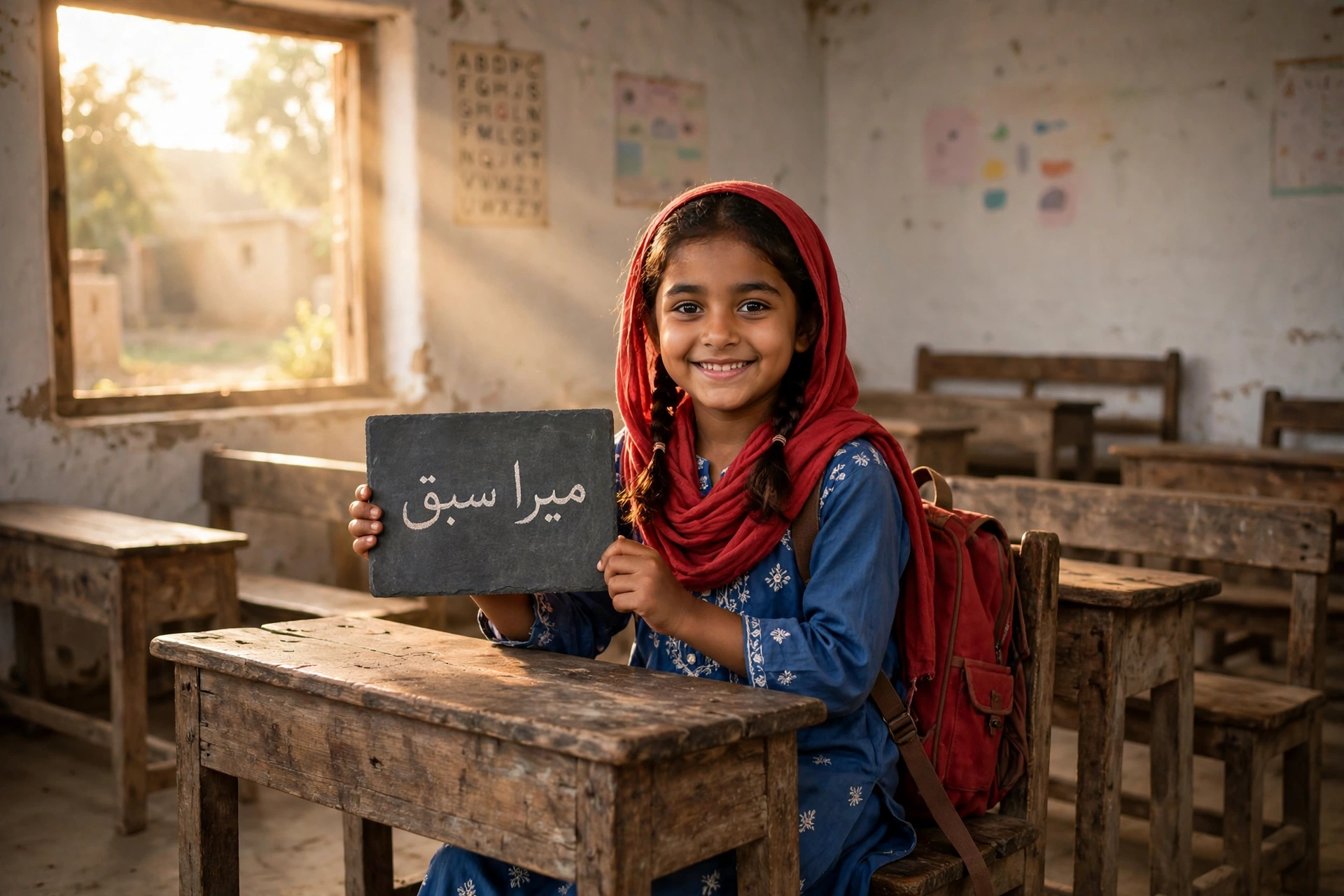
That night, Bilal could not sleep. He lay on his thin mattress and listened to the rain and thought about the river, and about the bridge that had washed away two years ago, and about all the mornings he had carried his sister and all the mornings he might not be able to. He thought about the girls who had stopped going to school altogether when the bridge went away, because their families would not risk the river.
In the morning, the rain had stopped, but the river was still high, and Bilal went to the tea shop where the men gathered, and he did something he had never done before. He stood up in front of them all — the landowner, the shopkeeper, the carpenter, the mason, the men who had talked about the bridge for two years and done nothing — and he spoke.
"I am fifteen years old," he said, "and I carry my sister across the river every morning because there is no bridge. Yesterday the river nearly took us both. Tomorrow it might take someone else's child. We have talked about the price of timber for two years. The price has not gone down. But our children are growing up, and every year without a bridge is a year some of them do not go to school. I cannot build a bridge alone. But I will work on it every day for free, from dawn until dark, if the rest of you will work beside me."
There was a silence. Then the carpenter, a broad man named Yousuf, stood up and said, "I have tools. I have some wood from my father's old house. It is not much, but it is something."
Then the mason stood. "I have rope. Strong rope. And I know how to set stone."
Then the shopkeeper said, "I will give the nails, and the tea, and whatever food the workers need."
And then Chaudhry Sahib, the landowner, who had never once spoken to Bilal except to give him orders, stood up slowly and said, "I have timber. Good timber. I have been keeping it for a new cattle shed. A cattle shed can wait. A bridge cannot." He looked at Bilal. "Your father was an honest man. You are his son. We will build the bridge."
Master Kareem, who had brought Amna home safely that morning, was the last to speak. "And when the bridge is finished," he said, "Bilal will come back to my classroom. I have kept his old bench empty all these years. It is time he sat in it again."
They built the bridge in eleven days.
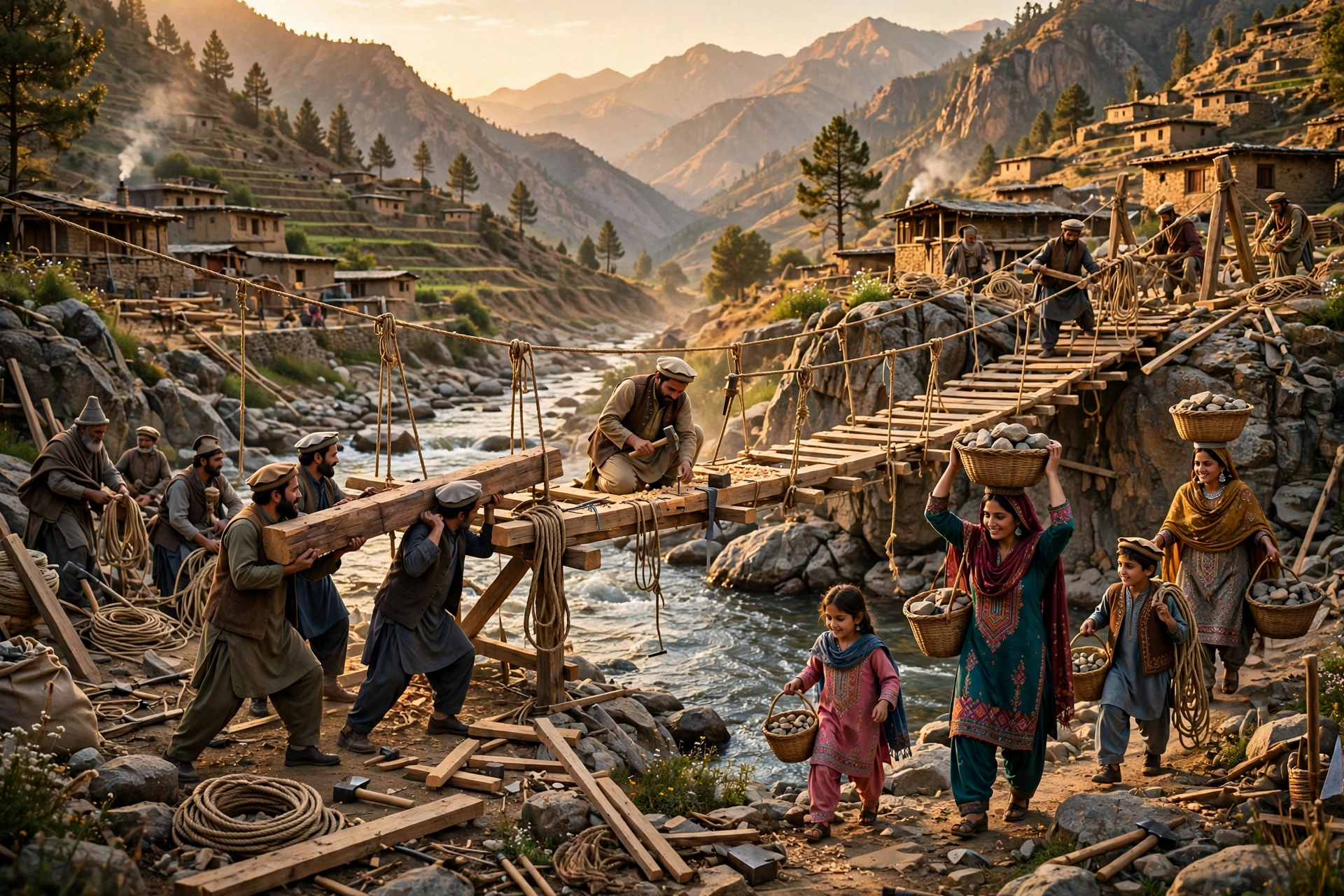
Every man in the village worked on it, and some of the women too, carrying stones, cooking for the workers, holding ropes. The children carried the small stones, proud to be part of it. Bilal worked the hardest of all, hauling timber, tying ropes, learning from the carpenter how to notch a beam so it would hold, learning from the mason how to set a foundation stone so the water could not move it. In the evenings, Amna brought them water in a clay jug, and she told everyone who would listen that her brother was building a bridge.
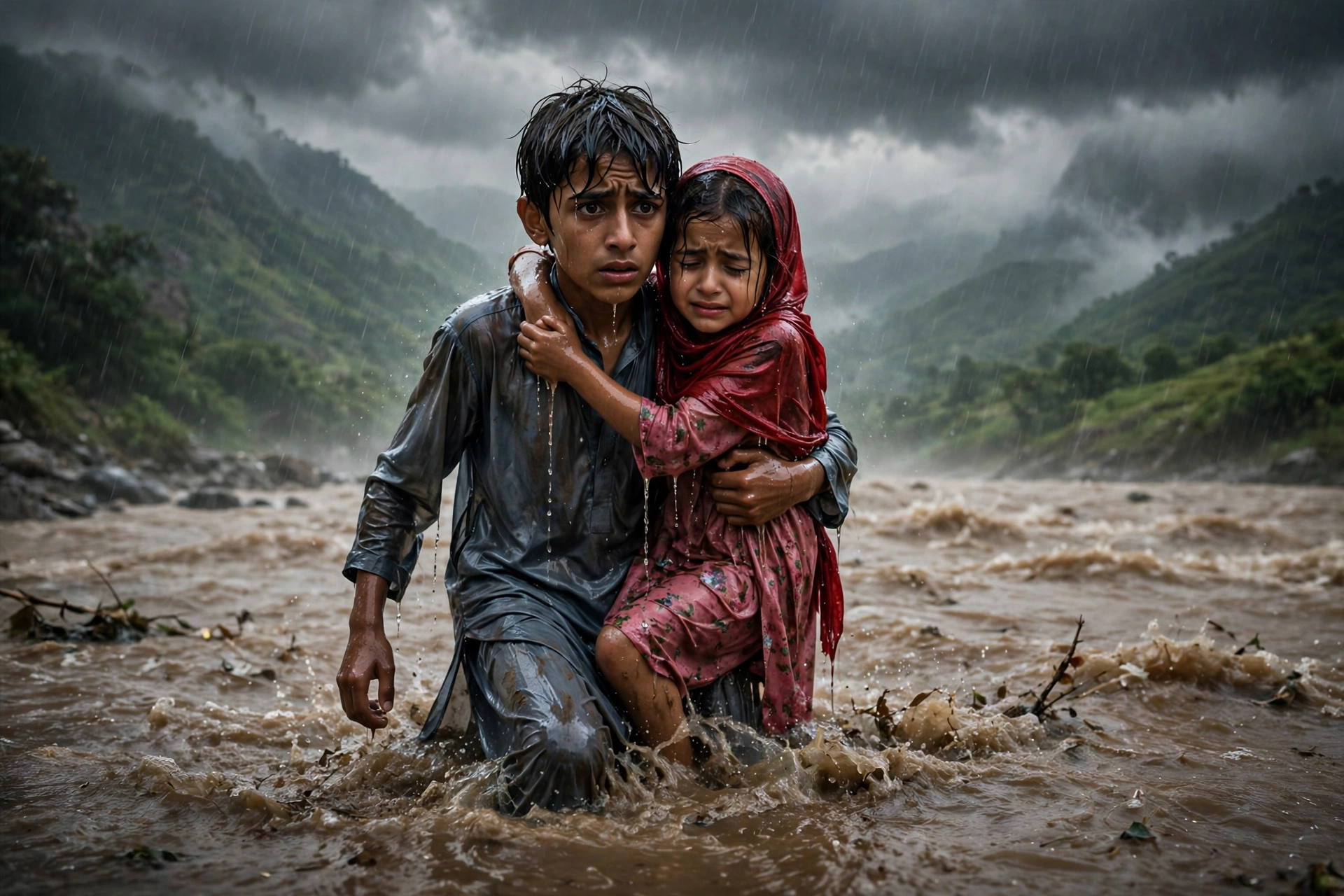
On the eleventh day, at sunset, the last plank was laid, and Yousuf the carpenter hammered the last nail, and the whole village stood on the bank and looked at what they had made: a simple wooden bridge, with rope rails, arched gently over the river, strong enough for a cart, wide enough for two people to pass.
Nobody spoke for a moment. Then Master Kareem took Bilal's hand and Amna's hand, and the three of them walked across it together, slowly, while the whole village watched, and the river ran beneath them, quiet and harmless now.
The next morning, Bilal walked across the bridge with Amna beside him, both of them carrying school bags. Hers was the old one, patched and faded. His was the cloth bundle of books he had folded away three years ago, the pages a little yellowed now. Master Kareem was waiting at the blue door of the schoolhouse, and when he saw them coming, he smiled the smile of a man who has waited a long time for something and finally sees it walking toward him.
The bridge is still there today. The wood has weathered grey, and the ropes have been replaced twice, and the children of the village cross it every morning in a laughing, chattering stream. They do not know the name of the boy who once carried his sister across the river on his shoulders. But Amna knows. She is a teacher now, in that same whitewashed schoolhouse with the blue door, and every year, on the first day of the monsoon, she tells her newest class the story of a boy who carried his little sister across a river, and a village that learned to carry each other.
And if you ask her what the story means, she will smile and say the words her brother said to her on the bridge all those years ago: that no one should ever have to cross a river alone, and that love is the strongest bridge there is.