Every evening at six o'clock, just as the sun began to soften over the rooftops, music drifted down the stairwell of the old apartment building on Rose Lane. It was not loud, and it was not showy. It was a violin, played slowly, like someone remembering something precious. The man on the ground floor would pause with his shopping bags in his hands. The woman on the second floor would stop scolding her children for a moment. For ten minutes, the whole building seemed to breathe more gently, and then the music would stop, as quietly as it had begun, and the ordinary noises of the evening would return.
No one in the building had ever seen the violin player properly. He lived on the fifth floor, at the very top, where the stairs grew narrow and the paint on the walls had faded to the colour of old tea. There was no lift in the building, so very few people ever climbed that high. The postman left his letters in a box downstairs. The neighbours knew only that his name was Elias, that he was nearly eighty, that his hair was silver, and that he had once played in an orchestra a very long time ago. Beyond that, he was a mystery, a closed door at the top of the stairs with music behind it.
Elias had not always been alone. For fifty-two years, he had shared that small flat with his wife, Mara. She had loved his playing more than anyone in the world. Every evening, she would sit in her favourite chair by the window, close her eyes, and listen while he played for her, and only for her. When she fell ill, he played beside her bed. When she died, three winters ago, he almost stopped playing altogether. The violin stayed in its case for months, untouched, because every note reminded him of the empty chair by the window. But one evening, when the silence in the flat became heavier than his grief, he opened the case again. He played because it was the only way he still knew how to talk to her, and so the six o'clock music began.
Down on the second floor, a new family had moved in that autumn. A mother named Aisha and her nine-year-old son, Samir, had taken the smallest flat in the building. Aisha worked nights cleaning wards at the city hospital, which meant she slept during the day and left for work just as other families were sitting down to dinner. Samir was a good boy, but he was lonely in a way that children rarely know how to explain. He did his homework at the kitchen table, ate the dinner his mother had left covered on the stove, and then sat by the window, watching the lights come on in other people's flats, wondering what it felt like to have someone waiting at home just for you.
One rainy evening in October, Samir heard the violin for the first time. He had finished his homework and was sitting on the stairs, bouncing a small rubber ball, when the music floated down from above. He stopped bouncing the ball. He stood up, tilted his head, and listened. The notes seemed to be calling him, the way a kind voice calls a child who is lost. Without quite deciding to do it, he began to climb. One floor. Two floors. Three floors. The music grew clearer with every step. By the fourth floor, his heart was beating fast, and by the fifth, he was standing outside a door he had never seen before, too shy to knock, too curious to leave. He stood there for the whole ten minutes, listening, his ball forgotten in his hand. When the music stopped, he ran all the way back down, his shoes thudding on the stairs, and he could not explain to himself why his eyes felt wet.
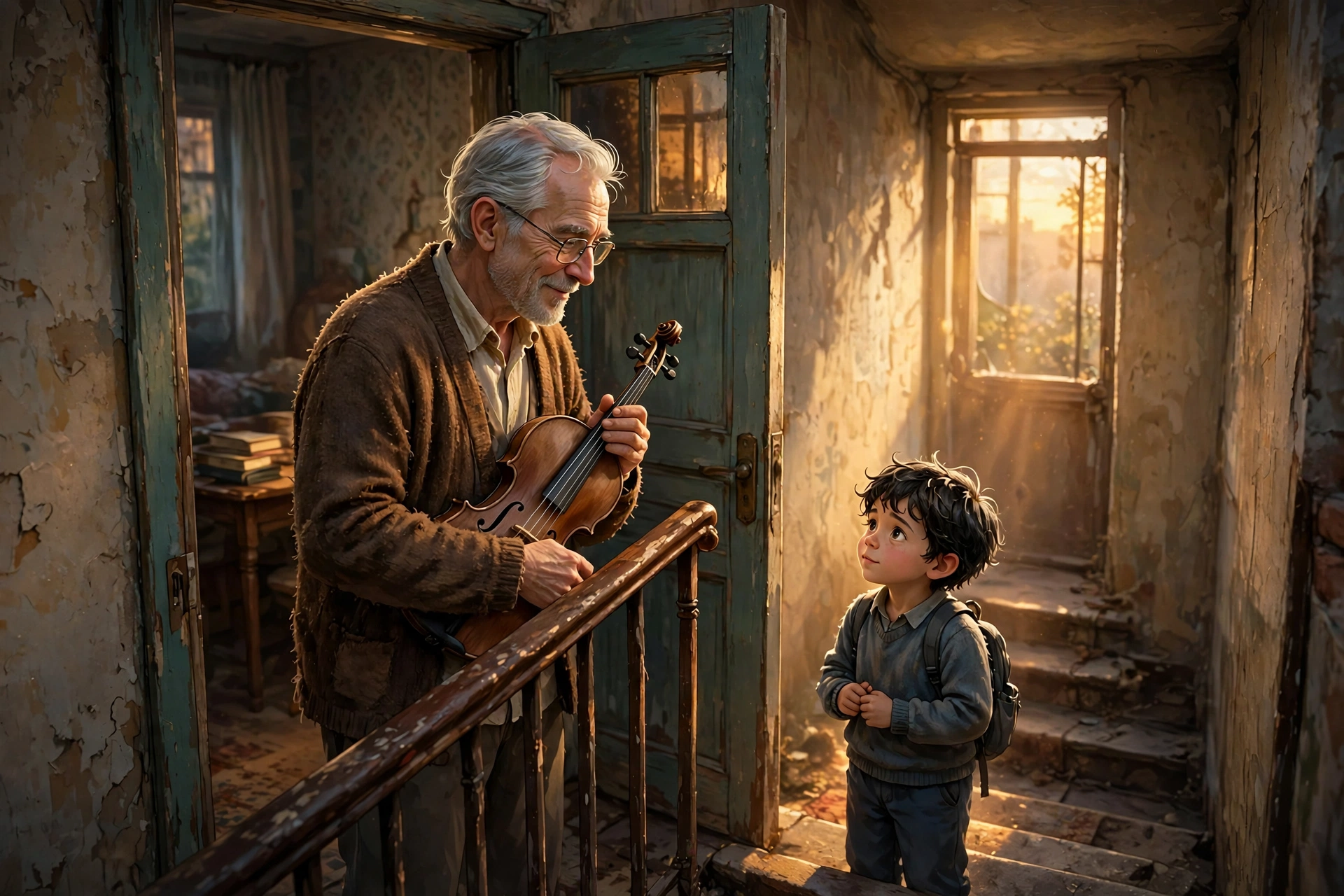
The next evening, he climbed again. And the evening after that, he climbed again. On the fourth evening, just as he settled himself on the top step to listen, the door opened. Elias stood there, tall and thin, with silver hair and glasses and a worn brown cardigan, holding his violin. He looked at the boy for a long moment, then smiled, a slow, careful smile. "You have been listening from the stairs for three evenings," he said, not unkindly. "A listener like that deserves a chair inside, not a cold step. Come in, if you like." Samir nodded, unable to speak, and followed him into the warm little flat, where the lamp glowed golden and the air smelled faintly of tea and old wood.
That evening changed everything. Samir told Elias, in a rush, that he had no one to talk to in the evenings, that his mother worked nights, and that the music made the lonely hours feel less lonely. Elias listened the way only a person who has known loneliness can listen, without interrupting, without rushing. Then he did something he had not done in years. He took down a second violin, smaller and dustier than his own, from the top of a cupboard. "This belonged to a student of mine, long ago," he said. "It has been waiting for another pair of hands. Would you like to learn?" Samir's eyes widened. He nodded so hard that Elias laughed, a real laugh, the first one the walls of that flat had heard in a very long time. "Then we begin tomorrow," Elias said. "Six o'clock. And bring no money. A teacher who charges a lonely boy for music does not deserve to be called a teacher."
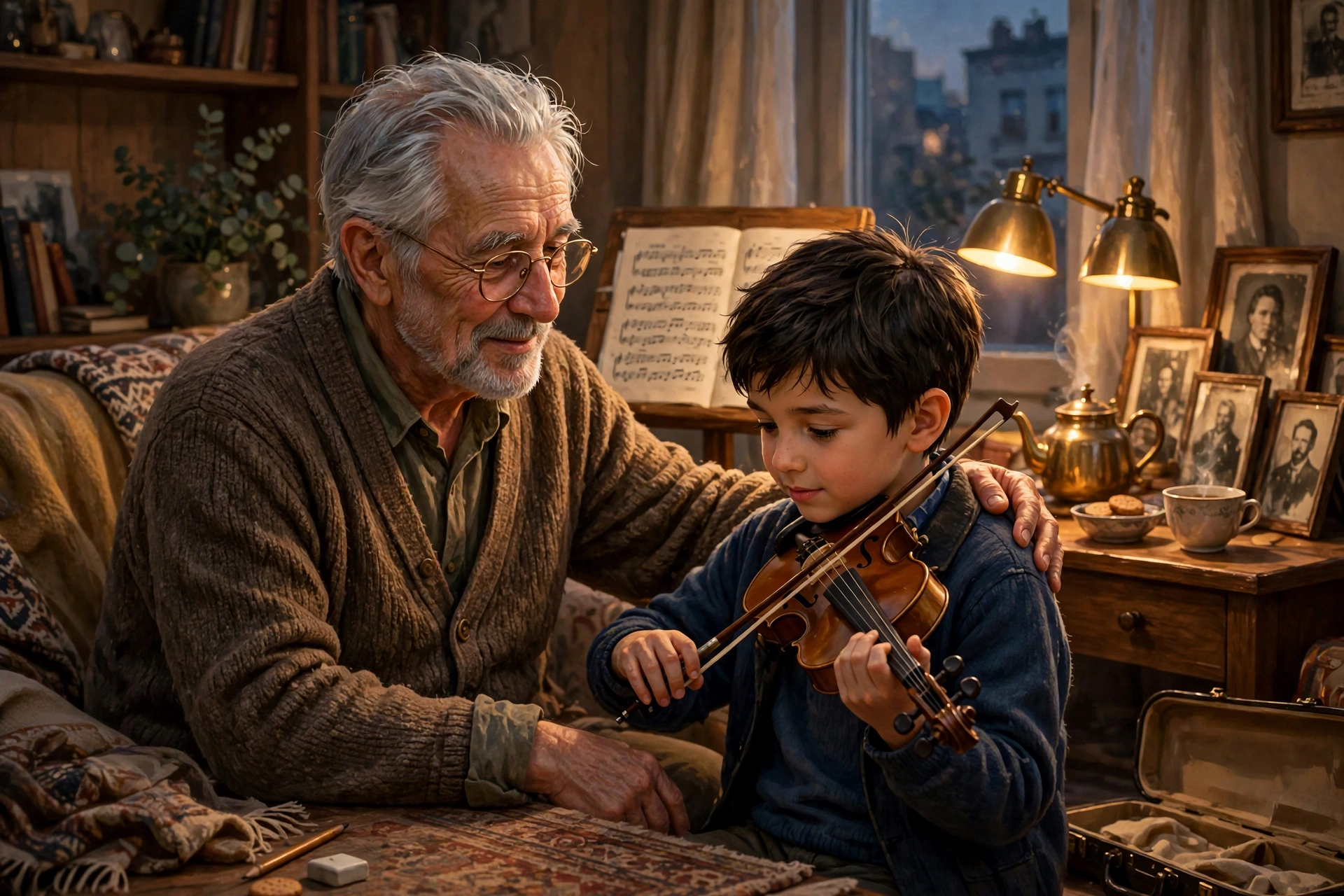
The lessons were slow, and at first they were terrible. Samir's bow squeaked. His fingers slipped. The notes came out wobbly and wrong, and more than once he was sure Elias would lose patience and send him home. But Elias never did. "Music is not about being perfect on the first day," he would say, tapping Samir's shoulder gently. "It is about coming back the next day, and the day after that. The violin forgives everyone who keeps trying." So Samir kept coming back. Every evening at six, he climbed the five floors, knocked twice, and spent an hour in the warm flat, learning one note, then two, then a simple tune that sounded, after many weeks, almost like a real song. Without either of them quite noticing, the lessons became the part of the day both of them waited for.
Not everyone in the building was pleased at first. A neighbour on the third floor complained about the squeaking in the evenings. Another said an old man had no business filling a child's head with music when the child should be studying. But Elias simply invited the complaining neighbour upstairs for tea one evening, and the man stayed for an hour, listening to Samir struggle bravely through his tune, and left saying nothing at all, only nodding to himself on the way down. Slowly, the building began to change. People who had lived beside each other for years without speaking began to ask each other about the boy on the fifth floor. Kindness, it turned out, was catching, like a tune you cannot help humming after you have heard it once.
Then, in the coldest week of winter, Elias fell ill. It was not serious, the doctor said, only a fever and a weakness that comes with age, but his hands trembled, and for the first time Samir saw fear in his teacher's eyes. "My hands," Elias whispered, holding them out so Samir could see them shake. "If they do not steady, I will not be able to play." Samir, who had never seen a grown man afraid before, did the only thing he could think of. He sat beside Elias, took his teacher's trembling hand in his own small one, and said, "Then I will play for both of us, until your hands remember." Elias looked at him for a long time, and then he smiled through his tears. "You have already learned the most important lesson," he said. "Music is not kept in the hands. It is kept in the heart that refuses to leave."
Samir had a secret reason to keep practising harder than ever. His mother's birthday was coming, and for the first time in his life, he wanted to give her something that could not be bought in a shop. His mother gave her nights to the hospital and her patience to a son she rarely saw in the evenings. Samir wanted her to come home from a long night shift and hear, just once, that she was loved, not in words, but in music. So every evening, while Elias rested, Samir practised in his own flat, quietly, so as not to wake his sleeping mother. He played the same simple tune again and again until his fingers ached, until the squeaks became notes, and the notes became a song. It was not a grand song. It was a small, honest one, the kind that sounds best when it is played for exactly one person.
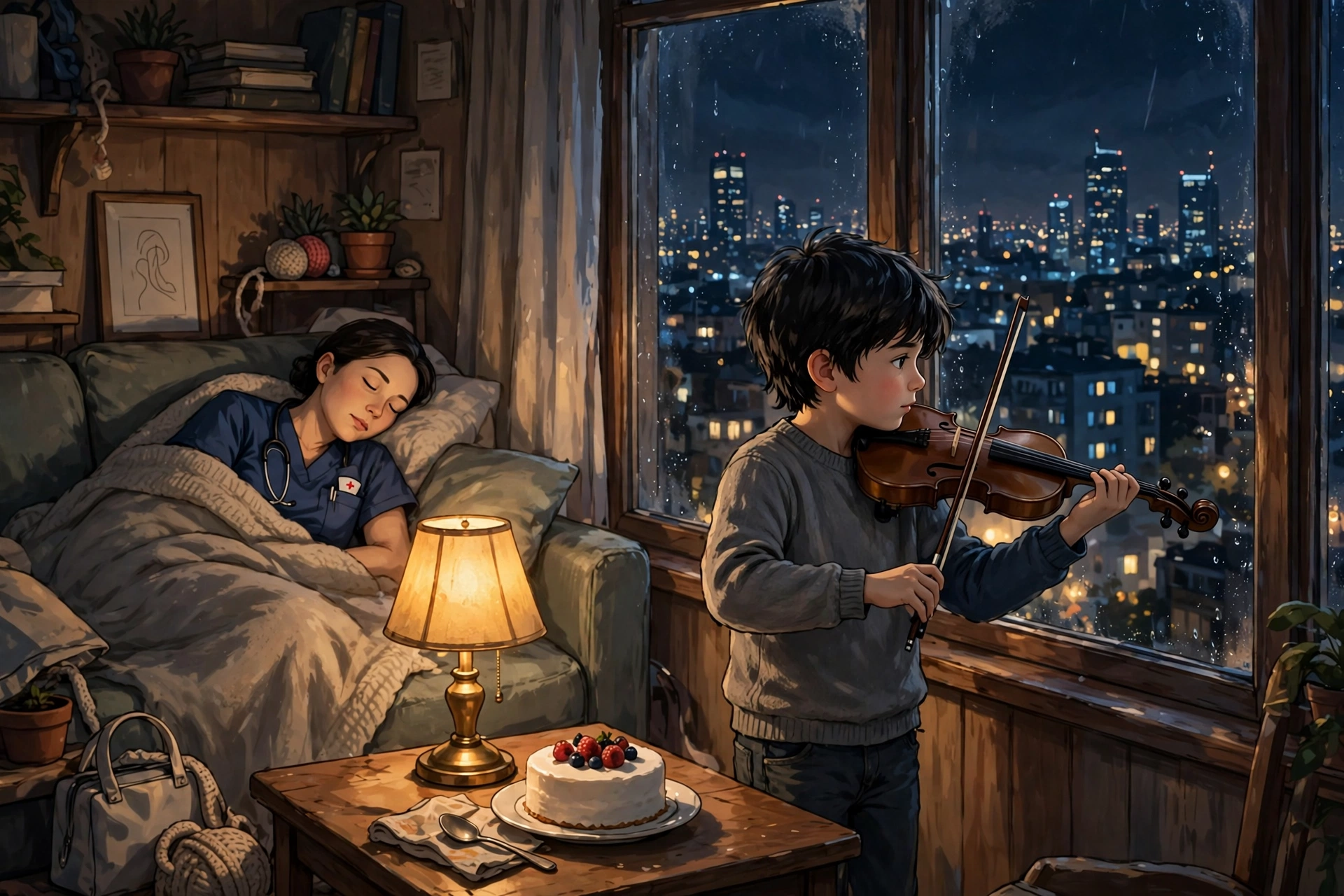
On the night of his mother's birthday, Samir asked Elias for a favour, and Elias, still weak but steadier now, agreed at once. When Aisha came home from the hospital in the early morning, tired to her bones, she found the door of her flat open and a trail of paper stars Samir had cut out himself leading into the sitting room. There, in the corner by the window, stood her son with his violin, and beside him, sitting in a chair, was the old man from the fifth floor, whom she had never met. Before she could speak, Samir lifted his bow and played. He played the tune he had practised for weeks, slowly and carefully, and though one note wobbled and another came a little late, it was the most beautiful thing Aisha had ever heard, because every note said the same thing: I waited for you, and I love you, and I am proud of you. When he finished, she sank into a chair and cried, and Samir ran to her, and Elias sat quietly, wiping his own eyes, thinking of a chair by another window, long ago, and of how love, somehow, always finds a way to keep playing.
Word of that morning spread through the building faster than any gossip ever had. The neighbours, who had once complained about squeaking, now asked when they might hear the boy play again. And so, on a mild evening at the end of winter, the whole building gathered on the rooftop, carrying chairs and cups of tea and plates of food, while the sun set in gold and rose over the city. Elias, his hands steadier now, played first, a slow and tender tune, and then Samir joined him, and the two violins rose together into the evening air, the old man's sure and deep, the boy's bright and brave. The neighbours listened in silence, and some of them held hands.
After that evening, nothing in the building was quite the same. The six o'clock music did not stop, but it was no longer the music of one lonely man talking to a memory. It was a duet now, an old teacher and a young student, playing together, and the whole building listened, not as strangers behind closed doors, but as neighbours who had learned each other's names. Elias never charged Samir a single coin, and Samir never missed a single lesson. Years later, Samir became a music teacher himself, and told his students about the old man who taught him that the greatest gift is not perfection, but time, patience, and company on a lonely evening. And whenever he played, in whatever city he lived in, he always began at six o'clock, because some habits are not habits at all. They are promises, kept faithfully, one evening at a time.