Every morning before the sun had properly woken up, Haroon was already standing at the crossing on Maple Street. He was seventy-two years old, thin as a winter branch, with a white beard, a faded orange vest, and a stop sign on a wooden pole that he held like it was something precious. The traffic on Maple Street was never very heavy, but it was fast enough to frighten a small child, and Haroon had decided long ago that no child would ever have to be frightened on his watch.
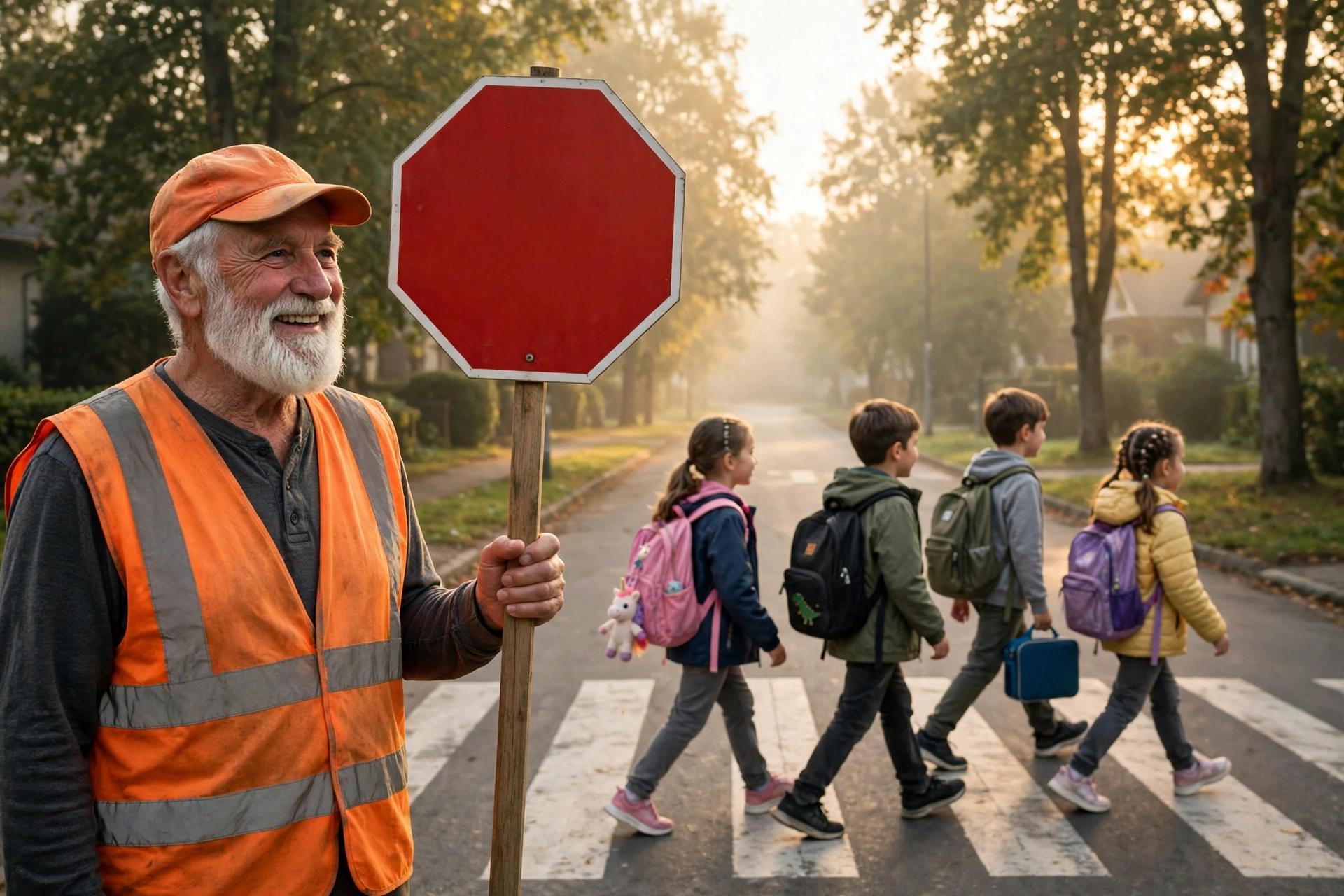
He arrived at half past seven, long before the first school bell. He swept the leaves off the zebra crossing with a small broom he kept behind the baker's shop. He checked that the painted lines were still visible. He placed a chipped blue mug of tea on the low wall and waited. When the first children appeared, walking sleepily beside their parents or racing ahead with school bags bouncing on their backs, his face changed completely. The stern guard became a grandfather.
"Good morning, Sara!" he would call. "Did you finish your drawing?"
"Morning, Uncle Haroon!" the children would shout back, and it was not the polite greeting children give to strangers. It was the greeting they give to someone who belongs to them.
Haroon knew every child by name. He knew which one was afraid of dogs, which one had lost a tooth, which one needed a little extra time because her shoes were too big for her feet. He knew that Bilal always forgot his water bottle on Mondays, and that little Ayesha, who had started school that autumn, never spoke at all. He kept a box behind the low wall, and in it were the things children lose: one red glove, a hair ribbon, a broken pencil, a marble. If a child came crying about something lost, Haroon would open the box like a magician and say, "Let us see what the street kept safe for you."
Nobody paid Haroon very much. The town council gave him a small allowance, and the baker gave him bread, and the mothers gave him tea in winter and cold water in summer. He had a small house at the end of Maple Street, with a garden he could no longer tend properly, and a photograph on the wall of a little girl with dark curls, smiling with a missing front tooth. Her name was Meher. She had been his daughter. She had died of a fever when she was only nine years old, a long, long time ago, when Haroon was still a young man working at the cloth mill.
People in the town knew about Meher, but they did not talk about her to Haroon. They did not need to. Anyone who watched him at the crossing could see it: every child he walked safely across the street was, in some quiet way, the child he had lost. He never said this out loud. He simply raised his hand, stopped the cars, and walked slowly beside the children, matching his steps to their small ones, as if time itself had to slow down for them.
One rainy October morning, everything changed in a small way that Haroon would remember for the rest of his life. A new girl arrived at the crossing, holding her mother's hand so tightly that her knuckles were white. She was small, with wet hair plastered to her forehead, and she stared at the road as if it were a river she could not cross. Her mother bent down and whispered something, kissed her cheek, and hurried away toward the bus stop, because she worked the early shift at the hospital and could not stay.
The girl did not move. The other children crossed in a laughing line, but she stayed on the pavement, frozen. Haroon lowered his sign and walked over to her slowly, the way you approach a frightened bird.
"What is your name?" he asked gently.
She said nothing. She looked at his orange vest, at his white beard, at the rain dripping off his cap, and she pressed her lips together.
"That is all right," Haroon said. "You do not have to speak. Would you like to hold my hand while we cross? Just for today. Tomorrow you can decide again."
Very slowly, the girl put her small hand in his. Her hand was cold. Haroon raised his sign high, stepped into the road, and walked beside her at her pace, not his. Halfway across, she looked up at him, and for the first time, her eyes were not frightened. They were curious.
At the school gate, she let go of his hand and ran inside without a word. Haroon stood there in the rain for a moment, smiling to himself.
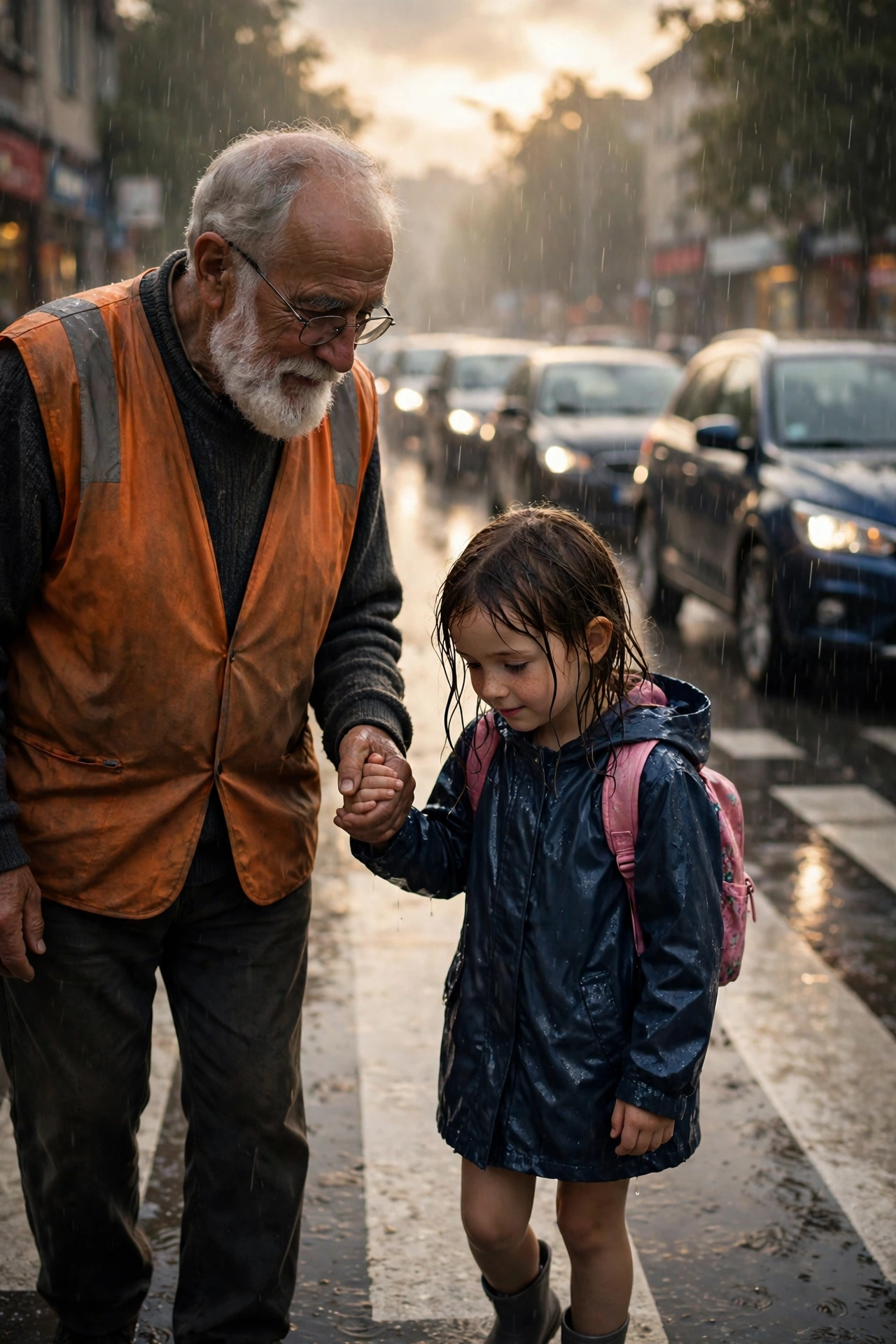 The next morning, she was there again, waiting at the edge of the pavement. She did not speak, but she held out her hand. And the morning after that, she did it again.
Her name, he learned from her teacher, was Ayesha. Her father had died the previous winter, and since then she had stopped talking to almost everyone except her mother. The teacher said the doctors called it grief, and that it would take time, and patience, and people who did not rush her. Haroon understood that better than anyone.
So Haroon did not rush her. Every morning, he waited at the same spot. Every morning, she held his hand across the street. And every morning, after they reached the other side, he gave her a small painted stone from his pocket. He had started painting them years ago, in the evenings, when his house felt too quiet: a yellow sun, a blue bird, a red flower, a white star. He never told the children what the stones meant. He only said, "For your pocket, so the day is not empty."
Ayesha collected them carefully. After a week, she had seven stones. After a month, she had a small cloth bag full of them, and she carried it everywhere. One frosty morning in December, as they stood waiting for the traffic to clear, she tugged his sleeve and whispered, so quietly that he almost missed it, "Uncle Haroon, today I will carry the sign."
Haroon's heart jumped. It was the first full sentence she had spoken to anyone at school in months. He knelt down, even though his knees protested, and handed her the wooden pole. It was too heavy for her, so he held the bottom while she held the top, and together they raised it toward the cars. A driver smiled and stopped. A mother walking past wiped her eyes.
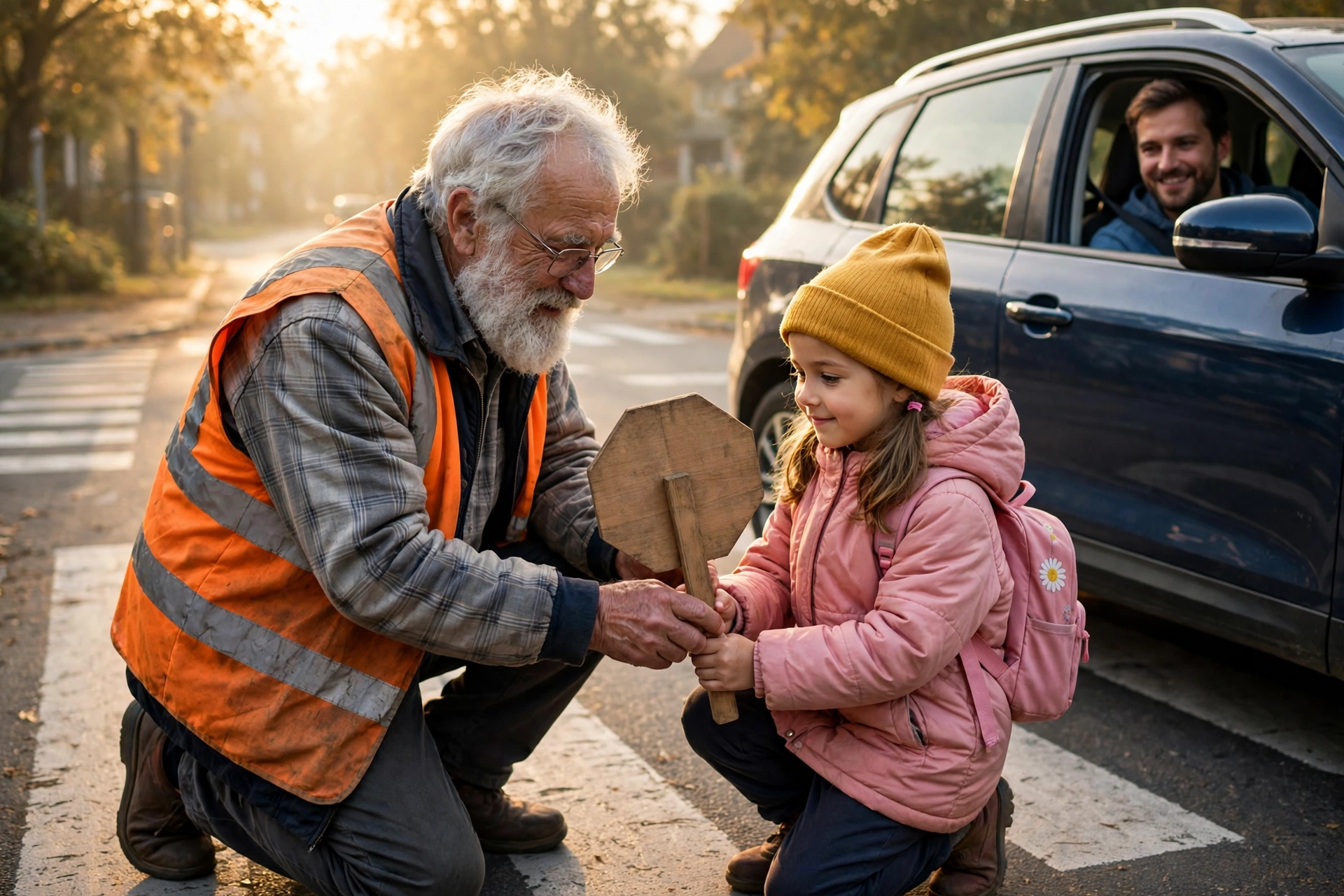 Haroon did not cry, though his eyes were wet. He told himself it was the cold wind.
From that day on, Ayesha spoke a little more each week. First to Haroon, then to her teacher, then to one girl in her class, then to a whole table of children at lunch. She still held his hand on the crossing, because some habits are not about need but about love, and she still collected his painted stones. By spring, her bag was so heavy that Haroon joked she would need a wheelbarrow soon, and she laughed, a real, ringing laugh that made the whole crossing turn and smile.
Haroon, meanwhile, was growing older in the way that old people do quietly, without announcement. His steps became slower. His hands, which had once been steady as stone, began to shake when he held the sign for a long time. On a Tuesday morning in April, he did not come to the crossing at all. The children waited, confused. The parents looked at each other. The traffic rushed past, and nobody raised a hand to stop it.
Sara, who was now twelve and far too grown-up to hold anyone's hand, was the first to act. She went to the baker and asked where Uncle Haroon lived. The baker told her, and by lunchtime, a small group of children and parents were walking down Maple Street toward his little house at the end of the road. They found him in bed, feverish, with a blanket pulled up to his chin and the photograph of Meher on the wall beside him. The doctor had already visited and said it was a bad chest infection, that he needed rest, medicine, and people around him.
What happened next, nobody had planned, but everyone remembered. The mothers took turns bringing soup. The baker sent bread every day. The children made cards, dozens of them, with crooked drawings of crossings and orange vests and stop signs. Ayesha brought her cloth bag of painted stones and placed it on his bedside table, one by one, in a neat row: the sun, the bird, the flower, the star. "So your days are not empty either," she whispered.
And Bilal, who was now a tall teenager, went to the town council and said, "Someone has to stand at the crossing while Uncle Haroon is ill." The council hesitated, but the parents volunteered in turns. For three weeks, while Haroon recovered, there was always someone at the crossing with a raised hand: a father before work, a grandmother after her morning walk, a shopkeeper who closed his shop for twenty minutes. The children crossed safely, and every one of them thought of Haroon while they did it.
When Haroon finally returned, on a bright morning in May, he walked slowly down Maple Street, leaning on a walking stick, and stopped dead when he saw the crossing. The children had painted the zebra lines fresh white. Someone had planted flowers along the low wall. And above the crossing, tied between two lampposts, hung a banner painted by the whole school in bright, uneven letters: "Thank you, Uncle Haroon."
Haroon stood there for a long time, unable to speak. Then Ayesha ran to him, no longer holding back, and threw her arms around his waist.
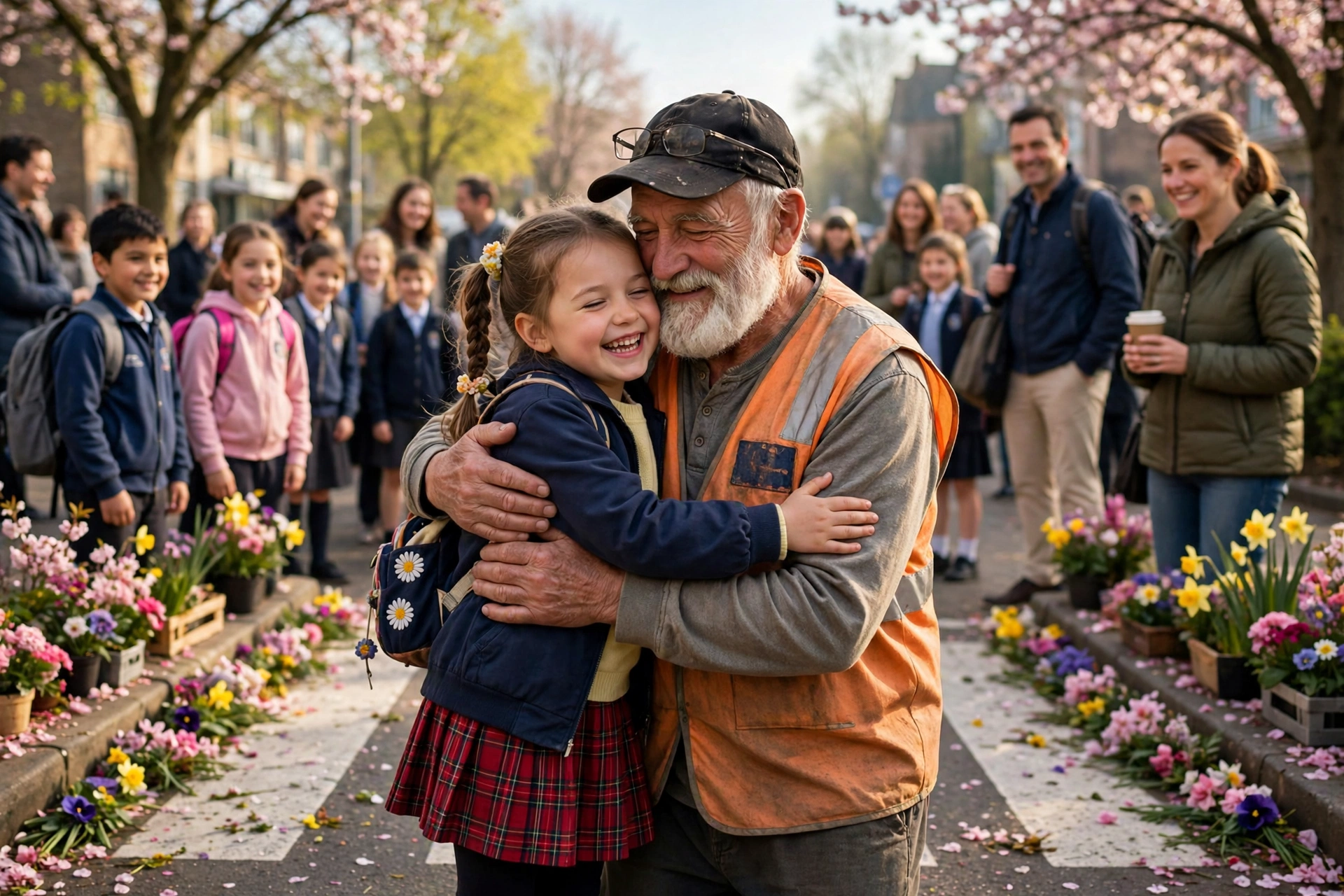 "You came back," she said. "We kept your crossing safe, just like you kept us safe."
He held her close and looked at all the faces around him: children he had walked across the street when they were barely taller than his knee, now nearly grown; parents who had once been children at the same crossing themselves. He understood, in that moment, something he had never quite allowed himself to believe. He had spent thirty years thinking he was giving something to these children. But all along, they had been giving something back to him: a reason to get up before sunrise, a name called out with love every morning, and a place in the world that was entirely his own.
Haroon still stands at the crossing on Maple Street, though now he shares the work with younger volunteers, and he sits on a wooden chair between crossings, with his tea in the chipped blue mug. He still knows every child by name. He still keeps the box of lost things behind the low wall. And every morning, when the first child shouts, "Morning, Uncle Haroon!" he raises his hand, stops the world for a moment, and smiles, because he knows what thirty years of small kindness can build: not just a safe road, but a whole town that knows how to look after its own.
If you ever pass through a small town and see an old man at a crossing, holding a stop sign like it is something precious, slow down. Wave. Say his name if you know it. Because somewhere behind that raised hand is a story of love, loss, and a thousand mornings of quiet care — and people like Haroon are the reason the rest of us learn how to be kind.